‘I want the poems to be hospitable to multiple voices. I want them to be porous – a kind of listening device, as well as a speaking device’ : Linda Gregerson on making art by ‘running forward in the dark.’

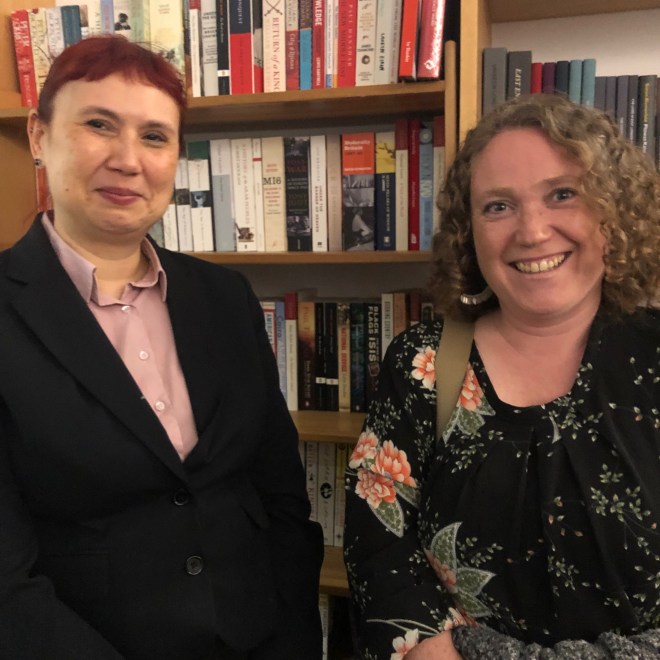
Gregerson_3998_flat.flat.croppedA child of the upper Midwest, and descendent of Norwegian farming stock, Linda Gregerson is a poet of winter, able to bring snow, and the lives shaped by its rigours, to the page. She is also a poet of time – and of the bodily selves in which our identities are vested. Awarded fellowships from the Guggenheim Foundation and the National Endowment for the Arts, amongst other distinguished accolades, she came to writing poetry through renaissance studies, and theatre making. We met last summer, under the plane trees of Russell Square in Bloomsbury, to discuss Prodigal, her collection of new and selected poems from 1976 to 2014. Gregerson was over from University of Michigan where she teaches, and has previously directed the MFA Program. Our conversation explored how Gregerson came to enter the worlds of ‘high’ culture, and academia, and claim herself creatively, while also remaining connected with the more visceral and direct voices of her upbringing. I asked her about the challenges of giving witness to the violent murder of a close friend, and exploring the sustained childhood sexual abuse of her own sister – without exploiting or diminishing these two women. We discussed how her poems work with contemporary scientific research, and what it can mean, as a woman, to write about blood. We also talked about writing towards lost fathers.  Overall, it was one of the most deeply nourishing conversations I had in 2019, and one which has stayed with me.     We opened with the multiple registers which her poems contain, and the gifts of open-ness, and possibility, which writing in ‘American English’ can confer.  Please note that the poems quoted are in a different font, as it was the only way to preserve the formatting. 

AH: Can we begin with how you work with words, Linda Gregerson?   You write of our “fractious, healing, double-dealing on-the-make vernacular” in your review of John Ashbery and Heather McHugh. Within your own work as a poet, and a critic, language is capable of sliding between registers with muscled suppleness, but also of breaking down into a naked vulnerability. Would you say something about this?

LG:     Thank you for the question. When I was writing about Ashbery and Heather McHugh, I was talking specifically about American English and the way these poets ride and celebrate it. I write like neither of them, but I think of myself as a very American poet too. I want American English, American idiom, American momentums – and stalled momentums – to be a legible part of the music. I commute among registers. Syntax is also really important to me. I want the poems to be hospitable to multiple voices. I want them to be porous – a kind of listening device, as well as a speaking device.

AH: As a reader, your poetry has the quality of a fairground ride. We plunge. We judder. It’s really visceral. And startling. I never see it coming. The syntax and variations keep me on the edge of my seat.

LG:   I take that as a high compliment.

AH: It is. The saltiness of everyday language is also arresting.

LG:     It would be affectation for me not to have that. I need that everyday register, I love it, it’s an essential part of the music available all around me. Also, some of the people I love and have loved most deeply in my life, spoke and speak a very particular idiomatic English, they’re upper Midwestern country people. My father never finished high school. He didn’t use what we would call standard grammar – and his voice was very important to me. I didn’t find enough space for it in my world when he was alive, so I need some space for it now.

AH:     Only time lets us see some relationships more clearly. Turning to your career, you have won numerous distinguished awards, including a Guggenheim Fellowship. I wondered if you would say something about how, where and why you got started with poetry? I know you were part of the Iowa Writers Workshop for your MFA. What got you to that point?

LG:     A very specific gift from a very specific friend. I did not write poetry when I was young. I still shudder at the memory of a poem I had to write for school when I was eleven years old. An impossible time of life in any case, and a dreadful poem. I spent each and every minute of each and every day trying not to be stupid, and here was a thing that made me stupider than I actually was. So I fled. The other arts were safer: visual arts and theatre, I had some wherewithal.

Years later, a poet friend and I had offices across the hall from one another, and we would simply talk. He’d say: These are poems. You’ve got to write them down. And me: You don’t understand. I have no idea how to make a poem. I have no idea how to read contemporary poetry. I can read Donne. I can read Shakespeare. I can read parts of Eliot – but I don’t have a clue when I open a journal of contemporary poetry. But he insisted; it was his way of making friends, and it wound up changing my life. So I staggered around trying to make poems of my own for a while, and it was a great piece of good luck that I was admitted to the workshop at all. They gave me financial aid! I was stunned. And the time there was transformative. I learned to read work in progress; I learned to read more broadly in contemporary poetry. The learning to write came in fits and starts, but the reading could be steady. It was like learning to breathe.

AH:     And they are languages, they are specific languages – that cannot in general simply be walked into.

LG:     I made all the mistakes one makes. At first I thought Ah – the key to this is compression. So it got over-elliptical. I made all the mistakes.

AH:     But that’s the only way that any of us learn to write – by getting it wrong so thoroughly that only the ‘right’ path is left.

LG:     Maybe it’s about exhausting all of the possibilities of wrongness.

AH      Very often you don’t like how you write. Your own voice is something that you resist. When you find that place of fit with your voice, it can feel dangerous. It can feel exposing.   There is a lot of resistance to inhabiting your voice – as well as a sense of relief at finally getting there.

LG:     For me, the key was finding that syntax was my real vehicle for thought.

AH:     For me it was imagery, and sound play. Once you have got your tools, the process feels slightly less dangerous.

LG: I knew what would tell me how to go forward.

AH:   Were there any particular poets, on the page, or in person, who spoke to you, or helped you when you were setting out?

LG:     That’s hard to say. The aesthetic that was dominant in the 70’s at the Iowa Writers’ Workshop was of the school of James Wright. I adore James Wright, but I couldn’t pretend to the coherent voice I heard in him – which might well be a misreading, by the way. I had to learn to allow for interruptions and shifts of gear. And in terms of individual poets – Stanley Plumly and Bill [William] Matthews, Sandra McPherson, Louise Glück and Donald Justice were on the faculty when I was there. I learned from all of them, but as to “voice,” I’m afraid it was rather clumsily patched together.

AH: A voice has to be.   Elizabeth Bishop resonates with me, but I could never write like her. I read a lot of different materials right across the board, outside of poetry. I read fiction. I read non-fiction. You read science.

LG:     Yes, I far as I can – or I try to persuade scientists to talk to me. There is a great kinship between what we do as poets, and what my friends the research physiologists do.   There are the combinations you were describing earlier of intuition and pragmatics and technique – and being open to being discovered by one’s own mistakes. This is what experimental models do. The object of study is this exquisite, complex, brilliant language of the body, which constitutes us but is also beyond us. The devotion to something that is already articulate, that we are simply trying to catch on to, that’s what joins the two enterprises. I worship the laboratory scientists.

AH:     I’m interested in writing on the brain and the brain/body interaction. It’s something I am trying to read more about. I feel that poetry is also writing about this in another language.

LG:     We know better than to talk about inside and out, or body and mind, yet there’s a reason we default to such dualisms. All we can hope to access are these small portals. The sixteenth and seventeenth century poets I study believed that both science and poetry were acts of praise. A tribute to creation.

AH:     In a wonderful way, that leads into ‘And Sometimes’ which is the opening poem in Prodigal, the selection you have made of your own poems from 1976-2014 which will be the focus of this conversation. Many of the poems we’ll be talking about walk with darkness. I’ll begin, though, with one of the poems from the ‘New Poems’ section at the front of the book.   ‘And Sometimes’ continues right after this title

    thank heaven, the question includes
                 a layer
           of real delight.

The poem contrasts a chimp, who goes straight for the solution within an experiment, with a human child who continues to follow a more ritualized, multi-stage taught route to “this happy accession of/ able-to-make-the-whole-thing-work”, ignoring the shortcut. You go to asking how we find meaning in our lives, and suggest that it derives from different ways of “letting the outside in” – which may include the forms, and rituals, of poetry, and art. You end:

         Not
         a single path but many,
   the forms of devotion, I mean.

   The part that makes us human more
                 elusive
         than we'd thought.

Could you say something about ‘And Sometimes’?

LG:     Certainly! For context, let me say that I have two very good friends and readers. One is the poet David Baker. One is my husband Steven. David had kindly looked at the manuscript of the new poems section in Prodigal and he said Linda, could we have something a little happier? And Steven said Could there be a little light? It was also Steven who told me about that particular experiment. It just seemed to me so joyfully to put us in our place.

AH:     Yes, the chimp could just take the lid off!

LG:     So much for the superiority of human cognition, right? There is a fabulous poem in Christian Wiman’s most recent book. ‘From a Window’ is actually written from a very bleak place within his own cancer diagnosis, “Incurable and unbelieving/ in any truth but the truth of grieving.” It begins with a visual misperception, and finds its way to a renewed embrace of the life that’s behind that misperception. In the end, this releases the self from the self: “that life is not the life of men./ And that is where the joy came in.” It’s a ravishing moment; it makes me weep. We are not the measure of the universe.

AH:     I practice Buddhist meditation, which is about dissolving the self. It brings relief to let go of who you are, and step beyond this narrow prism into the light which passes through it – as happens also at the end of ‘And Sometimes’.

LG:     It’s also about affection for our limits, true affection. Mastery is an insufficient value.

AH: When we were talking about limits, and Christian Wiman, I thought how, when my first husband was dying of cancer, in some ways, paradoxically, as a couple we were happier then we had ever been. Obviously not when he was in acute pain.   But simply, because we knew his illness was terminal, without discussing it, we got down to just enjoying being together in the day, in the moment, in the time that was good. There was this extraordinary happiness.   Falcon had a metatastic adenocarcinoma spreading everywhere – and yet a friend of mine said, I saw you two driving in the car and you looked like a pair of 20 year olds.   We were let go from all the complex life structures that we built around ourselves – and into simply being.

LG:     Oh that makes sense – it sounds like a great blessing.

AH:     It was. The strangest thing is that life, when it takes most away, sometimes also gives most back. Art can be a form of algebra that expresses that equation – because it’s unquantifiable in more straightforward terms.

LG: I think that is very wise. It says a lot about this whole dilemma of how can we find consolation, or how does poetry provide consolation in the midst of darkness.   It’s not by euphemizing or evading. On the contrary, it’s by engaging in such a way that somehow it won’t have been lost on us – and so much is lost on us.

AH: The earliest poems in Prodigal are from Fire in the Conservatory, published in 1982. The first poem ‘How Love, When It Has Been Acquired/ May Be Kept’, alludes to The Art of Courtly Love – De Arte Honeste Amandi – by Andreas Capellanus. It begins:

That was when the war was on, the one we felt good
to hate, so of course I thought he’d come from there.
It was June. The light grown long again.
She’d roll his chair to the window

and back. But no, you said, it was love.
They were getting it wrong.
A leg. A leg. An arm to the elbow.
Like the man who burned his daughter to get

good winds.

I know you are also a Renaissance scholar. Could you say something about the energy your work derives from refracting between past and present times, and in conversation with works made by other artists, often in visual media. It seems to me that this can form a means of gaining a purchase – a kind of coming in close, through coming in slant?

LG:     So if I follow the gist of your question, you’re asking about the route that takes me from a medieval handbook to a Vietnam era clinic to Agamemnon and Iphigenia? This is always a bit of a conundrum. If I let myself, I’d be constantly trailing tag lines of Shakespeare and Milton, and this has nothing to do with systematic thought or “bookishness” in the narrow sense. Quite the opposite. A chunk of something stuck in my heart or head insists on being allowed into the poem; it might as well be a stone through the window. It’s very like the ambush to my senses when I’m walking past the linden trees just east of SOAS: suddenly they’re in blossom, and that scent! That’s how bits of these poets and writers and painters and theatre-makers, who mean so much to me, it’s how they enter– it’s that quotidian. It’s like the smell of bread baking. It’s just another thing.

AH: Like a kind of loop that plays in your head almost. It’s not a matter of I’m going to sit myself in front of this picture and write something.

LG:     Now I’m going to be allusive. God forbid! But then, the question is to make sure there is enough of a talking voice around it that it’s convincing. That it feels ordinary, and everyday, instead of deliberately . . .

AH:     Imported.

LG:     Exactly. “The man who burned his daughter” is Agamemnon, but that particular section of the poem was based on something quite immediate. I was 21, my then partner had had back surgery, and I was visiting him in hospital. And in the hallway I passed a young couple: the man in wheelchair had lost an arm and both of his legs. All I could imagine, because we were in the midst of that horrible war, was that he had been terribly wounded in Vietnam. But no. He had metastatic cancer; the couple were newly married; they kept cutting off parts of his body in an effort to keep him alive. It broke my heart, and made me know my own utter incapacity. What would it mean to do things right in such circumstances? How do you love wisely when you’re terrified and very young? I started thinking about the bargains we try to make with fate. The trivial: I’ve lost my keys, please please please let me find them before I’m late for work. And the not trivial: I make the same panicked begging sounds when I’m praying for the well-being of one of my daughters. What am I thinking? Maybe if I offer the right thing in exchange, I can have some leverage here? It’s a human instinct, I suppose, when something of utmost importance is utterly beyond our control.

AH:     It’s a sort of gaining of imaginative agency.

LG:     The foundational human dynamics are not new. Others have known them before. Which gives us, well, not consolation exactly, but some small shelter against the descent into chaos – others have been here before.

AH:     And we can find our way through somehow. ‘Geometry’ is another of your earliest poems – spoken in the voice of a snowplow driver, which seems to enact a process of creative making, through its making visible of a specific, cold, snowy terrain, to which many of your poems about your family return. It begins:

What I like best about the snowplow is morning
then night, but anyway without sun.
I drive from town to old 16 and back again, wider.
The sound I make’s all mine, like the tunnel from the
                                           headlamps,
mine. First I plow with light and then with the plow
The best part closes up behind. I could tell you but I 
                                                won’t
how the farms separate, each one parked around a single
                                               light
for prowlers or company. The light that’s modern and
                                               blue
stops further out and sharper than the yellow kind.

Would you say something about ‘Geometry’ and its landscape?

LG:     Sure. The landscape is a very particular one in central Wisconsin. I wasn’t doing many persona poems at that point, but I guess I have always been attracted to what Stevens calls a mind of winter – that wanting to be rid of the clutter and noise of life with other humans.   I am not particularly proud of that impulse, but it’s one I have felt. It’s one I saw quite often in my father.

AH: It seemed to me it was also an artist’s poem. It’s talking about an artist taking a space in which to be alone and carve shapes.

LG: There’s the snow’s cleanliness – the white canvas.

AH: And the making lines in geometry. It is poem about form and beauty. It really seemed to be an artist’s manifesto.

LG: It also winds up being a kind of love letter to that landscape – the upper midwest in America. Settlement pattern there is very different than in Europe. The particular beauty of European settlement is village life with its intricate patterns and then the fields beyond. In vast stretches of America, white settlement followed the logic of government survey: square-mile sections carved out, north, south, east, west. As a child, of course, I had no sense of political geography. I chiefly remember being driven through darkness when we went to see my grandparents. My father’s notion of travel was: if we can’t get there by breakfast time, it’s not worth going, so we’d leave at four in the morning. Wisconsin farms in the darkness: a single yard light, and clustered around it the house, the barn, some animal sheds, a silo, and then the unpaved turnaround for tractors and cars. There is a rhythm to that visually, when you are driving on a country road. Darkness and then this gathering of light, and darkness within the gathering. That did seem to me really beautiful. So I suppose the poem is not entirely antisocial: it’s about that space where, family by family, people would make a light.

AH: It’s also about separation and relationship – because the seeing eye needs the separation to function. When you are in a farm, you can’t see the rhythm, the visual music of the passing in and out of light. It’s only when you are alone and separate that you can see.

LG: Yes, thank you! And it’s distance that allows us to see pattern, to take it in somatically.

AH: I love that poem.

LG:     I’m so glad! I have ambivalent feelings about that book. I mean – it was my first. I hadn’t found a way of lineating my poems. I hadn’t found a way of generating something whose rhythms, the rhythms I intended, were accessible to a reader. The subjects of those poems are still my subjects, but the prosody wasn’t there yet so I am of two minds, two hearts.

AH:     I’m glad you put the early poems in. Your second collection, The Woman Who Died in Her Sleep, from 1996, makes extensive use of the off-set tercets in which much of your work is realized, including ‘And Sometimes’. Among other things, it’s a collection about families, and a collection about harm. They sometimes join together – within the same family, and the same poem. The first poem, ‘For My Father, Who Would Rather Stay Home’, suggests a man who comes from, and is himself, a hard place. The three line form makes the relationship of the father to his surroundings, and the speaker’s relationship to him, appear to be both holding together, and coming apart. It begins:

  No deadfall in these woods of yours.
                 No
          hollowed-out trunks.

  No needy,
                unseemly
          hanging on, as puts

  a man with a chainsaw
                to shame.

Could you say something about how you came to use this three-line form within the poem, and more generally?

LG:     Absolutely. The tercet felt like a lifeline to me. I wasn’t imitating anything. I don’t know how much I had even read of William Carlos Williams at that point. His tercets are extremely different. I just basically messed around the way we play with clay, or in a sandbox. I messed around, and messed around, and then finally I thought, Oh this really helps. The tercets with their indents gave me a way to register syncopation, and the multiple tracks that I think consciousness is always going on. It was also a way of launching a sweeping trajectory of syntax without allowing it to look or feel like prose. It literally has to do with letting in light and air – white space – and also allows for the stop, and start, and stumble that seems to me to constitute consciousness.

AH:     When I was looking at the construction of your work, I saw these long shapes, but I didn’t feel crushed or oppressed by them. They were giving me space to take them in, and sort of live with them, and sit with them, and then move on a little bit, and it was really wonderful.

LG:     One thing that I love about long, dependent clauses is that I don’t really know where I am going when I’m inside them. I need to be rescued.  I’m walking in the dark, or I’m running forward in the dark, and I find that very very helpful – because then I am required to discover something, rather than paraphrasing something I think I already understand, or formulating some deliberate image, or analogy, which is deadly for me.

AH:     ‘For My Father, Who Would Rather Stay Home’, is seen from the point of view of the

  beggarly
        daughters,
  who haven’t struck your bargain

  with the pure hard edge
        of luck.

Would you like to say something about choosing to identify this perspective, and also the larger concept of “luck”, which is something many of your poems investigate?

LG: I think that is a very good question. It’s not something I have thought of from that angle. My first impulse is to say well, it’s hard luck that I mostly mean to be trying to accommodate in my vision of the world – and the profound injustice of it all, the arbitrariness: Why is one child born deprived of oxygen? Why is one child born to a mother who is starving or drug-addicted, while someone else sails through with every advantage in the world? Why is someone who works hard all his life suddenly deprived of a pension because some business goes bust? And this is not to mention the spectacles of larger violence on every side. This is the problem that all theologies have tried to manage – to build into some form of meaning. ‘Luck’ is a shorthand, of course. Its very insufficiency as a shorthand is part of the point.

AH: It’s such a scary word. You can be lucky at the game tables – or you might lose everything. ‘Luck’ is the knife-edge word. It can tip you into desolation.   It has this bright sparkle of hope. This my lucky token. This is my lucky Shamrock. It’s very a plain word, – but it holds both sides the coin.

LG: Even the brighter side is one that seems actually rather dark to me because of the helplessness it proposes – the disconnect between one thing and another is really hard to bear as we make our way through the world.

AH: Some people have had a relatively protected experience of life. It doesn’t occur to them what it might be like for everybody else.   If you are not of that protected group, you have a clear idea of what goes wrong. Right now, some children are dying of dirty water, of malaria, while other children are buying drinks from vending machines. How do we square that?

Another kind of desperately hard ‘luck’ is witnessed in ‘Safe’ dedicated to “K.M.S. 1948-1986”. ‘Safe’ addresses the larger topic of violence through the specific example of a friend, who died after an intruder broke into her house and attacked her murderously. You have previously written “When poetry taps and exploits the charged realms of human extremity and public opinion, without taking on the real burden of history and choice, it willy-nilly evolves a politics of its own, and one that can only be called exploitative.” It seems to me that you not only avoided that danger here, but also managed to make a form of language which can hold deep horror – in a way that enables the reader to see it, without flinching away. You write about the hurt, by imagining undoing it:

                The broken
       point of the kitchen knife – and here

  let the surgeon be gentle – removed and the skull
                  knit closed
     and the blood lifted out of the carpet and washed

  from the stairs. And the nineteen-year-old burglar 
                                         returned
                  to the cradle

The long, almost languorous sentence structure, the ‘rests’ generated by the line-breaks, and repeated use of “and’, brings a quality of ceremony and graciousness to the devastating depiction, that enables us absorb it, in a way which a more violent wording might not have. Your words are also suffused with evident love for the attacked woman – which only makes her fate more personal, as each act of violence is to those impacted by it. Could you say something about how you came to write ‘Safe’?

LG: First of all – let me say a little more about that danger, the danger of exploiting tragedy, and harm that comes to others especially – however close we may be to them. I think it is very important to write with a continual awareness of that danger. Especially when I am writing about such subjects, I am walking a razor’s edge. If I go an inch in either direction, I am trespassing. I came to write ‘Safe’ because a friend of mine was murdered. We had been in graduate school together. The house in which she was attacked was one she was living in alone because her marriage had recently ended. To her a house meant a lot by way of psychological safety – to own one, to have it painted, to put her things in it, to cook there. Horribly ironically – to invest in good kitchenware, including a good set of knives. I mean it’s just unbearable, and this was a complex poem to write. I didn’t deliberately plan, I will go in and reverse time here, but I didn’t want simply to narrate the story – what would be the point? The point isn’t the story. One has to feel first and foremost the voice telling it – and the voice’s need to say these words, to speak these words, to write these words. That kind of wish – contrary to fact – to be able to undo the harm was a way forward. It also then enabled me to select certain details and to leave out many, many others. The leaving out was the crucial part. So I had that first section – the essence gives the basics of my friend’s death. But that wasn’t the poem. I think this was one of the earliest poems I wrote in sections, of the sort where the sections are not schematic. They are actually ways of trying to continue to feel my way through the challenge.

AH: As a reader, the great gift was the humanity. You dis-assembled her – and she re-emerged whole. That was the achievement of ‘Safe’ – that you witnessed to what your friend had been through and what came back was her whole self, her humanity, her life. By acknowledging her death, you could lay it on the page, and let her rise up.

LG: It so happened that my first child was very young at the time, and my friend Karin had sent her a gift of a silver spoon – a highly symbolic gift. Karin did not have it easy in life. It was hard for her to afford such a gift – which it made it all the more meaningful. The side that actually had to remain unspoken in this poem is that the young man who knifed her to death had been apparently stalking her. I fibbed. He wasn’t there to steal anything, he just wanted to cut her apart. I know nothing about him. I never knew his name. I didn’t go to the trial, none of that. But it made me think about that razor edge of luck — and I don’t want to trivialise it in some awful platitudinous way – the sort of ‘there but for the grace of God go I.’ The woman in the bedroom, the boy on the stairs. There are imbedded, complex, heart-breaking stories that are part of this event that I will never know anything about.

AH: We were talking about people who had more straightforward lives and people who have less straightforward lives. As poets, we have to narrate the whole spectrum. We can’t say we will leave this difficult area in prison, or bury it underneath the earth with a nice gravestone.   We can’t do that.   We need to draw it into the whole story – because if we are also talking about a more equal distribution of resources, we have to know there is a kind of payback.  If you withhold mental health care, if you withhold education, if you withhold adequate housing, if you withhold adequate employment opportunities to generations of people – it will produce casualties.

LG: I was thinking a lot about such things. Nobody wants to hear a sermon, and I don’t know the solutions, I have nothing more than common wisdom and common feeling to offer.

AH: I think by witnessing to the murder, saying this spiritually beautiful person was alive, and then ceased to be alive, through a violent act, you did your work. You showed what lies under the ‘woman murdered’ headline with a blurry picture and one paragraph of story. That’s the work the poem performs. It’s an almost impossible subject to write about – to tread the line, to find the line – and it seemed to me you did it.

LG:     It was as important to me to convey the part where she actually didn’t die immediately. I wanted to convey what the paramedics reported to her family, that when they arrived, she couldn’t remember the attack but was worried about the blood on the stairs, was trying to clean it – and herself all covered in blood. That sense that the decencies of housekeeping were somehow something to hold onto.

AH: That was her identity. It was her sense of self. She was claiming herself notwithstanding her injury. I think in extreme trauma the brain can sometimes misinform the individual about what has happened – whether it is on the battlefield or in a traffic accident. It’s only after that connections get made again. There is a sort of mercy there. The subject of the next poem I wanted to ask you about is no less essential. This same collection also contains ‘For the Taking’. “Luck” is again at issue in this poem about the sexual abuse of a young child. You describe your sister’s “damp blond curls”, and her “o-/bedience”, and then, with a shimmer of a nod to Nabokov’s Lolita, continue to:

              the peeling brown shoulders–
              she was always
      a child of the sun. . .This

  was his sweet piece of luck, his
                find,
          his renewable turn-on,

  and my brown and golden sister and eight
               and a half
          took to hating her body and cried

  in her bath, and this was years,
               my bad uncle did it
          for years, in the back of the car,

   in the basement where he kept his guns,
               and we
           who could have saved her, who knew

    what it was in the best of time
               to cross
           the bridge of shame, from the body un-

    encumbered to the body on the
                block,
           we would be somewhere mowing the lawn

   or basting the spareribs right
               outside, and – how
           many times have you heard this? – we

  were deaf and blind
              and have
           ever since required of her that she

  take care of us, and she has,
              and here’s
           the worst, she does it for love.

In the UK at least, the widespread nature of the sexual abuse of children was only beginning to be known during the 1990s. You were giving witness to a very difficult, and tragic, family experience, relatively early on in your career as a poet. I wondered if this was an important thing for you to do creatively, as well as politically, and personally?

LG:     This was a poem that truly ambushed me. I sincerely thought I was simply writing about my sister and how lovely she was as a child. It’s a subject I’ve returned to recently. My sister died five years ago and the poem you have seen recently (‘Love Poem’ in The New Yorker) returns to those curls. The reason I must have been writing it in the first instance, that poem I thought I was writing so long ago, is because I’d failed to see it at the time, her loveliness. She was my little sister. She didn’t sit up straight. She was messy. I couldn’t stand it. So at first the poem was an attempt to recover joy in her loveliness – to properly take it in for the first time in my life – but very very quickly the act of describing began to feel predatory. There’s a dangerous terrain between appreciating the particular beauty of children and preying upon it. And for all our talk, all our efforts at enforcement, I don’t believe we have ever come fully to terms with this. We speak as though there were two worlds: the world of paedophiles and the world of others, the good people, utterly distinct. In fact, I think one of the things that humans find so lovely about young children is precisely their ignorance of their own beauty: a sort of inadvertency, the not-yet-risen-to-consciousness aspect. It’s enchanting, and not just to villains. And it is flatly not to be messed with.

When I wrote “For the Taking,” feminist film criticism had begun to establish a vocabulary about the violence of the male gaze, but the poem didn’t come to me through that lens. It didn’t live in the realm of ideology, or intellection. It hit me from behind, or within, the subject of my sister’s sexual abuse. I asked her permission before I published the poem, but what was she supposed to say? Silence – the enforced silence and the protecting everybody’s feelings – is part of the vicious damage that child abuse visits upon humans. It’s part of the cycle. Speaking out was important, is important, as you know in your own work. And still. To ask her permission was another way of making my sister responsible. More of the dreadful cycle. What the poem tries to acknowledge is the alchemy with which that beautiful child, and that beautiful woman, turned suffering into an aptitude for love. The fact that the poem could find its way to become tribute to her – that’s what finally allows me to tell myself it was ok to write it.

AH: As someone who was sexually abused in childhood, when the crime is witnessed in words, it becomes more possible for other people to acknowledge what has happened to them. Witness confers on the child who was subjected to the abuse, a kind of retrospective, and self-redemptive, agency. The patterns of grooming, and the abuses of power, implicit in facilitating the abuse – like your uncle taking your sister down to the basement where he kept his guns – become apparent. When the mechanisms by which the child was coerced and controlled are evident, then the impossibility of the child resisting become comprehensible. I resist ever using the word “victim” in that context – because that is actually a victimising act. I also resist “survivor” – because again that implies that you are always living in the aftermath of that experience, and whereas actually it is only one of the many events of your life.

LG:     It implies a tidiness and a wrapping up to the narrative.

AH:     Every life has many defining actions, and experiences. For me, aside from the sexual abuse in childhood, they include being able to love, being able to be intellectually interested and committed, being able to form relationships. Those were some of your sister’s other defining experiences, too. It seems to me that when we ‘say the difficult thing’, we can also then begin to say the whole thing. ‘For the Taking’ is a stunning poem. It works because it gives witness – but it also gives agency. And it doesn’t skimp on the crime. The physical actions of the mowing and the basting, cited earlier, carry the searing repetitions of sustained sexual abuse in childhood, without giving any details that would arouse a paedophile. As someone with this history, this reticence is crucial. Was this something to which you also gave consideration?

LG: Thank you for that reading — the “mowing the lawn//or basting the spareribs” – I hadn’t thought about their power to suggest somatic intrusion, to tell the truth. Certainly the need for reticence-with-clarity was something I felt throughout. But that pairing, well, it’s an example of how poems stumble toward themselves. Because the abuse was so dreadfully prolonged – it was years and years – and would happen most often when the family was together for holidays, I had inadvertently conflated seasons: at one point I had us mowing the lawn and basting the turkey, which would have made it another season altogether. So I had to do a little fixing. That’s the scotch-tape-and-scissors part of making poems.

AH: Also, just organising your materials – so they can move in a clear stream towards your reader.  All the rape in is there. It suggested to me an almost somatic transfer of knowledge between your sister and yourself – an unspoken somatic transfer – which I think can happen. Like how trees communicate by their roots, I think sometimes in families, people who are close to each other almost can absorb understanding from each other, without having to get out the pencil and draw the diagram. You empathetically absorb it – and that also acts as a tempering device for how you write about it. It gives you an unconscious frame of protecting the person you absorb the information from. That was how it came to me anyway.

LG:     I love that reading.

AH:     You write about your sister again in ‘Salt’, which starts out with your father sending her to bed with a broken collar bone, but then moves into the harshness of his own childhood, and specifically when he was taken, aged 6, by his tough, Norwegian father “Ole (like ‘holy’// without the h)”, in Ole’s capacity as JP, to cut down a body after a botched suicide.

Rather in the way that water condenses on a colder surface, you precipitate the mental pain leading to the suicide, and refracting out from it, into the description of how the subject “thrashed// for a while, and the northeast wall of the barn –/ the near wall –/ was everywhere harrows and scythes.” As before, the language is mellifluous and decorous, addressing the reader in the second person, in long, carefully punctuated sentences, and using predominantly formal language, but then just occasionally dropping us down a mineshaft into the every day, to evoke the enduring impact of the scene on your father aged 6:

  It wasn’t – I hope you can understand –
                 the
          blood or the blackening face,

  as fearful as those were to a boy, that, forty
                 years later,
          had drowned our days in whiskey and dis-

  gust; it was just that the world had no
                savor left
          once life with the old man was

  gone. It’s common as dirt, the story
               of expulsion:
          once in the father’s fair

  lost field, even the cycles of darkness cohered.
                Arvid swinging
          in the granular light, Ole as solid

  as heartwood, and tall...

Could you say something about the thought behind this poem – relative to the long burn of trauma?

LG:     I suppose it is also about, once again, the long burn of love. My father was a difficult man. He was an alcoholic. Nowadays we would say he clearly suffered from chemical depression. His anger was frightening. He was also marvellous. He was a real presence, as his father had been. That was true for a whole extended family.   My sister and I went off to University, had our families late – but the other side of the family did things properly. They got married early, had children and grandchildren, lots of boys. I have seen those sons of cousins worship at my father’s feet. There was an energy there when he was around.  He had wherewithal.  He had a shop full of lathes and drills and table saws and tools of every imaginable sort, some of them homemade. With the boys, he had a lot of patience. They would come with whatever needed fixing: their trucks, their chainsaws, a part for the sink. But this was all after he’d retired. Before that was really a life in exile from the life he loved – which was his life on the farm. There were six children…

AH:     Not enough farm to go around?

LG:     Exactly. He was born in 1912. During the depression, when the entire world seemed to be falling apart, that farm sustained a lot of people. My grandfather was formidable – I think he seemed to anchor the world. Even taking a child to see this aftermath of suicide – which was worse than my grandfather, to be fair, had expected – the sense was ‘better for him to see the world as it is early’.

AH: There is a truthfulness to it.

LG: We might call it trauma, but that’s never a word my father would have used. He was actually proud of his father for doing that. He was proud of himself for having taken it.

AH: He stepped up to the mark, even if the mark marked him.

LG: My mother suffered because of the drink and the anger – but not because he was ever vicious to her or us. He never harmed us ever. What has come to define him for me is the love he felt for his parents, and their way of life. It wasn’t that he was indifferent to us. I think his afterlife was just that. It was a kind of afterlife – it was a slightly lesser life.

AH: If you are out in the elements, there is almost a benediction – if you are someone who enjoys that expansive life, that very acute link to the changing seasons –

LG:     And physical work.

AH:     That sense of potency. You put crops into the land and – weather permitting – they come up and become food.   We were wired to do that.  Admittedly, many of us have no desire to now.   I think for some, though, it’s a calling. Why do people keep farming with very poor returns?   With the isolation, all those things? It answers to a deep need.

LG: In the part of the country where members of my family still farm, if a family does farm, it has to be way we write poetry. They have to have day jobs. They plow at night. You see the tractors with their headlights in the field. And no health benefits unless they come with the day job.

AH: With the National Health in the UK, we forget how exposed life can be.

LG: Farming that way is what one does for love now.

AH: What you do for love is what keeps your spirit alight. I think lots of people have that double-self. Better to have a double self than an extinguished self.

LG:     And here’s that word again, lucky – we are the blessed of the earth to have leeway for such a thing.

AH: I was talking to a tuk-tuk driver in India around 2000. There were women outside our hotel, all day in the pre-monsoon sun, breaking stones that go on railroads. I said This really makes me feel sad. He said it shouldn’t. That was how he afforded his tuk- tuk. He said Those women are buying their children food and education. For them it’s a really good thing.

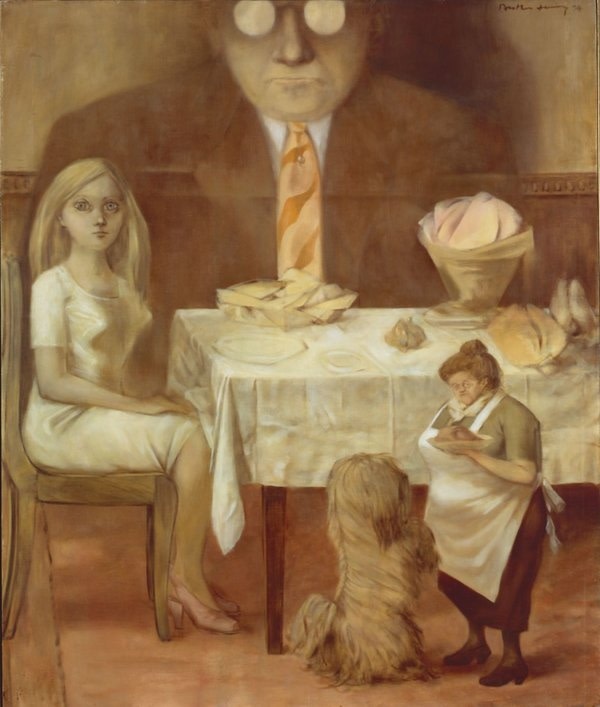
For all this darkness, you are also a poet of light. ‘Salt’ records your sister’s pleasure in using the hammock as a swing, before she broke her collar bone.  ‘Bleedthrough’, takes as its starting point a Helen Frankenthaler’s painting (‘Sunset Corner’), with its layered and saturated cohesion of reds, within a framing of black. The poem responds in waves to an explicitly female sense of self – that “world of women with its four fleshed walls/ of love” – and questions how it speaks through and into art, but also how it makes art of the lived female life. Honouring your mother’s ability to “turn the most unlikely// raw materials to gladness”, you also acknowledge the fierce energy of fertility and menstruation – “the body/ in even its / flourishing seethes and cramps” – from which you move to the “labor-in-the-flesh” of painting – “the wash/ of acrylic, / the retinal flare”.

The closing image in ‘Bleedthrough’ is of a “just pubescent” girl washing out cloth stained with what appears to be blood, and suggests that our ability to see, to make art, to have a sense of identity, all derive from the totality of our life-experiences:

         The fretted cloth on the third or fourth rinsing goes

  yellow, goes brown, the young
                girl’s hands
         – she’s just pubescent – ache

  with cold. Some parts –
                the red’s
         bare memory now – were never bad. The sound

  of the water, for instance, the smell,
                the rim
          of the stain that’s last to go.

Although it’s a homely image, I wondered whether it might be fair to understand within this a refraction of your own transmuting of life into art, and a reflection of the way that working with even the most difficult materials, and making them over into a secondary medium, can contain its own healing and reconciliation?   I’m thinking again of your recent ‘Love Poem’, in The New Yorker.

LG: I’m not from that generation of women poets who found it inherently compelling to write about menstruation But the beautifully saturated colours in the Helen Frankenthaler painting did make me think about my mother when she was growing up: there were no such things as disposable sanitary products; they used cloth which had to be washed. There is a way in which the body comes, the senses come, to claim things.

AH: Every woman has had to wash stained underwear.

LG: And deal with the sanitary pads.

AH: Yes! The giant, bulky things.

LG: I didn’t dislike that smell. I was in horror at the thought that someone else might smell it of course, but I rather liked it. I guess it’s just the blessing of the physical.  When you are trying to wash blood out of things, you have to use very, very cold water lest you set the stain, and the coldness hurts your hands. It’s not about anything else. It’s just itself.

AH: It’s wonderful.

LG: At some point in my life I’m going to write an ode to lochia.

AH: That would be a really strong project. I think also, in a way blood is our ink, the ink our bodies make. It’s what literally connects all our parts. It’s the liquid in which we write the experience of our lives internally, but is made manifest externally – either through trauma, or through this natural process of menstruation. It can feel very delicate to approach – trying to reclaim a bodily part of ourselves, that is symbolic of our fertility – of our still livingness – of our aliveness, so we can write into our larger place of being. It’s a mysterious poem – but it’s also an anchored poem, in the physical self.

LG:     And maybe it’s just that very particular combination of centring experiences.

AH: Also, as you say, just thinking about that sense that when you wash something – whatever the cause of the stain – you are transposing it, you are creating a ritual of transformation to arrive in another place. In the same way, when we make art, we are also engaging in a sustained ritual of transformation that takes us to another place, that engages this other material – but also in some ways releases us from it so we get that distance which allows us to make and to invent rather than just be a kind of straight newspaper reporter.

LG:     That is very well put.

AH:  Thank you. ‘Still Life’ closes Prodigal.   Structured as couplets, the poem moves through deaths further afield – photographed in Qaa, and in Krakow during World War II – to a father dying from cancer. You allude in the final section to images derived from still lives, known in French as ‘nature morte’, whereby the marks of beginning death – “The lemon,/ for example, where the knife has been;” are what enable us paradoxically to recognize the “luminescent heart” of life. The poem, and the collection, end:

  I see you in the mirror every morning

  where you wait for me.   The linen,
        Father, lemon, knife,

        the pewter with its lovely
  reluctance to shine. As though

  the given world had given us
        a second chance.

Would you like to say something about this ending?

LG: I come back again and again to writing to and about my father – when he was alive, we didn’t have a sufficient language together. I was more or less useless in his world. He never gave me that impression, never said such a thing, but all the things he did in the world, I just no good at. I was sickly. I was bookish. If I ventured into the garden, I succumbed to hay fever. Useless. And later, I was simply flailing about, trying to find a life of my own –

AH: That was so different from anyone your family had yet made?

LG: Different, yes. I never had the wherewithal or the presence of mind to ask him more about his life. When my father was older we – my husband and I and our two children – would visit my parents twice a year. Once in the summer, and once at Christmas.   Each time we left — car packed to the gills, kids in their car seats, a mountain of snow on either side of the drive at Christmas time or summer heat and the corn getting high — I remember looking back, my parents on the porch outside the kitchen waving goodbye to us, and I would be seized with grief. We never found a way of being together, my father and I, so every time I left and knew it was that much closer to the end, I was simply seized with grief. I haven’t felt that way about any other loss. I suppose I keep trying to find my way to him by writing.

AH: He lives through your words, for us. He is a very powerful presence. While you don’t deny his complexity – you allow it with a sort of generosity. You allow it its strength, through your own tenderness and compassion. Your father’s seems to be a life that is very valuable to be able to speak of at firsthand. These complex male lives, which are not spoken by themselves beyond their circle, can be otherwise lives that people don’t have imaginative access to, even though they are lived by millions of people. I think it’s a really meaningful project, and a deep creative spur. It is a wonderful place to end the collection – with that sense of him appearing to you in the mirror. That sense of his presence, which is present in your own reflection.   Thank you so much Linda Gregerson.

Photograph of Linda Gregerson by Nina Subin

Selected Bibliography

Poetry

Prodigal: New and Selected Poems, 1976-2014 (Mariner Books, 2015)
The Selvage (Houghton Mifflin Harcourt, 2012)
Magnetic North (Houghton Mifflin, 2007)
Waterborne (Houghton Mifflin, 2002)
The Woman Who Died in Her Sleep (Houghton Mifflin, 1996)
Fire in the Conservatory (Dragon Gate Press, 1982)

Prose

Negative Capability: Contemporary American Poetry (University of Michigan Press, 2001)
The Reformation of the Subject: Spenser, Milton and the English Protestant Epic (Cambridge University Press, 1995)

LGProdigal


Grief as re-generation: the Magma Loss issue.

Photo 23-11-2019, 16 26 19
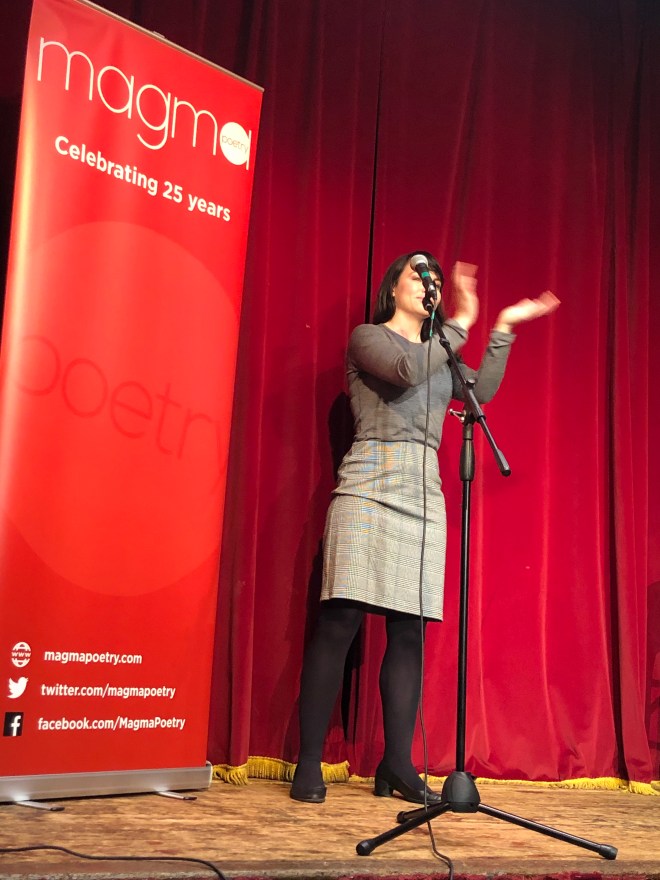
annie heyter reading at the Magma Loss launch

Some of our deepest experiences can be the hardest to articulate – whether through words, or other art forms. Particularly difficult are those involving loss, or absence.   While this is not always the case, it may take years, or decades for us to locate a language which comprehends what is gone.   I have found this to be the case when writing about sexual abuse in my childhood.

At the same time, this delay can provide a law of increasing returns.   That is, the longer we wait, and the further we travel in time away from what happened, the greater the chance we may have of generating something new in recompense for what was taken from us. Think of Emily Berry’s Stranger, Baby, or Elizabeth Bishop’s Questions of Travel and Geography III, or Rachael Allen’s Kingdomland, or Pascale Petit’s Fauverie.

Lovers, fathers, friends, languages and landscapes were all remembered, and made visible in words, as I listened to a selection of the Magma Loss poets reading at the issue’s London launch. Brilliantly commissioned and edited by Yvonne Reddick and Adam Lowe, the selection was whittled down from a record submission of over 8000 poems.

Photo 23-11-2019, 16 46 52
Zaffar Kunial

The issue includes commissioned poems, created when poets including Romalyn Ante, Malika Booker, Zaffar Kunial, Jhilmil Breckenridge, Jackie Kay, Nick Mahona and Jennifer Lee Tsai, met with collaboratively with each other, and psychotherapists, facilitated by Yvonne Reddick. Too many to list individually, these poems travel from pre-colonial Filipino culture to post-stroke recovery, by way of cricket, amputations, and family holidays in Jersey.

The church hall venue, in Exmouth Market, was decidedly British, by comparison. With its green 1970s retro-chic china, tea and biscuits, and chipboard stage, it seemed to be a distillation of the Wiltshire halls I visited after first coming to live in England aged 8 in 1972 – with the key difference that while they were unfailing damp and dank, and mandated keeping-your-anorak-zipped-up-at-all-times, the 2019 Clerkenwell version was cosy and warm on a battleship grey November afternoon.

Rather than the jumbled piles of clothes, dog-eared books, battered, discarded toys and cacti in margarine tubs, through which I sifted as a child to find something to spend my pocket money on, poet after poet stepped up on stage to share their wares. Natalie Linh Bolderston discovered in the first stain of menstrual blood “the shape/ of an

Photo 23-11-2019, 16 38 46
Jeffery Sugarman

unconquered country.”   Jeffery Sugarman cruised in memory “already dying men// in meatpacking houses” to elegise the “cum-shot floors” now redeveloped out of material existence, but still stalking the alley ways of memory. Kostya Tsolakis called a lost lover, ‘Patrick’, back to life with a flinted tenderness.

Switching the focus to female-identified queer lives, annie heyter stood up in DMs and a creased green silk cocktail shift to call to the stage a life where “we boiled our wedding dresses hand in hand/ then cropped our hair close as breath.” For Beckey Varley-Winter, writing in memory of Leanne Bridgewater, the space of loss was the ice shell formed round a “ghost apple, brittle bauble still splintered to the branch”. For Sarah

Photo 23-11-2019, 16 24 35
Seraphima Kennedy

Wedderburn a father lost in childhood, as my own was, stood “just beyond reach/ of my bramble-torn fingers”. For Seraphima Kennedy a “flock of coal-tits flew out of my ear” on the way to a funeral and Tamar Yoseloff crammed “jackrabbits, bighorn sheep, shild cats/ black bears” into a poem-house where all the “rugs had heads”.

These summaries barely begin to do justice to the richness of material in the issue, which includes reviews, including by Shivanee Ramlochan and interviews. Short prose commentaries by the commissioned poets lead readers along the lines of investigation that their works follow like animal tracks in wet grass.

The links below give a taster of what’s on offer. Equally, for anyone interested in connecting more deeply – buy, beg, or borrow, the Magma Loss issue.


Read sample poems from the Magma Loss issue here.

Buy the Magma Loss issue here.

Photo 23-11-2019, 16 56 27 (2)
Yvonne Reddick.

Radicalising “the feeling world of a poem”: Alice Hiller on why new work by Vahni Capildeo, Eugene Ostashevsky and Anita Pati is calling the ‘English’ language to account.

Photo 24-10-2019, 14 29 26Vahni Capildeo Skin Can Hold Carcanet £9.99

Eugene Ostashevsky The Feeling Sonnets Clinic

Anita Pati Dodo Provocateur The Rialto £6.00

How do thought and feeling realise themselves into language? Personal, political, or historical – what forces can obstruct this process? I wanted to begin this review essay with the battered, beloved, re-read books by Vahni Capildeo, Eugene Ostashevsky and Anita Pati that have helped me ask these questions over the past months.   Core to my own work of giving creative witness to sexual abuse in childhood – the same questions also go to the heart of our attempts to communicate, and represent our experiences, on or off the page. Hurrying to get the words out, we risk rushing past them, and the serious issues they raise, particularly around voicing more resistant, or culturally and socially ‘prohibited’, materials.

But poetry is one of the places where time can be freeze-framed, and rewound. It can transpose the past into eternally present, multifaceted, moments – and give them the possibility of different outcomes. Vahni Capildeo does this in their new collection, Skin Can Hold, within the essay ‘Astronomer of Freedom’, which also defines “the feeling world of a poem”.  The essay describes using a black box theatre at Cambridge University to explore and stage Martin Carter’s poem of struggle and independence, ‘I Am No Soldier’. Like peeling an orange to discover, its tense, translucent segments, and scent the zest, it shows how Capildeo, Jeremy Hardingham, Paige Smeaton and Hope Doherty collaborated to open up the apparently sealed and fixed world of Carter’s work:

Photo 05-11-2019, 10 28 30We were not interested, either, in a conventional dramatisation of a poetic script. Instead, immersive experiments became the context for events including reading of full texts alongside what I call ‘syntax poems’ gleaned from them.   The syntax poems offer traces of a way of being with and inside Carter’s poetry. They are not the kind of independent verbal artefacts called responses or reworkings.   They are rearrangeable elements for future experiments. They require several voices. They are best realised via bodies in motion.


“Being with and inside Carter’s poetry” and locating its “rearrangeable elements”, moves the reader away from the fixity of language on the page, and towards its energies of origination, and the forces resisting them. These were made visible in Cambridge through sets including a colonial school room, a jail/resurrection yard, and a galactic dance space. Capildeo writes of how, when realising the words live in this way, the performance arrived at “a dimension that exceeded the words: here, a reversal of the traumatic ‘Middle Passage’ voyages of slave ships, into an ark-like transit that embraces all ‘comrades.’”

The black box staging, with its possibility of giving the audience “an insight into symbolic and representative social environments by being in them with us and having them co-exist in one blackbox” also challenged the power structures implicit in established cultural practices. The two poems which make up Capildeo’s ‘Prologue’ to Skin Can Hold open the collection by highlighting the forces hemming in and constraining certain voices.

In an age when border controls can determine life or death for those trying to cross, ‘The Brown Bag Service’ satirises “brown bags in Wholemeal, Bleachers or Cricket sizes”, that are “tailored to your citizenship incorporation experience and your journey with us today.” Travelling of another kind shapes the second poem, which reads, in its entirety, via variously sized and aligned typefaces, ‘(IN THE)/ ZOO I AM/ (LEFT)/ THE/ CIRCUS’.

To inhabit this transformed, resisting, role-playing self, however, Capildeo suggests that shamanic or somatic rituals of self-reclamation are required. Instructions are given in the ‘Four Ablutions’ under the title of ‘Black Box Cleanout.’ In each of these, the ‘poem’ is not only the sets of directions addressed to a “you”, and expressed in black typeface on the white page.   Rather, it is the evolving instructions themselves, as reproduced within the reader’s imagined body. ‘Ablution I’ opens: “Standing at a great height in a black box rigged by chaos, take a stainless steel tankard. Dip it into a white washing bowl. You are not nude.”

What follows is an act of cleansing, and an act of claiming.   It is vulnerable and powerful both together.   It has agency, but it is also insecure – with the quality of a dream in which everything keeps shifting, and the clothes that once covered you, dissolve from your body. This happens in ‘Ablution II’, which asks “you” to inhabit one of the places from which the creative energies of Skin Can Hold originate. Without any explanation, now “you are motionless at his feet”, clothed, “unitarded”, or undressed, and

you are ignored by him and knowable to any others as vulnerability in
situ, a heap of lines that cannot be crossed out, except deletion by
delivery is what his voice does. He reads in a beautiful voice. The
evil in the room wants it petty, sieved, meshed, strained, howled:
the voice surrounded by surrogate sound, the rustle of unhung
shutters. But it is a beautiful voice. He does not notice you. He
does not look down. He steps over you; over and around.

Here is the raw feeling of having your selfhood denied – from which acts of resistance and reclamation can begin to arise in Ablutions III and IV. In III, armed with an “iris” wand, “you” starts to get their own back as “the giant reader is tied to his microphone with shredded clingfilm, the dolphin-choking image of liaisons past.” He is now immobilised, while

you stoop, stretch, circle, segment, re-attach the relation of your body
to the space around him. The iris is painterly. It brushes him into
existence. The long Chinese scroll of himself acquires a mountain
of characters.   Is this a ritual of freeing, or a ritual of realisation?”

“Freeing” and “realisation” remain touchstones throughout Skin Can Hold, afterwards informing Capildeo’s responses to Martin Carter and Zaffar Kunial. The fourth and final ablution moves into a voice made possible by the rituals of the “Cleanout”.  IV features “metre after metre of blue, green, bluegreen, azure cloth: water to be terracotta cladding”, shaken out by “healthily feathered” arms. It is the backdrop to the central image whereby –

Standing on a ledge under a tree, a thin girl sings vowels. Her arms are raised.
She is rigged with makeshift wings that double as racks for scarlet
and yellow ribbons: wishings and blessings blank of desire, since
nobody but herself tied them on.

Upright, vocal, and self-clothed, working in sympathy with what is present of the natural world, the “girl” figures the energy that the word-skins of Capildeo’s poems hold.Her singing holds a flame of resistance against the stories about attempted degradation within the ‘Shame’ sequence, that come immediately afterwards. Performing this at the Poetry London spring launch, Capildeo explained that the stories were not exclusively from their own direct experiences. The narratives are introduced by a series of statements challenging the possibility of shame, including “I have no shame but fury” and “I have no shame but the knowledge that I shall be disbelieved.” The first ‘Shame’ story describes a female child being sexually abused by an adult male:

I was not ashamed as an infant when he set me on his chest, my
chunky little legs wide and my cottony vulva unconscious of being
close to his face; nor when he made me learn to tweak his nipples
until they were peaks.

After further interactions, including being asked to “brush” his pubic hair flat, the child then surrenders her doll to this man, who “moved her up and down like a scrubbing brush, making her eat plip. She took her punishment mutely, and I did not reinvent her voice.”   “Plip” is glossed as meaning “shit.” Beyond the specific child/adult context of this text, the face down doll is afterwards a figure for others obliged to endure degradation without recourse to protection.

Something like “the scream” in Elizabeth Bishop’s ‘In the Village’, her muteness shimmers over, and is ultimately dissolved by, the other ‘Shame’ stories that follow, and other poems in the collection. The next story describes how a woman with “brown skin” is humiliated and physically injured by a beautician during the course of a hostile intimate waxing, and then again by her story being circulated by a third party within academia.

Lastly, ‘Shame’ gives us two attempted professional shamings, linked to publishing and academia. These are given additional weight by the recent publication of ‘Tackling Racial Harrassment: Universities Challenged’ by the Equality and Human Rights Commission – showing that a quarter of BAME students still experience racism at university – and the many academics of colour who have since gone on record saying how regularly they also experience racism in their professional and institutional lives.

The first attempted professional shaming is visited upon the narrating “I” in the course of meeting a “powerful-editor-poet-translator” – “Heinrich asked to meet me in a cafe, ostensibly to discuss the manuscript of my second book, but really to tell me to stop writing.[…] My book was antipoetic and destructive of poetry.” To face him down, and retrieve their book, “I” summons the “hella angry” Virginia Woolf and Sylvia Plath. The closing exposé describes providing teaching cover at what appears to be an Oxbridge type university, where the narrator is denied access to study rooms, and obliged to teach students sitting on the floor in a corridor and finds “Shame on behalf of others flips into fury.”

The writing through which each section is enacted summons the miasma of ill will that confronts those obliged to live in the face of malignant, misogynist and racist obstructions – which Anita Pati and Eugene Ostashevsky will also investigate. Capildeo asks the reader to absorb what it could mean to have to generate work within the orbit of this aggression and oppression. This includes the challenge of making creative work using the same ‘English’ language through which the assaults are being perpetrated, including those generated by “structural racists at well-meaning gatherings.” They are referenced towards the end of the ‘Shame’ segment, whose close sits somewhere between enactment and exhortation. It redefines the “feeling world of a poem”, making it a power source from which to appropriate and generate imagery and language. Whispered voices from within and beyond the self make words which arrive in a new dimension:

Shamelessness does not feel, smell, or taste until it is at home, its home,
wherever you are not, you are not at home, where is your home, and you
don’t celebrate Christmas, do you? Shamelessness is polyfleece. I open
the tap and drink it offcast in the water. Well.

You can do shamelessness. Shameless.

Two ‘Reading for Compass’ poems, one responding to Mark Ford, the other to Zaffar Kunial, go deeper into resistance to silencing pressures, and the making of new work beyond them. The reader discovers that while “Mr Ford didn’t/ get around to my corner of the world,” reading Kunial’s Us generates a very different feeling – “In each of these poems, I am with you./ They are with us.” Blurring the boundary between the creative and the critical, Capildeo forms a poem from noticing how Kunial reclaims and remakes language in the “yellow airy treehouse/ of your multifoliate verse”. Capildeo suggests it achieves its effect partly by moving into the gaps and absences from which people and experiences have been left out, and claiming them as apertures to enter through.

From the first you offer us ellipses,
long dashes, and like time itself the space
of triple spacing inside which a phrase
frays. The spacing grows longer. You whisper
death and birth in winged scripts and hospital
familiarities; no guarantee
of arriving pulsed and present; except
via soft, often untelated forms:
phoneless phonetics, limb-like roots, typed words.

Vowel-driven, like the song of the “thin girl” in the fourth ‘Ablution’, the sonic qualities of the lines generate a redemptive beauty which enacts the argument that they, and Kunial, are doing something different. Skin Can Hold also contains language of deliberate ugliness, as voiced in the slow-burn break up ‘Interlude: Ways to Say Goodbye’. Spoken by a covert racist, to the woman they are breaking up with, it showcases how the language of daily speech can be used to enact what Claudia Rankine and Fatimah Asghar characterise as the “microaggressions” of racism.

Using the second person, the speaker moves from the seemingly innocuous “I have fallen in love with your silence”, to the apparently throwaway – “Didn’t your mother teach you/ to cook ethnic food?” – to the determinedly othering: “We are very different people.” Capildeo’s text retains agency against the speaker throughout, via a use of black humour, but it does not seek to diminish the wrong, or hurt, of what is being enacted. The poem ends:

I am sitting here looking at you
without the slightest desire to kiss you.
Why do they want to get married?
Wow, that dress makes you look hefty!
I have activities on Sunday;
I can’t schedule in the seaside.

Drawing together the strands and arguments which have built through Skin Can Hold, the ‘Epilogue’ returns to another abandoned lover, but one who takes matters into his own hands, albeit at a cost. ‘Ringing Völundarkviđa/ Wayland Smith Moves’ retells the Old Norse story, from the Icelandic Poetic Edda, about how Volundr took control of the tools and mechanisms used to suppress him to reclaim his freedom and agency.

Volundr was originally one of three brothers, married to three swan maidens, who left them after nine years. While his brothers went off in search of their lost wives, Volundr remained behind making gold rings for his, and was captured by a king, who took him prisoner on an island, and had him hamstrung to prevent escape, forcing him to make jewellery.   Volundr’s revenge included killing the king’s sons when they visited, and then turning their skulls into jewelled cups. He afterwards drugged and impregnated the king’s daughter, before escaping into the air.

Capildeo’s retelling is divided into three segments – ‘Swanmaiden’, ‘Hunters and Government’, and finally ‘Artisanal, Isolate’. Spoken by Volundr alone, ‘Artisanal, Isolate’ is without shame about his retaliatory appropriation of the bodily materials of those who have exploited him, showing how “my wounds are wings”, and enacting the reclamation of self which has occurred:

I who had joy am joyless
and make joylessness
and fool your daughter
and fill her with grandchildren
and stamp out your laughter.
Though I languish under your vigilance
my wounds are wings.
Watch me go
if you can see how
my love and I never stopped flying.

These are Skin Can Hold’s last words. While the rape of the king’s daughter is challenging to applaud out of context, it occurs within the same register as the violence enacted against Volundr. The children born from it will carry Volundr’s genes within their skin. Likewise the ‘English’ language can be occupied from within to hold and transmit Skin Can Hold’s radical acts of insurgency and transformation.

Photo 05-11-2019, 10 27 43Volundr refers to “my love and I”, and the energy of reciprocation is also integral to Eugene Ostashevsky’s The Feeling Sonnets.   Written by a poet of Jewish heritage living between New York and Berlin, who originally migrated from the former Soviet Union to the USA aged 11, the fourteen part sequence questions what a poem is, and how it may achieve itself relative to the language from which it is formed, and the worlds it seeks to represent.

Ferociously playful, like exuberant, sharp-toothed young puppies, the sonnets simultaneously progress a deeply serious inquiry around challenging and disrupting exclusion, which speaks also to Capildeo’s and Pati’s work. While Capildeo gives witness to the presence of selves which history and dominant cultures have sought to ignore, Ostashevsky begins by asking us to engage with what constitutes a self, or place of consciousness, and how this may be defined. Sonnet I opens

I

It is with profound ambivalence that we inform you of our feelings.
We read feelings as a victory of the particular over the universal.
We cannot read feelings as there are always feelings between feelings and under feelings.
If we read feelings they would be called readings. Feelings are what we feel.
Can we name feelings and do they respond to their name.
The name feeling suggests there is something to feel for here.
Does it give us a hearing. Is it even here.
If it is not here is it even there.

Like waves mounting a beach and falling back, but successively bringing the tide in, the refracted, repeated formulations, by their gaps and absences, carry the reader towards understanding the sort of space that “our feelings”, and a feeling response – along with the poetry which they generate – may occupy.           These multiplying strands remain at play within the second and third sonnets. Setting up an opposition between what is experienced, and how it may be represented in language, Sonnet II warns “If the feeling is smothered it touches no one./ If it touches no one there is no one feeling.”

Sonnet III, which gives us “hands” which can “show us what it is to feel” whether “from the outside to the inside” , or “to the outside from the inside”. To ask this question, and to be prepared to hear its answers, is automatically to enable each experience registered in this way, denying the diminutions and exclusions of racism and misogyny which value some perspectives more highly than others.

How we may transmit, and receive, ideas, and what their recognition can entail, whether undertaken solo, or in relation, are explored more expansively in Sonnet IV, which begins: “We are trying to make sense of a feeling. /Making sense of a feeling is like building a boat from water.” Using the term “sense” moves towards the idea of touching another, which becomes a compass of intention for this shifting journey: “Feeling about means trying to touch the object of your feeling./ It is often done in the dark. We feel about when we cannot see and grasp.”

Sonnet V draws on the more public signifiers of portraits, and star signs, under the opening gambit of “feeling without feeling”, and then segues into the idea of “The portrait of war on the news. /It is my war by other hands. I do not feel it.” Like a tide going out, Sonnet VI then withdraws into a more intimate process of relating again, gesturing towards the form’s long history as a love lyric in the opening:

There is a you in this poem. Whose you it is.
It is my you. It is your you.
Is there a belonging in this poem.
Has it been left unattended.
Is belonging a possession.
Whose possession is it. Who is possessed.

“Belonging” questions to what extent the process of translation of anything into language constitutes an act of appropriation on the part of the generator of the language. But it also simultaneously registers the vulnerability and desire on which this act is founded and from which it arises, in the closing couplet: “Must belonging end with longing. / How long is longing.”

Eugene Ostashevsky’s awareness of the relative values of language is of course informed in part by his own multi-lingual experiences. English, German, and Russian (in Cyrillic characters) are present within Sonnet VIII. We learn “The Babylon of my body is falling./ My body is multilingual. It sticks out its tongues. Ah.” A sonic waterfall of images follows, separated by the word “rot”. They return over and over again to the changing body in super-long lines, which spill over the boundaries of the form. Sonnet VII ends: “My altars alter. My altars falter. My altars totter. My body, my body, my body, the Babylon of my body is falling.”

Broken into by time and multiplicity at its midpoint, the sequence is now able to open itself to sorrow and loss, enacting and transmitting the concept of feeling, which it previously showed itself as feeling towards. The first eight lines of Sonnet VIII each comprise two or three Cyrillic characters, apparently representing sounds. A sequence of longer, over-spilling lines follow, asking the reader to consider what may be invisibly embedded in language:

In economics or economic sociology, embedding refers to the degree to which economic activity is constrained by non-economic relations.

Sonnet IX is much blunter, beginning: “These are our words. What we do with them”, exemplifying how form may frame and direct meaning : “By how it looks the portrait shows us how to look.”   Sonnet X takes this further, positing “Reading. Writing. Rhetoric. Arresting” as “Agents with agency.” Written by someone who grew up in the former Soviet Union, and published The Feeling Sonnets under Trump’s presidency, the inference is anything but light-hearted: “Our rhetoric left us arrested./ We were framed.   We wrote what we rote by rote.”

From the start, The Feeling Sonnets have simultaneously wrestled with, and submitted to, the conventions of the sonnet sequence – whose fourteen lines it may elongate, or abbreviate, but never breaks. The decision enacts the constraint implicit in entering into conversation with the traditional practices and forms of language – even as it makes deliberate ‘nonsense’ of them. Sonnet XI parrots well-worn phrases, reaching back to Roman civilisation. Setting them alongside each other in a surreal, freely associative flow, the effect is to disrupt their traditional associations to make new ones, which serve to describe the process of imperial oppression, and enforced complicity, by which power and authority transmit and reinforce themselves:

Wrote. Red. It was the Faust. Or fist.
The fist with a pen. The fist with a penitentiary.
With a rotten mouth. A fistula.
A scent was sent up and rose. It was the scent of the century. When the centurions came marching in.
The fist came first. Centuries marched under the arch.
No one had anywhere to run. Instead, they greeted with roses.

“Wrote. Red.” is a history of the Left in two words. It calls to mind the writings of Karl Marx, and how in being read, and learnt by rote, they helped bring about the Red Revolution.   If this captures how political systems can enforce themselves through language, it also shows language is continually escaping. “Fist” elongates into “fistula” – and is then tramped down by the marching feet of the centurions of the rotten empire, whose feet beat out the compulsions of rhythm and meter from which form engages.

Sonnets XII and XIII address literary practice most directly, and the ways in which cultural dominance may be perpetuated and reinforced. Sonnet XII is titled ‘Teaching a Poem’, and is constructed to approximate more closely to a naturalistic, image-based work, insofar as it contains a location and a form of narrative. The landscape features are disruptively reflexive, however, and the reversed order of the ‘poetic’ diction of the first line rapidly descends into punning play, and colloquialisms, before swerving back:

Under the Pont Mirabeau cool the Seine.
A cormorant, black as a punctuation mark, comma.
The bridge is riveted. Are we riveted. We are riveted over the river.
We are riveted by rhyme.
I think of my daughters. I am here for my daughters.
My daughters are not here. Where are my daughters.
I think of Clara Smith’s ‘Shipwrecked Blues.’
‘Well I don’t mind drowning but the water is so cold.’
Under the Pont Mirabeau cool the Seine.

The final six lines open with the defiantly outsider melancholy of “It is possible that poetry is possible but not my poetry”. They reveal of the Pont Mirabeau that “Celan fell from here, arms flailing, before his time as if to Giudecca.” “Giduecca”, the name given to Italian Jewish ghettoes, was also the penultimate circle of hell in Dante’s Inferno, called after the Jewish Judas Iscariot. Ostashevsky continues “Dante wrote Tolomea but meant all the Jews of Giudecca riveted in ice.” When Dante and Virgil pass through Giudecca they do not linger to talk because all its inhabitants are frozen wordless in positions of agony cased within the ice.

It is a strong symbol of enforced silencing.   Within the context of The Feeling Sonnets, Giudecca also becomes a symbol for groups of people rendered voiceless by dominant or hostile cultures – as Jews were successively by the Catholic Church, the pogroms, and the Third Reich. Of Jewish heritage, the poet Celan grew up in the German-speaking area of Rumania, and lost his family to the Holocaust. He continued, however to write in his German ‘mother’ tongue in exile in France, composing some of the most resonant poems calling the twentieth century to account, in the language previously used to enforce the barbarities of the Nazi regime.

Celan can be seen as performing an act of resistance and reclamation commensurate –in different ways – with Vahni Capildeo’s process in Skin Can Hold, and also with Anita Pati’s in Dodo Provocateur. Ostashevsky’s closing Sonnet XIV is titled in Russian, and written equally in German and English, as if to call his three parallel languages to his side in order to support him in the task of finding a form of wording adequate to what is trying to be expressed, while declining to submit to the constraints of any single one.

It is an inherently disruptive and reclamatory act, requiring the reader to accept that any fixedness of meaning will be loosened by the triple language system. Full of feeling, Sonnet XIV opens “Das Lied hat gelogen. The song lied./ Sorrow was the issue. Der Ausgang war Leid.” This is the burden of feeling which jolts the poem into meaning. The lines then play their way sorrowfully, and subversively, through the permutations of “Lied” – song – and “Leid” – sorrow –  closing on a note of reclamation, through articulation, “Often you write das Leid but read das Lied.” That is, “Often you write the sorrow but read the song.

Photo 05-11-2019, 10 29 44Somewhere between a pamphlet and a collection, at 36 pages, Anita Pati’s debut, Dodo Provocateur, winner of the 2019 Rialto pamphlet competition, concerns itself with both sorrow, and song.   Intermixed with them is a powerful jolt of anger at the acts of racism and violence which some of the poems record, as they move between bird and human life, and England and India, and past and present.   While Capildeo and Ostashevsky summon agency, and varying measures of lightness and pleasure, in part through their recourse to wit and black humour, Pati additionally generates a redemptive tenderness around the generosity of love within families. This becomes a place of resistance and nurture, notwithstanding the very dark materials with which some of her poems engage.

With a manifesto-like clarity, in 8 short lines, ‘Ornithology’, Pati’s first poem, indicates the direction of travel. Its three stanzas outline three different sorts of “bards.” There are those whose paths are apparently easy. They know “the plume/ in their chest from the nest”. Others “follow and fuss/[…]/ swelling the flock with voice”.  Then come those whose process of song is resisted by both internalised and external pressures – “For those too wounded to squawk:/ Earth tamps down their song.” Skin Can Hold also works within this terrain. What sets Pati apart from Capildeo is the deliberately undignified, rambunctiousness of “squawk” as a verb, along with the ugly, strangulated noise it carries to the reader’s ear.

As a poet, Pati reaches repeatedly for words in common usage, as well as more archaic and deliberately ‘clunky’ coinages. The result is to bed her poems down into the ‘everyday’ lives to which they are responding. ‘Silver Jubilee’ gives witness to an explosive moment of violence in 1977, told from the point of view of the child experiencing it.   The action opens with the child running “red crayon/ around her bunched fingers/ to draw knuckly flowers.” The image is tender with menace.   The crayoned line calls to mind the outline drawn around murder victims, while the ‘u’ sounds in “bunched” and “knuckly” generate a subliminal punch waiting to be landed. Sure enough, it comes:

Her face, hushed,
is a copper ha’penny,
serene, like the Queen’s,

when the brick gets in,
sailing like boats
she’d learned to fold as a toddler

to land square at her face
(kaleidoscoping
the patio glass)

from where their splinterous
GET BACK HOME! whoops
ransack the air. And no

it’s not fair that no-one will see
her picture now.
Should she draw it again?

The heft derives from Pati’s ability to hold in play the delicacy and creative hope of the child’s world of folded boats, and crayoned drawings – and the arc of the brick which shatters it.   Drawing the “picture” again, within the poem named for the “celebratory pageant on paper” on which the child was working, Pati stages a punk refusal of the 1977 Jubilee images of mugs and street parties. She asks us her readers to be with her in seeing the totality of British life of the late 1970s – and the ugliness that crouched within its displays of supposed patriotism, which remains unresolved forty-two years later.

While ‘Silver Jubilee’ is a poem which tucks down into the world of a small, absorbed child, ‘Paperdolls or Where Are My Curly Scrolls of Sisters?’, starts with images of child’s play, but grows them into a simultaneous child/adult perspective. The poem opens with a couplet that evokes injury, healing, and resilience in equal measure:

They are wedging me open with lapwings, the feathers
angled and birded to hurt. But I’ve a tight heart.

Voices off whisper cruel comments in italics – “that’s where you come from// your hands are dirty”. They observe and reflect their consequences–“you’re so quiet we thought you’d disappeared: sssshhhh.” But the speaker of the poem has a centre of self which, though driven deep underground, refuses to be extinguished, hunkering down “in the boiler room, making ski lifts from off Blue Peter.” While not without complexity and ambivalence, this is an image of elective integration. The child is choosing to use British cultural prompts to foster her own creative making, and this agency becomes central to the process of healing, and recovery, also held within the poem, whereby the speaker becomes both paperdoll, and cutter:

cut me a row of paperdoll aunties –

keep cutting inside me with your instruments. You are making holes
for the light to get in. I’ll stay in Recovery if you nurse me.

Where are my mockingbirds for sisters?
Tetrapak houses, rainy terraces, grey, no laughters.

I’ve threaded the mothers on daisy chains which I pluck
some times. Plant in oasis.

Tumeric lightens the skin: we’ve become cream boaters and lace.
Fold up your plaits, village girl. I know I lapse; please keep on trying.

The poems which follow develop this careful alternation of child and adult perspectives, accreting a narrative which cuts between early experiences, and their impacts and resonances later in life. All are held within an unblinking scrutiny of the larger cultural artefacts which can be seen as working to sustain a hum of subliminal hostility to those deemed as outsiders. ‘Twixt /(after Shakespeare’s Sonnet XXVIII)”, appears at first to be a witty, modern update on obsessive, unreciprocated passion. It begins “Call this love? I’m whacked and dainty over u –/ that pigeon heart has pestered me all year.” But reading it against Shakespeare’s original, plays in another more shadowed strand, which looks back equally to Capildeo’s and Ostashevsky’s investigations of how language has been used against groups of people.

Pati does not directly quote Shakespeare’s reference to “the swart complexiond night”. But the sublimated metaphor turns the reader back towards the earlier image of the child, “her face, hushed,/ is a copper ha’penny,” in ‘Silver Jubilee’ – when the family’s different skin colour led them to be attacked. What ‘’Twixt’ gives us instead is an ubiquitous white-out, which appears to infect the speaker’s mind with inescapable persistence:

My brain’s not a computer yet it fires
a trillion cross-wired pings that sting of thee.
And when I work to block you out, my screen
spurts Facebook feeds that eat the nub of me.
I pick your pixelled face to breath hard on,
I flatter flesh but then your steaming head
spirals into kitty snarls so I
start furrowing your golden forum threads.

These destructive “golden forum threads” have been valorised in opposition to Shakespeare’s explicitly “swart complexiond night”. As such they reflect the process of cultural ‘grooming’ which endeavours to generate a sublimated, internalised racism, even within those whom it discriminates against. Pati touches on this in the final couplet of ‘Paperdolls or Where Are My Curly Scrolls of Sisters?’ (already cited) and ‘Self-Portrait Exaggerating My Unknown Features’ which describes how the speaker sweats “behind skin-lightening Hollywood mango cream.” ‘’Twixt’ ends:

I meditate I plead I flick you off
and still you grunt in me no mind to stop.

Continuing the investigation into canonical contamination, Kipling’s ‘The Boy Who Would Be King’, and Vaz de Camōes ‘The Lusiad OR the Discovery of India’ both come under scrutiny in Dodo Provocateur. The latter informs the first person account of ‘I, Washerwoman’. A citizen of “our Old Goa town”, the washerwoman relates her forced sexual encounter with “Dom Felipe” under the cover of night. He has watched her, “ a copper pot by the temple”, and then come for her “in blackened robes, sceptre flesh.”   Her rape is conveyed with precision through an image from the natural world, which nails the part of the body attacked with a compelling deftness:

A gecko clamps in its jaws a moth
whose purple wings breath a twitch like velvet gills.

For anyone tempted to relegate such assaults to the more distant colonial past, or even Britain of the 1970s, Pati makes it clear that such attitudes are also informing the rise of Islamophobia within the UK and beyond. ‘Operation Homegrown 2024: My Lone Wolf Has Boarded’ begins “Hello, Hamid, we have you/ frisked in white noise”, but goes on to show how such persecution has the capacity to permeate at a cellular level:

Let us finger your unzipped spine
till it spills
a marshbog of sleeper cells; somatic green.
Your lung, what a wheezy kameez!

The ‘jokey’ phrasing parodies the ways in which groups who deploy racist language endeavour to downplay it, and turn on those who call them out.   It also performs the acts of subversion that are at the heart of Pati’s recuperative, redemptive project. Like Capildeo and Ostashevsky, she declines to defer to linguistic and grammatical conventions – in order to reclaim a form of agency within the language through which her work realises itself. All three poets may write in ‘English’, but it is an ‘English’ which their work has challenged and called to account with reference to “the feeling world of a poem.” Or, as Pati writes in ‘Self-Portrait Exaggerating My Unknown Features’:

And so you know my made-up face? I make me up.
I’ll echo me, I’ll echo us, we won’t shut up.

Skin Can Hold by Vahni Capildeo

Dodo Provocateur by Anita Pati

The Feeling Sonnets by Eugene Ostashevsky


Eight ‘hearing the less welcome’ poets live at the Bloomsbury Festival 2019


sarah grout
S.K. Grout performing at Moon Poems from the Dark Side at The Bloomsbury Festival.


On Thursday 17 October, I was among eight poets who took to the stage at The Harrison in London to perform our ‘Moon Poems from the Dark Side’ within the Bloomsbury Festival. Seven of us are part of a loose workshop group, numbering fifty poets, whose strapline is ‘hearing the less welcome.’ We began life as the Poetry Society Covent Garden Stanza, meeting at their offices in Betterton Street, and retain this affiliation.

As living creatures, we all need to be held within the understandings of other beings, and feel ourselves part of communities.  Enabling this, for writers who (like me) work with difficult or different materials, was part of my intention when I invited our first members into the group.

We’ve now been going for two years, and our members’ work is being published in periodicals and pamphlets, winning competitions and being performed by us everywhere from San Francisco, Aldeburgh, Birmingham and Brighton to Norwich – to name but a few places.

We had a free, but sold out ‘Mass Publication Celebration’ to share six members’ pamphlets earlier this year at Burley Fisher.  It featured readings from Natalie Linh Bolderston, Jeffery Sugarman, Natalie Whittaker, Karen Smith, Joanna Ingham and Edward Garvey Long.  I also recorded the celebration within this blog, and you can read a poem from each of these poets and see photos of the event if you scroll back.

When Richard Scott offered our group the possibility of a slot within the prestigious, and inclusive, Bloomsbury Festival, it seemed an opportunity not to pass up on. We all got behind collective promotion, helped as before by member poet Isabelle Baafi’s outstanding and evocative poster. Jenny Mitchell joined us as a special guest to celebrate the launch of her collection, Her Lost Language, from Indigo Dreams.

Like our ‘Mass Publication Celebration’, ‘Moon Poems from the Dark Side’ also sold out. I therefore wanted to create a permanent record of the night.  All of us who were there that October Thursday will always remember the warmth and dynamism which electrified the basement venue.

We hope this account, with photos and poems, will share something of its transformative force for those of you not able to join us, through lack of tickets, or distance.   As I heard poet after poet perform their work, I was filled with a sense of the power, and creative daring, of what we are doing – making work whose shapes can assume the forms of silence and colour our dark spaces with light.

To achieve this, we are committed to working through words to change and enlarge awareness. We support each other in expressing, with safety and agency, materials that some people may feel uncomfortable with hearing. In these difficult times, when language is being used destructively and dishonestly, we believe that speaking up – and listening to each other – are key acts of creative citizenship and community.


Julie reading 2Our first poet was Julie Irigaray, a Basque poet living in London. Julie’s work asks how national identity functions, why societies and countries fit together, and what it can mean to belong. She works through a language of concrete, vividly evoked, detail – often setting her poems in the Basque country, where she was born and grew up, whose mountainous landscapes and folklore and legends make visible deep themes within her work. Her poems have appeared internationally, in the US, UK, Ireland, Canada, Mexico and South Korea. She was selected as one of the 50 Best New British and Irish Poets 2018 (Eyewear Publishing), and won second prize in the 2018 Winchester Poetry Competition.

Tales of the Woodcock

A picture of me holding a woodcock my father had freshly shot
takes pride of place in our living room.
What a peculiar thing to let a three-year-old child
pose with a dead bird, and such a majestic one.
But I’m not repelled.  I am familiar with
the woodcock’s umber and burnt sienna
plumage – I even know her Latin name is
Scolopax Rusticola, that her belly resembles
bandages.  I have learned to find the pin feathers,
these delicate stripped tears used
by artists as brushes for miniatures.
I spread her wing as one unfolds a moth, trying
not to touch the powder which allows it flight.
I’m not thinking about why her head is dangling:
I just love to caress her coal skullcap.  I grasp
the woodcock tightly – my father’s most precious
treasure.  I don’t realise yet that he will neglect
his family to track her down every weekend.
I don’t resent her being our rival.

*

A snapshot of the mind: I’m no more than twelve
and my mother cooks woodcocks in boiling
duck fat to preserve them.  She offers to prepare me
one for breakfast: I accept but feel embarrassed
as I know she is going to tell her friends
and all the family how good a girl from
the south west I am, eating woodcock at 9 a.m.:
‘Such a strong child, a hunter’s daughter.’
Now I feel terribly guilty when I devour the woodcocks
my father shoots.  I lock the crack of the beak
when I open it to catch the tongue, breaking the skull
to suck the brain, the succulent taste of what I enucleate.
Then I reflect on this pair of obsidian eyes, always glassy
– the most impenetrable I’ve ever seen.  So I make a small
sacrifice by not asking my father to bring me others,
hoping my opposition is of principle, not a rejection of him.

Julie Irigaray

Visit Julie’s website here.

Published in The Best New British and Irish Poets 2018 Anthology by Eyewear Publishing,

Sarah Grout 2Next came SK Grout – also pictured at the start of this blog.  She is a poet whose work conjures moonlight for me, because of the way it finds silvery, sliding forms to catch at the parts of our lives, and our selves, which are so powerful, but can be so resistant to expression. She grew up in Aotearoa/New Zealand, has lived in Germany and now splits her time as best she can between London and Auckland. SK Grout is the author of the micro chapbook “to be female is to be interrogated” (2018, the poetry annals) as well as the forthcoming “what love would smell like if it had a scent” (2019, dancing girl press). She is a Feedback Editor for Tinderbox Poetry Journal and a Poetry Editor at honey and lime literary & arts magazine.

Running from the sun

The interstate highway may be tedious
steady hum of the hired car
clacking of the road markings
artificial bleached light flashing overhead
like sham starbursts,
false friends;
but when you’re running from the sun,
when your skin is the colour of
tea-stained newspaper
and your fingers wear rings of dust,
you take what you can get.
All day I have been drowning in smoke;
breath catching on cement lined lungs,
demi-sleeping through the stench of
two and half star highway hotels
riding a quest for curtain corners of gloom.

This is what happens after the fall.

Not an explosion of life,
but an exultation of the blues.
The quiet stretching eternity of interstate
after interstate, the low hum of late night
talk radio – debating immigration influx,
challenging the cosmos,
travelling around Tibet.

This is what happens when you dance with galaxies
gallop with deities.

The moon is wild
with grief.

SK Grout

Visit SK Grout’s website here.

AppiahAppiah Sackey was our third poet of the night. His work has a brilliantly spring-loaded quality, using humour, and slant-visions, to make something you thought you knew become completely different, and dramatise the workings of an imagination which plays mischeviously and subversively between his childhood in Accra, and his adult years in London. Off the page, he is a London-based poet, life coach and teacher. Born in Ghana, he moved to the United Kingdom in 1984. He has published two pamphlets: The Dream Bearer and Other Poems (2008) and Pieces of the Light and Other Poems (2014). He says he is a poet of celebration – of the good, the bad and the ugly.

Moon Scoop

The moon is resting
just beyond my window sill

I could scoop it in one hand
and bring it into our room

no one would know
who stole the moon

we could play catchball with it
all through the long night

or direct its light to inspect
the shadows of our little games

Appiah Sackey


Jenny Mitchell by NatJenny Mitchell, who closed our first half, is an extraordinary poet and writer, who performs regularly in London. Her work engages deeply and feelingly with transatlantic enslavement and legacies of trauma. Widely published, she is joint winner of the Geoff Stevens’ Memorial Poetry Prize; a prize winner in the Ware and Segora poetry competitions; and has been highly commended/commended in several competitions. Her work has been broadcast on Radio 4 and BBC 2, and published in various magazines, including The Rialto, The New European, The Interpreter’s House and with Italian translations in Versodove. She has work forthcoming in Under the Radar.

Jenny Mitchell’s debut collection, Her Lost Language, is published by Indigo Dreams.

https://www.indigodreams.co.uk/jenny-mitchell/4594685475

Song for a Former Slave

Her dress is made of music
humming through the hem,
high notes in the seams.

A rousing hymn adorns
the bodice
with sheer lace.

The heart is stitched with loud amens,
the back a curving shape
of hallelujahs.

She’s proud enough to hold
her own applause
tucked in a pleated waist.

The skirt sways freely
when she walks
to show there are no chains.

Her dress is made of music.

Jenny Mitchell


Alice at HarrisonAlice Hiller: I opened our second half by explaining that, for anyone who shares my history of having been sexually abused in childhood, the moon is an ambiguous light source. It can bring light to dark places, but it can also make visible things that are difficult to see. For my set, I shared five poems, which charted my experience from when the abuse began when I was eight, through a pivotal moonlit night in December 1976 which finally led to me refusing my abuser. I ended with three poems tracing the moonlit paths of adolescence which began to lead me towards freedom and healing. ‘circular’ remembers a shocked, terrified night in an icy bedroom in a Wiltshire village late in 1972 .


circular

the ball is me caught
in lank winter grass

slick as the hair
between the legs

in the bedroom
which the round moon

peeks into
then looks away

Alice Hiller


Emma JeremyEmma Jeremy followed on from me with poems that also respond to difficult times when growing up. Her work builds semi-surreal worlds which feel deeply truthful, and profoundly revealing. They have a capacity for contained danger, created by using language, and imagery to go places in our minds which many fear to address. Emma is from Bristol, and her poems have been included in publications such as Poetry London, Poems in Which, The North and Magma. Emma’s pamphlet Safety Behaviour came out in summer 2019 and deals with themes of anxiety and panic, and the strategies we use to keep ourselves feeling safe.


Safety Behaviour

The thoughts, I’ve been told, to put somewhere else.
So I put them on the roof. I put them in a box
and post them. I put them in shoes I never wear.
I split them up from each other and put each one inside
a stranger’s pocket, to be taken home and washed so
the thoughts drown in several different washing machines.
I put them on the wing of an aeroplane. Inside a hollow
bit of wall. I tie them to balloons and they fly off.
I put them in the ocean and they swim away. I hold
them over a candle and they evaporate. I hide,
no, bake them, inside an enormous, delicious cake,
seven tiers high, and I give a piece of it to everyone.

Emma Jeremy.

Buy a copy of safety behaviour here.

AngusOur penultimate poet of the evening was poet, musician, and songwriter Angus Strachan. Angus creates work which is constantly pushing at the boundaries of form and language to find ways of expressing and addressing places, and states, that many draw back from, with a degree of musicality that calls to the ear. Angus is also a playwright who has had plays on in several countries around the world. He won the James Joyce Suspended Sentence Award; and had poems and short stories published in a variety of online and printed magazines/newspapers in the UK, Ireland, USA and Australia. This succint poem has just been printed in Vahni Capildeo’s brilliantly rich Ecopoetics issue of The Stand magazine, in which I was also lucky enough to have a poem.


 Tree

 tree


Angus Strachan


https://www.standmagazine.org/current-issue


Kostya goodClosing our evening of moon poems, we had the magnificent, questing Kostya Tsolákis.  His set carried us from wilded woodland on Hampstead Heath to the thick vine that grows at his family’s stone house in Northern Greece – and continued his key work of making spaces to hold the textures of LGBTQ+ lives and loves. A star on the live scene, for his experimental, raw-edged, risk-taking performances, Kostya is a London-based poet and journalist whose poems address the personal and political in equal measure, queering the centre stage. His work has appeared in Magma, Wasafiri, Under the Radar, perverse and Strix, among others. He founded and co-edits harana poetry with Romalyn Ante, an online magazine for poets writing in English as a second or parallel language, which I’m lucky to be the reviews editor for. Our third issue is out now. Visit harana poetry 3 here.

Antlers

I catch my father
admiring them on the boys
who live in our block, boys
who bellow at each other
on the basketball court, boys
who fill their cars with petrol,
who work in tight blue jeans
at the taverna in the park.

My schoolmates carry theirs
with pride. True bone rising
from stiff-gelled heads
and yet I know my neck
could not stand the weight.

Vitamins and vats of milk
can’t make mine grow.
Still small as thumbs,
even coating them in honey
mixed with blood
will not work.

I watch the boys
muck around in the schoolyard,
how they always seem to compare
scars, to size each other up. I watch
how a playful little slap
in the face escalates into
combat, into rutting, twisting
violence, pulled-up shirts
exposing lean, winter-pale
waists, sweating
bodies and antlers
intertwined.

Kostya Tsolákis

See ‘Antlers’ in the Magma Changeling issue here.

Special thanks to Natalie Linh Bolderston who took the performance photos at The Harrison, to all our brilliant audience who filled the evening with life and energy, and listened with such passion to our poems.

Thank you also to The Harrison for being so warmly welcoming, and to The Bloomsbury Festival for giving us a the opportunity to perform out ‘Moon Poems from the Dark Side.’

“I would like this book to show people some of the many ways you can f**k with gender rather than always being f**ked over by it” : Dean Atta speaks with Alice Hiller about growing up Black and queer and coming out to yourself, and the world, in feathery, rasor sharp, high-heeled drag in The Black Flamingo.

image002 (1)

Sometimes I read a book which will change lives.   The Black Flamingo by Dean Atta is one.   A novel in verse, interspersed with stand-alone poems, it follows Michael, also Mikey, and Mike, and later The Black Flamingo, from his first hatching at the crack of the new millennium, through the multiple twists and turns, and fully-fledged transformations, that finally lead to his glorious coming out in full drag at university. Written for the YA market, but equally resonant for adult readers, it showcases the spare, intimate voice which led to Dean Atta’s debut collection, I Am Nobody’s Nigger, being shortlisted for the Polari First Book Prize, and saw him named as one of the most influential LGBT people in the UK by the Independent on Sunday. Dean’s poems have been featured widely on radio and tv, as well as on social media, which he works with as powerful channel of communication, using his facebook page to be open about intermittent negotiations with depression, as well as his writing, and performing, and political activism. The Black Flamingo is already picking up rave reviews and fan letters. As the bi-queer mum of an adult queer son, who rocks a mean line in drag himself, I connected with The Black Flamingo at many levels, and valued being able to ask Dean how the project came together and what his intentions were in writing a queer coming of age story that begins in very early childhood and encompasses the black British experience. We also discussed being emotionally truthful, how it felt to speak to a YA readership, at a potentially key moment in their lives – and whether a gender-liberated identity is possible.

AH: There is a scene about three quarters of the way through The Black Flamingo when your teen narrator, Michael, is asked in a barbershop, what he writes about. He replies:

I don’t say Coming out as gay.
I don’t say Sleeping with men.
I say ‘Identity and stuff.’

He doesn’t ask me anything else.

Have you sometimes felt that Michael’s story, of growing up Black-Greek-Cypriot-British, and finding and claiming a Drag identity, is one that people have resisted, or felt uncomfortable, about hearing?   If so, did this contribute to your impulse to write?

BedDA: I judged it in terms of Michael’s feelings of comfort and safety with whomever he is talking to. There is an earlier part of the book when Michael takes his time to figure out if he wants to tell his school friend Daisy that he is gay. I think I come from the school of thought that you’re sexuality is not necessarily everyone’s business, and it’s up to each person to decide if they want to come out and who they want to come out to. Coming out isn’t something you just do once and it’s over and done with. Michael finds himself coming out over and over again. By this point in the book Michael has come out to many people including his extremely supportive mother. I wanted to show him having lots of positive coming out experiences, throughout the book. However, the barbershop isn’t a place I could in good conscience locate one of these positive coming out moments. I would not feel comfortable to talk about my sexuality in a barbershop. There’s a lot said in barbershops that makes them feel unsafe in many ways.

AH: You begin, in the Prologue:

IMG_1639

Throughout, your narrative combines teenage and child selves, and flamingo and human selves. Was it a challenge to create a structure to hold so many intertwining strands? How did you set about it?

DA: Everything about writing this book was a challenge. The only easy part was getting the publishing deal because I didn’t do that, my agent Becky Thomas did. Once I was under contract to write the book the logistics of writing a verse-novel immediately became very daunting. I was very unsure how I was going to pull it off. The flamingo metaphor was central to the book and had to appear from the beginning and so the idea of the egg came to me quite early. There’s repetition of eggs, feathers and flight imagery throughout the book. Some were written into the very first draft of the book but many were added when I was redrafting. I initially wrote the whole book with Michael as a teenager starting when he sees The Black Flamingo when he’s on holiday in Cyprus, with all the earlier childhood stuff in flashbacks. However my editor Polly Lyall-Grant suggested that we could start with his early childhood and tell it chronologically. When I had moved everything into a chronological sequence we found it flowed much better as a story.

AH: The Black Flamingo is told in the first person, beginning with Michael’s parallel egg and millennium births, and his human parents’ separation.  It then cuts straight to his sixth birthday – for which he has asked for a Barbie. Michael’s words have complete clarity and believability, which comes across compellingly when you perform them. I wondered if you were you interested in capturing the voice of early childhood, for personal as well as political reasons? The early ‘chapters’ have great titles – ‘Barbies and Belonging’, ‘Sandcastles’.

DA: Michael’s childhood was initially written from the perspective of a teenager looking back knowingly on these younger memories. However when we changed this to have Michael’s narration start at six years old and age through the book I had to go back and rework these scenes to be more naive and less knowing. Capturing the voice of a six, seven, eight year old was really fun in terms of limiting the vocabulary and knowledge of the narrator without losing any of the emotional truth or poignancy of the poems. I had to take care not to put adult intentions, motivations or interpretations onto the actions of Michael in his childhood.

AH: At a time when education about identity and orientation is being challenged in some schools, did you feel that giving witness to the formation and articulation of a queer identity from when it starts to have consciousness of itself, was an important act, politically?  Fierce


DA: It’s an authentic story that is similar to my own in many ways so it just felt like I was telling the truth. In the sense that there was an emotional truth to the book, even though it is a work of fiction. It can be viewed as a political statement but it was just the best way to tell Michael’s story. Meeting Michael as a child makes the story somewhat similar a firework with a long fuse; a slow burn and big bang. What was most important for me about writing this book is that I wanted it to be full of love and optimism, I wanted Michael to have a loving family and friends that he could fall back on when he encountered more hostile and negative forces in the world.

AH: I read The Black Flamingo as bi-queer woman, and the mother of a queer adult son. It is incredibly moving, and totally gripping, partly because Michael/Mike and his mum are so warm, and human and believable, and involving. It is also really powerful because of the ways it shows his identity forming itself, relative to the world in which he moves, and the friendships he makes – and the challenges he faces through school, and then into university. It’s been published by Hodder Children’s Books, and is aimed at YA readers. I wondered what led you and your publishers to position it in this way? Your debut, I Am Nobody’s Nigger, was an adult publication. The Black Flamingo felt to me like a book I will be giving to both adults, and teenagers.

KissDA: Polly at Hodder is a children’s book editor so Young Adult fiction was the only option if I was to publish with her. I also had interest from a poetry publisher to do The Black Flamingo as a straightforward poetry collection and a non-fiction editor at another publisher to rewrite it as a memoir but I wasn’t so interested in writing about myself, I wanted to try something else. So creating a character seemed more appealing to me and writing a verse-novel seemed like an exciting challenge. Polly gave me lots of editorial support along the way to make sure the story was appropriate for teenagers and I arranged a number of readings with school groups and university students whilst working on the book to check we were getting it right.

AH: Was there a reason for Michael to be born in 1999, which I believe makes him a little younger than you are?

DA: Michael is much younger than me, I was born in 1984. I was sure that I didn’t want to make the book a throwback to the 90s and noughties. I wanted to use contemporary references and deal with the concerns of teenagers today. I wanted Michael to be a teenager today, so I worked backwards from there to pick his year of birth. Some pop culture references got confusing because certain movies have been remade from the 80s and 90s, and some music artists have been around for ages so I had to ask myself, Which version of the movie would Michael have seen and would he actually be into that singer or is that just my own childhood seeping out through him?

How to Come Out 1AH:  Your text combines the ongoing narrative of the novel-in-verse with shorter inset poems, laid out on lightly lined pages, as if taken from a notebook, and text messages in rectangular bubbles. Was it important to you to embrace multiple forms of typography, as well as different forms of poetry-making, within the project to create a more open, possible feeing?

DA: I just wrote the words. In some cases I specified that this would be written in his notebook or this would be on a mobile phone screen. But the design elements of the book are down to the designer Alice Duggan and illustrator Anshika Khullar. It turned out even more beautiful than I could have imagined.

TBF_FINAL_RGB.jpg

AH: Anshika Khullar’s graphics and layout – with its flowing illustrations all over the pages of flamingos, and seagulls, and drag queens, and feathers, and aeroplanes, and stars, and landscape features – is integral to the way the text performs itself. How did your collaboration come about, and what did it feel like to work together? When did Anshika come on board?

DA: We didn’t collaborate directly, Anshika was picked by my publisher on the strength of their work on Instagram. I was focused on writing the words. They were sent a brief for designing the cover before the book was even written. We were working simultaneously on the insides but never met or communicated directly, it went via Polly and Alice. Our publisher had a big summer party and this was the first time all four of us were together. This was after a year of working on the book. By this point the it had already been sent off to the printers.

AH: Malika Booker was another creative force within The Black Flamingo’s realisation. Could you say something about her role? I know you go back a long way with her through Malika’s Kitchen.

DA:   Malika Booker spent a few days working on it towards the end. She spent a day reading and making notes on the manuscript, then we had a meeting where we discussed her feedback. I took a day or two to digest it all and then we had a follow up phone call so I could ask her any further questions. Malika’s feedback was very tough but necessary. She was focused on the poetry. I had already put a lot of work into the manuscript and received countless rounds of notes from my editor and a proofreader on the storytelling, grammar and punctuation. Malika was looking for music, metaphor and striking images. She didn’t refrain from telling me all the places in the manuscript where these were lacking. To use Malika’s own words: “where it flatlines.” With her feedback I went back over the manuscript to revive the poetry. I believe that having Malika as a critical friend was crucial to the book working so well.

AH: Brighton, where Michael goes to university, also has a key role role. I know you wrote segments of the work on location by the sea. Did you already have connections with the city, and how did living there work out? The poem ‘On Brighton Beach’ speaks with great strength from and to the Greek Cypriot and Caribbean parts of Michael’s identity, as well as the traditional ‘island nation’ idea attached to Britain. It ends:

When
I need to breathe
I sit
on Brighton Beach.

I love to know
I live on an island.
I know my people
are island people.

DA: I think anyone who has lived or spent time by the sea will know how calming it is. I spent a week in Brighton at the University of Sussex working on the book but the bigger amount of time was spent in Southend-on-Sea at a place called Metal that hosts artist residencies. I went on three occasion for a total of six weeks. From my room at Metal I could see the sea/Thames Estuary and I found it so beautiful and calming. There is a part in The Black Flamingo when Michael goes to Brighton Beach when he needs to calm down after an upsetting incident. This has always been the case for me. If I can get out of the city and to the coast I’m happy. Brighton & Hove has the best of both worlds being a lively city and seaside resort. It’s a great place to be a student. I’m an alumni of the University of Sussex and they’ve continued to be really supportive of me and my books. I go back often to give poetry readings and workshops.

MasqueradeAH: Michael is Black-British-Greek-Cypriot, and part of The Black Flamingo is set in Cyprus, when he visits his mum’s family. He can follow Greek, but not speak it with any confidence. Not being able to speak your parent’s first language, as a result of growing up in the UK yourself, is something that Nat Linh Bolderston and Arjunan Manuelpillai are also exploring in their work. Was it a topic that you wanted to give space to?
DA: I have already touched on this in my collection I Am Nobody’s Nigger in the poem “Mother Tongue” but in The Black Flamingo I get to give more space to it throughout the story, when Michael visits his family in Cyprus, when he has a phone call with his grandfather, when he meets a Greek guy at university, you get so many occasions where he is at a loss for words.

AH: The Black Flamingo gives witness to the ways in which sections of UK society assault and challenge the Black British, and specifically Black British male identity, whether through unwarranted police harassment, or crassly stereotypical and inappropriate assumptions within daily life. Did you want to put that out there for teenagers, as well as adults, to think about, from within the empathetic point of view of the first person? This is a moment from just after Michael and Uncle B have been pulled over by the police for no reason whatsoever, driving to university, at the start of his first term. Uncle B says:

‘I always thought education
and money was going
to earn me respect,
but a successful black man
is a threat. Pulling me over
for driving a nice car.
This isn’t what I wanted
for your moving day
but this is what it’s like
to be black in this country
or anywhere in the world.
They interrupt our joy.
Our history. Our progress.
They know they can’t
stop us unless they kill us
but they can’t kill us all,
so you’re living your life
and suddenly interrupted
by white fear or suspicion.
They fear sharing anything.
Our success is a threat.’

DA: I guess there are many ways one could approach this, I like how Claudia Rankine in the book Citizen places the reader in the shoes of the black person experiencing microaggressions – small acts of racism – by addressing them as ‘you’ because it allows any reader to imagine themselves as that person in that moment. I didn’t necessarily write The Black Flamingo as a call for empathy, I think the ‘I’ first person point of view serves the book in that you can see how Michael realises things, and changes his mind about things, and sometimes misses things that might be obvious to the reader. He sometimes gets things wrong and misinterprets them. When Michael and his uncle have a run in with the police, Michael finds out for the first time that his uncle has quite strong views about the police and about white people, the reader finds this out at the same time as Michael. I wanted Michael to begin innocent and unencumbered and slowly learn what the world is really like. I think there are white people who still don’t realise these things, so they may begin reading the book as innocent as six-year-old Michael.

image001 (1).jpg


AH: As someone who loves, and respects drag performances for their transformative, and radical possibilities, I found it really interesting to read how Michael puts his Black Drag Self together with the support of other members of the Drag Soc at university. Was that a narrative that you wanted to chart and share, at a practical level of wardrobe and make up, as well as through the larger philosophical questions that inform a performed gender-liberated identity? There’s a conversation with the Drag King David/Katy, who channels David Beckham, which goes as follows:

‘You don’t seem to want to change
much about yourself for the show,’
she says. ‘You want to keep the beard
but still pretend to be Beyoncé?’

‘That’s not it,’ I reply. ‘I don’t want to
pretend to be anyone, not any more.’

‘So who is The Black Flamingo?’
asks Katy, with genuine curiosity.

I reply ‘He is me, who I have been,
who I am, who I hope to become.
Someone fabulous, wild and strong.
With or without a costume on.’

DA: I think drag is about intention, it’s about character, it’s about costume and make up too. There’s just so much going on when you decide to do drag, whether you’re cis, trans or non-binary it will raise questions around gender identity, for yourself and for those who see you perform. I’m not sure if a gender-liberated identity can yet exist in a society like ours that is still so heavily gendered but I would like this book to show people some of the many ways you can fuck with gender rather than always being fucked over by it.

AH: It surely does that, Dean. I know you have been staging shows with other Black queer writers and performers in the run up to publication. Would you like to give us some other names to look out for?

DA: Keith Jarret, Lasana Shabazz, Caroline Teague, Olivia Klevorn, Travis Alabanza and Sea the Poet are all part of The Black Flamingo Cabaret. I hope in the future to include Adam Lowe, Remi Graves, Jay Bernard, Paula Varjack, Yrsa Daley-Ward and many many more Black queer writers and performers.

AH: Could you say something about the relationship between your own Black Flamingo drag act, and The Black Flamingo?

 DA: No. If people come to the The Black Flamingo Cabaret on 16th October at Kings Place in London, with Poet in the City, or when we do it again in the future, they can find out for themselves.

AH: Have you performed The Black Flamingo in drag to YA audiences yet? If so, how was it received?


Dean Atta - credit Thomas Sammut
Dean Atta by Thomas Sammut

DA: I haven’t done yet but mostly because I haven’t fancied getting into drag for a 9am school assembly. It takes at least an hour to do my make up and I’m not really a morning person.

AH: Point taken! Are there any live dates/ performances coming up, in or out of drag?

DA: The Black Flamingo Cabaret at Kings Place, Wednesday 16th October 7.30pm with Travis Alabanza and Sea Sharp Book here.


The Stories We Tell YA Panel at Waterloo Library, Thursday 17th October 6pm with Alex Wheatle, Patrice Lawrence and Alexandra Sheppard Book here.

Being a Writer: Interactive Forum at Free Word, Wednesday 23rd October with Yomi Ṣode, Hannah Berry and Nathalie Teitler  Book here.

YA Lit Day at Southbank Centre, Saturday 26th October 4.30pm with Sara Barnard, Yasmin Rahman and Nikesh Shukla  Book here.

AH: Thank you Dean Atta. I’m really looking forward to your King’s Place show tomorrow – and many more beyond that.

You can buy The Black Flamingo here.

You can buy I Am Nobody’s Nigger here.

‘I feel similarly when I’m watching a horror film to when I am reading poetry, like some kind of truth of the world is being exposed.’ Rachael Allen speaks with Alice Hiller on opening yourself to extreme states and alternative forms to reach, and make, the new in your work.


AUTHORThe first time I saw poet and editor Rachael Allen live a few years back, she performed her complex, vegan anthem, ‘Many Bird Roast.’ It’s a tumbling, shifting, exposing poem, that comes in “dandy and present”, and moves to a surreally different, but intensely truthful-feeling, place. Rachael gave it to the room with an energy which made the lines rise up like juggling balls, and then float, reverberatingly, as objects in a Dutch still life.   In our conversation, we discussed pulsing boundaries until they bend and melt, why the horror genre, and poetry, can each have the ability to expose truth, where human and animal rights meet, why it is important to be “serious” and “childlike” simultaneously – and avoiding getting hung up on the ‘right’ language around poetry. I was able to ask Rachael about the nameless, ambiguous female figures who slip in and out of Kingdomland, and she explained how the title poem, which came to her on a train journey, was her debut collection’s starting place, and the skeleton which gave form and direction to the material which took shape around it.  As founding editor of online journal tender with Sophie Collins, editor at the poetry press clinic, and Poetry Editor of Granta, it’s a real delight to be able to share her immensely thoughtful and rich words on ‘saying the difficult thing’ in her work with you.

AH: Can I begin by asking about your path into writing poems Rachael Allen?

RA: At 15 I read Modern Women Poets, an anthology edited by Deryn Rees Jones published by Bloodaxe, and it is one of the most important books in my life. I think I can say I started writing poems because of this book.

AH: Were there any particular poets, writers, or artists, who made this collection seem more possible to you? The historian, Carolyn Steedman’s Landscape for a Good Woman, is credited relative to the title of your final sequence, ‘Landscape for Dead Woman’, but several poems seem to be in conversation with her work?

RA: There are a huge number of visual artists, writers and filmmakers who informed the poetry my book. When I read the book now it seems to be just a mesh of influences. I love horror films, novels and stories, and there’s an untitled poem that’s a kind of homage to my favourite M.R. James’s story, ‘Oh, Whistle and I’ll Come to You, My Lad’. Horror films in general are a big visual influence for me; the way certain images can initiate suspense and tension. This visual essay I read recently speaks to the aesthetic pleasure and beauty I find in horror films here. Horror films are epic to me in the emotions they can engender. I feel similarly when I’m watching a horror film to when I am reading poetry, like some kind of truth of the world is being exposed. But it was the visual artists I worked with during the writing of the book that feel like the most essential external influences. I collaborated with a number of artists over the course of writing the book, including Marie Jacotey, Guy Gormley, JocJonJosch, Oto Gillen and Vera Iliatova, and I wrote poems about sculptures by Anna Mahler. There are probably more poems indebted to my work with visual artists than not; it’s an incredibly generative process for me to work with other people.

kingdomlandAH: I know that Kingdomland was written over a number of years, and that some work appeared in your two previous collaborative publications,   Jolene and Nights of Poor Sleep. It nonetheless feels as if the collection was conceived as a whole, to be read consecutively, as well as through individual poems. Was that part of your intention?

RA: ‘Kingdomland’ is the oldest poem in the book, and I remember when I wrote it I felt a strong connection to the kind of landscape or world it felt like it was trying to access. I wrote the poem quickly on a train, and I remember worrying that I would lose whatever I’d been thinking at that time that gave me access to the landscape or world that the poem seemed to invent for itself, so I worked hard from that point to write poems almost fulfilling the world that I felt the poem was establishing. In my mind I see it as a kind of genealogical tree, and even if I wasn’t realizing it early on, I was writing poems that wanted to flesh out the universe that started with this poem. There was a quote by my favourite horror writer Thomas Ligotti that I very nearly used to open the collection, which is ‘The only value of this world lay in its power – at certain times – to suggest another world’, and while I struggle to articulate the thrust or overall feel or intention of the book, when I read that quote I remember attaching my idea of the book to it. I feel very close to that quote and the desire to create worlds.

AH: One of the elements which drew me to reading Kingdomland as a continuous experience, was the six lyrics which open and close the collection, and appear episodically between the poems – almost as a form of commentary. Resisting the convention that a poem is by default titled for its first line, they are each denoted in the contents by a forward slash and their page number. The first lyric begins:

Watch the forest burn
with granular heat.

A girl, large-eyed
pressure in a ditch

grips to a dank and
disordered root system

no tongue
flavoured camo

bathing in the black
and emergent pool.

It seemed to me that one of the things that these lyrics were doing, was requiring the reader to see the world from a ‘young female’ perspective of being vulnerable, and undefended. Would you be able to say something about your decisions around these lyrics, and your idea of the “girl” in Kingdomland?

RA: I’m not very good with structuring or appreciating white space, but while I was writing the collection I wanted it to be interrupted by fragments that would link both to each other and to the sequences in the book, something that would hold everything together. In Vera Iliatova’s paintings, who I worked with on a number of poems, girls appear silently in various landscapes – running through trees or swimming or sometimes with a more sinister aspect, like face down in water. I liked the idea that the collection could have people running through it, cropping up here and there, but sparsely, like in a nightmare. Disappearing for a bit then popping up again. I think that could probably be influenced by films as well. The fact that these girls are almost acting as untrustworthy guides through the poems speaks to the balance between some elements that dominate the book, I’ve realized since publishing, which are female characters oscillating between being sinister and coquettish, and whatever exists in-between.

AH: ‘Kingdomland’, the title poem, appears to sit on a fault line. It opens:

The dark village sits on the crooked hill.
There is a plot of impassable paths towards it,
impassable paths overcome with bees,
the stigma that bees bring.
There is a bottle neck at the base of the hive.
There is an impassable knowledge that your eyebrows bring.

While these images are of resistance, intimidation and obstruction, the sound orchestration – the gliding open vowels in particular – has a quality of propulsion, as if this dangerous journey can no longer be resisted.   Were you interested in exploring these conflicting energies within the collection, as well as this poem?

RA: This poem takes a lot from Lorca’s ‘Moon Poems’, and the poem has been previously published with a small epigraph line from Lorca, one of my favourite lines of poetry, which is ‘at the rise of the moon, bells fade out, and impassable paths appear’. What I love about these lines is they seem to offer an entrance into darkness and nocturnal thinking. I otherwise find it slightly hard to talk about this poem because it was one of those that almost just seems to drop into your head. I resist the kind of muse-struck mystical chat around poetry, because I think it can lead to a mode of thinking that tries to anti-intellectualize poetry, claiming that it needs to have come out of nowhere to be gifted some inexplicable brilliance, that it needs some kind of protective wide birth just in case we wreck it. I think this leads to people worrying they don’t have the ‘right’ language to talk about poetry, which I hear a lot from people who are more general readers. It can be really off putting. I work as an editor and can demystify a poem very quickly. But for all of that, this was one of those poems that just seemed to kind of write itself; which is the worst sentence ever, so I think I’d rather say I wrote it on a train from Cornwall, which is where I’m from and have conflicting feelings about, was probably the impetus for these feelings of resistance, intimidation and obstruction.

AH: The speaker of ‘Prawns of Joe’ (which responds to Selima Hill’s ‘Prawns de Jo’), seems to be haunted by a fatally injured female body – “burned in the oval/ purple and mystical”. She also expresses a light-filled moment which merges menace with possibility:

I hold her name like grit between my teeth
turning cartwheels by the edge of the stream.
The air is touchy, fiberglass,
summer streams through the trees like a long blonde hair.
I want to grab all the things that make me ashamed
and throw them from the bridge

Could you say something about these lines, within the poem more generally? They felt like a jumping off point to me, and a claiming of space at many levels.

RA: This poem is heavily indebted to Hill’s imagery in ‘Prawns de Jo’. I’ve spoken about Hill’s poem quite a bit, and Sophie Collins described the poem brilliantly as like a wound in the collection it’s taken from, Bunny, in Sophie’s extraordinary book Strange White Monkeys. So I think this poem could be seen as an exercise in being a fan, and how a poem – or a piece of art or music – can have a hold over you. I first read this poem when I was 15 in the book I mentioned earlier (Modern Women Poets), and now I think about it, I feel like the poem I wrote was perhaps me trying to exorcise certain feelings that poem held over me? It’s a frightening poem, and I think it frightened me when I first read it. It’s an incredibly tactile poem, talking about wigs and pubic hair and burned bodies. It struck me as not really a poem as I had recognised poems up until that point, and was probably the starting point for all my writing, that imagery, that shock factor and horror. I think this poem was written in the wake of all those feelings.

 AH: I remember Wayne Holloway Smith telling me, admiringly, that you were one of the most “hardcore vegan poets” he knew. Some of your poems – ‘Lunatic Urbaine’, ‘Beef Cubes’ amongst others – melt the violence done to animal bodies into the violence done (on occasion) to women’s bodies. It is as if you were making a double mirror which reflects and refracts both sets of attacks, and lets us see the actions and lack of agency underlying current power structures more clearly?

RA: I have spent a long time researching how humans have used animals historically. Animal rights are a big part of my personal ethics and the way I live my life, and there are a few important texts that helped me think these things through and write poems out of this. Carol J. Adams The Sexual Politics of Meat, Nicole Shukin’s Animal Capital, Val Plumwood’s Feminism and the Mastery of Nature, and works by Gauri Maulekhi. In poems, Ariana Reines’ The Cow was huge for me, as I know it is for many other female writers. I was amazed at how a whole collection could dedicate itself to something as prominent (but ignored) as the abuse we see in animal agriculture every day, aligning that with violence towards women’s bodies in a way that still feels so incredibly radical, without making a metaphor of either, critiquing society through a critique of metaphor and damaging poetic structures, while utilising the power of them. She gives marginalised beings some kind of power in their margins. I think the way a society talks and thinks about animals speaks to how they treat other humans. This research into animal-human relationships has cemented my belief that, generally, the way we treat animals is barbaric. Unfortunately, I don’t see this changing anytime soon. I also know that not everyone has the room or time or want to consider this, and there are intersecting factors that make talking about eating and using animals tricky, and this was something I wanted to embed into the poems I wrote that try and think through human and non-human relationships, vegan ethics, and all the contradictions inherent in them.

AH: In ‘Lunatic Urbaine’ the voice reveals:

There’s nothing like a man
to serve you pain deep-seared
on a silver dish that rings
when you flick it, your table
gilded and festooned
with international meats,
cured and crusted, each
demanding its own sauce.
I ask to be taken home
but of course I am home,
so I turn my attention elsewhere.

Along with a complex complicity and vortex-like sense of powerlessness, I also found in the poem the kind of horror which some of Dorothea Tanning’s paintings of formal meals evoke. I wondered if you could say something about your table-setting here?

RA: I’m not much a fan of formality or formal settings but I do like aspects of ceremony and the performance inherent in formal settings, and I think that’s the thinking behind this table ceremony, it feels a little like a performance. And thank you so much for this comparison! Dorothea Tanning is one of my absolute favourite artists and writers. I adore her. She wrote this seriously underrated horror novel called Chasm that she spent 30 years writing, or something. I love her formal dining scenes, they are so claustrophobic, but also absolutely bizarre, and haunting and sinister. The way she twists what should be a homely or comforting scene is a draw to me. Tanning is a writer and artist who also knew the power of creating ‘horror’ in a scene. Some of her paintings haunt me. Maybe it’s easier to link to a few of my favourites? I think this one here.  The overbearing figure of the father! And the dog of course, which is in so many of her paintings. At her recent show at the Tate there was a small film where she talked about her dog as being descendent from a dog that was kept in a Tibetan monastery. That it held seeing powers.

AH: Speaking of visual artists, I wondered how your collaboration with Marie Jacotey came about, and what the process between you was? The first poem in the ‘Nights of Poor Sleep’ sequence – ‘Meeting you in the first place was great though’ – introduces the reader to very dark material, continuing after the title:

I am the girl with the chapped cheeks and blue bow
with my breasts taped down
dancing silently on my father’s lap
of course I wake with a start in the
new bedroom
painted blue
in a cacophonous pool of blood

the moon sways over me whitely
too quickly
bordered by trees
in the ghost town where I live

RA: I have been in touch with Marie since around 2013, when Sophie Collins and I published her in Tender, the journal we edit. But collaborating with her came through my work with the gallerist Hannah Barry at the Hannah Barry gallery, who saw an affinity in our work and put us forward for a collaborative commission for a magazine. I responded to Marie’s paintings, and she would paint in response to the poems I wrote. We made work for the publication, but afterwards, I didn’t stop writing poems that came from Marie’s drawings and paintings. I feel a deep connection with how her work presents female desire as intensely powerful and destructive, complicating agency and control, what it means to be submissive or to dominate. Her work objectifies bodies in a way that is subversive to me, and there is a kind of performative confessionalism in her work that I adore. It all feels like a performance in the absolute extremes of high emotion, it has taught me a lot.

rachael and marie

AH: In ‘Rodeo Fun on a Sunday’ (also within this sequence) the speaker refers to the man “who made me feel like I was falling from a cliff”, and afterwards to following their lover “around the larger parts of an unfamiliar forest”. Before this, ‘Monstrous Horses’ described “falling without help/down a steep white cliff”, and seeing a “forest so green/it is an optical illusion/ mounted on foam.” I wondered if you could say something about your use of landscape within Kingdomland?

RA: I remember a period of time spent trying to write these kind of staid landscape poems. As in, describing a hill I might be on top of or a sea I was looking out to, and the poetry was very trite. I was frustrated at one point that the landscapes in my poems, when written true to my thinking, feel like the set of a cartoon. When I have tried to replicate a real landscape I have always failed. I think I went through phase of kind of wanting to be like a proper nature poet, but I was just crap at it. Everything is ballooned and unreal. I think it was working on the Marie poems in their entirety that made me realise this could be a strength. I love cartoons, and I love the strange simplicity of a cartoon landscape, the limited colours and perspective, it feels naïve and knowing all once. I think to be serious and childlike at the same time is one of the most difficult things to do but is powerful and important. I was looking at some of the landscapes in Pingu the other day, and they were so melancholy and simple, and beautiful, surreal and quietly kind of epic. Edward Lear was one of the first poets I read when I was very young, and this probably made more of an impression than I realise. And my favourite poets, most recently, are poets who seem to have a child-like naivety in their poems, coupled with extraordinarily dark themes. Vasko Popa translated by Anne Pennington and Charles Simic, Sakutarō Hagiwara translated by Hiroaki Sato, Michael Earl Craig, Toon Tellegen translated by Judith Wilkinson.

AH: In my own work, I am interested in how trauma can result in inappropriately, or unwittingly, sexualized behaviours in adolescence. This inquiry also seems to be present in Kingdomland.   I’m thinking of “hot tight Penny” in ‘Beef Cubes’, and also the poem ‘You look unwell, my dear’ describing a young girl sauntering into a café, “lipstick on my teeth/ a pair of pants hanging around my arm/ little smacked-on stain”. The poem ends, in her voice, “I’m having problems with my vision, sort of short lines of blue/ perhaps becoming blinder”. Carolyn Steedman writes in Landscape for a Good Woman of the “refusal of a complicated psychology to those living in conditions of material distress” as being something her work seeks to challenge.

Carolyn Steedman’s work also writes “Part of the desire to reproduce oneself as a body, as an entity in the real world, lies in a conscious memory of someone approving that body” [p.95]. Your poem ‘The Indigo Field’ responds with compassion to the grief which can result from a termination, even when there may have been no other possible outcome for the pregnancy. Picking up the bees in ‘Kingdomland’, to give a suggestion of brutal, or forced sex, in the image of the bees “forgetting that they’re supposed to/ pollinate/ flowers instead of/ the roughly opened gland/of a mammal”, ‘The Indigo Field’ concludes:

You stood no chance
of being born
I tell myself, as the sea
cannibalises.
It manages to forgive itself
every day, without visions
of the baby
making her way towards me
across the indigo field.

Adjacent to violet, indigo is a darker shade than blue within the colour wheel, and I wondered if you would say something about how it entered this poem, and also how it relates to some of the other blues within your collection?

AH: Matthew Hollis who edits the poetry list at Faber counted up that the word I said most in the book was ‘blue’, which I think has no real significance other than thinking back to how I like to utilise cartoon imagery, as I also mention a ton of other colours, and think I just like and am attracted to very bright things. I am not (or at least I don’t think I am) synaesthetic, but when I am writing I can see some of the words and scenes of the writing as having a certain colour attached to them. Some poems feel yellow, some green, etc. I am attracted to visual works of art that utilise big blocks of colour to communicate emotion. I have felt physical symptoms when in front of some pieces of visual art, which is nothing too special, but they are usually pieces considered ‘abstract art’ with seemingly simple colour contrasts. There’s a big black painting by Rothko that made me feel nauseous when I first saw it. I had a panic attack once looking at Picasso paintings. I love Patrick Heron and Clyfford Still’s big stark colour paintings. Also Matisse’s swimming pool room in MOMA made me cry when I first saw it and makes me cry even when I think of it. It’s a small room that he made a frieze for when he was too old to make it down to the beach or swimming pool, and the frieze is made up of a collage of very basic and simple blue shapes of people jumping into water and water splashing. I don’t think this is doing much to answer your question, but I am led by the power that associations from colour can bring, so perhaps that’s where this indigo came from.

AH: I’ve also had that feeling of nausea rising from black paintings by Rothko, specifically in an exhibition in Tate Modern a few years back. For me, colour holds and triggers mood visually, as music does sonically.   ‘Seer’, which follows immediately after ‘The Indigo Field’, contrasts “The kind of dark you find inside a body./ The kind of darkness you find a body in.” Its landscape suggests a world in which we all of us, wittingly and unwittingly, can do violence to each other through our processes of interaction. ‘Seer’ ends:

The sky is wet with blood and solvent,
sinewy like a fish spine, illuminated
with stars like bone ends. If you climb
onto the roof and watch this weather
from the weather vane, to hold this
poor memory up, like a sacrifice
to the firmament, you will be exposed.

There’s a Jamesian suggestion of the impossibility of innocence, and I wondered if that was something that preoccupied you in these difficult times?

RA: I’m not sure if it directly preoccupies me, but I write about violence a lot, in various ways. The poem ‘Seer’ actually came about through another collaboration with the arts collective JocJonJosch. They’d sent me a photograph of a spooky old hotel – or at least that’s what it looked like to me – with sort of Blair Witch-esque scratches all in it, and what I thought was the word BLOOD sort of coming through in the background. It sounds a bit over the top, but I absolutely loved it, and wanted to make a poem about this hotel scene. Anyway, turns out I misread the word BLOOD and what was actually written was the word POTATO, which I think just proves we all see what we want to see.

AH: Keeping with the idea of blood, and of the idea of inscribed landscapes, ‘Banshee’, the penultimate poem, holds the room where the act which brought about the ‘Landscape for a Dead Woman’ finally becomes visible:

There’s the kitchen
where she was murdered
where she was delivered
into a weapon with force
like a small model forester
axing up plastic logs
in a red wooden clock

The reader is simultaneously drawn in, and exposed, by the miniaturisation of the scene, and the seemingly disarming, and tender, use of rhyme and sound patterning. Like a tiny mouthful, we swallow too fast to stop – in the way that the murder described must also have happened. We then learn that “her hair was a clotted/ pattern of wallpaper/ like a tapestry of rabbits”, and also that the murdered woman can no longer be thought of separate from what was done to her. ‘Banshee’ ends:

She dons now a grey sheet
the dusk colour of bonbons
to seem more like a haunting
light pools through the mock-glass
and the door she approaches
the red door approaches

Would you be able to say something about the creative decisions you made relative to the form and tone of this poem?

RA: I’d say this was definitely a cartoon poem, the miniaturization of it. As I was writing I could see the action being played out in my head, cartoon-ized. With a quite easy reason behind it, the poem thinks about a relatively difficult subject, and to write about it I had to create an aesthetic distance between myself and it, which was this framing.

AH: There is great impact for me in what you have achieved.   The “dusk colour of bonbons” has an alphabetised plangency – d, c, b but no a  – , as if this ending is also remembering its beginning, which helps us mourn and honour the living-ness of the life that was taken, without denying the crime that caused it to be forfeited.

As you mentioned, you are also someone who helps bring the work of other poets to the world through your work as an editor. Will Harris told me how much you have helped him with RENDANG, which is going to be Granta’s first full poetry collection, out in February 2020. What does it feel like to swap chairs, and help other poets to realize their work into its published form?

RA: It’s hard for me to talk about Will’s book without hyperbole or with restraint. I think he is one of the most important poets writing now, and I cannot believe I have been lucky enough to work on this book with him. It blows my mind every time I read it, and I find new things in it every day. I feel so lucky to have been able to be a part of it. I have been working as an editor for as long as I’ve been writing poetry seriously, so the two feel inextricable for me, it doesn’t too much feel like chair swapping as I love editing and making books as much as I love writing.

AH: What are your future projects – as a poet, and an editor?

RA: There will be lots of books coming through with Granta, confirmed in the upcoming weeks and months. I have missed working on pamphlets with Clinic after a little break, so hopefully we should be publishing more next year. I am writing lots of new poems, but I think I’m going through a phase of trying to be a nature poet again. Terrible. I’m writing a book of horror short stories that will probably never see the light of day but are working in spooking me out when I’m alone in the house, which is maybe the only reason I’m writing them to be honest, I’ve just run out of horror films at this point.

AH: Thank you so much Rachael. I really look forward to your poems – and the short stories!  For anyone wanting to go deeper into the creative power of horror, occult poems, fantasy landscapes and surreal worlds, I know that you’re running a two day pre-Halloween workshop at the Poetry School in London on 26 and 27 October (link below). Those of us not able to join you there will be looking forward keenly to all the new work you’ll be publishing over the next months and beyond.

Rachael Allen’s Weird Weekend

An intensive weekend exploring the strange, surreal, and weird in selected contemporary poets at the Poetry School in Canada Water, London, UK.

Taking cues from weird fiction and the genres that informed it – horror, sci-fi, supernatural, and fantasy – this course will spend time looking at contemporary poets, such as Noelle Kocot, Oki Sogumi, Daisy Lafarge, Jenny George, Kim Kyung Ju, Mary Ruefle, and Dorothea Tanning to see where aspects of these genres intersect with poetry. Expect horror writers, surrealist artists, occult poets, and fantasy lands.


MOON POEMS FROM THE DARK SIDE – hearing the ‘less welcome’ poets Jenny Mitchell, Kostya Tsolákis, Emma Jeremy, SK Grout, Angus Strachan, Julie Irigaray, Appiah Sackey & Alice Hiller at The Harrison on 17/10/19 for Bloomsbury Festival

moon-poems-poster (1)

The Cambridge Dictionary defines democracy as “the belief in freedom and equality between people, or a system of government based on this belief.” To read those words, at a time when people of all beliefs are feeling unheard, generates a deep sense of longing – but also of possibility.

No matter the political circumstances, day by day, as individuals we retain the option to enact “freedom and equality” between ourselves. We can bring their energies  to the respect and consideration we show for each other. We can transmit them in the conversations we have, and the values we try and live by.   And we can record them in the art we make, and share, as our ‘hearing the less welcome’ poetry collective will be doing at The Harrison, in Harrison Street, London WC1 8JF, within the Bloomsbury Festival, from 7 pm on Thursday 17 October.

 Variously oriented, and gendered, and from around the world, our poets are committed to creative innovation and experimentation – and the realisation of beauty in multiple forms and voices. On and beyond the page, S.K Grout, Alice Hiller, Julie Irigaray, Emma Jeremy, Jenny Mitchell, Appiah Sackey, Angus Strachan and Kostya Tsolákis work though collaboration and witness to transform how our societies know themselves.

Humour, sensuality and playfulness alternate with radical, courageous exposure, to bring healing and understanding to difficult experiences, and injured places.   Our ‘dark side of the moon’ poems explore migration – forced and chosen – queerness, race, mental health, class privilege and exclusion, the inheritance of slavery, gender rebellion and sexual abuse in childhood, alongside the strength that community gives all of us working to bring change.

Ghana, Australia, Greece, the Basque country, France, the Caribbean, the UK and New Zealand are just some of the many countries that speak through our queer, and queer-allied works.   Tickets are free to maximise inclusivity. Booking is strongly recommended as our previous collective performance was sold out and standing room only.   We will be performing two sets either side of the interval with four poets per set. We warmly invite everyone to stay on afterwards in the hospitable Harrison – to play and share with us, in freedom and equality.

Reserve your FREE ticket for ‘Moon Poems from the Dark Side’ here.

Find out more about Jenny Mitchell and order her award-winning, debut collection Her Lost Language here.

Read an interview with Jenny Mitchell at the Wombwell Review here.

Find out more about Emma Jeremy and order her award-winning debut, Safety Behaviourhere.

Check out Kostya Tsolákis here.

Read poems by S.K. Grout here and here.

Poems by Alice Hiller can be found in the Poems section of this blog.  Scroll back for interviews with Romalyn Ante, Natalie Linh Bolderston and Karen Smith, who are all members of the ‘hearing the less welcome’ collective.   Also check out our previous, sold out MASS PUBLICATION CELEBRATION in this blog.

Warm thanks to poet, writer and film-maker Isabelle Baafi , and fellow member of our ‘hearing the less welcome’ collective for this beautiful poster.

moon-poems-poster (1)


‘I believe we are an integral part of this very sprawling, messy web of living things’: Yvonne Reddick talks to Alice Hiller on eco-poetics, oil, bereavement, Brexit – and editing the forthcoming Magma ‘Loss’ issue.

IMG_1486Born in Glasgow, and raised for the first years of her life in Scotland, the poet Yvonne Reddick has always had a profound affinity for wild, and mountainous landscapes. Her work explores the relationships between the natural world, and its human and animal inhabitants – within the dual frameworks of eco-poetics, and her own Swiss-French heritage. These deep interests have informed her three pamphlets – Deerhart, Translating Mountains, and Spikenard – and her academic research and publications on Ted Hughes. Meeting in Liverpool’s Bluecoats building, where she was due to read with Deryn Rees Jones at the conclusion of a year of mentoring under the inaugural Peggy Poole award, Yvonne and I began our interview among a clatter of teacups in the Bluecoats café, and finished it rattling back to Manchester on a late night train. We talked about writing in response to the loss of her father, and the creative workshops which Yvonne has led, drawing on making work from this experience. We also compared notes on the ways in which Brexit has impacted us as dual language women of joint English and European heritages. In conclusion, Yvonne previewed the forthcoming Loss issue of Magma, for which she and her fellow editor Adam Lowe received over 8000 submissions. Most recently, Yvonne has just won first prize in the 2019 Ambit Magazine poetry competition, judged by Liz Berry, for her poem ‘In the Burning Season’.

AH: Can I begin by asking about your journey into poetry, Yvonne?

YR: I started with things that everyone is exposed to in childhood – songs and rhymes. The breakthrough moment for me was reading Al Alvarez’s The New Poetry Anthology. My Dad had a copy. It was full of scribbled schoolboy notes – amazingly insightful things that were probably his English teacher’s words. There was work in that anthology that really stood out for me, like Ted Hughes’s work. I knew I was interested in what he was writing. I liked Seamus Heaney, and Peter Porter. I liked Sylvia Plath’s work. There were two women added as an afterthought to the second edition. It was still very white and very male – but it was an anthology of newer poetry than what we normally got at school.

AH: What sort of age were you when you came across the anthology?

YR: Ten or eleven. I can’t pretend that I understood all of it. I certainly wouldn’t have got the full meaning of all the poems.

AH: Was that when you were living in the Middle East?

YR: We had just come back.

AH: Were there any particular writers or teachers who encouraged you to think about becoming a poet yourself? Your first pamphlet, Deerhart, has poems about both Sylvia Plath and Ted Hughes.

YR: Lots of writers’ groups were popping up when I was at university. Everyone seemed to go to poetry readings. My work was probably pretty rubbish at that stage, but we could still go to writing groups and have work critiqued, and share poems. That was a lovely thing.   There was a writer-in-residence at the college I went to. He was Peter Manson. I’ve met him since. A lovely fellow – very humorous, very experimental, some incredible play with language in his work, and yet my poems are very different from his.   He helped me to critique some of my early work. I was still sounding as though the New Poetry hadn’t happened. I was probably stuck at about 1900 with my diction.   It was good to have feedback from somebody contemporary. My PhD at Warwick University was when I got some really fantastic encouragement for my poetry. Jonathan Bate supervised the first two years, and the last year was supervised by Emma Francis and David Morley. David Morley is like a Romani showman among poetry professors. All kinds of things would happen. A Painted Lady butterfly hatched out of his bookshelf. He had a bird feeder right outside his office. He’d encourage his student poets – tell them to send their poems out to magazines, tell them that they should go to open mics, tell them to get pamphlets out. He gave us the practical nuts and bolts of a publishing career. To have that kind of structured advice was really helpful.

AH: When I did my PhD at UCL during the 1990s, I felt that poetry was a space that I could only respond to critically, not enter creatively. To have someone saying poetry was yours to claim, and move within, was presumably energising?

YR: It was a wonderful thing. I studied a bit later, at a time when creative writing was expanding. There were lots of visiting writers, and writers employed there, and writers finishing up their PhDs. It was an exciting time. If you are in that kind of environment, where you feel you are tripping over other writers, it’s lovely because you can support each other and it doesn’t feel like you are stuck by yourself – with no idea of whether your work is good. If you have a bad writing day, then people can encourage you. There is something lovely about that situation. I have it now with my poet friends.

AH: And did Deerhart come out of that period?

YR: No, Deerhart emerged when I was being mentored by Zaffar Kunial, the poet-in-residence at the Wordsworth Trust. He had a year-long residency. Everyone in the village recognises the poet-in-residence. There’d be events happening all the time. It was a bit of a trek from where I lived in Preston – but there was that sense of a community for writers.

AH: There is a poem about Ted Hughes in Deerhart which contains the line “you write yourself into the river”.   You are talking to Hughes, but it seemed to me that you also have a project of writing yourself into the river – as an environmentalist and an eco-poet. Was always part of your intention or has it developed later?

YR: I think eco-awareness has always been part of my make up as a human being. I share it with our joint Jerwood Arvon mentor, Pascale Petit, whose poems are always an inspiration for me. I believe we are an integral part of this very sprawling, messy web of living things, human-made artefacts, non-human things. We depend on agriculture, the oceans, and everything else – just for our existence. I haven’t ever really seen myself as set apart. My sense of connection comes from doing things like catching newts in a pond when I was a kid. I always put them back! I used to know the calls of birds singing and I would respond to them. It sounds very idyllic – but it was only in a suburban garden that had slug pellets. I have always had a sense of environmental connection. The person to blame for that is Richard Adams. Watership Down was formative. I can’t have been much more than eight when I read it. I re-read it and re-read and re-read it as I grew up.

AH: I read Watership Down around eight or nine and it hugely impacted me too. It was in the early 1970s, and I had just moved to Wiltshire from Brussels. Being driven to and from school, we would go past blind rabbits, dying from myxomatosis beside the road, not able to get out of the way of the car. My father had just died and I found Watership Down almost unbearable. We are super-impressionable at that age. Very deep influences enter us, and then somehow they grow with us.  We respond to them in more complex ways as our intellectual apparatus develops. They are the seeds that are sown early on. Your second pamphlet, Translating Mountains, is also connected to the natural landscape. It won the Mslexia competition in 2017-8. It responds closely to the mountainous landscape around Ben Nevis, and also to the death of your father while hill-walking alone during a family holiday with you, your mother and sister. The opening poem begins with what is a suggestion of search party, and immediately gives us its terrain:

At the Corrie of the Birds

two figures emerge from lightless spruces
one wraps a delicate arm around the other.

They scan a map of densely-contoured crags
for a chance that is becoming remote.

I wondered to what extent focusing on recording the close details of mountains which you and your father both loved, helped not only to bring a degree of creative agency to your project, but also created a physical space, and spaciousness, in which to explore the constricting experience of grief and loss?

YR: I think the space, or at least the physical landscape, was key. It had been part of my life since I was very young. When I was very, very small, before I started school, I would be taken up to the top of the Cairngorms in the chair lift on family walks. Initially, I suppose that I would have seen those landscapes as very suffused with grief and loss about my Dad’s death. They would probably have seemed overlaid with memories. There’s that quite vulnerable stage that you go through in the immediate aftermath of bereavement – where everything reminds you of the person you have lost. What I have always been aware of, though, is that those hills were there before I was, and are going to be there when I am gone. We are making a fair bit of a mess of the planet in many ways, but the hills aren’t going to disappear. They are enduring. But they are also in the flux of being eroded. They are moving. Ground in Scotland is actually rising compared to England – after the weight of the ice from the last Ice Age was lifted. If you write elegy, it’s very traditional to return the beloved to the landscape. What I am doing is maybe a little bit different than that. I suppose it is envisaging how humans are very, very small compared to massive earth systems. That brings me comfort now – although perhaps in the immediate months and years after my father died, it didn’t.

scotland
Photo by Yvonne Reddick

AH: I felt that there was a dialogue between you and the mountains – and a process. As a reader, I had a sense of space, and of being able, through this, to be present within the writing, and also with the views. They made a loss, which was huge, become more bearable – almost as the air moved over it, and the landscape moved with it.

YR: I think that’s fair to say. There are interesting histories there as well.   Most of the west Highlands peaks have Gaelic names. This is a language and a culture that has been extirpated and sort of pushed to the margins of the Scottish Highlands. I was always aware that I was surrounded by a landscape that I did not have the skill to name. I was curious about who had been before me. If you read translated elegies by the Gaelic poets – Sorley Maclean’s ‘Hallaig’ chokes me up every time I read it – there is a very acute sense of what history had done in these places as well. I was born in Glasgow. I moved to Aberdeen when I was small. Growing up, I went back to Scotland almost every single year of my life, at least once. That was where we spent our holidays. My

IMG_1485
Train journey to interview Yvonne through hills she walks among.

parents wanted to relocate there in retirement. I wanted to work there. I’m in Manchester and Preston, so I have not quite managed, yet. I don’t really know if Scotland’s become a country of the mind for me – because I have been away for so long, but I always felt I missed something when I first arrived in England.

AH: It sounds like another strata of deep loss – which is also for all of us, the loss of the country of childhood, and of our parents as we knew them, then. While Translating Mountains responds to the practical realities of you father’s death – the search helicopter, the choice of urns, the inquest – it is ‘Risk’ in which you remember “The way he carried two compasses/ in case one failed, spare batteries for the GPS.” Was it important to you to use direct, everyday memories, and language, to keep his memory anchored, and is that a larger part of your elegiac project?

YR: I suppose so. I always think that the things of this world have a huge amount to tell poets. I believe in anchoring a poem in everyday objects. You give it a tighter focus than if you try to tackle massive abstract concepts straight out. It’s probably evidence of influence as well actually. One of my favourite elegaic poems is Mona Arshi’s ‘Phone Call on a Train Journey’. There is a list of things that are in the speaker’s brother’s rucksack. At the end of the poem, the rucksack, when handed back, becomes “(without the perishables)/ lighter than she had imagined.” It is just devastating.   There is such economy, such skill and it’s so moving at the same time. There are other elegies by women poets that I have really enjoyed. Karen McCarthy Woolf uses objects to bring together some sense of focus, in the aftermath of the shattering loss of her baby son. Equally, I wanted to get at least some sense of a kind of person my Dad was.   In that poem, ‘Risk’, there is a great deal of humour. Ironically, he was incredibly well prepared, whenever he went off walking, but he kept his ancient maps in feet and inches, even though everything had changed and the car park was in a different place. It was really quite funny. You would see scrawly hand writing on an old survey map and think he was calculating and how long was going take him to get from A to B. There is something very endearing in that methodical approach. I have some very, very fond memories of him.

AH: That really comes across in the poem. I definitely had an anchored sense of your dad. And it is lovely to hear you laughing as you talk about him. We think of elegy as the great Tennysonian weep, and so a memory can actually bring back the joy of the life that has been lost is a fantastic achievement.

YR: It is lovely to hear, thank you.

AH: I know you teach elegy. Would you like to say something about the workshops you run?

IMG_0407
Yvonne reading at Aldeburgh Poetry Festival 2018

YR: The workshops take different forms. I like to take people outside and get them to work in a nature reserve if possible. You can also do very powerful, transformative work indoors as well.  I have found helping other people to write about loss quite challenging myself. I have learned about what psychologists have to say about grief, also about expressive writing, and writing as a form of emotional release, to reflect the processes in your own mind. I have run workshops for the Harris Museum Gallery in Preston. A curator gave us objects that she owned, including a Victorian mourning brooch for us to write about. There is something quite comforting about seeing how other societies have dealt with grief. In Britain you get a certain amount of compassionate leave. Your friends and family will be phenomenally supportive at first – and then suddenly everything has to snap back to normal. That can be very disorienting. I think it’s not necessarily healthy. A friend of mine said how in villages in Ireland when she was a child the entire village would shut for a few days. And everybody would turn up for the service and the wake.   It’s not necessarily the stereotype of the incredibly boozy Irish wake. It’s that people will cook for you or come round to your house and look after you. We have a bit less of that in Britain. I think people are very reluctant to say anything about loss. The Victorians would wear mourning suits as a sign that something, something was out of the ordinary, and they would treat people differently as a result.I have also run workshops to write a poem that could go in a memory box, using the idea of a smooth river and this whirlpool of bereavement – then using metaphors and images and voice to describe your state of mind. It’s about re-ordering experiences to enable healing.

AH: I know people who have done your bereavement workshops and found them transformative. Several poets said how helpful the one you ran at the Aldeburgh Festival was, last year. Translating Mountains also engages with your Lausanne French-Swiss heritage, and the grandmother who willed you the crystals collected by her grandfather in the Alps. ‘Cristaux de Roche’ begins “their gleam haunts my sleep.” Did it help you creatively – to call on this lineage, and vest your identity symbolically in these fragments of the mountains?

switzerland
Photo by Yvonne Reddick

YR: I’ve walked around Mont Blanc. I used to go walking around a place Samoëns where my grandmother took us on holiday with my Dad as well. The Swiss have a tremendous attachment to some of their mountains. You would expect that. They have this fascination with the Salève which is Geneva’s mountain. I think technically it’s in France. My grandmother used to tell me the same and I would find it very funny. Just above Lausanne is Mont Tendre – Mount Tender is lovely. They have gorgeous names. One that I write about in the pamphlet is Lac de Folly. I suppose I wanted to bring out my connection to a place that was not in Britain, wasn’t in England, wasn’t in Scotland.

AH: I know you have recently returned from a residency in the Chateau de Lavigny courtesy of the Fondation Ledig-Rowohlt, which let you revisit places connected to your grandmother, and also make new work arising from the wild life and mountain landscapes. Could you tell me a little more about this? I gather it was a really amazing experience?

chateau pic
Photo by Yvonne Reddick of Chateau de Lavigny

YR: It was fantastic: I was really grateful to have time away from all the things I have to do, and which I use as excuses for not writing! The other writers in residence there were super – great company, and full of ideas and encouragement. I went to visit the flat where my grandmother lived in Lausanne. All the local shops she used to go to were still there. I completed some poems that I’d been storing up in my mind for a long time. One of them features the invisible border between France and Switzerland, under Lake Léman. I even tried my hand at prose nature-writing as well, which was good – a different craft from the technical business of fretting over line-breaks! Lavigny is a small village surrounded by vineyards. They specialise in growing Chasselas grapes. There’s an old tale that Joyce was partial to a glass or two of Chasselas wine, and the result was Finnegans Wake!

AH: Europe, and our relationship to it, is a constant presence within your most recent pamphlet, Spikenard, published by smith/doorstop in 2019 as one of Carol Ann Duffy’s four final Laureate’s Choices. Is she a poet for whose work you have always felt a creative affinity?

IMG_3551

YR: I’d admired her work since we read Mean Time at school. I think it was my first experience of poetry that was truly contemporary: from the 1990s, not the 1950s. I admire her for her fearless exploration of women’s experiences, and her affinity with nature. She’s been wonderfully kind to   me.

AH: Spikenard returns to the themes of family history, and your father, but also explores the relationship between two lovers, set against a series of landscapes whose changes, and degradations, witness to your environmental concerns.   Spikenard’s opening poem, ‘Desire Path’ – in which a young woman addresses her lover – is a hymn to life, and sensuality, written with open-ness, and courage.   It begins “Once, we thought we’d find a route around the borders/ and feel the bounds dissolve”. The second stanza continues:

I’d flash you the glance you called that French look
as you traced the curve of my back, the contours of my flank,
then I slid my Genevan tongue in your ear: Je t’aime, moi non plus,
as if I’d become two speakers who split and merged
as tides braid, then loose, the waters of the Channel.

Did you want to foreground the female body, physically and emotionally, as the starting point for the pamphlet? I know there are other themes also alive within this work.

YR: I hadn’t really intended to focus on the female body. In a veiled form, that is one of my Brexit poems. There is the kind of line, the fracture line of the English Channel.  Brexit is one of the biggest political issues that the UK is facing. It is huge deal for Europe. It feels almost as if the UK has decided to drift off across the Atlantic and I am getting further and further away from the the people I knew and loved who lived in Switzerland. It’s almost as if I’ve had my roots and connections to Europe cut, or weakened. That that for me is very scary and strange.

AH: I had a French Grandmother. Yours was French Swiss. Brexit was really personally traumatic for me. I am European, not English – if I have to choose.

YR: The morning after the referendum results, I was talking to a Polish academic, who had come over with a lucrative European Research Council grant. I got coffee with her. There were hardly any people in the café. We were shell-shocked. She couldn’t believe it. I was absolutely stunned. I had watched the news first thing that morning and I felt ashamed meeting with her. I thought it was a disgrace.

AH: I remember the whole of that day being as if someone had punched me. I had been punched by that news. Where I live in London, there are people of many nationalities. Everyone was reeling. We are an integrated community. I know French people who are moving back to Europe, because they don’t want to risk bringing up their children feeling that they are foreigners in England. Brexit has been like a form of bereavement for me.

AH: Spikenard also includes the sorrow that comes with the end of a relationship. ‘Firesetter’, which won the Platinum prize in the 2018 Creative Futures Award, translates a break-up into a forest fire. The poem is realised through a fierce, tense, shorthand of visual images – flaring successively up off the page. You write “Three months of drought; those trees were jackstraws. A flicker in the tinder, bird-call panic.” Would you like to say something about how the poem came into being, and         the terrains, and fires, which inform it?

YR: My friend told me about the Swinley forest fires which are not far from my Mum still lives. They took place in a pine forest that is a nature reserve. I used to go off on kids’ nature walks with rangers there, when I was young. As in the poem, there was a severe forest fire, that did actually burn underground. The soil is peat, and flammable. I found the idea that fire could spread under the earth, in rainy Britain, incredibly sinister. Whenever I am writing about fires, I am writing about climate change. Those fires are linked to the oil fires and the fires of industry and of combustion. In a sense it’s part of the same body of work for me.

AH: Fires are very frightening, but they are also a visible manifestation of something growing rapidly out of control – when you think of forest fires in California, or in Greece. A lot of environmental change happens slightly more slowly, and then catches up with us, whereas the fires are a visible experience of catastrophe. It’s very potent – not a metaphor, but an actualisation. This is another form of mourning, for the earth and its losses?

YR: I finished ‘Firesetter’ at the very beginning of a summer of terrible droughts of 2018. In some ways, I felt a bit guilty about having written that poem when there were far worse forest fires happening, say in California. But that summer there was a forest fire on Skye actually caused by somebody burning litter. It destroyed a plantation and some areas of grass and that was Skye – the rainy west coast. It seems absurd.

AH: You’ve also written directly about the fossil fuel industry. ‘In Oils’, in the Laureate’s Choice Anthology, explores your father’s life as a petroleum engineer, and remembers your own experience of living in the Middle East as a child while he was working out there, and the devastated landscapes after the first Iraq war. It’s called ‘Light, Sweet Crude’ in Spikenard. You describe how he “drilled an emirate with straight-ruled borders”, and how, before your time, during the war:

‘The burning pipeline howled–
Sara said like a jet engine.
Fire-trenches and oil-lakes under a sky dark at midday’

What made you want to write about this topic?

YR: When I realised that commercial, printed ink was made of burnt oil, it was a light bulb moment for me. It made me feel very conflicted because my family’s living has been made from this volatile viscous substance, that is a cause of wars. Writing anything verging on the confessional – that makes me squeamish.   I will pour it into some kind of poetic form generally – to get some kind of distance, and to let the artistic process take effect, and let me let me mould the raw material. Otherwise it is too it’s too intense.

AH: That absolutely makes sense. ‘In Oils’/Light, Sweet Crude’ ends with memories of your father returning, “jet-lagged and running fumes,/ to plant English lavender on Texan time”, and then gives us the moment of his death, realised with an engineered precision that perfectly holds its grief:

A two-stroke heart has steely valves and chambers
but frail fuel-lines. He’d said he’d hike the path

above the falls, but dusk failed to bring him home –

The theme of fire returns in ‘Muirburn’, which was commended in the 2018 National Poetry Competition. It describes returning your father’s ashes to the earth in the Highlands. The scattering brings back the memory of him teaching you to lay a fire in the hearth at home – “how he taught me to breathe on the steeple of logs” – and then leads into a dream about a heath fire which beautifully concludes the poem:

A voice at my shoulder said, ‘You’ll inherit fire.”
And through the smoke I glimpsed a line of figure
on the hillside, beating and beating the heather,
as the fire-front roared towards them.

A volley of shouts: ‘Keep the wind at your back!’
My grandmother threshing with a fire-broom
Dad hacking a firebreak. My stillborn brother, now grown
sprinting for the hollow where the spring once flowed
the whole hill flaring in the updraft.

And there: a girl, running for the riverside –
she wore my face, the shade of ash.

Would you be able to say something about “inheriting fire”, as a woman, and a writer?

YR: Fire, and the use of fire are the only things that actually separate human beings quite decisively from other creatures. We are the only species to have domesticated fire. Loads of other animals – tusk fish, crows – they can use tools. Many other creatures have language as well. Fire is something that is unique to us. It has tremendous potential for good, with the fire of the hearth that is warming. Needless to say fires can be profoundly destructive. For me, that inheritance of fire is the inheritance of the age of fire. What was at the forefront of my mind was that my Dad had been cremated, and again this was another source of combustion. It’s like, you know how much more can we put into the atmosphere?

AH: The final poem, ‘Spikenard’, returns to the theme of breaking-up, and separation, exploring a woman who traces her former lover by following the scent the cologne she bought him – right up to the doorway behind which he is now – with someone else. I had to look up Spikenard. I was really interested to see that it is an essential oil, from a plant that was used in incense as well as perfume. It goes back hundreds, if not thousands of years, so ties in with the idea of oil, which runs into the other poems.

YR: I think that is a really wonderful interpretation.

AH: I know you have just been mentored for a year by Deryn Rees Jones, under the inaugural Peggy Poole award. Would you like to say something about that experience?

IMG_1505YR: It was Deryn who helped me shape the oil poems. I don’t think I would really have had the courage to tackle that material if it hadn’t been for her encouragement. It’s a topic that I think I will run with.   Going further back in my family tree, my grandmother’s father distilled oil from coal.

AH: Was this your father’s side?

YR: Yes, yes it was my Dad’s side. There was this family legend that my Grandmother was related to George Stephenson, the railway engineer. My Grandmother was a Yorkshire woman. She’d sit there on the phone with a Silk Cut cigarette in her hands – this plume of smoke. I have tremendously fond memories of her as a very strong minded matriarch. She is a link to an industry in the past that was coal capitalism.

AH: I trust there will be a poem about her, if only to capture those plumes of smoke. Just before we finish, I know you have just been editing the ‘Loss’ edition of Magma, which will be out in October 2019. Could you say something about how this came about, and what it was like to select and edit so many poems responding to this theme?

YR: I’m delighted to be helping Magma out as an associate editor, although I feel a bit like the proverbial poacher turned gamekeeper! It’s fascinating to be the one selecting poems – I’m usually the one sending work out for selection. It’s also a really difficult process, as you’ve got a limited amount of space and you wish you could take twice as many poems as you have room for. I’m working on the Loss Issue with author and editor Adam Lowe. People submitted over 8,000 poems – more than any issue of Magma had ever attracted before! Loss touches so many people, and it was amazing to have that kind of response. However, it meant we had to turn down some superb poems. I work as an academic, and universities are expected to make an ‘impact’: to run projects benefiting society, business or policymakers. I want to do what I can to support poetry and writing. Because I’d been writing about my Dad, a colleague suggested running writing workshops for people who had been bereaved, but the Magma issue is designed to expand the idea of loss a bit. Adam and I invited poets to submit work about anything from Brexit to losing a homeland to the loss of extinct animals – even beneficial losses, such as losing a gender label. We were lucky enough to get Arts Council funding, and with that, we paired poets with psychologists so that they could exchange ideas and write commissioned poems. We’ve commissioned reviews of books that resonate with the theme. I’m excited about launching the issue of the magazine later this year, with readings from some wonderful poets.

Photo 23-11-2019, 16 56 27

Yvonne Reddick’s editorial introduction to Magma 75 is here.

You can buy the Magma Loss Issue here.

You can find more about Yvonne via her website YvonneReddick here.

You can buy Translating Mountains for a special offer price of £2.50 here.

You can buy Spikenard for £7.50 here.

Details of Ted Hughes Environmentalist and Eco-Poet are available through Yvonne’s website. 

You can buy Poetry, Grief and Healing here.   The book combines poems and writing exercises for people to develop their own creative responses to grief and loss.

All photos by Alice Hiller unless otherwise credited.

Interview Index

‘I am a different person in one language than I am in another’: L.Kiew on combining Teo Chew, Hokkien and English in ‘The Unquiet’ – then rewriting privilege by letting words become ‘beasts that rub up against each other’.

‘I’m trying to write the stories not only of how my family suffered, but also how they survived’: Natalie Linh Bolderston on witnessing and healing in ‘The Protection of Ghosts’.

‘When your mother is being unmotherly, it’s taboo to show that’ : Karen Smith on the transformative power of creating in her debut ‘Schist’.

‘I wanted to think about the possibility of a revolution based on female principles’: Rebecca Tamás speaks with Alice Hiller.

Belinda Zhawi: I started writing fundamentally because I felt represented when I read Black writers, and then I felt that it was my duty as well to contribute.

“Everything I write, I give access to devastate me first” : Shivanee Ramlochan, on ‘saying the difficult thing’ with “weapons of conjure.”

‘vulnerability as power’ : Romalyn Ante speaking with Alice Hiller


‘I am a different person in one language than I am in another’: L.Kiew on combining Teo Chew, Hokkien and English in ‘The Unquiet’ – then rewriting privilege by letting words become ‘beasts that rub up against each other’.

Lisa poetry cafe

Identifiable in any gathering by her scarlet hair, L. Kiew is not a poet who seeks to conform. Her pamphlet, The Unquiet, was published by the prestigious independent publisher, Offord Road Books, earlier in 2019. A Chinese-Malaysian living in London, and working as an accountant, she is someone whose work I have loved for a number of years – for its originality, and willingness to take risks to arrive in new places, and open different ways of seeing and speaking. Over coffee in the Poetry Café in Covent Garden – ahead of a reading by her publisher Martha Sprackland – we spoke about her rebel great-grandmother refusing to have her feet bound, Chinese ghost stories, diaspora experiences, writing in multiple languages and dialects, arriving in England from Malaysia, and what feminism means outside of America and Europe. To give readers a sense of her multi-lingual poetry live, L. Kiew recorded three of her poems, which are available at the end of this interview, with more on her website.

AH: Your biog says that you’re an accountant and a dancer. Were you always a poet as well – and when did you start actually writing the poems down?

LK: I probably wouldn’t have thought of myself as a poet until my late teens. As a younger child I was happily writing little stories. In my late teens and early twenties I began to think a lot about language, and about the people I was speaking to, and about the challenges of communication. That is when I moved into poetry. I was very influenced by the more experimental work.

AH: Were there any poets who particularly inspired, encouraged or supported you?

LK: Very early I found Lisa Robertson. She was very very influential. I stumbled across Reality Street Press, so I was reading a lot of work from them. That really opened up things for me and made me think about language in quite a different way.

AH: When you are starting out, if you can find someone who is working in your area, it radically expands the field, and your sense of the possible. When it’s on the page, you can engage with it at your own pace. If you are taught in class, often it is being slightly pulled out of you – whereas sometimes you need to work more quietly.

LK: The curriculum was always quite conventional. The canon of English poetry. Obviously it is changing now. I read English at University.

AH: Likewise. Sylvia Plath was as close as we got to contemporary poetry.

LK: She was for me too. Sylvia Plath was quite a big influence on my work, as were a lot of the Imagist Poets.

AH: I really loved HD.

LK: That was a kind of beginning.

AH: Did you have any kind of mentors – or were you just writing on your own?

LK: Pretty much writing on my own. There was a writer in residence at the University. I saw her once. I felt very outside the thing that everyone else was doing so it didn’t really gel. All of my engagement was pretty much on the page.

AH: ‘Swallow’, the first poem in The Unquiet is about working within  a multi-tongued framework. You write about “overeating from the dictionary” and “nouns as sticky as langsat”, but also that “The words I swallow become/ feathers poking through my skin.” Would you say that language learning can be a form of migration in itself, separate from travel?

LK: Yes, because I think when you learn language, you move from one view of the world into another. It is about a change of state. I am a different person in one language than I am in another. Jennifer Lee Tsai write about this in her poem ‘Another Language’, published in Wild Court this year. It is a poem about being different in Cantonese and being in English and I feel that very much too.

AH: I grew up speaking French as well. Your thoughts take different shapes, reflecting the word containers that are available. I wondered if it was important for you to allow your readers to make this journey as well, into a different language, through the physically embodied textures and sounds of Malaysian dialect words with which your poems enact themselves?

LK: Language is a visceral thing – because it comes out of your body, and you experience it through the body as well. I wanted that to be in the writing. I also wanted that sense of when you walk down the street, and things are partially heard. For me, language is all about the lines between one kind of experience and another. I think of conversations and literature and your experience of reading as beasts that rub up against each other. You may rub a little longer some times than others. Sometimes you rub, and you move on. I wanted all of those to be possible in the experience of reading The Unquiet.

AH: When you read words that you don’t understand, you pronounce them in your head because you are trying to get the physical feel of them, to make an engagement. That is definitely a kind of rubbing that also opens your head to different sounds.

LK: I think you can engage in things in all sorts of different levels. One level doesn’t have to be privileged over another.

AH:     Absolutely. Would you be able to say a few words about your own childhood – because that is where your understanding of the world originated? You were born in Malaysia, where both your parents were scientists?

LK:     Yes, I grew up in Malaysia until I was 10. I came to the UK to boarding school – only going back in the school holidays. Both my parents are scientists. My mother is a botanist and my father is a zoologist. Nature plays a really big part in my writing as well, because of that experience.

AH: Once you started to come to England for boarding school, you were cutting between Malaysia and England, so you were having parallel but very different climates and landscapes?

LK:     Yes. In Malaysia, my parents would do field work at the weekend, so we often went on expeditions with them, when they were collecting locally. When my parents went on longer expeditions, we went too. My father ran a field study station for the University for many years, and we spent a lot of time there as children. People in Asia are very tolerant of children so the university students let us be underfoot. I had this wonderful experience – of playing there all the time.

AH: This was in the rainforest? With that density of sound and heat and visual stimuli?

LK: Whatever the students were studying, we were looking at too. We were alongside when they were trapping and collecting things in the rainforest. It was all very close.

AH:     It sounds really fantastic.  Like Natalie Linh Bolderston, whose pamphlet The Protection of Ghosts has just come out with V. Press, your poems occupy the voices of people from multiple generations. I’m thinking of Ląomà and Ah Jek in ‘Haunts,’ but also ‘Pitched in’ and ‘The Catch.’   Could you say something about those three poems?

LK: Some poems in the book are about ghost stories that I remember – family ghost stories. ‘Haunts’ is a series of ghost stories that I was told about people in the family. The Chinese love ghost stories. I really wanted to explore that because it’s not a genre that translates into English much. I was really wanting to write a whole series of ghost story poems.

‘Haunts’ is also about my great grandmother who came from China. I have been thinking a lot about her life, because she moved at a time of great transition. When you look back, she was an incredibly strong woman. For her time, she made very very difficult choices.   She chose not to have her feet bound and she came all the way across to Malaysia. Because her feet were not bound, she had to marry a much much older man. He died very early and then she had a whole brood of children that she needed to bring up. She was a very successful matriarch in that way – but also so incredibly tough.

AH: She would have had to be tough from the start to be able to resist foot binding at a young age?

LK: She had an iron will, I have to say. You have to admire those people who get through life with that strength when so many around them are, in a certain respect, powerless around certain things.

AH: What period did she come over to Malaysia?

LK: I don’t really know. Sometime between the turn of the century and before the second world war.

AH: There is real sorrow, and pain in ‘Pitched in’, which ends simply “dragging steps/ msa”msĭ/ the water is dark”. The words feel wrung from the speaker, but also flinty. You begin:

kangbāng covered in dust
a worn shirt on the line
with no one to fill it

Father at the door
I refused twelve
this was all that was left

kiaogià empty rice bowls
anguish springs like bamboo
on steep slopes

LK: ‘Pitched in’ covers choices about whom you marry.   I was thinking of my grandmother’s generation, where those choices were not great. ‘The Catch’ comes from a family story about my great grandmother and how she didn’t have sons until quite late, and she adopted one son.

AH: ‘The Catch’ has this wonderfully direct, but also swimming-with-feeling, emotional language. Its metaphors are viscerally embodied, and through this, inclusive of the reader. We get the mood of the poem, its love, combative-ness, and wounded-ness, because we can intuit them from the diction. I’m assuming ‘our little fish’ is her son? The poem in total reads:

When he brought that stinky parcel
of catfish home from the market,
Mother-in-law turned her eyes away
like swifts swimming across water.

My heart was an empty
house with its red door swinging wide.
I held our little fish
safe from the monsoon, the gossip

of storm clouds hurled and smashed papayas
against the shutters.
It’s impossible to wash the face of
our house clean.

LK: In Asia, it was quite common that if you don’t have a son of your own, and somebody else had an abundance of sons, then you would come to an arrangement. It is a rumoured in the family that is what she did, so one of my great uncles is apparently adopted. As with all family stories, only half of it comes down to the next generation.

AH: Children come into families in many ways. What matters is the welcome that they receive, rather than the door that they entered through.

LK: Yes, and in Chinese culture a son is very very important. A son is always treasured.

AH: I love all the physical textures in the poem. The “storm clouds” and the “smashed papayas” – and how they speak to a world of unarticulated, but deeply felt emotions around this tiny baby coming into the house from a different background. You’re making in your words a very different world to what some readers in London know – and making it very tangible and palpable. Having been born in Singapore, I really appreciate it. You register heat, and humid atmosphere. That level of physical detail makes different realities three dimensional – rather than saying one place is real and everywhere else is ‘on the map’.

LK: It’s very real for the characters in the poem. I wanted it to be the same for the readers.

AH: That really comes across. There’s also a strong strand of feminism which runs through The Unquiet, again spanning generations, and social classes.   ‘Francesca’ pays a beautiful tribute to a housekeeper “who walks to church/ daily, strong as bamboo// as persistent.”   Elizabeth Bishop also wrote about women in positions of service, and more recently the film Roma honours a woman obliged to take this role in her employer’s family. Was it important to you to give space to this area of working lives? You say also that she “makes sweet/ and sour pork better than anyone” and “tends/ the avocado tree, […] picks its fruit”.

LK: We privilege experience in different ways. I feel that work is equally valid regardless of where it is done. Everybody has a thing they do incredibly well, that is very valuable. I wanted to foreground that because it’s very easy, when you read from a position of education, to say ‘They weren’t educated. They didn’t have great options, so their lives must be less rich’. I don’t that is true. It is really important to show that all of these experiences are equally valid –regardless of their relative socio-economic position, regardless of the position that we read into it coming from the west and being educated, and with a certain reading of feminism as well. It is really interesting to be asked about feminism in relation to this because I read feminism as a western concept. I don’t think my great grandmother or Francesca would recognise it in the articulation that exists. They would say ‘well of course we do these things but there are constraints’. But you know you can get around these constraints. It’s just a different articulation.

AH: I think if you have Francesca’s role, you are a functioning economic unit and that gives you agency. Every being needs agency. Having a value put on your services gives you the ability to pay for food, to pay for housing, to educate your children. It’s a very powerful way of claiming your space as a human being.

LK: There were people who chose domestic work as a career path.   That’s not any different from any other career path you would choose. You know I would say Francesca, from the stories that she told me, chose it deliberately. It wasn’t that there were no other options. This is a path she deliberately chose.

AH: That was a real profession and a respected vocation. I just love that poem. It’s really beautiful and unapologetically celebratory. It really chimed with me.

LK: She is a marvellous and again, a very strong woman. Lots of strong women in my background.

AH: ‘Learning to be mixi’ is one of several poems which suggests that acquiring English language and culture can be a bruising, as well as enabling, experience, socially and personally.   You write:

I was buckled in, and taken off
to England, the boarding school
(not like Enid Blyton, not at all) and
Cambridge, the colleges,
the backs and the hate,
suppressing the suffix-lah,
being proper and nice, cutting
my tongue with that ice.

Could say something about this? It sounds as if you were not necessarily treated in the kindest way?

LK: England was a huge culture shock. I considered myself a speaker of English.   My mother was English. I didn’t perceive myself as being unfamiliar with the culture, having read English storybooks.   You have an expectation – then you arrive. It is so so different. As a child you just go through life. It happens to you.

AH: You live in your skin; you get on with it.

LK: It is only now that I am an adult, and have contemporaries with children at that age, that I look back and think that was actually quite a bruising culture shock. Behind this writing, there has been a lot of reflection – to do with reaching a certain point in my life and seeing other people’s children.

AH: The boarding school I went to very hierarchal and very prioritising of social class and conformity. My father was dead, and I was in a dormitory with girl whose mum was a single parent.   The third girl was from Northern Ireland. We felt marked as different.

LK: There were a lot of children who went home every weekend. The ones that were left behind at the weekend had our parents very very far away. It made a barrier.

AH: Certainly in the 70’s, when I was growing up, English people were not very tolerant of difference. There was a reluctance to allow people to integrate in the schools that I went to. Hopefully that is shifting now.

LK: Yeah, it has shifted a lot. Not everywhere to the same extent but there is certainly a lot more openness. Moving from England to Scotland was a really interesting dynamic. Scotland was very mono-cultural but with a very strong self-identifying of itself against English. As long as you were not English, you were in. It’s been interesting to move around the United Kingdom.

AH: ‘Speech’ begins “Ah Ba speak red: liddat tone/ of voice sure salah wan.” The poem goes on to enact a merging of dictions, and dictionaries, ending:

And I let my words landslide,
ferrous, carrying both stone chips,
rice and tapioca roots.
I dig down, ah, I speak lah,
pearl and pebble, new shoots.

Did this combining reflect an act of healing that has taken place within the pamphlet by bringing in so many different sorts of words?

LK:     As I wrote the pamphlet, I began to really embrace that movement across languages and through languages. Recognising it very much as the identity that I came from – because in Malaysia people are usually multilingual to varying degrees. That kind of dropping between languages is very common. Going to Malaysia with my partner was a lightbulb moment. I realised that shifting between languages within a sentence – something that I took as absolutely normal – was not something that everybody else experienced or practiced. I wanted to embrace that part of myself as I think in different languages. I grew up speaking different languages all simultaneously.

AH:     My father was half-French so I have French and English. I learnt Italian, and can follow Spanish, so I’m quite happy to shuffle languages. My Italian and my Spanish are not particularly good but but I can get by and listen to radio or tv in all those languages. It gives you a different mindset.

LK:     In England people tend to view a language like EU customs tracks. You are put into lines, but life is not like that. There is a lot of movement with the writing across languages. It is much more common than it used to be, and also in more of the poetry coming out of America, with writers who grow up with additional languages.

AH: Although you don’t give translations, because the words that you use are phonetically spelt, rather than written in ‘Chinese’ characters, and can be sounded out, I didn’t feel closed out as a reader. I could still get their sound quality. It didn’t feel that you were putting up icy walls that I couldn’t go across.

LK: I chose romanisation for The Unquiet because actually for me there is an interesting politics around the learning of characters, especially now when the only way to be able to learn them would be through Mandarin. And the primacy of Mandarin is a kind of construct that has come out of the rise of communism in China, and the development that they describe as Mandarin being the common language.   That wasn’t the case previously.  You can write all Chinese dialects in characters but when you do that, what tends to happen is that most readers will then attempt to read them as Mandarin, which they are not. I didn’t want that at all. I wanted to foreground the primacy of dialect in that space.

AH: Which is also functioning much of the time within the spoken space anyway?

LK: Yes. It is also about levels of literacy and levels of education which sit behind the text on the page. I am English educated, but I am not Chinese educated.

AH: You presumably hold the dialects primarily orally? As sounds in your head?

LK: For me, Teo Chew, Hokkien and other dialects were always oral languages. A lot of the older generation would never have completed school, so would read little or nothing. There is not much literature in dialect available outside of China and I’m not sure how much there is within China itself.

AH:     So in fact the ghost stories you re-tell are political, in that they are a form of family literature, and shared storytelling. They may not be written down but they are your heritage and a resource. When we have stories in common, or stories that echo each other – even when you said read Enid Blyton and I got it – there is bonding over those common imaginative currencies.

LK:     Yes, I think stories are common currencies across a lot of cultures. We all have a degree of archetype. They get changed according to the context – but there will be things that people recognise.

AH:     I felt it with the “red shantung” dress in ‘Haunts.’ ,

Ląomà believes the dead
cling to their possessions.
My dress is red shantung;
its last occupant is
heartbroken and tugging
on my hem.

The widower holds me
at arms’ length, cold and stiff.
I waltz around, around.
When I sink down, a white hand
strokes my feet, smearing black
blood over my cracked heels.

It is saying that clothes which pass between owners carry stories, but the dress is also the vessel in which you choose to pour a meaning, that is probably an archetypal, universal one – which each culture, and reader, will particularise. It is a story about past and present, and difficult relationships, and strange things, but also how we make, and find, images to understand our lives. On that note, would you like to say something about your decision not to give any translations, so the English language reader has to try to hear and feel the words they don’t understand, rather than simply dismissing them into meaning? Poetry has that ambiguity built into it. When you don’t translate a word – are you making it an extreme poetry moment?

LK:     The whole thing with poetry for me is the consciousness of language. I am foregrounding of it, and foregrounding the sound and the shape. For readers who can’t access the meaning automatically, they have to engage in it quite differently. I wanted those things not to be that smooth. I like your phrase ‘dismissing it into meaning’ because there is sometimes a tendency in how literature works that everything is made easy for the reader.   That is, easy for the educated reader.   So again there is a sort of dynamic of privilege that is in language. Choosing not to translate was partly about undermining. I want to privilege people who come from that multiple dialect background, and who can recognise some of it. I didn’t want to privilege the reader who has gone to Oxford and who has Latin and Greek but not any other languages. In their text, they might not translate classical Greek on the assumption that all the rest of us should understand. I wanted to shift that dynamic. We have Google translate these days and so actually it’s easy to find out.

AH: Yeah, I really loved it as it was. I think your realisation was a great triumph. Towards the end of The Unquiet, in ‘Cryptography’, you write about words which lie “like a forgotten cellar/ under the house of your childhood”. In ‘Lassaba’ there are “paper wings/ filling the hall with their shadows”. Whereas the earlier ghost poems called up histories in which there was suffering and cruelty, this seems like a more nourishing form of haunting – allowing the past also to be present in a sustaining way, and establishing a form of equilibrium. Does that seem fair?

LK:     The past is who you are, and you can’t change it. Those stories form who you are. It’s about reaching an equilibrium, because you have to acknowledge it, and take where you are, then grow from that soil.

AH: If you said to me cheese soufflé, I would straight away see the cheese soufflé in my French grandmother’s house, because that’s where I ate it. Whatever that word means to anybody else, to me it means a kitchen in Normandy, how we beat the eggs, grated the Gruyère, the way the spoon broke the crust when it was served. Soufflé is just a word – but it holds so much for me.

LK: And it informs all your future cheese soufflés doesn’t it?

AH: I made it when my elder son came home from university for the first time. It was a deep celebration. I wanted to reach back into the good part of my past and have it with us. On that subject, I know you were with Nina Mingya Powles and Natalie Linh Bolderston on a Bi’an retreat for writers of Chinese heritage. Nina tweeted that there was a lot of food talk. How was that as an experience?

LK: It was actually amazing; I have to say, completely, completely amazing to be in a diaspora group.

AH: Nina is New Zealand Chinese. Nat is Vietnamese Chinese English.

LK: It was amazing to meet people who come from different places in the diaspora, in different the waves of diaspora. The commonalities and the differences were extremely interesting. Those sorts of things are really enriching and so very fascinating – because it wasn’t just a retreat for poets. I only really interact with poets on the whole, so it was fascinating to meet people who write fiction, who do life writing, who write for the stage and who write for the cinema. It was a really broad experience. We did some fascinating workshops around translation – which was also really interesting. Working with a group of people with different language levels to read across languages in terms of translation was absolutely fascinating.

AH: Nat and Nina I know came back very happy.

LK: It was an amazing experience.

AH: Have you taken part in any writers’ activities in Malaysia? I know that Romalyn Ante has been really supported by a programme, which she won a place on in the Philippines, for Filipino writers. Did you ever participate in anything like that – or maybe there aren’t those kinds of programmes in Malaysia?

LK: Not that I’m aware of. Malaysia until fairly recently had a small publishing industry. So most Malaysian writers you would come across, Malaysian writers in English, tend to have come overseas and are published overseas first.

AH: Before we go down to hear Martha and Jean Sprackland read, can I ask, in conclusion, where are you headed next, creatively and geographically?

LK: Creatively I am working towards my full collection. I have been exploring the language that people use about the natural world, and what is a native species and what is non-native species. It is very much about belonging – but also drawing on that heritage that I have, from my parents’ scientific background.

AH: That sounds really good. Are you going back to Malaysia, working on this?

LK: I don’t go back that often – every three to five years or so. The more I thought about it, the more I realised lots of things migrate. If you look in your garden, and see where your plants originally came from, you suddenly discover that they are from all over.

AH: I have this ferocious yucca – which is definitely not from an English hedgerow.

LK: Lots of plants we think of as very common, or that have become very common like cyclamens, are not from here originally.   Cyclamens are from around the Mediterranean and down to Middle East. Tulips are as well. Lots of plants that we think of as native to the UK are naturalised. They weren’t originally from here.

AH:     That sounds like a perfect note to end on. Thank you very much, and thank you also for give us live readings of some of your multi-lingual poems, featuring Chinese dialects, Malay and English, which readers will be able to hear with these links.

‘Learning to be Mixi’

‘Cryptography’

‘Swallow’ recorded by Lunar Poetry podcasts.

You can buy ‘The Unquiet’ here.

L. Kiew will be performing at Rich Mix in London’s Bethnal Green on Saturday 13 July  – ‘with a sword on her head’.  More details here.

There’s also a link to L.K’s website with more information about publications and performances.   L. Kiew is shown with fellow poet and Westminster Library collaborator Joanna Ingham – whose debut pamphlet is due out with Ignition on 22 July.


Lisa and Joanna