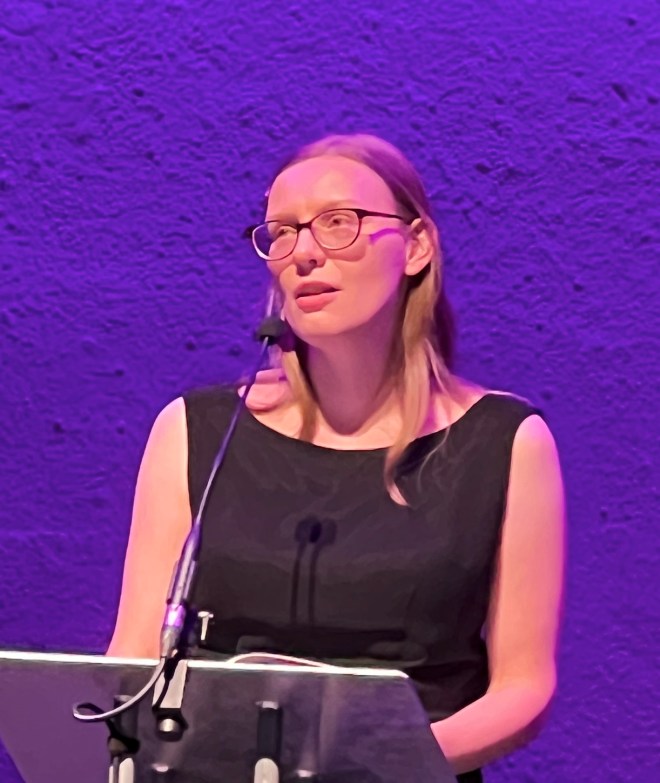
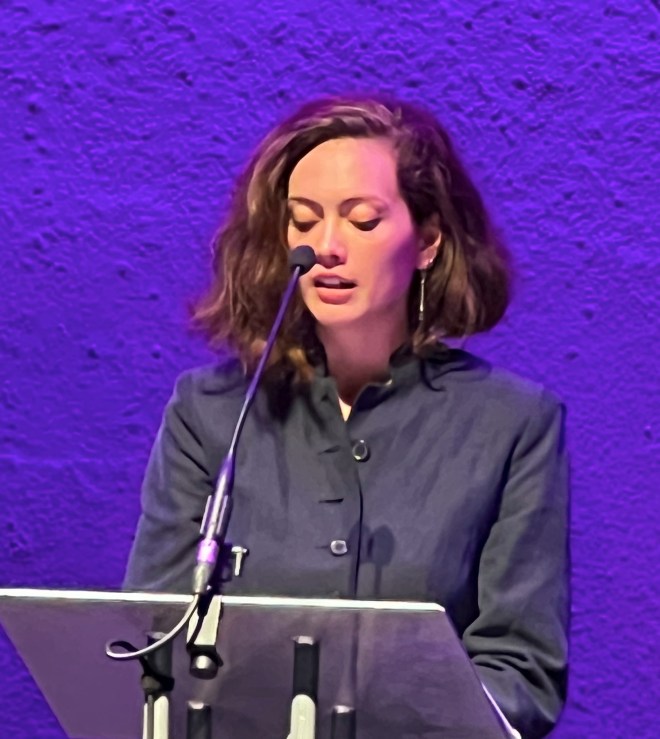
I was driving to London the night before I was due to speak with Jennifer Lee Tsai, Simon Maddrell and Neil Douglas, about different ways in which our personal experiences can also be inherently and creatively political. To get myself in the right headspace, I’d cued a London Review of Books podcast featuring So Mayer and Sarah Schulman. They are both distinguished, deeply committed writers and activists. Piloting my car towards the motorway, a huge, blood red sun sunk slowly below the horizon, as if to emphasise a world already on fire. Heading east, the light fell quickly, as dusk began to thicken the end of what had been a hot August Sunday. Sarah Schulman and So Mayer were discussing their two new books, The Fantasy and Necessity of Solidarity, and Bad Language, and how those of us who want to make a difference can try to do so.
With decades of civil rights activism behind her, including ongoing support of Palestinian rights, and within the legendary Act Up, Sarah Schulman’s position was that “the real challenge is to be effective”. I’d been re-reading Simon Maddrell’s and Jennifer Lee Tsai’s debut collections, Lamping Wild Rabbitsand Melete, together with Neil Douglas’s online pamphlet Ghosts of Former Patients,over the weekend, ready to introduce them, and speak with them about their work. When So Mayer said ‘In poems, words are actions”, I found myself nodding vigorous agreement towards the red lines of rearview lights streaming ahead.
When I read Neil Douglas’s work, I living alongside meticulously anonymised ‘looked after’ children he worked with as a community paediatrician, travelling across the sand dunes of Northern Africa ferried by traffickers, or delivering tiny packages of illegal drugs to middle class houses. With Jennifer Lee Tsai, I walked among Liverpool’s longstanding British Chinese communities, and followed the routes and histories that led them to build Europe’s oldest Chinatown, and become creative, world-changing players within our society. Plants grew up around me in Simon Maddrell’s worlds, and helped me feel and know how queer communities make and claim the strength and beauty of their beings in the face of ferocious adversity. By the end of the weekend, I’d been changed by the act of reading them and made different by the imaginative engagements their poems offer.
SAT 14TH SEPT 2024, BRIGHTON, EAST SUSSEX, UK. A selection of photographs of local poet Simon Maddrell. PHOTOGRAPHY BY DIENSEN PAMBEN.
The four of us go back. We’re all part of a very loose collective I set up eight years ago, through which people exploring complex materials work in solidarity with each other, whether offering feedback, insight, or support and encouragement in the face of challenges. Ours a delicate and subtle form of activism, whose processes are mainly internal, taking place within the individual creative members.
To write a poem is put together a puzzle. You have to figure out where to find specific words that can explore and dynamically engage with an idea, experience or thought experiment. Once you have done that, and arranged them, you have to see how they come apart, and are interpreted, and then put back together to be experienced once more in action.
To have some people to try out your poem-puzzle along the way is always helpful, to know if it working as you hoped it might. When the puzzle plays out, and the poem happens, as you will see take place over and over again with Simon, Neil and Jennifer’s work in these readings, the results can be mind-changing for the individual reader, as well as game-changing for how things we once thought we knew now appear new and different.
We really hope you’ll enjoy hearing Neil Douglas, Simon Maddrell and Jennifer Lee Tsai reading a selection of their poems that politicise the personal in different ways, and then hearing us briefly discuss their work together, thinking in particular about how the poem stages itself for the reader, and the role of research in forming work, available by following this link.
SAT 14TH SEPT 2024, BRIGHTON, EAST SUSSEX, UK. A selection of photographs of local poet Simon Maddrell. PHOTOGRAPHY BY DIENSEN PAMBEN.
Two or three years ago, on a warm, late summer afternoon, Simon Maddrell and I met on the South Coast of England, just along from Brighton. The sea was a flat lustre of gold and blues, barely moving, the tide beginning its slide out towards France. With the air tickled by the faintest breeze, we drank at a beach cafe, sitting on the shingle among barbecuing families, then set out with my dog Ithaca on a long, slow meander along Worthing’s gritty sand, skirting between tide pools, looking for hag stones and beach treasures for Simon’s Brighton garden, and flints and sea-shaped chalk for my desk in London. As we scanned and walked together, comparing finds, pointing things out to each other, the sea always beyond us, the sky huge and wide, we felt an ease of familiarity growing, recognising the mutuality our shared of experiences of London in the early 1980s, when HIV and AIDS were visited upon the queer communities in which we moved, and comparing notes on coming to write poetry in our fifties, and why each of us had needed time to arrive at voices that would hold our complex subjects. That conversation is still flowing. It is the greatest pleasure to bring some of our words to the page — as Simon publishes a long awaited debut collection, after a string of stirring pamphlets, on both sides of the Atlantic. The photos which flower between our words were taken by Simon Maddrell in their salvaged, cherished Brighton garden — from which many of the poems grow.
ah: Let’s start with the big news. Your debut collection, lamping wild rabbits,is published by Out-Spoken Press in February 2026, edited by the legendary Anthony Anaxagorou. Tracing the rainbow arc of your life, you begin by exploring being born queer and Manx at a time when homosexuality was still illegal on the Isle of Man (IOM). The poems ask how a person can be, and grow, if their deepest self not only is prohibited, but also punished in law? It’s still a live, and lethal, issue in many countries around the world. Is the personal inherently political for you?
sm: lamping wild rabbits with Out-Spoken Press is my best poetry dream-come-true. Anthony was the first poet/teacher to encourage me, even as he gently demolished six of my earliest poems at a Poetry School one-on-one session! (I looked it up; it was March 2nd, 2019). He has been a mentor and teacher of mine at various times ever since, so it was wonderful for him to be so effusive about my collection manuscript, and then to work with him to craft the final book. It’s such a privilege to be part of the Out-Spoken stable, and I hope its reception does them justice.
Talking of justice and the ‘personal as political’ –– our mere existence is political, and for too many of us, who we are personally is an existential threat. Of course, my personal existential threat is not what it was 40 years ago, but lamping wild rabbits shares some of that experience, and some who didn’t make it. Even if childhood traumas are personal, they soon become political e.g. how the social service system fails to support victims of child abuse.
It must be said that whatever existential threats I have endured, they don’t compare to the fears many trans women have walking down the street today; the ten miles that women in Africa walk for water daily to sustain their families; the 24/7 drones in Gaza that are even felt by deaf children, never mind the horrors that are inflicted upon Palestinians. The collection does reflect on these more collective threats, and I firmly believe that the ‘personal and collective’ are allowed to sit alongside each other, rather than in competition, or even comparison, with each other. There is neither competition nor comparison in these things.
When I think of the times of my youth, they are deeply affected by the Greater Manchester Police GMP) Chief Constable James Anderton and his assistant Robin Oake, who exported their homophobic policies to the IOM in 1986 –– harassment, entrapment, and inequitable law enforcement that cost lives. My youth was shadowed by these direct & indirect threats, like The Bolton Seven who were arrested & convicted for consensual sex, Anderton buying a cruise boat with a spotlight to catch men kissing under bridges on Canal Street, Manchester, him epitomising people with AIDS as ‘swirling around in a human cesspit of their own making’, and Oake’s illegal entrapment and forced confessions of gay & bi men in the IOM in the late 80s/early 90s (Brilliantly portrayed in the short film No Man Is An Island). I think when a serving Chief Constable says, as late as 1987, that “sodomy between males…ought to be against the law” it is difficult to not see the personal as political.
ah: Your opening poem strikes a sombre note, while simultaneously upholding a movement of hope and transformation. It begins
it’s as though we have to climb out of our damage up an invisible rope and apologise. a rope we’ve been carrying all our life
That determination to give witness, alongside a refusal to be defeated, appears central to your creative impetus. Is that how you experience it?
sm: I believe that ‘bearing witness and a refusal to be defeated’ are central to my life’s impetus, but only a part of my creative one, if I am understanding the question correctly. As will hopefully be apparent in discussing my pamphlets and the collection, I feel the central impetus to what I write is varied. Of course, as with most early-stage writers, I began with the autobiographical in the way your question describes. Queerfella was “my journey from shame to unashamed” and hence central to the creative impetus. One might say section one of lamping wild rabbits, ‘caged rabbits’, is just a better version of Queerfella, but I hope people experience it as more than that. I think at other times, the creative impetus is more subject-driven, whether that be queer history, queer biography, the ambivalence of an exile, or the Isle of Man as a place (even if, like Penny Lane, it ‘is in my ears and in my eyes’). Whether that does or doesn’t include my direct experience is just a consequence of how to best explore the subject, rather than it being central to it, or even necessary to it.
ah: Going back to you beginnings as a poet – your first publications were the pamphlets Throatbone and Queerfella in 2020. I believe they found their way into print along two very different pathways?
sm: Throatbone did have an unusual birth. The Raw Art Review, a Massachusetts magazine, published a couple of Manx poems in Summer 2019. In December 2019, I was shortlisted for their Poet-in-Residence. The editor, Hank Stanton, loved the Manx poems I had submitted, so I asked if I could pitch the pamphlet draft, Throatbone, in January, which he accepted (thanks also to the mentoring support of Anthony Anaxagorou). The Manx heritage organisation, Culture Vannin, funded 300 copies for me to sell over here –– I just sent the last copy to the British Library!
Joelle Taylor mentored me to improve Queerfella, but it was rejected by four publishers before eventually jointly winning The Rialto Open Pamphlet Competition 2020 alongside Selima Hill’s Fridge –– the latter being a particularly surreal fact.
ah: Since then, you’ve published The Whole Island and Isle of Sin, which grow out of the intersections of your Manx heritage and out and proud queer identity, and the history informing both. Tell us about these two books.
sm: Even though Isle of Sin was published first, in Feb 2023, it came as an overspill from The Whole Island, which I wanted to be an exploration of what I later realised was an ambivalence about the IOM, albeit an ambivalence of joy & sadness rather than love & hate. The central titular (but in Manx Gaelic) poem was inspired by Virgilio Piñera’s long poem La Isla en Peso, 1968. Whilst this is usually translated as The Whole Island, literally it means “the weight of the island”, which to me, more poetically encapsulates both poems. The Whole Island explores the ambivalence of a returning exile, rather than someone ‘stuck there’ but also explores the place, the island as a body, the body as an island. The Whole Island was funded by the Manx sister to the IOM Arts Council –– Culture Vannin, and published by Valley Press.
In embarking on this, I found myself also reflecting more on the dark days of the police harassment and entrapment of gay & bi men in the late 1980s. I’d done this in a poem sequence in Throatbone, but was now driven to transform that anger into activism and, to be frank, mockery. Consequently, I was involved in lobbying the IOM Police for an apology (they became the first police force in the British & Irish Isles to apologise for the way they treated people like me). This also coincided with It’s A Sin when I became aware of Manx actor Dursley McLinden –– who was one of the inspirations for Olly Alexander’s character, Richie Tozer –– and how he had been mostly erased from history (I performed at the launch of the first-ever queer exhibition at the Manx Museum and he didn’t even appear anywhere). After all of these diversions, I ended up with too much for a pamphlet, and as I didn’t want to do a first collection yet, I developed a manuscript for Isle of Sin –– including improved versions of the Throatbone sequence –– and approached Peter Collins at Polari Press who I knew was keen to tell queer stories.
ah: A more recent publication, on the thirtieth anniversary of Derek Jarman’s death, is the wonderful, intensely moving, a finger in derek jarman’s mouth, with Polari Press. How did this project come together?
sm: Derek Jarman is an overwhelming inspiration, not in the least because of his response to being diagnosed HIV+ and his ‘return’ to the coast and creating a garden out of nothing, which inspires mine. I re-immersed myself in Jarman, in particular his time (and garden) at Prospect Cottage, along with the Protest! exhibition at Manchester Art Gallery, plus the ones at The Garden Museum, London and John Hansard Gallery, Southampton. I found myself writing voraciously about him –– or perhaps more accurately –– about HIV, mortality and connection to nature.
a finger in derek jarman’s mouth was turned down by nine publishers (longlisted by only one) so I approached Polari Press about the idea of a series of three pamphlets over three years, with the third being Patient L1 in Feb 2025 (more of that later). I also knew that Peter liked the idea of doing a boarded-cover limited edition at some point, so I pitched that too –– we sold out the 130-copy limited edition before publication date, and Peter deservedly won the Michael Marks Award for Best Illustrated Pamphlet in 2024 –– for the cyanotypes that feature in both editions.
ah: If we ever needed someone to defend the values of persevering, and always trying another route if the obvious path is blocked, you would be that person Simon! Ideas of continuing, and persisting, and creating things which will resonate beyond our lifetimes are at the heart of your relationship to Derek Jarman as you have told us. In the last but one poem, ‘dear derek jarman’, you write
you refused to die without the sun rising without stones threaded and hung in a garden that grew out of nothing, without going quietly smiling in slow motion like an iceberg sinking from the sky, the ripples still licking shingle in a one-way tide.
These lines hold for me the coalescence of life in death, and life despite death, which contribute powerfully to the book’s magic. Could you say something about them?
sm: As I mentioned, engaging with Jarman is an exploration of mortality, and while you capture it, I’d perhaps say ‘life despite impending death’ and the reckoning with the truth that ‘impending’ is true for us all, not just those with a terminal illness. I think for me, life felt like a terminal illness until I accepted my queerness as a ‘gift’ (if that doesn’t sound too glib). Jarman helped me do the same with HIV –– “as if being banned and disliked is a pinnacle after all” (‘dear derek jarman’). I think ‘giving life’ is part of the human condition, and for queers of my generation, ‘offspring’ wasn’t an (easy) option, but gardens are! Perhaps, the older we get, the more we see life, like Dennis Potter’s whitest, frothiest, blossomest blossom that there ever could be.
ah: That’s a wonderful way of seeing things Simon. I concur, wholeheartedly, in full blossom! Thinking more into the connections between you and Jarman, refracted dualities are at the heart of a finger in derek jarman’s mouth, which adapts its title from Jarman’s collection a finger in the fishes mouth. You are, and Jarman was, both out and HIV positive with all the difference that three decades make in terms of effective treatment protocols. In speaking queerly with him, through blurred and echoed reflections and transmissions of his artworks across multiple media, was part of your intention to explore how, without invoking biological intergenerationality, we all live through and beyond time, through our enduring vibrations within the lives of others?
sm: I’m not sure I am capable of intentions that grand –– or that well-thought through, but now you say it, I do think that’s what the book does. I guess I’m primarily a practical man –– so decide to ‘do things’ wholeheartedly, and it is through that whole-heartedness that something deeper emerges, something you can arguably only realise or discover in hindsight, rather than plan for in advance. Also, if Jarman creates ‘enduring vibrations within the lives of others’, as I feel he does, then those vibrations are there anyway –– rather than requiring exploration, they need expression.
ah: By working so strongly through multi-gendered transitory experiences – flowers, gardens, weather, sex – the poems give off this heady summer heat, and with that the sense of being a memorial to a whole generation of people of both genders dying in the prime of life from HIV/AIDs before treatment became available. While Europe and North America saw a predominance of male deaths in the first wave, in Africa and beyond, gender was not a factor in transmission and infection. Was that an interest of yours?
sm: With a finger in derek jarman’s mouth being a tribute to Jarman then to me the focus of the book was to reflect his UK experience of HIV/AIDS, as you say “the sense of being a memorial to a whole generation”. But also, what he said and role-modelled in terms of confronting HIV stigma, and how that is even more important today.
But worldwide HIV/AIDS is absolutely an interest of mine. I get frustrated when queer people and organisations talk about HIV/AIDS as though it is a thing of the past. (For heaven’s sake even The Guardian refer to it as “Aids” for that very reason). It is still a global epidemic. Not only is HIV/AIDS a real, and growing, problem here, but it is even more of a problem in the USA due to lack of blanket access to medication, and even more of a problem overseas, especially in Africa. Africa has 50% of new infections, and the latest Trump attempts to block US-funded medication for Africa would be catastrophic.
630K people died of HIV-related causes in 2024. WHO is only targeting this to decrease to 400K by 2030. Can you imagine if WHO had said that about Covid?
ah: The physicality of Prospect Cottage, and the shoreline at Dungeness, moves like a blessing through the poems. They are good places where the reader can seek imaginative refuge, as Jarman did. At the time of writing you had yet to visit. How did you make the site feel so real?
sm: I am an island boy, and had also moved to Brighton in early 2020 with its shingle beaches. Like Jarman I collected hundreds of hag stones from the beach and hung threaded ones from trees, or on spikes, in the garden. A garden I was creating inspired by Jarman, albeit mine had four walls rather than none, and some of the jetsam is from the street not the beach! I also immersed myself in his books and the amazing derek jarman’s garden (Thames & Hudson, 1995). There was also a wonderful exhibition, replicating the cottage at The Garden Museum in London. The gateway technique, of course, is to focus on capturing the emotions of it all. The technical facts are easy in comparison, but still crucial as we are reminded in William Blake’s “holiness of minute particulars“.
ah: The photos you gave given us from your garden, which blossom through our conversation as moments of ecstatic, transient, green beauty enact what you say, Simon. More soberly, since COVID, the whole world has discovered what it’s like to become vulnerable to a new virus. You and I both remember the onset of HIV/AIDs at first hand, and its early ravaging of queer communities in the UK.
Like COVID, HIV/AIDS offers us the chance to look at natural evolution in the raw, with all its extraordinary potential for mutation. In ‘powered by HIV’ you write of
an overactive fuel energy from atomic cell destruction
Did this terrifying energy also run through these poems as a paradoxical creative source?
sm: I saw radioactive destruction as a metaphor for HIV and saw, as Jarman did, HIV as a creative energetic force –– driving the imperative to explore and accept mortality. Radioactivity is of course a paradox in itself –– giving energy, curing cancer and giving us a toxic legacy for generations, and in that it is not alone. In many ways, there are other ‘terrifying energies’ we face as human beings, especially the ‘others’ and ‘less powerful’ amongst us, and that certainly fuels what I want to say and explore. It is probably fair to say that the toxic energy and impacts of shame are very predominant in the collection, as is the power of redemption.
ah: Both energies pulse through the poems. You have mentioned that in Europe and North America the most deadly aspect of HIV/AIDS is the stigma that is still attached to it, and the consequent reluctance of people to come forward even when they suspect they may have symptoms, or have simply had an unprotected sexual encounter which should logically point to the need for testing. Could you say more about this perceived stigma, as the statistics, and their consequences, are something people need to be more aware of.
sm: I don’t think stigma is perceived, but there are two types– the stigma attributed and directed by others, and the stigma we impose on ourselves, HIV stigma, both of which negatively impact male suicide rates (and also female suicide rates in Scandinavia). According to a study published in The Lancet, the male suicide rate is five times higher than average in the first year after diagnosis and twice as high overall. Of course, we know how high male suicide rates are for men already (especially for those 18-30 and 45-60). The reason that the study concluded that the prime cause was stigma was that the rates were unchanged between 1996 and 2012.
I would argue it is the prime cause of the fact that more people are now diagnosed with HIV in the UK through heterosexual sex than ‘men who have sex with men’ (MSM), and even more crucially, why late diagnosis is significantly higher for straight men and women, compared to MSM (70%, 50%, 30% respectively). Of course, late diagnosis means that it is highly likely that more people have been infected per diagnosis, and that the risk of suffering life-long or life-threatening illness such as PCP is much greater. Someone died of HIV-related illness in Brighton last week.
Stigma was something that Jarman recognised, which is why he was the first ‘famous’ person to declare his status in late 1986. Greater openness is a key to breaking down stigma, but so are public attitudes –– hopefully helped by HIV no longer being a “lethal weapon” carried by those successfully managed on medication. In my own case, I realised in the 2-3 years after diagnosis that I risked being locked into another closet, and more so reinvigorating that ‘voice of shame ‘ telling me I was worthless and ‘being what I deserved’. To counter the championing of openness, it is important to acknowledge that English Protestant culture, and many of the other cultures here, don’t really approve of talking about sex, and the fear of being considered queer is more prominent than one might expect.
ah: In the ‘feral rabbits’ section, a short sequence of sexy, razor-sharp, poems rush the reader into a space from which safety abruptly exits. We get to feel-along with what it might be like to find yourself with an HIV positive diagnosis. How did these poems come together? They feel brave, intimate, and honest, but also deeply crafted and deliberately made – acts of beauty that refuse shame.
sm: I’m really pleased that is how you read and saw the poems. The three poems, ‘Private Members’ Club, ‘The first sex party…’ and ‘Did he…?’ were originally written as a triptych (I honestly can’t remember why they now aren’t!). I wrote them over a relatively short time period, but ten years after my diagnosis (and after a finger in derek jarman’s mouth, which may be relevant or significant). For years, I’d found it impossible to write about the specifics of my HIV contraction or diagnosis, or about navigating the trauma. There are so many pitfalls, and at least three mineshafts to fall down — and I know you’ll forgive me, but I won’t name them as they do not warrant being ‘invited in’ for scrutiny. Those three poems were definitely the hardest poems to write in the whole collection, so it makes me very proud when you, and especially you, say they are “deeply crafted and deliberately made”. They were poems I knew I had to write, there would have been an elephant-sized hole in the collection without them, whether anyone else would notice or not.
ah: More practically, would you be able to share a few words about your experience of being supported by healthcare providers on this journey, in the event that someone who reads our conversation is fearful of being judged if they come forward for testing?
sm: HIV doesn’t discriminate, and neither, almost without exception, do healthcare professionals, who are also bound by professional confidentiality. Self-test kits are now available, albeit I would recommend going to a clinic if you feel there is a high chance of diagnosis so that you get the excellent support they offer. I have taken PrEP twice, which you usually get via A&E rather than the specialist health workers –– on both occasions, I was thanked by the doctor for coming in and taking it. My dentist didn’t bat an eyelid and I am unaware of any actions they take which make me feel stigmatised (e.g. the ‘end of day appointments’ of yesteryear). I had my ear pierced the other week and I told them. The response? “Oh, that’s fine! I don’t think we are even allowed to ask you that nowadays! It makes no difference, but thank you for thinking about it.”
ah: Life lived alongside HIV is also a theme within the poems that you have co-created through conversations with actor, activist, artist and tailor Jonathan Blake. They have so far been published in your Polari Pamplet, Patient LI, which you and Jonathan have performed from together, but this is just the beginning.
sm: In 2019, I approached Jonathan Blake (who was played by Dominic West in the film, Pride) about writing his life story in poetry. He was diagnosed with HIV in 1982 ––known as ‘Patient L1’ at London Middlesex Hospital. He is now 76 years old. I have done over 50 hours of interviews with Jonathan and I also have access to 4.25 hours of interviews done by the British Library in 1991.
Thanks to Arts Council England, Polari Press published a pamphlet version of Jonathan’s story, Patient L1, in February 2025. Jonathan read poems at the launches, which included found poems from a journal Jonathan’s partner of 39 years, Nigel Young, wrote on a holiday in April 1985. The poems went down so well, we published, under Nigel’s Septum Press, Jo & Ni Go Cruising in July 2025 –– thanks to Andrew Lumsden’s Grand Camp Maisie Fund.
Work continues on the full book, which is a mixture of prose in the writer’s voice and verse in Jonathan’s voice, provisionally entitled, The Life of Jonathan Blake in Twelve Acts –– with a Prologue, Interlude & Epilogue. Its length and complicated categorisation will make finding a publisher difficult, but sure we’ll get there.
ah: I have both books, and cherish them. I also really valued hearing you and Jonathan Blake reading the poems together. His story, through your and his words, in both of your voices, is a compelling and miraculous enactment of what co-creating can engender. That’s a pleasure to come, but let’s close for now with lamping wild rabbits. Having had the privilege of reading a press proof, I know that ‘dead rabbits’ is the last section, albeit that these poems are uncompromisingly full of life. Tell us a little more about them, and also what leads into this final act.
sm: Death, and hence mortality, is such a taboo, but I find exploring it strangely reassuring. For me, I can’t have lived through the last two years without meditations on mortality broadening to what it is to be human, broadening into considering the deaths that we are seeing every day –– especially those under the shadows of war crimes & genocide.
lamping wild rabbits hinges or pivots around the central ‘dungeness rabbits’ –– a tribute to Derek Jarman’s responses to his HIV diagnosis, with nine poems from the pamphlet. The book begins with ‘caged rabbits’ –– arguably a better version of Queerfella escaping shame and embracing freedom while ‘feral rabbits’ confronts the trials and tribulations of escaping the ‘domestication’ of sexual oppression. ‘wild rabbits’ is my response to HIV, inspired by Jarman connecting gardens & nature.
I’m excited about it. Outside of the Jarman section there are only seven poems from my pamphlets leaving over 50 poems –– half of which have never been published anywhere else.
ah: I know that readers will be as blown away by them as I have been, Simon. For people who want to order a copy, or attend a reading, the links are here.
Preparing to speak with Tamsin Hopkins about bird of winter, alongside new projects, for Red Door Poets on Sunday 30 November,(you can watch our conversation here) I’ve been thinking about art-making as a healing energy, and a source of agency that can generate transformative encounters between the maker and the work, and the work and the world. It made me realise how much I have received, and continue to receive from the voices around me, whether on the page, in person, or over the airwaves – as with the recent, riveting, brilliant documentary, Ladies First, about the first generations of Black African American women claiming their voices through Hip Hop.
Paul Tran and Chen Chen are two poets whose practice and fierce, sometimes fiercely funny, creativity inspires and informs my own. Ahead of my conversation with Tamsin, I wanted to share my review of how they define and document complex events that have been visited on them, their families and their wider communities, while simultaneously refusing to be defined or diminished by energies that had their origins in acts of intended harm. The text of the review follows:
Near to the end of All the Flowers Kneeling, a segment within Paul Tran’s long poem ‘SCHEHERAZADE/ SCHEHERAZADE’ reflects: “Reap. Pear. Pare. Aper./ These are versions of the word// I won’t say the word/ without which there’s no speaker.” Recognising and articulating this paradox is central to the work of change Tran’s poems perform. Defining, but refusing to be defined by, traumatic experiences is equally a live issue in Chen Chen’s Your Emergency Contact Has Experienced an Emergency. Audacious in their uses of form, and possessed of a fierce sense of mission, Tran’s and Chen’s new works have in common a doubled structure exploring overlapping generations of trauma. Compellingly readable, each collection also arrives at a new relationship with their core materials through a redemptive turn into the once rejected or diminished body-self.
Giving witness to two sexual assaults, and multiple historic acts of violence, Tran’s All the Flowers Kneeling is nonetheless a freedom song. ‘Victim Report’, then later ‘Progress Report’, direct our path forward. The larger healing work is also shaped by the Buddhist tenet that nothing is fixed. Structured as four segments, the first part of Tran’s debut centres around “my death in that room without sunrise” on “the night before my twenty-first birthday”. It also holds a partial account of what happened to “my mother/on her knees” fleeing Vietnam as a young woman. “Her silence demanding mine” means neither adult-child nor parent can speak fully what was done to them:
My mother disappears whatever blights her the way she now makes her living: altering and tailoring the story
as though the truth were trousers to be hemmed.
Tran’s second segment opens with “my father”, who “lives alone”. He is similarly haunted by the Vietnam War. Driving his 93 Mazda MPV: “We sail I-15 South as though it’s Thu Bồn River,/ flee Hội An’s cinnamon forest barricade, viscera-flooded streets/ American soldiers peeling his house apart, straw by straw.” Formally recording the separate traumas which continue to entrap their parents, enables Tran’s voiced self to recreate on the page the place in which their own mind was caught. We the readers feel it with them: “the right hand placed over my mouth/ while the left hand held me, held me// there, held me down”. Refusing silence generates a shift into agency. ‘Winter’ retells the fable of a Buddhist monk and his mother which leads the speaker to understand that “She left me behind in// Hell, where I had to find a way to save us both.”
Transformation takes root through a Buddhist metaphor of rebirth within Tran’s third segment: “I had to keep on/ Remembering the desert wind, the flames that broke into and broke open// This body, that released from me another me, another”. These flames seem at first reading to be the sensations experienced when “A man seeded me without consent”. They become also the successive selves arising from living beyond this event, and the artworks these evolving selves make. Tran afterwards offers the image of a desert blooming “after decades dormant […] a sea of gold and pink and purple”.
The final segment begins with ‘Enlightenment. It reveals “I close my eyes to open them” and celebrates “coming/ back from the dead”, most gorgeously in the poem which gifts the collection its title. Named for California’s “desert wind”, ‘The Santa Ana’ rejoices in the full flamboyance of self-created, trans life:
How far we have travelled towards “sunrise” is registered in the same poem’s “Pop quiz: who’s that bitch?” The answer can only be: “That bitch,// bitch. That’s me/ looking at myself/ for the first time!” Queer gorgeousness as a radical, political act is also at the heart of Your Emergency Contact Has Experienced An Emergency. Written during Trump’s presidency – “endorsed/ by the KKK” – and the pandemic, Chen Chen’s second collection documents the double assault of coming of age in an America, some of whose citizens publicly denigrate Asian Americans, while at home your parents deny and endeavour to change your queerness.
Chen’s poems confront head on the fearfulness that living in a frequently hostile environment may exacerbate. ‘The School of Fury’ recalls “my father almost getting arrested for trying to retrieve his son” as a result of having gone to “the neighbor’s door”, rather than that of Chen’s friend, at the end of a play date. This occurred not long after the family had arrived from China, but such incidents are shown as continuing right up to the present day, and possibly contributing to the harshness with which Chen’s parents enforced what they perceived to be a protective conformity.
‘The School of Red’ recalls being “struck” on the face, aged fourteen by his mother, for saying “I think I like girls/ & boys”, and afterwards being told for many years “never” to tell his brothers, or any other family, about his queerness. ‘I Invite My Parents to a Dinner Party’ is a brilliantly funny, and bitter-sweet, enactment of the slow process of change, and the deep family love that enables this. Chen does not turn away from how he likewise absorbed self-hostile beliefs. ‘Winter’ remembers “my first boyfriend” approving my “not really chinky eyes. The way I said, Thank you.” and “my third boyfriend, how he liked to call my dick an eggroll, proudly called himself a rice queen.”
What strengthens Chen to resist and make different are the qualities for which he was persecuted and diminished. From ‘Every Poem Is My Most Asian Poem,’ to multiple segments in untranslated Mandarin, to a celebration of his mother’s rocking a three-sweater-look, Chen affirms how where he hails from nourishes and roots him. Aesthetically as well as personally. Similarly, he shows how he writes out of the life-givingness of queerness, and his committed partnership to “my Jeff, who fixes the computer, who fixes us dinner, fucks my face et mon ȃme”.
Sounding a note of jubilant defiance, ‘Ode to ReReading Rimbaud in Lubbock, Texas’ plays out “my poetics of deepthroat & tonguefuck”. Their chant is “Let’s holler, troublemongers. In the/ lick of many summers”. The last poem is ‘The School of Joy’. It closes the collection with Chen’s hand refusing exclusion and making instead
From October 2028 – seven years now, and counting – I’ve been part of a loose affiliation of poets who work with complex materials. Drawing together our earliest members, my hope was to create a group whose participants would co-resource each other. I wanted us to collaborate creatively, and editorially, but also offer mutual support – especially where confidence and courage, and above all, tenderness, might be needed. What we had, and still have, in common was knowing that we were working with materials that had the potential to be dangerous to us, and to each other. Together, we enact our shared commitment to go gently as we allow new work to take shape. Many of us work with our individual experiences as starting points to travel outwards towards the world, and inwards towards the wider histories and geographies that have embedded themselves within our spaces of being and are ask to be spoken to and of.
While work always originates with the maker who creates it, since that autumn evening in 2018, many collections, and pamphlets, including my own debut bird of winter, have gained strength and momentum through being brought, one poem at a time, to our group’s monthly meetings. We started out above the Poetry Café in Betterton Street in Covent Garden, then moved to the foyer of the National Theatre on London’s Southbank, waiting for the audiences to take their seats before getting down to our feedback. Having gone online during the pandemic, we have stayed there ever since, freed from geographical restrictions.
In different ways, all of us have been nourished by the conversations around process, and working practices, which open every session. The privilege of meeting each other’s works in progress, and giving them our careful responses, has been powerful and generative. Natalie Whittaker, Wendy Allan and Mary Mulholland have all engaged at different times with the group. When I heard they were planning to share a reading at The Poetry Café, I was thrilled to be asked introduce them. It seemed like a true celebration to hear their work and voices out loud and proud, two floors down from where our group began.
The evening didn’t disappoint. In fact far from it. Going to places where many might fear to tread, Mary Mulholland, Wendy Allen, and Natalie Whittaker make poems to hold the central acts of our lives. Through their words, we live, love, bleed, heal – and meet life towards its endings, as well as its beginnings. The audience’s warm engagement with their passionate, wry, fiery readings, and the conversations we had about the poems following on from them, made me want to share something of that evening with a wider audience.
What follows are my introductions, and videos of Mary, Wendy and Natalie reading their sets, which they filmed individually at home afterwards. At the time publication, Wendy’s was still on its way. The blog finishes with a question from me for each of them, engaging with a theme that’s central to their practice. I’ve also included the all-important buy-links within the titles of their books, so you can go deeper, and support them, and, the publishers bringing this essential work onto the printed page and into beautiful bound volumes.
Mary Mulholland reading at the Poetry Cafe.
A few words about Mary Mulholland, now, before the video of her reading. Her first two publications were both collaborations with Vasiliki Albedo and Simon Maddrell, published by the inimitable Nine Pens. All About Our Mothers led the way, with its logical sequel,All About Our Fathers, following. Both acid-sharp pamphlets. Her first solo pamphlet, the wonderful, not entirely woolly, What the sheep taught me, then came out with Live Canon in 2022. Most recently the elimination game, published this year by Broken Sleep. Rebecca Goss hailed it as “an illuminating, fearless study of the rich intricacies of female life”. Beyond Rebecca’s tribute, Mary Mulholland is widely published. More recently her poems have appeared in 14 magazine, Anthropocene, Stand, and are forthcoming in Finished Creatures. Mary also founded the generative and nurturing, live and online gathering, Red Door Poets, and is Editor of The Alchemy Spoon.
Speaking more personally, for me one of the delights of Mary’s penetrating poems is how they encompass adventure and irreverence as life-giving energies, but then move in a heartbeat to questing, questioning vulnerability. Time is folded and unfolds itself from moment to moment, as we move from a “kohl-eyed girl in a purple kaftan” to a “bronze age mummy” smelling of “honey scent and sweet bark”. Elsewhere an older woman enters an arctic whose cold “takes her back to childhood,” only for the mood to shift again as we come upon “a cluster of Parisian grandmothers” who are “elegantly chatting and laughing”, entirely oblivious to their charges’ high risk play choices.
Here’s Mary Mulholland’s ‘Woodstock’ from the elmination game as a bonus.
Our next reader was Wendy Allen, who shot, more or less fully formed, into the poetry firmament, after a first career in aviation. Early on, Caroline Bird hailed how “reading Wendy Allen’s poetry makes me realise there is a precision to the erotic, every line feels like a held breath.” Wendy’s debut pamphlet, Plastic Tubed Little Bird, was published by Broken Sleep, in 2023. She has since collaborated with Charley Barnes on freebleeding(Broken Sleep 2024) and Galia Admoni, i get lost everywhere, you know this now (Salo, 2024). Most recently, we have Portrait in Mustard from Seren. All are magnificent, and unmissable. Wendy’s currently in the final year of her Creative Writing and Art History PhD and is a tutor in Contemporary Poetry at Manchester Met.
Wendy Allen reading at the Poetry Cafe.
I love how Wendy’s work is centred on, and translated through, the variously fertile female body, and its desires, and despairs, often calibrated relative to made artworks and consumable objects. In ‘Apricot’ the narrator ends up inside the said fruit only “the stone is missing, and I am/ curled up in the pit where/ time should be.” Moving through such landscapes, Wendy’s poems creates a magic lantern play of shadowed and projected selves. They rise up and deliquesce away, even as their “nipples tiara against an/ endlessly repeated new-start sky.”
Finally, our third reader was the extraordinary Natalie Whittaker, celebrating the launch of The Point is You Are Alive, her heart-stopping first full collection which came out with Broken Sleep in April this year. As many of you know, Natalie writes with a spareness and precision that allows her poems to vibrate with imagistic intensity. Writing for the Poetry School, Jonathan Edwards admired the way “elegant sentences and striking images cast enormous shadows, conjuring something much bigger than themselves.”
Natalie Whittaker reading at the Poetry Cafe.
Integral to the work she makes are Natalie Whittaker’s roots in South East London. A poet and teacher, she is the author of two stunning previous pamphlets: Shadow Dogs, published by ignition press in 2018, andTree, published by Verve in 2021. Natalie was also a London Library Emerging Writer from 2020 – 2021.
Deeply embedded in landscape and place, Natalie’s poems often ask us to see visually, as a starting point to participating in an act of shared perception. In SANDS, facing the loss of a child, “it is November I steer headlights through drizzle / pull up outside a church that’s switched off”. Earlier, there had been a “ghost dog […] beneath the ice”. Finally, and redemptively, comes SPRING “in a contagion of blossom/ a pink blooming pandemic” – where, paradoxically, life can start again.
To close, the three questions, which transitioned us from the live readings into a wider discussion with the audience. It’s always so powerful to hear poets speaking about the making and thinking of their work, bridging the gaps between the creative energy as it first came to them, and the shapes it forms on the page.
Firstly, a question for Mary Mulholland.
ah: You’re a savagely witty, wry writer in a way that is pure delight for your readers. Tell us about humour as a lightning rod shooting us deep into the complex heartlands of your work? In short, why so wry?
MH: I suppose I find people behave in funny ways. The disjunct between what they say and do. Our secret lives. And life/ fate has its own sense of humour, which is not always kind, but perhaps serves as a reminder that things are always changing. I never set out to be funny so I guess it’s ingrained – I have a fairly existential approach. Life’s taught me there’s much that one should not take too seriously. Seeing the ridiculous or ironic in difficult situations can ease the tension and laughter is infectious, it connects us, releases endorphins, transforms, breaks through, like shining a light in the dark.When my father who was so sharp and accomplished developed dementia, the subsequent crazy conversations we’d have ironically enabled me to get to know him better, as if a lid had been lifted from his controlled way of being. It’s irony mainly that I enjoy. Humour is a bit like playing with fire. Of course not everything can or should be laughed at, but without humour life would be very heavy going.
ah: Wendy, as you write her, the female self is infinitely expansive, imaginatively, physically, and aesthetically. Also witty, and hungry. Tell us more about working through seemingly individual female experiences as portals to something much larger. In short, why so radical?
WA: Why so radical? A conversation.
Dear alice, Mary, and Natalie,
I’m writing this at the onset of my period. I am so tired I feel like I’m filled with lead.
You may, at this point, be questioning why you need to know this. You need to know this because I write what I am, and what I currently am is a body about to bleed.
I have just started teaching at a university, and one thing I repeat to my students, is the value of feeling the poem – to understand our bodily response to the poem – to its visuals -to its (the poem’s) body.
Recently in the news it has been reported there has been research into how visiting a gallery and looking at art is beneficial to our health.
I think the same about looking at the poem.
I love looking, and by that, I mean really looking, at poems, just as I like looking at my menstrual cup, just as I like looking at the sculptures of Barbara Hepworth (and we all know I like that).
My poetry is not a book of hidden desire. It doesn’t mute desire or mask its own pleasure. All my books speak of desire with pride. They paint desire on a huge canvas and make pleasure so large that when you walk past it in the gallery-that-is-a-book, you are unable to not see it. The fact that sometimes, my poetry may provoke a response which questions its necessity, simply highlights that there is a need for this. I think of Eileen Myles here. I love writing like this.
In answer to your question, alice, why so radical? Because it makes me sad when I see bestselling books of women sharing their fantasy as a hidden desire. In Portrait in Mustard (Seren Books, 2024) the speaker of my poems uses poetry to display her pleasure, her disappointments, her sex as her art. She wants to flaunt this –
In April 2024, I attended the For Art History conference at York University. On the final day there was a panel on the work of Art Historian Griselda Pollock, and at the end, Pollock gave her own response to the papers.
I will never forget that in her introduction to the lecture, Pollock acknowledges the work of the panel but raises the point that her work’s impact should not be viewed as a singular, rather, because of the community of women she worked alongside, whose belief and desire for change, collectively changed feminism in art history, and the wider sphere. Radical practice involves collaboration. It is incredibly important to me to address this notion of change through my poetic practice.
At the recent reading at the Poetry Society in Covent Garden with yourself, Mary and Natalie, our conversation reminded me that collectively, we can achieve so much. Our practice may differ, our poetry may be thematically different, but when we are together, when we share our work and engage with each other, as we do within our Stanza community, that, then, is where the change happens. That is where we are at our strongest.
Wendy x
ah: Natalie, your collection holds some tough material, around societal harms, and the profound loss of stillbirth. At every turn, though, your poems pulse with fierce life, and an intensity of being that sees off their darknesses. In short, where does the joy come from?
NW: The joy comes from writing poetry; the joy of playing with language and experimenting with form. Even though the subject matter of my poems is often something that has troubled me in some way, there is usually a real joy in the act of writing a poem. The ‘Tree’ sequence is an exception, as I can’t honestly say that I ‘enjoyed’ writing those poems. But there’s a different sort of joy in those poems; a slow-burning joy that comes from transforming painful experiences through art, and the joy of sharing my work with others who may be going through something similar.
Every city we travel to, we meet a new version of ourselves. Meantime, the city becomes a different version of itself through our eyes. That was certainly the case for me when I arrived in Newcastle on 9 May, the day of the train strikes. With all the dazzle of fresh green growth, and light, bright clothes, summer was coming in a sudden rush of heat, that caught us all half unawares. Confirming the sense of a new world, York station, normally a constant to-ing and fro-ing of trains and passengers, was all but empty. Under a blue sky, cafes were closed, the lines and platforms silent, as I waited for my connection.
Newcastle itself was alive and bustling once I left the station and walked along the Tyne. The hotel the Newcastle International Poetry Festival had booked me into was directly opposite the glamorous 1930s Baltic Arts Centre. The air felt warm and tender, the river was quiet and glassy, the passersby lingering over drinks on waterside terraces. With a sense of adventure, I left it all behind to head uphill to Newcastle University, and the Northern Stage venue. Walking through the layers of the town its history was written in its built structures, from solid Victorian municipal buildings to Sixties and Seventies car parks and office blocks. Buskers turned the long shopping streets into layers of sound that inscribed the always changing present moment.
Millennium Bridge, Newcastle.
To enter the Northern Stage venue, where the Newcastle International Poetry Festival was taking place over three days, we had to pass alongside the student encampment, protesting the genocide being committed in Gaza, and the larger international and institutional complicities enabling this. It felt right and necessary that Abigail Parry, who joined Jane Clarke for the T.S. Eliot Prize Reading, to close the first day, directly referenced the huge disparity between our security and comfort within the theatre, and those co-inhabiting the planet with us who are denied a place on our ship of plenty. These thoughts and images were in my mind as I walked back after eating with the festival poets. The party streets of Newcastle were unfurling nights of summer hedonism and along the jet black Tyne where the Millennium Bridge formed a shark’s mouth of rainbowing colours.
Occupation Camp, Newcastle University, Photo by Anita Pati.
Wanting to prepare both for the workshop I was running on the Friday, about colour as a conduit and energy portal, and my own reading on Saturday, exploring healing beyond childhood trauma, I sat on the public deck of the Baltic Centre in the quiet of early morning, looking out across the Tyne, and seeing the seaweed exposed where the tide had flowed out. Built by Rank Hovis from the 1930s as a flour mill and huge grain silo, it once stored 22,000 tons of grain. Now a community and arts space, the Baltic Centre held within its built structure the memory of the 300 workers employed there during its 1950s heyday. Back then, it was only one of several silos and grain stores along the Tyne. As I looked across the water, shimmering with reflections, to the cafes and bars on the far side of the river, it was impossible not to think of the acute need for grain and foodstuffs in Gaza, and other parts of the world afflicted by shortage and famine.
The changing presences of history made themselves felt again during the Newcastle Poetry Festival’s readings for that afternoon, when Kit Fan and Jennifer Wong spoke of what it meant to them to have grown up in Hong Kong, and the almost unimaginable shifts currently underway in that city. Chaired by Festival director, academic and poet Theresa Munoz, they were also reading poems and speaking with Troy Cabida, of the connections arising from their shared heritages, discussed in the interview exchanges of State of Play: Poets of East and Southeast Asian Heritage in Conversation. Having bought the book at the excellent Poetry Book Society bookshop upstairs, I read it all the way back on the train to London, and warmly recommend its paired conversations between poets and writers.
Closing Friday evening’s performances with her longtime friend Carol Ann Duffy, Imtiaz Dharker shared work from her new collection Shadow Reader, noting how “the map of this country/ is made of scars” and asking “can the writer be forgiven/by the one who is written?” Over dinner, in a former monastery, with stone walls, and high, beamed ceilings, I talked in depth with Jennifer Wong and Marjorie Lofti on the impacts of displacement and childhood trauma on the adult self. We were agreed on the need to tread carefully in adulthood, and recognise the vulnerabilities that necessarily remain. Having read and loved the collection, I was also able to tell Marjorie how much I appreciated her debut with Bloodaxe, The Wrong Person to Ask, exploring her childhood flight from the Iranian Revolution, and what she witnessed before her family was able to leave.
On Saturday, for the Royal Society of Literature lecture ‘Nostalgia: Architectures of Longing’, poet, musician and academic Anthony Joseph spoke accompanied by photographs he had taken of the Caribbean. Approaching from multiplying, interconnected angles, he used the images to explore the process of becoming conscious of your separation from your place of origin as a pre-requisite for being able to comprehend it creatively. Joseph’s Sonnets for Albert, which takes the death of his father as its starting point, was one of my most revelatory and moving reads of 2022. I shared poems within my Newcastle workshop. It was therefore even more of a gift to hear Anthony Joseph remember his own arrival in wet, April London, and the resonance of this shift within his subsequent creative output. He explained “you don’t become a Caribbean person until you leave the Caribbean”, but that “this liminal space is full of uncertainty, where the work of being occurs.”
Anthony Joseph: Nostalgia, Architectures of Longing, Newcastle May 2024.
[‘Finding New Flight Patterns: Healing Beyond Trauma’ talk given by alice hiller at Newcastle Poetry Festival, 2024, photo by Anita Pati].
Thank you for inviting me to this beautiful festival and city. It’s a real privilege to celebrate Pavilion’s founder Deryn Rees-Jones, Alison Welsby, of Liverpool University Press, and of course my wonderful fellow poets. Like everyone on the Pavilion list, I value how gently Deryn holds the radical risk-taking and uncensored experimentation which is integral to our hatching new work. In bird of winter, Deryn guided me to bring together a collection which directly addresses the global crime of childhood sexual abuse, and its long aftermath – but also documents creative paths towards healing and reclaiming ourselves.
As some of you may know, I was sexually abused by my mother until I turned thirteen, in 1977. Incorporating both that hurt, and my recovery beyond it, and paying tribute to Hannah Copely’s brilliant Lapwing,my reading’s structured around the bird poems of bird of winter. With an emphasis on hope, it’s titledFinding new flight patterns: healing beyond trauma.
As we share this space, I would ask you all to keep in mind the ongoing genocide in Gaza. Let us stand in solidarity with the Palestinian people, and the occupation encampment honouring them outside the Northern Stage, looking with them to when they will regain their territorial freedom and autonomy.
Whatever our histories and circumstances, as humans we instinctively define ourselves by what we love, not the injuries we may receive. Connecting with where we feel joy can help us recover our agency, and resilience, no matter the challenges we face. Reading my bird poems, I’ll focus on how they were created as acts of beauty and care for my younger selves. Linking them to larger patterns and processes of art-making and art-sharing, I’ll also show how I wanted to change the energy around difficult times which they record, and my relationships to them.
I’m going to be talking about complex subjects, but I’ll be careful to keep us safe. From the start, birds are at the heart of the collection’s voicings and transformations. They appear in the first poem, ‘o dog of pompeii’. Going in search of the dog’s buried howl, we enter “my mother’s house where the garden/ hides dark sheds hung with limp pheasants” and “the dead eye of the bird bath/ looks up but sees nothing”.
This is rural Wiltshire during the early 1970s. I was nine, and being regularly raped. In their stillness, and apparent lifelessness, these pheasants offer images of my child body in my mother’s bed. But they also hold the possibility of flight in their folded wings, linking into a long tradition of representing the soul as a bird. This reaches back at least to Ancient Egypt, whose treasures nourished me when I discovered photos of them in books at my primary school.
‘o dog of pompeii’ was the second poem I ever wrote. Although it wasn’t consciously planned, as I continued to work with the darknesses of my childhood experiences, I found that more and more birds kept flying in. A robin took my place in ‘the holly tree’, which responds to my homelife while I was learning about the pyramids and Pompeii.
An Easter chick helped me record where I hurt during, and after, those nights in my mother’s bed. It also registers how very young and vulnerable children remain, when adults injure them, and how this experience colours every waking moment, and follows them into their dreams.
Shaped visually like a clutch of eggs, ‘cyclical/ house of the cecii’ is structured on a rotating axis. I wanted to reflect how it’s always open season for sexual abuse, but also claim the poem’s place in the tradition of works that turn with the year. The interleaved text, of a hunting scene fresco from ancient Herculaneum, links the collaged images to the tradition of art that records the hunting of prey. This reaches back to the cave paintings that I also learnt about at school. Looking back on those times, I have understood how crucial the sense of adventure, choice and growth implicit in learning were to helping me retain a sense of myself notwithstanding the abuse. They also resourced the art-maker I have become, laying down places of resonance to which I could return.
If birds are emblems of hurt, they can also provide markers of healing. My poem ‘bains de mer’, meaning literally ‘sea bathing’, remembers the Normandy holidays I spent throughout my childhood with my French bonne maman or grandmother. Celebrating the two of us us heading down to the beach below her clifftop house, to swim together at high tide, she is “eighty-four your robe zipped/sure-footed as a penguin/ me your chick kept close”. Every day that we spent together, Bonne Maman let me know I was loved, and through this anchored my identity and sense of self, helping me to withstand the crime my mother was committing against me.
There was a limit to Bonne Maman’s protection, however, as she lived in another country. A couple of years later, birds in a snowy English churchyard near where I lived with my mother in Wiltshire, gave me another freeze-frame image of myself while the abuse was ongoing.
Aged twelve and a half, in the icy winter of 1976-77, I was becoming able to see in ways not possible when younger. ‘snowfall’ dramatises the moment of revelation, something like the separation that Anthony Joseph identified in his lecture, that would allow me eventually to “speak winter”. The mood music comes from Breughel paintings of snow scenes. I remembered them from Brussels, where we lived until my father died when I was eight, and where my Bonne Maman continued to live when not by the sea in Normandy. Breughel’s tiny, busy figures suggested the persistence of life – as mine returned. The painting below is from the Brussels Royal Museums, and is titled ‘Winter Snow with Bird Traps’ by Pieter Breughel.
A much darker experience had precipitated ‘snowfall’s’ moment of seeing. It is recorded in other frozen birds, naked “plucked pheasants” held within my mother’s house, in the poem ‘december 1976’. The poem is preceded by the epigraph “seize your slave girl whenever you want it’s your right”, taken from Roman graffiti in Pompeii:
On the night of 24th December 1976, my mother had claimed that my visiting uncle needed my bed, rather than sleeping on the couch in the living room. This meant I had to sleep with her after the carol singers had left, leading to the poem’s feeling of heaviness and soiling the following morning. I wrote the first draft of it in a workshop run by Sarah Howe, also attended by Mary Jean Chan, and it came to me with the sung quality of a carol of the unspeakable. Because the subject was so painful, the beauty and control of the long open syllables and child-like images – threading stars through the prickly branches as an image for the rape that occurred – gave a measure of safety to their holding.
I went back to boarding school when the holidays ended, and after seeing the birds in the churchyard, and myself within them. Come the Easter holidays of 1977, my mother used a short holiday to Stranraer, in Scotland, to make me share a bed with her again. Aged nearly thirteen, I finally saw a way out, and decided to stop eating, and refuse her. By that autumn my weight had dropped to 28.5 kilos, or 4.5 stones and I was hospitalised. ‘primary or classical anorexia [1977]’ revisits this experience through a sparrow child. Like call and answer birdsong, it grows from two merging voices.
The more authoritative voice paraphrases Obesity and Anorexia Nervosa: A Question of Shape, published by Peter Dally, who treated me. Fortunately my main doctor was Peter’s less conventional, more compassionate ex-wife, Ann Dally. She recognised the risk my mother represented, though I wasn’t able to speak directly about the sexual abuse. Remembering Ann’s daily visits, the pill-shaped title poem, ‘bird of winter’, learns from a chaffinch that the possibility of being heard can support healing.
Ann Dally made it a condition of my release that I couldn’t live full-time with my mother after leaving hospital. During the school term, I was taken in by relatives in London. I began ordering Spare Rib and feminist zines, and going to the cinema and the theatre, and to free art galleries. I was connecting myself to the conversations of consciousness-raising, and art-making and sharing, and being nourished and transformed by them. Bonne Maman had encouraged me to engage with all forms of artworks from when I was very small. The next poem pays tribute to her and her magical flat in Brussels, where my bird-self was safe.
Life was improving, but I was still a long way from being out of danger, as the pigeon chicks reflect in ‘when they begin to have feathers’. It alternates my teenage memories with advice by the Roman author Varro on preparing squabs for the table, to reflect the vulnerability that persists in adolescence for people who share my history. Once again, the words that came to me were very simple and light, suited to a teenager who couldn’t begin to understand the world into which her body was leading her, while her mind closed off what had gone before.
Even as I was being preyed upon, I was simultaneously finding and opening my own wings, helped by partly the languages I was learning at school. Absorbing their separate vocabularies, their layered literatures, I climbed further out of the tight, silenced box of the abuse into larger, more possible modes of being. Through books, I met Violette Leduc, Camus, Italo Svevo, Primo Levi, Dante and Ovid. Each writer gave me new words, and let me know that I could mediate my lived experience through my own forms of art-making, however long it might take me to be able to do this.
‘libation’, which recalls my father’s death on 22 November 1972, is informed by the myth of Leda and the swan, inviting a “cygnet” and a “swan beak dress” to hold something of what it meant to be to be told that news by my mother when I was eight.
In a place of the most absolute darkness, birds open their “wild wings” to hold me to life. Like the birds in cave paintings, or Ancient Egyptian tombs, they are conduits to resurrection and new being. Reflecting this, and how poems may also perform shamanic rituals of healing, ‘libation’ sits opposite a short found poem. This describes an object found in one of the graves of Pompeii, onto which the ritual libations of wine would have been poured to link the living and the dead, as I imagined myself being connected to my papa by our shared love of endives.
Almost at the end of bird of winter, more songbirds appear in ‘vesuvius’ which re-visits the eruption as an experience of revelation and refusal of silencing. Working from film footage of the 1944 eruption, the poem asks the volcano to “pour down ash and pumice/ muffle our streets with mourning” and to “press your lips against/ those who turn their faces”. It ends in an image of healing and new growth, that arises from the rich soil created in the aftermath of volcanic eruptions: “let grief melt the ash/ until vines climb your slopes again/ until birdsong is heard.”
Far into adulthood, flocks of birds flew in to help as I felt my way back towards understanding how transformatively I was loved by my lost father, at the start of my life, and how this love had contributed towards me finding my own wings, and voice. The title of the next poem translates as ‘birds of winter’. It’s dedicated to him.
A found poem which follows immediately after communicates how my bird and human selves live relative to each other. It’s captioned “wall painting from the ‘villa of the mysteries’ pompeii”. I’ll read it, then end with ‘o goddess isis’, the last poem of bird of winter. I wrote it on the train back from Liverpool, after Deryn had said Pavilion would like to publish my poems. Please place your feet flat on the floor, then breathe slowly and gently, as we move through these words, into the light of this late spring afternoon.
If anything I have written about has been difficult for you, the Mind website is a good place to look for support.
How do we see ourselves when we look in the mirrors that other people have held up to our lives, during times when we ourselves had little or no control over them? Do official records have value if they were made while we were silenced children, or discredited teenagers, and only our bodies were able to communicate that a crime was being committed against us?
These are questions I ask myself working with my historic medical notes, specifically those relating to my childhood, adolescence and early twenties. For the past decade, first as I wrote the poems of bird of winter, and now as I put together a new prose memoir of my first eighteen years, I’ve been looking at the ways these records register and reflect the sexual abuse to which I was subjected by my mother until I was thirteen, and also its long aftermath.
I initially requested my medical records from my GP following surgery for ovarian cancer, which was diagnosed in 2011 when I was forty-seven. I had no idea what my file might contain, or how far it would reach back. I had lived permanently in the UK from 1972, when I was eight, but moved around until I was seventeen, with a series of different doctors.
After the GP’s receptionist called to say my file was ready, it took me six weeks to be ready to walk the fifteen minutes from my home to the surgery to collect the photocopies. A further eighteen months were required to go through the file in depth. There were a limited number of pages, but the events they referred to were seismic for me. Reading about them remained impactful – even at a distance of decades. I had to take it slowly. I would advise anyone else with a complex history to proceed with care in investigating its official documentation, and think about how you will keep yourself safe as you do.
Some of the things I read were eye-opening. Seeing myself described by different doctors, while knowing what my mother was actually doing to me at home, I found repeated evidence of the lack of awareness of childhood sexual abuse within the medical profession during the 1960s and 1970s. Doctor after doctor clearly had never been trained to look out for how children being subjected to this crime might present when seen in their surgery.
I also discovered extensive, and often devastating, examples of how some of those doctors judged me as a child, and later a teenager, for behaviours arising as a consequence of what was being done to me by my mother, who was my abuser. To those doctors, I was clearly misbehaving, delinquent, disreputable and of less worth than a better behaved child. Others connected with me, and let it be understood through what they wrote to each other that they had concerns about how my mother was behaving towards me, as when she was pressuring them into performing an appendectomy on my for my teenage stomach aches.
What I saw were only samples of a larger body of material to which I was not able to gain access. Huge swathes of documents and correspondence had already gone missing from the photocopies I was given across the counter. The receptionist wanted to know why it had taken me to so long to come in for them. She then backed down and became more understanding when I told her.
Whether the missing documents had been lost or destroyed over the years, and during the moves from one practice to another, or simply not photocopied for me, as the file was considered too large, I will never know. This GP practice would not allow me to see the original file of my historic medical records despite my requests. The same historic file then failed to arrive at the new, much more helpful, practice I transferred to. It has since become untraceable, despite my repeated attempts.
Redacted and circumscribed though they were, the blurry photocopies I finally recovered, when I was approaching fifty, were nonetheless invaluable documentation. In them, I found concrete records of physical symptoms I remembered, tests I knew I had gone through, hard conversations that I had been part of, and a prolonged hospital stay when I was thirteen and being treated for anorexia within a psychiatric unit after the school nurse had insisted I was referred for medical attention, while all around me were busy looking away.
Reading through the pages, over and over again, I met my younger selves holding onto life – sometimes against all odds. As a child, I presented with symptoms that tried to say all was not well with my mind and my body. As a teenager I ‘acted out’ and asked questions some doctors considered inappropriate. While this was not always the case, often I was often heard and responded to with care and professionalism by the doctors who made the notes and wrote the letters – even if they did not question the root causes.
Because I eventually left my childhood home with no material objects, these medical records gave me back needed physical evidence of how my younger selves moved in the world, and who surrounded them. Confirming events I remembered with unexpectedly forensic precision, document by document, vertebra by vertebra, they grew into an invisible but strong spine of correlations — as I continued to write and heal.
The photocopied records also allowed me to hear fragments and refractions my own muted voice, under the dominant tones of my mother speaking about me to medical professionals. Through the doctors’ recorded comments in my file, and in correspondence with each other, I witnessed how my mother re-positioned the physical and psychological symptoms which her sexual abuse of me gave rise to, so that the doctors would look away from what caused them as my family members did.
This reframing of the abused child’s narrative is of course the practice of many abusers. Along with the child, the abuser grooms the circle of adults around them. From relatives, to friends’ parents, to teachers, to medical professionals, all are led to look in other directions, so that the abuser can continue to perpetrate their crime without interference.
What prompted me to think about this subject more recently was a request by the poet and academic Dr Danne Jobin for an interview about using my medical notes withinbird of winter,as part of the Poetology series. I wore a spring green cardigan I’d bought the day before in a charity shop for positive energy and hopefulness, and set a photo of Ithaca behind me to reflect her invisibly lying on guard at my feet. Together these magical objects worked their spells of protection. Danne and I could talk about hard things with laughter as well as anger, as our conversation opened further into how we experience and process childhood trauma, but also recover our lives beyond its harms as you’ll see if you watch the video whose link is here.
Danne and I additionally explored how creative acts of making have the power to generate autonomous objects, such as the poems in bird of winter,through which trauma can be interrogated with a measure of safety and agency. Invoking the collaborative play that arises between a recipient and an artwork, whatever the medium, this interactive process is integral to its reception.
To give readers a chance to find out for themselves how this works, and also to see how one of my medical notes became part of an artwork, I’m ending this blog with my poem ‘pistil’, along with an extract of the medical note which I built into it as an act of witness. As you decipher the looping handwriting, imagine a GP somewhere near Victoria Station. I would have been taken to visit her during the course of a trip from Paris, where my father worked as a diplomat, to London for my mother to see her family.
This doctor, who I’ll call Dr P., is named for a fruit. She has short grey curls, framing her round face. Green Virginia creeper leaves surround the window, giving the light an underwater feel. Dr P. wears a business-like white shirt, and matching grey flannel jacket and skirt, with flat black shoes. Her belly bulges a little under her skirt and her calves are wide and strong. I notice them because I’m sitting on a red and blue Turkish rug quietly taking toys out of a wicker basket, and turning them over.
Meanwhile my mother, who has been this doctor’s patient for many years, tells her with some irritation how I am Difficult with medicines. Aggressive & difficult with other children, that I bite and Scratch and that it’s difficult to get her off to sleep at night, leading the doctor to conclude ie spoiled++. All the time my mother is saying these things, she knows that back home, when no one is looking, she’s pushing her fingers into parts of my body where no parental finger should ever go.
‘pistil’ holds how I was presented by my mother, and how this was received by the doctor who wrote the note. I would continue to see her intermittently until I was a teenager. The poem also records how this exercise of power over me resonated within my own two year old body, and the stomach aches the abuse resulted in. It closes with an image of me at that age, drawn from a remembered holiday photograph taken by my father. Named for the female reproductive parts of the flower, but reflecting in the shape of the gun and bullet how historic medical practices could be weaponised to further injure an abused child, as a poem ‘pistil’ honours the girl who I was, and her role in forming the woman I am now. Together, and notwithstanding the harms that were visited upon us, we look to the future with hope.
If anything I have written about is difficult for you, the Mind website is a good place to go for further support.
We’ll be exploring how colour can be channelled to intensify the emotional, political and philosophical resonances of your poems. Generative practical exercises will offer fresh ways into creating – including a colour-themed guided freewrite, and a three stage writing exercise drawing together memory and association with found materials to begin new and develop new work. I’ll be supplying visual prompts and art materials. Supporting this, we will also look at colour theory and consider how colour is used by poets including Elisabeth Bishop, Gail McConnell, Airea D. Matthews, Anthony Joseph, Paul Tran, Padraig Regan and Ella Frears.
I’ll also be reading live and online with my fellow Pavilion Poet Hannah Copely between 1.30 to 2.30 pm on Saturday 11 May as part of Pavilion Poetry’s 10th birthday celebration. Hannah has recently published her wonderful second collection, Lapwing, and I’ll be reading from bird of winter.
Some blogs begin upbeat. Others have to work their way towards hope. This falls into the second category. But stay with me, and we’ll travel towards a light of reclamation together. Like most of you reading this, I’ve never been bombed. I’ve never had to leave my home and live in a tent in a refugee camp. I’ve never fallen asleep on the ground not knowing whether the people I love will be killed as we sleep. In some ways, there is a gulf of uncrossable distance between me and the Palestinians who are being subjected to genocide by the current Israeli government in Gaza.
But in other ways, less so. That is, I have some insight into aspects of what Palestinians may be going through. Partly as a result of reading the firsthand accounts that people are managing to get out of Gaza and following videos and news reports. But also because my late father-in-law, the sculptor Oscar Nemon, lost twenty-four family members to the genocide of the Holocaust during World War II, including his mother, his brother and his grandmother. The man I met in 1980 had lived by then for forty years in the shadow of that loss, and been transformed by its absences. The drawing below is a mourning sketch by Oscar Nemon, as is the image at the top of the blog, written on a ‘Don’t Forget’ notepad which he used more than once for these memorial sketches.
The German branch of my own Messel family of origin was similarly truncated by genocide. As a teenager in the 1970s, I visited two elderly relatives, an architect and his wife, who had escaped from Berlin during the 1930s, and by then lived in Swiss Cottage. Like my father-in-law Oscar Nemon, almost all their family members were transported to their deaths by the Nazis as a result of having been identified by the Third Reich as Jewish.
I also have some understanding of the longer term psychological consequences of what is taking place in Gaza. This comes from my own history of growing up being subjected to the powerlessness, and violence, of childhood sexual abuse. For these reasons, and because I am a human being, it haunts me to know the current Israeli government has chosen to put a neighbouring nation in hell – and keep them there, with long-reaching intergenerational consequences, even beyond any ceasefire.
In mid-February 2024, preparing to read as one of three headline poets at the legendary Verve Festival in Birmingham, with the brilliant, ferocious Nicole Sealey and Rebecca Goss, the Palestinian fight for life and freedom has been very present to me, as it has been to so many of us. Drafting the text I planned to read, I continued to follow news updates and saw the horror worsen by the day, as food supplies in Gaza became even more insecure, notwithstanding the trucks lined up and ready to deliver essential aid at the border.
With this in mind, I built my set from bird of winter to explore ‘words as pathways to freedom’ from poems which held both my own childhood experiences, and references to the current occupation of Gaza. I wanted Palestinians to be honoured, and kept with us, through every word I said in Birmingham’s Hippodrome Theatre. I needed the progression and evolution of my child self from oppression and injury through to reclamation and freedom also to articulate our and Palestine’s hopes for their nation.
During the week before Verve, writing and redrafting my linking words, rehearsing the chosen poems, I started to re-experience childhood injuries arising from the abuse like those described in ‘remnants/silvae‘, which you will see below. Through them, my adult body expressed its memory of what had been done to me fifty years earlier. Rather than backing off, I kept redrafting and rehearsing, while also take time out to safe-guard myself and swim. I recognised the oppression that had overwhelmed me when I was too young to refuse it, but knew I was managing it as a side-effect of generating the possibility of transformation and healing.
As I took the train up to Birmingham on Friday evening, where I was also going to lead a workshop on colour for Verve on the Sunday, a violet wash of sunset illuminated the dregs of the ending day. The sky seemed to sing hope and promise to the muted greys and the greens of the winter landscape.
I took this as an omen for my Saturday performance with Rebecca Goss and Nicole Sealey, hosted by fellow poet and former archaeologist Jo Bell. The next morning, after catching Holly Pester’s brilliant Verve/ Poetry School lecture, I carried my script for the evening to the canal side, and sat on a bench in the sun rehearsing quietly. I asked for the day’s energy to illuminate the darkness in which Rebecca, Nicole and I would perform together, and bring from it light.
The words which I shared with a packed theatre space in Birmingham, on 24 February follow. What Rebecca Goss and Nicole Sealey read was no less searing, as you’ll see if you follow the links here through to their work. Rebecca’s poems illuminate what it can mean to lose a child, and then and live beyond that loss. Nicole’s ask us to face how institutional racism wounds, and that it destroys not only individual lives, but also the societies from which they grow.
As you read my own words spoken in the Hippodrome Theatre, which follow, imagine me swinging a sacred sistrum out over the audience to initiate the poems, then overarm-bowling a red rubber ball among them to be chased by the resurrected ‘dog of pompeii’. At the end, as ‘vesuvius’ closed, I joined my palms in a gesture of prayer, raising them up to eye-level, and then opening my arms out to form the branches of a tree, symbolising new growth and a healing future for all of us in the theatre and beyond.
words as pathways to freedom
alice hiller Verve Poetry Festival, 2024
Thank you for inviting me to Verve. It’s heartening to be here, particularly at such a hard time, as we witness the genocide underway in Gaza. Like many of us making our lives beyond trauma, I rage, and grieve, that what is taking place under the Israeli invasion will continue to impact the Palestinian people for generations, even after their land is restored. I have chosen poems whose imageries stand in solidarity with their fight.
When I speak of ashes and rubble, of ‘entombed cities’ and ‘absent peoples’, let your thoughts go also to Gaza. When I ask that our streets may be ‘muffled with mourning’ think of their streets also. But when I speak of growth and reclamation, be with Palestinian peoples, who are fighting for their own secure future.
Plaster casts of the fugitives, who died in Pompeii, fleeing the Vesuvius.
For all of us facing hardships, even on a lesser scale, words open pathways towards freedom. I hope to share one aspect of this process tonight, through the poems of bird of winter. They respond to my experience of sustained sexual abuse in childhood, but also of finding healing beyond a crime that impacts millions of us around the world. Whether in therapeutic, creative or social contexts, arriving at language that can hold and release trauma is, of course, tough.
To speak, we may have to re-enter spaces of near annihilation, and reclaim the selves and memories we left behind in order to survive. Recognising the real dangers this represents, my work also plays out the opposites of what I was subjected to. Where I was without agency, my poems summon it. Where I was left in darkness, I claim light. Where I was hated, I counter this with love for the child and the teenager I once was, and the woman we have become.
Because I want the collection to perform acts of resistance, and restitution, as well as witness, bird of winter interleaves the sexual abuse by my mother, and its aftermath, with poems honouring what allowed me to come through. I also celebrate the nurture I received, and still receive, from the world around me, having turned outward towards it very young, with no secure home for shelter.
In bird of winter, this sustaining communion is channelled through found materials arising from the buried Roman cities of Pompeii and Herculaneum. I was first drawn to their histories as a child when the abuse was ongoing, perhaps because I sensed in them mirrors of my own experience. I’ve been deeply absorbed by them ever since.
Taking us beyond injury into healing, found materials from Pompeii and Herculaneum seed all the poems I’ll share with you. ‘o dog of pompeii’, which opens bird of winter, includes a plaster cast of a guard dog, and the charm bracelet found on a child in Herculaneum. Engaging with them let the poem rise up and take flight. The dog is below, and the charm bracelet concludes this piece.
Erasing an epigram by the Roman poet Martial, that featured before and after images of Vesuvius, allows me to honour the beauty inherent to my body and spirit as a child. It also suggests what was done to me.
In bird of winter, the pyroclastic flow from Vesuvius is a recurring expression of the onslaught of sexual abuse. The rock, into which that volcanic ash and debris hardened, solidifies also into the difficulties I meet, trying to dig down into my past. Against this, three shrines rescued from Herculaneum’s harbour, hold energies which sustain my spirit. Through them, I was ultimately able to face down what sought to destroy me.
The poet Statius was born near Vesuvius. His work helped frame my reflections on what it means to live beyond rape in childhood. Written a decade after the volcano erupted, a fragment in his long poem Silvae imagines when the landscape will have healed, but asks what this new growth could hide. I translated his Latin and then interleaved our couplets.
As happens for many abused children, while I was growing up, and the crime was ongoing, most people around me looked away. Aged thirteen, I was hospitalised weighing twenty-eight kilos.
Water is my healing element. I cleanse and rediscover my body with every immersion, every length I swim. Photos of a mosaic found in the House of the Faun in Herculaneum were the starting point for ‘sea level’.
The image above is of the charms taken from the ‘burnt child’ found on Vesuvius’s shoreline in ‘o dog of pompeii’. She was awaiting rescue with others in the harbour area. Many were good luck charms, presumably collected for her by family members who loved her and wished her well in her life, at least until that fateful day when the volcano began to erupt. The child was also holding the beautiful vase photographed below them. These objects moved me deeply when I saw them, because they gave us back her life, and her humanity, and the tenderness in which she was held. When I wrote the poem, these objects nestled a kernel of hope into the harsh images of what was done to me.
This hope is also present to those people currently trapped in Gaza, as they fight to stay alive day after determined day, as they have had to for so many years now. The last poem I’ll read comes close to the end of bird of winter. The force of the volcano has been reclaimed to represent the energy needed for change. With it, we stand at last in a place of healing and growth.
The poems quoted are all frombird of winter, published by Pavilion Poetry, who are ten years old this year.
Few journeys are ever single or simple. Whatever we leave behind often moves alongside us – whether as a source of harm, or healing. In ways that feel radical, and necessary, Sarala Estruch’s revelatory debut poetry collection, After All We Have Travelled, invites us to look with new eyes at the complexity of diaspora, and how the violences implicit in empire may impact successive generations. The poems also reflect strong energies that arise in speaking beyond the silencings of history – as Estruch does here, through fragmentation and uncertainty.
Published by Nine Arches, and edited with great thoughtfulness and care by Jane Commane, After All We Have Travelled is a collection which speaks additionally to me as someone who lost their father in childhood, as Sarala did. This is something about which Sarala and I have talked about briefly in person, and in more depth within the interview which follows this review. Because I feel that both her poems, and the themes she explores, will speak to many of us with multiple heritages or languages, and complex histories, in addition to reviewing her collection in this blog, I wanted to offer Sarala a space to talk about how about how the collection came together, and the thinking, and reading, and living which informs the poems.
Review of After All We Have Travelled by alice hiller:
After All We have Travelled’s prefatory poem, ‘On Sound’, notices how it remains at a “frequency / our ears // cannot touch/ but // the body / hears”. In the speaker’s history, this reverberation is true of the separation before she was born (at the insistence of his family), of her Indian father and European mother. ‘Starting from a Dream, 1983’ observes the speaker’s pregnant “mother-to-be” waking at night in a separate room, in his family’s home. By day the family appear “as though they are // already / watching her leave”. At the close of the poem the speaker’s unborn self rises up into an act of self-claiming that fuses separate perspectives into a voice that is simultaneously scattered, and whole:
All too soon, the “single star” of the speaker’s father has been extinguished by his early death. Elegising his gifts to her, and honouring the inarticulacy of childhood bereavement, ‘the things that remain’ is made up of fourteen tiny couplets, laid out as seven pairs, with a central dividing space running between them. Enacting smallness, the worn objects hold a potent residue of love alongside the grief through which they have been cherished:
Speaking to a theme to which Will Harris, Sarah Howe, L.Kiew,Rowan Hisayo Buchanan, Nina Mingya Powles and others respond, this second section also documents the complexity of growing up of mixed cultural heritage, and the fragmentations and dispossessions of self that can ensue. In ‘Freight’, these include “believing people/ were praising the whiteness/ in me when they called // me ‘pretty’.” Set alongside this is the confusion of travelling alone to India to meet the plethora of loving relatives who nonetheless chose to be strangers during her father’s lifetime. ‘Home/Home’ begins “It is hard to feel Indian when this country is as unknown to you/ as you are to her.”
Like a tide flowing back, from the midpoint, the poems shift towards reclamation as the speaker understands what she has lived without, and becomes more able to heal. ‘how to talk about loss’ reflects “for // decades i’ve been a river-bed/ bereft ~ not a drop of// what i was made to hold ~ ”. Responding, ‘To leap’ is one in a sequence of passionately alive love poems encompassing an energy of deep regeneration. Opening with an epigraph from Toni Morrison, ‘I didn’t fall in love, I rose in it.’ this honours “pitching your strength/ at every atom that has pressed// you down & soaring”, then ultimately “learning to live// with doubt, learning to rise in it;/ learning to love like that.”
The collection closes with multiple reintegrations. Arriving at “Indira Gandhi International Airport” in ‘Return’, the speaker and her Jamaican husband are told by the immigration officer that their children are “universal.” ‘Dear Father’ records a sense of homecoming in India when the grandfather, who originally refused her and her mother, now welcomes her husband and children, making her lost father also present again with them: “These rooms pulse with you, motes/ of thought and feeling still in motion.”
Three powerful poems directly address the harm resulting from the British Empire. ‘The Residency, Lucknow’, documents “crumbling walls pierced with exit wounds.” ‘Vaisakhi, Vaisakhi’ contrasts the speaker’s family observance of the Spring Festival in 2019 with the 1919 Jallianwala Bagh Massacre, when the British Army killed somewhere between 400 and 1500 of the people who had gathered peacefully in Amritsar to celebrate, wounding many more. ‘Grandfather Speaks (Via Audio Recording)’ documents how the family dispossession of their home, in the Punjab during Partition, remains unspeakable by him even in the present day:
The final poem, ‘Ghazal:Say/ After Will Harris’, centres around a memory of the speaker running to meet her father in a “garden”, and cutting her knee. Her spilt blood is both historical fact, and a metaphor for the redemptive interpersonal transactions that occur through the reactions of art-making and art-sharing, and the energies that they confer on those who create and receive them. In a way that encapsulates both personal experience and the reverberations of history, the speaker realises: “All I know is you’ve been gone these long years and, at the same time, you haven’t,/ you’ve been right here.” The collection ends with loss and connection inseparable from each other, remembering a father and daughter who have moved beyond fixed time into the resonant indeterminacy of art and memory:
Interview between Sarala Estruch and alice hiller
alice: We both started out trying to write novels – then found our projects translating themselves into poems. I found the wildcards, and subconscious dark woods of poetry helped hold spaces in bird of winterthat simultaneously required, and denied, language. What led you into poetry from prose, Sarala, and how did writing in this form help you realise After All We Have Travelled?
Sarala: Yes, ever since my late teens, I had been wanting to write about my parents’ story – how they met, loved, and separated. I kept trying to find ways into writing it. For years, I thought the book would be a sort of historical novel set in London in the 1970s and early 80s (where my parents met and then lived together for several years). Then, in 2016, after reading Bhanu Kapil’sThe Vertical Interrogation of Strangers, I tried to write the story as an experimental novel or a hybrid work of prose/poetry, but eventually realised that what interested me most – where the energy really resided – was in the poetry.
I came to see that I was less interested in narrative progression and more interested in language, specifically language’s ability and inability to explore the complexities of human psychology and emotion. Saying that, narrative is still important to me, and, in some ways, my collection could be described as a novel-in-verse, but the experience of feeling and thinking beyond the ordinary day-to-day parameters is more important, if that makes sense.
And yes, as you’ve said, poetry is a place where it is possible to attempt to speak about things for which ordinary language doesn’t suffice – inexplicable loss, complicated and prolonged grief, devastating personal, communal and/or intergenerational trauma. Poetry helps us in our attempts to articulate that which cannot be articulated, to create a language (or a non-language) of the unspeakable.
alice: That’s such a beautiful and thoughtful answer. I love the idea of the ‘language (or a non-language)! Following in that train, during your launch with Nine Arches Press, you referred to the voices of the poems in After All We Have Travelled as coming from their ‘speakers’, rather than necessarily articulating your single experience. I see my poems as speaking through and with me, but coming from a larger hinterland. Would you be able to say something about how your poems are voiced?
Sarala: I think when I insist that the voices in After All We Have Travelled are those of ‘speakers’, I am trying to draw attention to the fact that, while I have drawn on personal experience and family history, these poems are not purely works of autobiography or biography. The poems are works of invention and craft; throughout the writing of AAWHT, factual accuracy was less important to me than emotional and imaginative truth.
In addition, a huge source of inspiration for my work, beyond my personal experience, is the work of other poets. The poems in AAWHT were created in conversation with the works of writers including Bhanu Kapil, Marie Howe, Emily Berry, Sarah Howe, Sandeep Parmar, Kayo Chingonyi, Ocean Vuong, Will Harris, and many others.
alice: Those are all poets whose work has also been crucial to me in different ways. Some of them, like you and I, also operate in more than one language. ‘Bouchon’, meaning stopper, explores your work’s relationship to language, and to the blockages which also shape it, but moves beyond them towards a space of freedom and speaking. The poem ends ‘There are no stoppers –’ How has this journey come about in your own work and life as an artist?
Sarala: These are all such excellent questions – thanks so much for your care and attention to the work, alice. I think, in terms of ‘Bouchon’, the poem is speaking about how language can get in the way of experiencing things, how language can sometimes ‘stopper’ the world by making us see things in a habitual way, rather than allowing us to experience things afresh, as children do, without language. This poem is about having a complicated relationship with language, fearing how language can ‘hold things down. Its false claim / to ownership’ (which, of course, can also refer to the colonial impulse of ‘naming’ that which is ‘unknown’, but which may already have a name). I think this poem is about embracing the joy of not knowing; how there can be real joy in being in a place where you don’t have the language to describe the things around you, which takes you back to experiencing the world in a sensory, pre-verbal way. I suppose, in my work, I am interested in exploring ‘the nameless / things, a poet spends her life chasing and / never quite arriving at’. It’s a way of accepting that we can’t know or control everything; that it’s OK to ‘just be’ – this is also a form of belonging. You don’t need to know everything in order to belong.
This was a new way, for me, of writing about unknowing, which is a strong theme of the book and of my life, if I’m honest. There is a lot about my family history and about my parent’s countries and cultures that I don’t know and that I often feel shut out or apart from, since both my mother and father immigrated to England before I was born (from France and India, respectively) and, also, as a result of the difficult, painful things that families avoid speaking about and which are enveloped in shame, such as my paternal relatives preventing my parents from marrying and being together. However, in this poem, the speaker is embracing the state of ‘unknowing’, how it can be a fertile and joyful ground to stand on.
Of course, another important theme of the book (and one that is even more significant in my pamphlet Say), is the journey of moving from being unable to speak (about trauma, childhood bereavement, and complicated grief) to finally finding a language and the courage to be able to voice these experiences and emotional states, so yes, that is also another possible reading of the poem – thank you.
alice: Developing what you say here, poems including ‘The Residency, Lucknow’, ‘Vaisakhi, Vaisakhi’ and ‘Grandfather Speaks (via Audio Recording)’ address the ingrowing silences and shames that living beyond catastrophic loss may precipitate for some individuals, and considers the ways that art-making can offer spaces of communication, as well as commemoration and witness, which confer agency on both creator and recipient. Was that something which was important to you?
Sarala: Yes, very much so – thank you for putting it so beautifully. Attempts at communication and connection are central to my work, as are attempts to create poetry of commemoration and witness. Trauma is carried in the body and passed down through generations, so speaking about and sharing our experiences of trauma, in a safe way and in a safe environment, can create space for reparation and healing, which is so important – otherwise we become stuck in cycles of suffering.
Thank you for everything you’ve said here, particularly about the poems’ attempts to confer agency on both creator and recipient – this is such a vital component of the work.
alice: It is a collection which means a lot to me Sarala. I feel changed by reading it, which was part of why I wanted to share my response to the poems and ask you more about them. In reviewing After All We Have Travelled, I was strongly drawn to your experiments with form, and the freedoms these gave you, which of course generate agency for both reader and writer. Would you like to say something about this space of deep play, perhaps with reference to ‘Camera Lucida/ After Roland Barthes’?
Sarala: Yes, I consciously wanted to include a wide variety of forms in this collection, having been inspired by Sarah Howe’s Loop of Jade, in this regard – Howe’s use of multiple poetic forms really highlights and illustrates the points she is making about the instabilities and multiple possibilities of language/meaning, and also in terms of shaking up the English canon and creating a space where multiple poetic forms (originating from various countries and cultures), languages, cultural myths and histories can sit side-by-side and be enriched by one another. Howe’s work also creates a fruitful space to think about the many possibilities inherent in cross-cultural and mixed-race relationships, and mixed-race identities. I was drawing on all of this while writing AAWHT.
It was also, as you say, a space for deep play – a liberating and (mostly) joyful (although, of course, at times highly challenging) experience to write these poems in the forms they asked to be in.
‘Camera Lucida’ was strongly inspired by Barthes’ eponymous text on photography and mourning. The poem began because I had a memory of seeing a photograph in my father’s photo album which carried a lot of significance to me. I told Sarah Howe (who worked with me as a mentor on these poems) I wanted to write about this photograph but I wasn’t sure how. She suggested that I read Camera Lucida. As soon as I began to read Barthes’ text, I very quickly felt the urge to replace the word ‘photography’ with the word ‘father’ or ‘lost father’. Barthes seemed to be, from the very start, speaking directly to my experience of losing a parent, while, at the same time, speaking very intelligently about photography. I, therefore, played with Barthes’ words and incorporated many of them into the poem (the words in italics are direct quotations lifted from Camera Lucida) – so this poem is, in part, a found-poem.
Early drafts of the poem included several parts, which were short and fragmentary, like discrete photographs. Then my editor at Nine Arches Press, Jane Commane, had the wonderful idea of drawing faint boxes around the separate parts of the poem, so that they would visually appear to be photographs in a photo album. In addition, I asked Jane to typeset the poem so that ‘the photographs’ slowly fade over the course of the poem, so that the final ‘photograph’ is only faintly visible, evoking how memory (like photographs) fades over time. At least, that is my reading of the poem. I am open to other interpretations; I don’t think an author has absolute authority over the meaning of their work, and, in fact, there is often a lot in a work which the author does not know is there, since it is as a result of the work of the unconscious mind.
alice: I agree very strongly with what you say about the role of the unconscious mind in generating and shaping the work we make. Continuing with the theme of the deep experiences which inform our beings, I wondered if we might think alongside each other about early childhood bereavement, which I touch on in my review also, and is something my own work addresses. One of the most moving and profound journeys of After All We Have Travelled is towards finding forms of words to hold this succession of losses, which travel alongside a child as they grow towards adulthood and find their parent is absent also from the new places that are opening in their lives. Could you say something about the process of creative reclamation which your collection performs, and the sense of nurturing presence it generates?
Sarala: Wow, alice, I can’t quite express how very grateful I am for your careful, close reading of AAWHT and what the work is trying to do.
Yes, the central journey of the collection is the process of moving through life as a child who lost a parent, then as an adult and, finally, as a parent oneself, and all of the different and cumulative losses of growing up and living without a parent throughout the various stages of one’s life. However, as the closing poem ‘Ghazal: Say’ suggests, even while the person who was bereaved in childhood has keenly felt the loss of their parent throughout their life, they have also, at the same time, keenly felt their parent’s presence: ‘All I know is you’ve been gone these long years and, at the same time you haven’t, / you’ve been right here’.
The creative reclamation of After All We Have Travelled is the acknowledgement and expression of what bereaved persons know to be true: when you lose someone important to you, at whatever stage of your life, the person never fully leaves you; they are still always here, with you, within you – in your mind and in your heart. They are always present in your life, just as the loss of that person is also, simultaneously, always present. Expressing this perplexing, contradictory, and yet strangely beautiful truth gave me much solace, and I hope that readers of these poems will find a similar solace.
alice: I personally felt that beautifully realised, complex, tender solace Sarala, and it is one of the many elements of your work that I wanted to bring to others. Finally, and to close, can I thank you again for the gift of your poems, and ask what you are working on now, and where we may hear you read from After All We Have Travelled in the months to come?
Sarala: Yes, I am currently working towards a second collection of poetry, as well as a work of creative non-fiction. Both continue to explore and develop themes of identity, (un)belonging, and loss, which are so central to AAWHT, although in new and different ways.
‘black river’ or ‘fiume nero’ : the Arno by night.
Studying Italian at school in England, I never dared dream that I’d write poems that would be re-created in the language of Dante and Fiorucci, Italo Svevo and cappuccino – by the distinguished poet and professional translator Piero Toto. I speak to him here about the larger project of travelling curiously between cultures. We also explore how meaning and sensation can move from word to experience across the boundaries of geography.
River Arno by day.
Writers, clothes, food, Pompeii from my school textbooks, films with people riding fast through Roma on scooters – as a teenager during the late Seventies, for me Italy was the land of gritty glamour. Somewhere I longed to visit. A language I wanted to grow up into. I got my wish the summer I turned sixteen, when I spent two months in Florence. After running away from my family of origin, I funded my trip by working in London as a cashier in a supermarket by day, and then a nightclub-come-restaurant by night. By July, I could afford to travel to Firenze on a hot, jolting sleeper train, pleasurably full of rucksacks and backpackers.
Leda and the Swan at the Bargello Museum, Florence.
Florence in the hot summer of 1980 was not today’s tourist Airbnb honeypot which I revisited in 2019 to take these photos. Aged just sixteen, I found a shadowy city where men wolf-whistled me me on dark streets, followed me on hot summer nights, propositioned me, invited me into their cars. But it was also the city of blazing, luminous sunshine, the city of train stations. I met a girl from Catania in Sicily, working as a secretary. She took me travelling on weekends. We came to share a room, drank our morning cappuccino standing up at the bar together. With her beside me, I was beginning to find myself in a body that had known sexual abuse in childhood, but was now coming to feminity, coming to maturity – as poems like ‘imprint of a young woman’, translated for Atelier by Piero Toto as ‘impronta di una giovane donna’, record. Because I grew up between French and English, and then added Italian into the mix, I understand something of the challenges of translation, which made more valuable the gift of being able to discuss them with Piero.
Firenze dopo la pioggia / Florence after rain.
ah: Thank you so much for translating my poems from bird of winter,Piero. It was a huge honour to be translated so beautifully by another poet into his mother tongue. I feel I am meeting my work with new eyes, new senses. Can I begin our conversation by asking you to say a few words about Atelier, for readers who may not know its work? When did it begin? What’s its mission? Who are the team behind it?
PT: First of all, thank you for accepting my invitation to be published in Atelier. Like I said in our recent pre-translation chat over Zoom, I knew we had to do something together the moment I saw you perform at the Forward Prizes back in 2021. Luckily the opportunity to collaborate came with my involvement as translator for Atelier, one of Italy’s most prominent poetry magazines. It is produced by Giuliano Ladolfi Editore in two different formats, online and in print. It was founded back in 1996 to bring attention to the new generations of poets, but also to feature critical contributions on 20th century poets and poetry in translation. Throughout the years, Ladolfi Editore has also published monographs, conference proceedings and other publications dedicated to contemporary poetry, critical essays on poetry and new voices in the European poetry scene. The current Atelier team is made up of poets, critics and writers who all contribute pro bono to both the online version of the magazine and its print sister. I am part of the online editorial team.
ah: It sounds like a hugely important and necessary space of cultural transmission. I know you have been collaborating with Atelier to showcase contemporary English-language poetry in translation. You have translated Andrew McMillan, Peter Scalpello, Anthony Anaxagorou, André Naffis-Sahely and Golnoosh Nour so far, with more poets lined up for 2023. How did this come about and did you have any particular criteria for the poets you chose to translate? I noticed that a number of the poets you have chosen identify as queer poets, as I do myself.
Bacchus by Caravaggio, the Uffizi Gallery Florence.
PT: The main criterion I follow is to include poets that are little known or completely unknown to Italian-speaking audiences. The process for choosing them is very easy: does their poetry speak to me? Does their poetics or collection introduce something new for the Italian poetry scene (in terms of form, content, language, imagery, etc.)? UK and American poetry are very different from Italian poetry, which tends to be slightly more ‘lyrical’ compared to the more prosaic tendency of English language poetry (with exceptions of course). The other question I ask myself is: in my current position of privilege, can I use my voice to amplify (other) marginalised voices? Especially as a queer poet, I feel that it is my duty to make sure that I can support other queer poets’ work by offering them a platform – if I do not do it, who will?
In the early selection stages, a deciding factor behind the inclusion of a poet was whether or not I knew the poet personally, as this would speed things up: as a matter of fact the first two poets I published are poets I am close to and whose work I deeply admire. The later selections were based on whether the poets were known to Italian-speaking audiences or whether they had an upcoming collection. Apart from the poets’ own bios, I hardly introduce the poets or their work, so as not to influence our readers. When we decide to include a note or a short explanatory introduction (as I did for Peter Scalpello or with your own poems) it is because we feel that it is 100% integral to the poetry itself.
Luminous with young, female possibility – Botticelli’s ‘Primavera’ or ‘Spring’ in the Uffizi.
ah: I was very grateful that you should have translated my note about living beyond grooming and childhood sexual abuse with the poems from bird of winter. Bringing words to this space where there has historically been so much silence is integral to my creative project. You bring to your translations both your academic background as Senior Lecturer in Translation at London Metropolitan University, and your creative process as a poet who writes in both English and Italian. Could I ask you how you set about translating poetry, as opposed to other materials?
PT: I have been working as a translator for almost 20 years, dealing with a variety of materials, genres and clients. Compared to commercial translation, where most of the time it is the target audience’s needs that must be kept in mind when translating (depending of course on your clients’ instructions), with poetry I constantly try and remind myself of honouring the original poet’s voice, their lived experience, and this is probably more prominent in my case because I am a poet myself and I have been translated too, so I know first-hand how it feels to undergo the process of translation, and once again I felt that if I am in a position to be able to lend my services to introduce new voices on the current poetry scene, then I must do that. Other poetry translators will probably say differently, but for me this is my main mantra when translating. That is why I tend to approach contemporary, living poets with whom I can have a chat beforehand or whatever, feed off their energy and intuition, and then try and channel that in my translations. Basically, though, I just keep my fingers crossed and hope that everything goes well!! [joking of course]
Piero Toto, translator, academic & poet.
ah: In my own case, I found that your translations brought out beautiful textures and subtleties that the English could not deliver in the same way, being a terser language. From ‘imprint of a young woman’ translating “the husk of your voice/ musked my being” to “il graffio della tua voce/ muschiava la mia essenza” laid the lingering sensuality of that encounter down onto the page through Italian’s long vowel sounds, and whispering, sibilant consonants. It was a true gift. Following on from this, what was your own route into translation, and how did you decide on this as part of your career path?
PT: I believe I can be described as a xenophile and a citizen of the world rather than belonging to a specific nationality, so my need to explore different cultures and different countries as well as being able to put my language skills to good use, to be of service, are at the core of everything I do. This has motivated most of my personal and professional choices.
Inspirational mysterious Etruscan female figure alive with power for my teenage self from the Etruscan Museum.
ah: You are not alone in feeling that way, Piero. In an interview in the current issue of The Paris Review, [243], poet Rita Dove looks back on beginning to learn German as a teenager in Akron, and thinks of it relative to the process of coming to understand poetry. Dove was a Fullbright Scholar in Germany, and is a fluent German speaker, married for many years to German writer Fred Viehbahn. She speaks as someone used to moving between languages:
At that time I also started learning German – Akron had a sizeable German population, so our teacher was a native speaker. I realized that figuring out how to talk about poetry was, in some ways, similar to speaking in another language – with practice it was something I could master but, ultimately, true understanding of a poem happened on a level beyond words. It was untranslatable.
Would you care to comment on Dove’s insights, both as a poet, and as a translator?
PT: We often hear the traduttore traditore [translator traitor] expression in translation circles, meaning that there will always be a level of imprecision in our translations and ineffability in the original pieces of work which make the act of translation seemingly redundant. I would tend to agree with Dove: the superficial symbols (the language) that we use to write poetry can merely represent what has been revealed to us, what has emerged out of our experience of the world. It is in the interstices of those symbols that we need to seek meaning: it takes only one vibrational deflection from language to reveal its limits (its untranslatability) and at the same time its power beyond these limits. Meanwhile, though, we must make do with the instruments at our disposal (i.e., translation) to get by. Because, what is the option otherwise?
ah: I couldn’t agree more with you. I love your formulation of ‘vibrational deflection’, and the idea of meaning occurring at the ‘interstices of symbols’. Thank you for those Piero. As I mention in my preface to this interview, I learnt Italian for three years at school as a teenager, and lived alone for two months in Florence the summer I turned sixteen. Before that, I had grown up speaking French to my French grandmother from my earliest childhood. In both cases, I understood without consciously articulating it that I thought differently when I was expressing myself in a different language. In French you say J’ai peur, j’ai faim, literally translated as I have cold, I have hunger. It is if these sensations come bodily to inhabit you, rather than define you, as they do in English. Developing this idea, I loved the way the lines of my poems were transformed as well as translated in your transmission of them into Italian. I wondered if you might say something about how this came about?
Hills beyond Firenze
PT: Firstly I think it is important to acknowledge some of the basic structural differences between languages, and in our particular case Italian and English, in terms of grammar, sentence structure, etc. Having said this, poetry is probably the one ‘language’ that allows us to deconstruct those very same differences and take some liberties in order to honour the poets’ voice. When translating extracts from bird of winter, I considered the ‘mood’ of the collection and the vivid imagery contained within it. For example, when translating the first verse of the poem elegy for an eight year old, where the English opens with the subject “she” followed by a verb in the present form + an adjective to describe how the protagonist is sitting, I turned that into a past participle [seduta dritta] instead to create a vivid snapshot of the little girl and to put even more distance between the reader and the initial scene, which for me sets the tone of the whole poem. In this way, the reader is slowly shown the image described in the opening verses, as if it were a slo-mo camera approaching the eight-year-old girl. It also introduces the repetitions of “d’s” and “t’s” to enhance the soundscape. Compensating with other rhetorical/stylistic devices for what is lost in translation is an essential part of poetry translation, or at least for my own practice. In this case, however, I do not see it as a loss.
ah: I read ‘elegia per una bambina di otto anni’ as both a miracle of subtle empathy, and a truly generous gift. In her recent memoir, Dandelions,writer and translator Thea Lenarduzzi reminds her readers of the weft of indigenous languages across Italy, from Sardinian and Neapolitan in the South, to Friulian in the North, that underlie and co-exist with ‘standard’ Italian. Do you feel that growing up in a country where the construct of language is in and of itself so diverse, and at times also so politically charged, helped shape your own relationship to communication as a space of nuance, opening and possibility, rather than fixed meaning? I know you co-edited Gender Approaches in the Translation Classroom: Training the Doers, which published in 2019 by Palgrave Macmillan.
PT: I guess you could say that. When growing up, especially in the heel of Italy – which is where I am from – you are exposed to dialects, which are languages in themselves, with their own grammar and lexis. They are imbued in the fabric of society and carry a lot of history within them: my own dialect comes from Latin but has strong French, Spanish, Greek and Arabic influences, for example. So code-switching (almost without realising) is a thing!
Etruscan woman in terracotta from the Etruscan Museum in Florence – one of Italy’s many cultural inheritances.
ah: And indeed genre switching. After so much generous support of the work of other poets, could we close with a few words on your own career as a poet writing in English and Italian. You published tempo 4/4 in 2021 with Transeuropa Edizioni, and have published many wonderful individual poems in Italian, German and English periodicals and magazines from La Repubblica to Queerlings and harana poetry. For readers who would like to read more, would you like to say something about the themes which your own work is drawn to explore, and where you see your career taking you next creatively?
Il Duomo, Firenze.
PT: I recently completed my first poetry collection in English, which I hope will find a good home soon. I am attracted to the value and meaning of human relationships, of existence per se, and the way our experiences forge our vision of life. In particular, exploring sexual identity and incommunicability. Constantly shifting between languages, harmonies, sounds and meanings can be a rather messy business… as I said on another occasion, I navigate through multiple cultural and linguistic identities inhabiting the world on its margins. I am not sure where I will be creatively in the near future, given the many hats that I wear (as a bilingual poet, as a translation scholar, as a poetry translator…) but poetry-wise I intend to look at the overlaps between poetry and the visual arts, specifically poetry-music and its digital fruition. For those interested in my work, you can check out my linktree.
ah: Thank you again Piero. I will be first in the line to buy your collection. It can’t come too soon. And thank you also for your generosity in conversation and in translation.
2022 Forward Prizes winners Nick Laird, Stephanie Sy-Quia and Kim Moore exiting Forwards photo shoot.
It’s not often you get asked to read 222 books at a sitting – let alone within two months. But that was the challenge – and the gift – that being asked to judge the 2022 Forwards Prizes brought to the doorsteps of Fatima Bhutto, Nadine Aisha Jassat, Rishi Dastidar,Stephen Sexton and I over the spring of 2022. Delivered by increasingly disbelieving couriers, box after heavy box of books made their way to us. They were accompanied by emailed individual poems, for the Best Poem category. With submissions for 2023 closing on 5 March, and this year’s judges revving up for their marathon read, it seems a good time to look back on the gift of being one of the 2022 Forwards Prizes crew. I also wanted to re-share the 2023 good news that poets can submit their own work for Best Single Poem, Performed here, free of charge. All other entries need to be submitted by publishers.
Anthony Joseph reading from ‘Sonnets for Albert’
Back in 2022, for Fatima, Nadine, Rishi, Stephen and I, the impact of all those books arriving was something like a lifelong chocolate lover finding themselves suddenly swimming in a chocolate fountain. How to take it in the richness we were offered, without becoming overwhelmed and losing our powers of discrimination, was the challenge we faced. In my own case, to fit in the reading, overnight everything became book-shaped. If I was making a meal, I was reading a book on the side. If I was eating a meal, I was reading a book on the side. If I was travelling on the tube, I was reading a book standing, or sitting. When we met for the short-listing meeting, one of my fellow judges said that they were reading anything between two and ten books a day once the numbers of submissions ramped up. The rest of us simply agreed.
Clare Pollard
Because the books followed me everywhere, wherever I happened to be, I was constantly reminding myself not to let go of, lose, mislay or forget the collection which was my companion of the moment. For all I knew, it might prove to be one of the ones which made the prestigious Forwards Shortlists for Best Poem, Best First Collection, or Best Collection, or indeed ultimately won one of the big prizes. Respectively worth £1,000, £5000 and £10,000, they offer an incalculable and enduring career uplift to the poet concerned, beyond their already significant cash value.
Cecilia Knapp
To make it more interesting, I’d never formally judged anything before. I have a PhD from UCL. And I’ve done a lot of reviewing over the years, everywhere from the TLS to the Poetry Review and Poetry London. So the tools were in place. Would I know how to use them to winnow down such a huge mass of material? The first test would be creating our individual shortlists, ahead of the formal shortlisting meeting. Building up to it, I found myself waking in the night with the weight of responsibility. I was comforted by knowing this was a shared endeavour. Up and down the country, and across Scottish borders and over the Irish sea, and further afield too, Fatima, Nadine, Rishi and Stephen also had their shoulders to the wheel. We were carrying the decision-making collectively.
Helen Mort reading from ‘The Illustrated Woman.’
Fortunately, as I read steadily onwards, in my book-shaped world, a sense of the material began to emerge. We were sent many outstanding poems, but certain collections had a coherence, as well as newness and difference, that made them stand out. Their parts held together and were of a consistently high standard. As Rishi Dastidar observed, they often also made our pulses race with excitement. These books, and individual poems, also gave us a sense of entering new worlds – defined by the language through which they were realised, the shapes they made on the page. In my own case, this was the work which began to make its way onto my longlist. Or rather into the set of four stacked plastic drawers into which I was posting my serious contenders, for further consideration.
Joint hosts Stephen Sexton and Shivanee Ramlochan
When we came to swap longlists, ahead of our first meeting, our intersection points became the roadmaps which led to the eventual nominations. The judging meeting to decide the shortlist took place over many zoomed hours, on a hot, late spring day. It was exhausting and wonderful in equal measure, generating deep conversations around the works under consideration with other people who had thought about them as intensely as we each had. At the end of the day, we all felt that the shortlists that we arrived at were genuinely communal decisions.
`Holly Hopkins reading from ‘The English Summer’
We chose poems written on front lines, responding to climate change, exploring migration, queerness, illness, identity, questioning, affirmation, faith, shame, desire, sexual predation, and sexual reclamation. They went into the woods, and into stinky kitchens, peered back at us out of buckets. Our non-human species included crows, butterflies, hyenas, cats, dogs, seagulls, and fungi, to name but a few. Mothers were sometimes wrecked, sometimes wrecking. Other times sources of profound nurture. Fathers might, or might not be, not terrorists. We were there as life began, and ended, with Nobel prize winners, and poets who had yet to publish their first full work.
Kaveh Akbar reading from ‘Pilgrim Bell’.
There was humour and anger, play of all sorts, a relentless inventiveness and above all a sense of the sheer magnificence, and courage of the creative process, on page after page. It felt extraordinary, and deeply heartening, in a year when hope and joy often seemed in short supply. You can read excerpts from all the 2022 shortlisted collections, and the single poems in full, on the Forwards website, and find them, along with all the Highly Commended Poems, all in the Forwards Anthology for 2022.
Nick Laird
Over the summer and autumn, we then had the task of winnowing down the five shortlists to a single winner. Every shortlisted poet had a compelling case for being chosen as the winner of their category, so it was a hard call. Because I knew how much I’d valued hearing from Stephen, Fatima, Nadine and Rishi, there was less anxiety this time around. We were a good team, who had found our collective process and identity through the first sets of strong choices. But we were going to need all those skills to come to the best decision we could make.
Padraig Regan reading from ‘Some Integrity’
The days were shortening by the time we met again, and the conversations were engaged and warm, but also searching. We had had the summer to live with our fifteen shortlisted books and poems, to think about them from different angles, to respond to them in more open and relaxed ways than had been possible in the frantic read-to-the-finish-line of the first judging meeting. Once again we gathered on our zooms, with companion animals appearing in the background, or sometimes foreground, and occasionally barking their comments. And the winners that we arrived at were, miraculously, all ones we believed in, and stood behind wholeheartedly.
Misty Manchester on the evening of the 2022 Forwards Ceremony
That knowledge made the awards ceremony in Manchester’s Contact Theatre a genuinely joyous event. The event format celebrates the entire shortlist, with each poet reading, before the final decision is announced. This was also the Forwards Thirtieth Year, and its first Award taking place outside of London, which added to the edgy, vibrant excitement. Despite the chilly weather, there was a real buzz in the theatre even before the sold out audience took their seats, with many more joining from around the world via streaming. Reflecting the Northern location, poets within reach of Manchester were packing in, including Malika Booker, Jason Allen-Paisant, Andrew Macmillan, Simon Armitage, Kayo Chingonyi, Natalie Linh Bolderston, and many more.
Warsan Shire reading from ‘Bless the Daughter Raised by a Voice in her Head.’
The readings were mesmerising, and moving, bringing out the value in each work. Together we cheered Stephania Sy-Quia, Padraig Regan, Warsan Shire, Holly Hopkins and Mohammed El-Kurd for the best debut, with Kim Moore, Anthony Joseph, Kaveh Akbar, Shane McCrae and Helen Mort for Best Collection, and Nick Laird, Cecilia Knapp, Louisa Campbell, Clare Pollard and Carl Phillips for Best Single Poem. You can read more from each of them on the Forwards website, and I would warmly recommend this. Kim Moore, Stephanie Sy-Quia and Nick Laird were then announced as the winners.
Louisa Campbell with furry dog head.
Because the word ‘winner’ can have an almost obliterating quality, as if that achievement becomes the defining quality of the work, I wanted to finish this blog by sharing something of what I felt gives so much to readers in the Kim Moore’s and Stephanie Sy-Quia’s collections, and why the work of the Forwards Prizes has so much value in supporting artists whose work will make a lasting difference to the world at many levels. Nick Laird’s extraordinary poem, ‘Up Late’, can be read in its entirety via the Forwards website, and speaks for itself, but it can be a big investment for many people to buy a book at the moment. Here are some pointers towards what lies between the covers of Amnion and All the Men I Never Married, for those considering taking the plunge and buying these two brilliant collections.
With fellow judge Nadine Aisha Jassat
Turning first to Stephanie Sy-Quia, who won the Felix Dennis prize for best debut for Amnion,from the first time I heard from her read from the book, at the online launch, and well before I ever saw a printed copy, I had the sense that she was working into crucial new territory around questions of migrations and gendered identity, both thematically, and in terms of delivery. I was also struck by how she was able to embed a very young woman’s voice into the poem, including sections which were first drafted while she was still at school.
Best First Collection and stand in waiting nervously to read.
Through the extended, fragmented form, Amnion builds an organically alive structure which is simultaneously open and connected, able to interlink multiple generations and diverse identities, always questioning how the individual narratives are sited relative to the dominant power structures and historical realities shaping their outcomes. Part of this arises from Sy-Quia’s ability to find language and imagery that locates the individual as a moment in time, and a product of their histories and migrations, but also of the languages which have determined the apprehension and transmission of their cultures, and the experience of their gendered bodies.
Stephanie Sy-Quia reading from ‘Amnion.’
Re-reading Amnion for the second Forwards judging meeting, I found the idea of the family or social group as an externalised amnion – that is a symbolic version of the membrane that protects the growing foetus – interesting to explore. It made me think about how groups can shelter and contain growing, evolving beings, but can also generate their own forms of harm through the holding-in of intergenerational and other traumas, especially ones that lead to, or result from, displacement. My own father-in-law, Oscar Nemon, came to the UK as a refugee, and lost 22 members of his family to the Holocaust. Sy-Quia’s ability to invoke and create imaginative empathy for the impacts on psychological health (including depression), of feelings of un-rootedness arising from cultural displacement therefore resonated with me, as it will potentially with many readers.
Writing about adolescence and young womanhood, Sy-Quia also places the female body centrally within the narrative, as a unit of reception, and perception. She explores teenage desire and vulnerability, and the loss or confusion of self which can come about as a result of predation, and exploitation during those vulnerable, hope-filled, urgent years, in a way which felt radical. There is a degree of privilege in the boarding school segments, but they butt the narrative up against the gender and class monopolies which Amnion interrogates, while also reflecting how ‘history’ and myth may be manipulated to shore up existing power structures, including those of empires and their toxic, ruinous aftermaths. All these questions come together towards the end in the final ‘Epilogue: Epithalamion’, which merges the political and the personal with immense power:
I AM WRITING NOW from the inky heart of empire, its assonance no more unknown to me. I shall knock the pillars out from under you and label you up in room upon room of Wedgwood blue.
I HAVE SHUFFLED ALL THE SHARDS of what came to me broken and I have not pried, for dealing in shards is what I wanted; these being my inheritance.
THESE BEING my demands my thanks my by rights
I USED TO WORRY that the performance was never quite for my own benefit; that I owed it to others, that without me they might never apprehend and therefore I was duty-bound to make the point again and again with the quiet militancy of washing rice before cooking it in a saucepan. This has been the extent of it: cooking rice. But it is possible, as I have found, to delineate blood-bearings to each their own. My brother, for instance, is less interested in this quandary. My father, for instance, professes to be half, which would make me a quarter. I reserve his right to do so; but my claim is my own.
Forwards Audience taking their seats
Ultimately, Amnion left me with a feeling of making a path out of darkness and displacement towards claiming and belonging, which was powerful and real, and to which I think many will relate. Kim Moore’s second collection, All the Men I Never Married, also works with the gendered body as a political, as well as an intimate space, engaging with and articulating some of the forces and constraints which inform how women, and men, move in the world – both as living beings and as artists. It is the interplay between these two strands – of the lived experience and the creative response – which gives the collection much of its uniqueness.
Best Collection waiting nervously to read.
As I read, and re-read Moore’s collection, it became a hauntingly ‘big’ book. Its surface ‘accessibility’, arising from a string of ‘anecdotal’ poems in a variety of registers and forms, builds a navigable causeway leading the reader out into deeper waters. Moving through them, we explore desire, and its consequences, and the complex societal and cultural forces that form and give rise to this force within individuals, whether they are predatory, or subjected to predation. The poems also allow us to question from whose perspective the narratives under scrutiny are, and have historically been, represented.
Moore is writing in conversation with Rachael Allen, Rachel Long, Olivia Laing, Maggie Nelson, Katherine Angel, Fiona Benson, Helen Mort, also on this list, and many others, giving a porousness and permeability to the poems within a larger discourse – which enhances their resonance. Her building block is the individual self, and the individual body, and how these tessellate either lastingly and fleetingly to those around them. The prefatory, un-numbered poem begins, ‘We stand at the base of our own spines/ and watch tree turn to bone and climb/ each vertebra to crawl back into our minds,/we’ve been out of our minds all this time’.
A stand-out poem is 7, which Moore read at the Forwards ceremony. Beginning “Imagine you’re me, fifteen, the summer of 95” it remembers the “stranger” at the end of a log flume ride who reaches out to brush a drop of water from the speaker’s thigh. The work of the poem takes place in the doubled perspectives of the account, moving from the second person address to the teenage girl – “And you are not innocent, you’re fifteen,/ something in you likes that you were chosen./ It feels like power, though you were only/ the one who was touched, who was acted upon.” – to the third person, seen as if from the man’s point of view. Now she becomes “A girl… with hair to her waist/ and he’s close enough to smell the cream/ lifting in waves from her skin…/ and why should he tell himself no, hold himself back?” The poem closes “You remember this lesson your whole life,/ That sliver/shiver of time, that moment in the sun./ What am I saying? Nothing. Nothing happened.”
There’s a blend of delicacy, quietness, and horror, and a sense of this transgressive action echoing down through the years because not called out or defined as wrong, that is potent, partly in its restraint. Other poems aren’t afraid of exploring rawness, and a compulsive, propulsive sexualised intoxication, as with 15, when the speaker writes of a relationship where: “I thought love was a knife/ pressed to the throat, I thought there was a blade/ in each of our hands. I am telling this now so he appears/ as real as that first night when we didn’t sleep./ The slight red stubble of his beard, the freckles/ covering his arms – his gaze, his attention all mine –”.
From fumbling teenage confusion, to disturbing encounters in hotel corridors, or on trains or in taxis, while including also support from mentors and others who positively expand the sense of being differently, the collection makes the reader part of its own process of investigation and discovery. Through this, we share in the work of progressive redefinition and reclamation, from the starting point of being “a stone pretending to be a woman/ in the dark or like someone returning/ from a land nobody else could see.”
This trajectory generates a sense of arrival upon reaching 48, the concluding poem. Here, Moore’s voice recalls being told by an established, canonical, male poet, at the start of her writing life, that she should not speak of straightening her mother’s hair as a child. We, the readers, feel why she has come to understand that as a result of this “I have held my tongue for many years.” Evidence of the journey travelled, away from that silencing, lives within the poem. Moore has formed language and imagery that enables what was not allowed to be said to resonate with the reader in all its subtle complexity and vivid life:
My father elsewhere, and part of me still there, part of me in the library with the man who told me not to speak about such things. The lawn. The drifting dusk. The bats. My mother’s hair. My hands. That house. The shudder of a horse’s flank.
As I publish this, the 2023 Forwards judges will be receiving their last boxes of books, and print-outs of poems. This year’s judges are Kate Fox, Karen McCarthy Woolf, Andrés N. Ordórica, and Jessica Traynor, coming together within two separate panels, being chaired respectively by the legendary Bernardine Evaristo for the Best Collections, and Joelle Taylor for the Best Single Poems. Along with many others I will be waiting, when summer comes, to hear the results of their hours of careful reading and thought, and to investigating the recommendations of the 2023 shortlists.
Kim Moore reading from ‘All the Men I Never Married.’