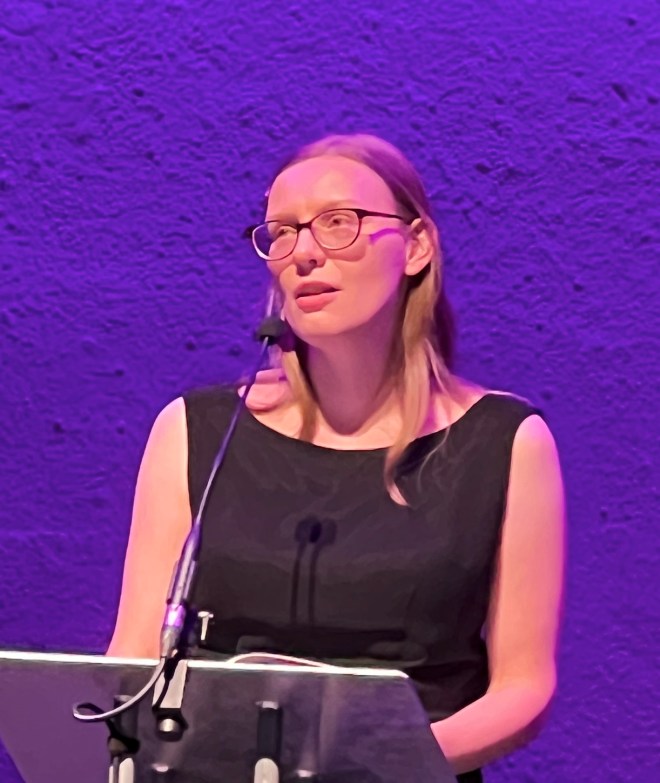
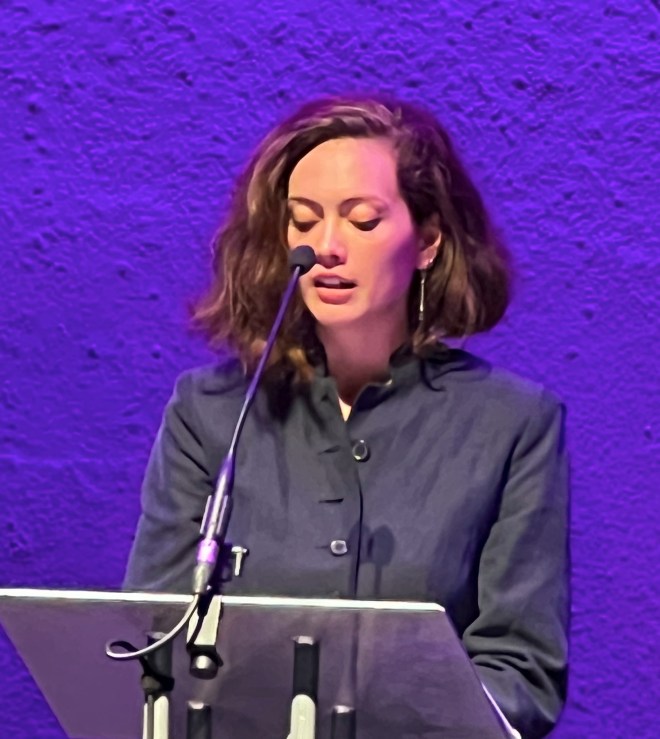
‘Finding new flight patterns’: working creatively to heal beyond trauma at the Newcastle International Poetry Festival 2024.

Every city we travel to, we meet a new version of ourselves. Meantime, the city becomes a different version of itself through our eyes. That was certainly the case for me when I arrived in Newcastle on 9 May, the day of the train strikes. With all the dazzle of fresh green growth, and light, bright clothes, summer was coming in a sudden rush of heat, that caught us all half unawares. Confirming the sense of a new world, York station, normally a constant to-ing and fro-ing of trains and passengers, was all but empty. Under a blue sky, cafes were closed, the lines and platforms silent, as I waited for my connection.

Newcastle itself was alive and bustling once I left the station and walked along the Tyne. The hotel the Newcastle International Poetry Festival had booked me into was directly opposite the glamorous 1930s Baltic Arts Centre. The air felt warm and tender, the river was quiet and glassy, the passersby lingering over drinks on waterside terraces. With a sense of adventure, I left it all behind to head uphill to Newcastle University, and the Northern Stage venue. Walking through the layers of the town its history was written in its built structures, from solid Victorian municipal buildings to Sixties and Seventies car parks and office blocks. Buskers turned the long shopping streets into layers of sound that inscribed the always changing present moment.

Millennium Bridge, Newcastle.

To enter the Northern Stage venue, where the Newcastle International Poetry Festival was taking place over three days, we had to pass alongside the student encampment, protesting the genocide being committed in Gaza, and the larger international and institutional complicities enabling this. It felt right and necessary that Abigail Parry, who joined Jane Clarke for the T.S. Eliot Prize Reading, to close the first day, directly referenced the huge disparity between our security and comfort within the theatre, and those co-inhabiting the planet with us who are denied a place on our ship of plenty. These thoughts and images were in my mind as I walked back after eating with the festival poets. The party streets of Newcastle were unfurling nights of summer hedonism and along the jet black Tyne where the Millennium Bridge formed a shark’s mouth of rainbowing colours.

Occupation Camp, Newcastle University, Photo by Anita Pati.

Wanting to prepare both for the workshop I was running on the Friday, about colour as a conduit and energy portal, and my own reading on Saturday, exploring healing beyond childhood trauma, I sat on the public deck of the Baltic Centre in the quiet of early morning, looking out across the Tyne, and seeing the seaweed exposed where the tide had flowed out. Built by Rank Hovis from the 1930s as a flour mill and huge grain silo, it once stored 22,000 tons of grain. Now a community and arts space, the Baltic Centre held within its built structure the memory of the 300 workers employed there during its 1950s heyday. Back then, it was only one of several silos and grain stores along the Tyne. As I looked across the water, shimmering with reflections, to the cafes and bars on the far side of the river, it was impossible not to think of the acute need for grain and foodstuffs in Gaza, and other parts of the world afflicted by shortage and famine.

The changing presences of history made themselves felt again during the Newcastle Poetry Festival’s readings for that afternoon, when Kit Fan and Jennifer Wong spoke of what it meant to them to have grown up in Hong Kong, and the almost unimaginable shifts currently underway in that city. Chaired by Festival director, academic and poet Theresa Munoz, they were also reading poems and speaking with Troy Cabida, of the connections arising from their shared heritages, discussed in the interview exchanges of State of Play: Poets of East and Southeast Asian Heritage in Conversation. Having bought the book at the excellent Poetry Book Society bookshop upstairs, I read it all the way back on the train to London, and warmly recommend its paired conversations between poets and writers.

Closing Friday evening’s performances with her longtime friend Carol Ann Duffy, Imtiaz Dharker shared work from her new collection Shadow Reader, noting how “the map of this country/ is made of scars” and asking “can the writer be forgiven/by the one who is written?” Over dinner, in a former monastery, with stone walls, and high, beamed ceilings, I talked in depth with Jennifer Wong and Marjorie Lofti on the impacts of displacement and childhood trauma on the adult self. We were agreed on the need to tread carefully in adulthood, and recognise the vulnerabilities that necessarily remain. Having read and loved the collection, I was also able to tell Marjorie how much I appreciated her debut with Bloodaxe, The Wrong Person to Ask, exploring her childhood flight from the Iranian Revolution, and what she witnessed before her family was able to leave.

On Saturday, for the Royal Society of Literature lecture ‘Nostalgia: Architectures of Longing’, poet, musician and academic Anthony Joseph spoke accompanied by photographs he had taken of the Caribbean. Approaching from multiplying, interconnected angles, he used the images to explore the process of becoming conscious of your separation from your place of origin as a pre-requisite for being able to comprehend it creatively. Joseph’s Sonnets for Albert, which takes the death of his father as its starting point, was one of my most revelatory and moving reads of 2022. I shared poems within my Newcastle workshop. It was therefore even more of a gift to hear Anthony Joseph remember his own arrival in wet, April London, and the resonance of this shift within his subsequent creative output. He explained “you don’t become a Caribbean person until you leave the Caribbean”, but that “this liminal space is full of uncertainty, where the work of being occurs.”

Anthony Joseph: Nostalgia, Architectures of Longing, Newcastle May 2024.

I had the great privilege of opening that final afternoon’s readings with a celebration of Pavilion Poetry’s tenth birthday, alongside Hannah Copely, whose extraordinary second collection, Lapwing, was published by Pavilion this year. Fellow Pavilion poets Linda Anderson and Anita Pati were in the audience. Titling my talk ‘Finding New Flight Patterns: Healing Beyond Trauma’, I decided to explore the bird poems of bird of winter, and specifically how they helped the collection navigate beyond the trauma of childhood sexual abuse towards healing. The slightly expanded text of my reading follows. If you would prefer to watch the video, please click this link, kindly supplied by the Newcastle Poetry Festival and the Bloodaxe Books team.

alice hiller by Anita Pati

[‘Finding New Flight Patterns: Healing Beyond Trauma’ talk given by alice hiller at Newcastle Poetry Festival, 2024, photo by Anita Pati].

Thank you for inviting me to this beautiful festival and city. It’s a real privilege to celebrate Pavilion’s founder Deryn Rees-Jones, Alison Welsby, of Liverpool University Press, and of course my wonderful fellow poets.  Like everyone on the Pavilion list, I value how gently Deryn holds the radical risk-taking and uncensored experimentation which is integral to our hatching new work. In bird of winter, Deryn guided me to bring together a collection which directly addresses the global crime of childhood sexual abuse, and its long aftermath – but also documents creative paths towards healing and reclaiming ourselves. 

As some of you may know, I was sexually abused by my mother until I turned thirteen, in 1977. Incorporating both that hurt, and my recovery beyond it, and paying tribute to Hannah Copely’s brilliant Lapwing, my reading’s structured around the bird poems of bird of winter. With an emphasis on hope, it’s titled Finding new flight patterns: healing beyond trauma. 

As we share this space, I would ask you all to keep in mind the ongoing genocide in Gaza. Let us stand in solidarity with the Palestinian people, and the occupation encampment honouring them outside the Northern Stage, looking with them to when they will regain their territorial freedom and autonomy.

Whatever our histories and circumstances, as humans we instinctively define ourselves by what we love, not the injuries we may receive. Connecting with where we feel joy can help us recover our agency, and resilience, no matter the challenges we face. Reading my bird poems, I’ll focus on how they were created as acts of beauty and care for my younger selves. Linking them to larger patterns and processes of art-making and art-sharing, I’ll also show how I wanted to change the energy around difficult times which they record, and my relationships to them. 

I’m going to be talking about complex subjects, but I’ll be careful to keep us safe. From the start, birds are at the heart of the collection’s voicings and transformations. They appear in the first poem, ‘o dog of pompeii’. Going in search of the dog’s buried howl, we enter “my mother’s house where the garden/ hides dark sheds   hung with limp pheasants” and “the dead eye of the bird bath/ looks up    but sees nothing”. 

This is rural Wiltshire during the early 1970s. I was nine, and being regularly raped. In their stillness, and apparent lifelessness, these pheasants offer images of my child body in my mother’s bed. But they also hold the possibility of flight in their folded wings, linking into a long tradition of representing the soul as a bird. This reaches back at least to Ancient Egypt, whose treasures nourished me when I discovered photos of them in books at my primary school.

‘o dog of pompeii’ was the second poem I ever wrote. Although it wasn’t consciously planned, as I continued to work with the darknesses of my childhood experiences, I found that more and more birds kept flying in. A robin took my place in ‘the holly tree’, which responds to my homelife while I was learning about the pyramids and Pompeii. 

An Easter chick helped me record where I hurt during, and after, those nights in my mother’s bed. It also registers how very young and vulnerable children remain, when adults injure them, and how this experience colours every waking moment, and follows them into their dreams.

Shaped visually like a clutch of eggs, ‘cyclical/ house of the cecii’ is structured on a rotating axis. I wanted to reflect how it’s always open season for sexual abuse, but also claim the poem’s place in the tradition of works that turn with the year. The interleaved text, of a hunting scene fresco from ancient Herculaneum, links the collaged images to the tradition of art that records the hunting of prey. This reaches back to the cave paintings that I also learnt about at school. Looking back on those times, I have understood how crucial the sense of adventure, choice and growth implicit in learning were to helping me retain a sense of myself notwithstanding the abuse. They also resourced the art-maker I have become, laying down places of resonance to which I could return.

If birds are emblems of hurt, they can also provide markers of healing. My poem ‘bains de mer’, meaning literally ‘sea bathing’, remembers the Normandy holidays I spent throughout my childhood with my French bonne maman or grandmother. Celebrating the two of us us heading down to the beach below her clifftop house, to swim together at high tide, she is “eighty-four   your robe zipped/sure-footed as a penguin/ me your chick kept close”. Every day that we spent together, Bonne Maman let me know I was loved, and through this anchored my identity and sense of self, helping me to withstand the crime my mother was committing against me. 

There was a limit to Bonne Maman’s protection, however, as she lived in another country. A couple of years later, birds in a snowy English churchyard near where I lived with my mother in Wiltshire, gave me another freeze-frame image of myself while the abuse was ongoing. 

Aged twelve and a half, in the icy winter of 1976-77, I was becoming able to see in ways not possible when younger. ‘snowfall’ dramatises the moment of revelation, something like the separation that Anthony Joseph identified in his lecture, that would allow me eventually to “speak winter”. The mood music comes from Breughel paintings of snow scenes. I remembered them from Brussels, where we lived until my father died when I was eight, and where my Bonne Maman continued to live when not by the sea in Normandy.  Breughel’s tiny, busy figures suggested the persistence of life – as mine returned. The painting below is from the Brussels Royal Museums, and is titled ‘Winter Snow with Bird Traps’ by Pieter Breughel.

A much darker experience had precipitated ‘snowfall’s’ moment of seeing. It is recorded in other frozen birds, naked “plucked pheasants” held within my mother’s house, in the poem ‘december 1976’. The poem is preceded by the epigraph “seize your slave girl whenever you want it’s your right”, taken from Roman graffiti in Pompeii:

On the night of 24th December 1976, my mother had claimed that my visiting uncle needed my bed, rather than sleeping on the couch in the living room. This meant I had to sleep with her after the carol singers had left, leading to the poem’s feeling of heaviness and soiling the following morning. I wrote the first draft of it in a workshop run by Sarah Howe, also attended by Mary Jean Chan, and it came to me with the sung quality of a carol of the unspeakable. Because the subject was so painful, the beauty and control of the long open syllables and child-like images – threading stars through the prickly branches as an image for the rape that occurred – gave a measure of safety to their holding.

I went back to boarding school when the holidays ended, and after seeing the birds in the churchyard, and myself within them. Come the Easter holidays of 1977, my mother used a short holiday to Stranraer, in Scotland, to make me share a bed with her again. Aged nearly thirteen, I finally saw a way out, and decided to stop eating, and refuse her. By that autumn my weight had dropped to 28.5 kilos, or 4.5 stones and I was hospitalised. ‘primary or classical anorexia [1977]’ revisits this experience through a sparrow child. Like call and answer birdsong, it grows from two merging voices.  

The more authoritative voice paraphrases Obesity and Anorexia Nervosa: A Question of Shape, published by Peter Dally, who treated me.  Fortunately my main doctor was Peter’s less conventional, more compassionate ex-wife, Ann Dally.  She recognised the risk my mother represented, though I wasn’t able to speak directly about the sexual abuse. Remembering Ann’s daily visits, the pill-shaped title poem, ‘bird of winter’, learns from a chaffinch that the possibility of being heard can support healing. 

Ann Dally made it a condition of my release that I couldn’t live full-time with my mother after leaving hospital. During the school term, I was taken in by relatives in London. I began ordering Spare Rib and feminist zines, and going to the cinema and the theatre, and to free art galleries. I was connecting myself to the conversations of consciousness-raising, and art-making and sharing, and being nourished and transformed by them. Bonne Maman had encouraged me to engage with all forms of artworks from when I was very small. The next poem pays tribute to her and her magical flat in Brussels, where my bird-self was safe. 

Life was improving, but I was still a long way from being out of danger, as the pigeon chicks reflect in ‘when they begin to have feathers’. It alternates my teenage memories with advice by the Roman author Varro on preparing squabs for the table, to reflect the vulnerability that persists in adolescence for people who share my history. Once again, the words that came to me were very simple and light, suited to a teenager who couldn’t begin to understand the world into which her body was leading her, while her mind closed off what had gone before.

Even as I was being preyed upon, I was simultaneously finding and opening my own wings, helped by partly the languages I was learning at school. Absorbing their separate vocabularies, their layered literatures, I climbed further out of the tight, silenced box of the abuse into larger, more possible modes of being. Through books, I met Violette Leduc, Camus, Italo Svevo, Primo Levi, Dante and Ovid. Each writer gave me new words, and let me know that I could mediate my lived experience through my own forms of art-making, however long it might take me to be able to do this.

‘libation’, which recalls my father’s death on 22 November 1972, is informed by the myth of Leda and the swan, inviting a “cygnet” and a “swan beak dress” to hold something of what it meant to be to be told that news by my mother when I was eight. 

In a place of the most absolute darkness, birds open their “wild wings” to hold me to life. Like the birds in cave paintings, or Ancient Egyptian tombs, they are conduits to resurrection and new being. Reflecting this, and how poems may also perform shamanic rituals of healing, ‘libation’ sits opposite a short found poem. This describes an object found in one of the graves of Pompeii, onto which the ritual libations of wine would have been poured to link the living and the dead, as I imagined myself being connected to my papa by our shared love of endives. 

Almost at the end of bird of winter, more songbirds appear in ‘vesuvius’ which re-visits the eruption as an experience of revelation and refusal of silencing. Working from film footage of the 1944 eruption, the poem asks the volcano to “pour down ash and pumice/ muffle our streets with mourning” and to “press your lips against/ those who turn their faces”. It ends in an image of healing and new growth, that arises from the rich soil created in the aftermath of volcanic eruptions: “let grief melt the ash/ until vines climb your slopes again/ until birdsong is heard.”

Far into adulthood, flocks of birds flew in to help as I felt my way back towards understanding how transformatively I was loved by my lost father, at the start of my life, and how this love had contributed towards me finding my own wings, and voice. The title of the next poem translates as ‘birds of winter’. It’s dedicated to him.

A found poem which follows immediately after communicates how my bird and human selves live relative to each other. It’s captioned “wall painting from the ‘villa of the mysteries’ pompeii”. I’ll read it, then end with ‘o goddess isis’, the last poem of  bird of winter. I wrote it on the train back from Liverpool, after Deryn had said Pavilion would like to publish my poems. Please place your feet flat on the floor, then breathe slowly and gently, as we move through these words, into the light of this late spring afternoon. 

If anything I have written about has been difficult for you, the Mind website is a good place to look for support.

bird of winter can be ordered here.

It’s not often you get asked to read 222 books in two months: looking back on being a 2022 Forwards Prize Judge.

2022 Forward Prizes winners Nick Laird, Stephanie Sy-Quia and Kim Moore exiting Forwards photo shoot.

It’s not often you get asked to read 222 books at a sitting – let alone within two months. But that was the challenge – and the gift – that being asked to judge the 2022 Forwards Prizes brought to the doorsteps of Fatima Bhutto, Nadine Aisha Jassat, Rishi Dastidar, Stephen Sexton and I over the spring of 2022. Delivered by increasingly disbelieving couriers, box after heavy box of books made their way to us. They were accompanied by emailed individual poems, for the Best Poem category. With submissions for 2023 closing on 5 March, and this year’s judges revving up for their marathon read, it seems a good time to look back on the gift of being one of the 2022 Forwards Prizes crew. I also wanted to re-share the 2023 good news that poets can submit their own work for Best Single Poem, Performed here, free of charge. All other entries need to be submitted by publishers. 

Anthony Joseph reading from ‘Sonnets for Albert’

Back in 2022, for Fatima, Nadine, Rishi, Stephen and I, the impact of all those books arriving was something like a lifelong chocolate lover finding themselves suddenly swimming in a chocolate fountain. How to take it in the richness we were offered, without becoming overwhelmed and losing our powers of discrimination, was the challenge we faced. In my own case, to fit in the reading, overnight everything became book-shaped. If I was making a meal, I was reading a book on the side. If I was eating a meal, I was reading a book on the side. If I was travelling on the tube, I was reading a book standing, or sitting. When we met for the short-listing meeting, one of my fellow judges said that they were reading anything between two and ten books a day once the numbers of submissions ramped up. The rest of us simply agreed. 

Clare Pollard

Because the books followed me everywhere, wherever I happened to be, I was constantly reminding myself not to let go of, lose, mislay or forget the collection which was my companion of the moment. For all I knew, it might prove to be one of the ones which made the prestigious Forwards Shortlists for Best Poem, Best First Collection, or Best Collection, or indeed ultimately won one of the big prizes. Respectively worth £1,000, £5000 and £10,000, they offer an incalculable and enduring career uplift to the poet concerned, beyond their already significant cash value.  

Cecilia Knapp

To make it more interesting, I’d never formally judged anything before. I have a PhD from UCL. And I’ve done a lot of reviewing over the years, everywhere from the TLS to the Poetry Review and Poetry London.  So the tools were in place.  Would I know how to use them to winnow down such a huge mass of material? The first test would be creating our individual shortlists, ahead of the formal shortlisting meeting. Building up to it, I found myself waking in the night with the weight of responsibility. I was comforted by knowing this was a shared endeavour. Up and down the country, and across Scottish borders and over the Irish sea, and further afield too, Fatima, Nadine, Rishi and Stephen also had their shoulders to the wheel. We were carrying the decision-making collectively. 

Helen Mort reading from ‘The Illustrated Woman.’

Fortunately, as I read steadily onwards, in my book-shaped world, a sense of the material began to emerge. We were sent many outstanding poems, but certain collections had a coherence, as well as newness and difference, that made them stand out. Their parts held together and were of a consistently high standard. As Rishi Dastidar observed, they often also made our pulses race with excitement. These books, and individual poems, also gave us a sense of entering new worlds – defined by the language through which they were realised, the shapes they made on the page. In my own case, this was the work which began to make its way onto my longlist. Or rather into the set of four stacked plastic drawers into which I was posting my serious contenders, for further consideration. 

Joint hosts Stephen Sexton and Shivanee Ramlochan

When we came to swap longlists, ahead of our first meeting, our intersection points became the roadmaps which led to the eventual nominations. The judging meeting to decide the shortlist took place over many zoomed hours, on a hot, late spring day. It was exhausting and wonderful in equal measure, generating deep conversations around the works under consideration with other people who had thought about them as intensely as we each had. At the end of the day, we all felt that the shortlists that we arrived at were genuinely communal decisions. 

`Holly Hopkins reading from ‘The English Summer’

We chose poems written on front lines, responding to climate change, exploring migration, queerness, illness, identity, questioning, affirmation, faith, shame, desire, sexual predation, and sexual reclamation. They went into the woods, and into stinky kitchens, peered back at us out of buckets. Our non-human species included crows, butterflies, hyenas, cats, dogs, seagulls, and fungi, to name but a few. Mothers were sometimes wrecked, sometimes wrecking. Other times sources of profound nurture. Fathers might, or might not be, not terrorists. We were there as life began, and ended, with Nobel prize winners, and poets who had yet to publish their first full work. 

Kaveh Akbar reading from ‘Pilgrim Bell’.

There was humour and anger, play of all sorts, a relentless inventiveness and above all a sense of the sheer magnificence, and courage of the creative process, on page after page. It felt extraordinary, and deeply heartening, in a year when hope and joy often seemed in short supply. You can read excerpts from all the 2022 shortlisted collections, and the single poems in full, on the Forwards website, and find them, along with all the Highly Commended Poems, all in the Forwards Anthology for 2022

Nick Laird

Over the summer and autumn, we then had the task of winnowing down the five shortlists to a single winner. Every shortlisted poet had a compelling case for being chosen as the winner of their category, so it was a hard call. Because I knew how much I’d valued hearing from Stephen, Fatima, Nadine and Rishi, there was less anxiety this time around. We were a good team, who had found our collective process and identity through the first sets of strong choices. But we were going to need all those skills to come to the best decision we could make. 

Padraig Regan reading from ‘Some Integrity’

The days were shortening by the time we met again, and the conversations were engaged and warm, but also searching. We had had the summer to live with our fifteen shortlisted books and poems, to think about them from different angles, to respond to them in more open and relaxed ways than had been possible in the frantic read-to-the-finish-line of the first judging meeting. Once again we gathered on our zooms, with companion animals appearing in the background, or sometimes foreground, and occasionally barking their comments. And the winners that we arrived at were, miraculously, all ones we believed in, and stood behind wholeheartedly.

Misty Manchester on the evening of the 2022 Forwards Ceremony

That knowledge made the awards ceremony in Manchester’s Contact Theatre a genuinely joyous event. The event format celebrates the entire shortlist, with each poet reading, before the final decision is announced. This was also the Forwards Thirtieth Year, and its first Award taking place outside of London, which added to the edgy, vibrant excitement.  Despite the chilly weather, there was a real buzz in the theatre even before the sold out audience took their seats, with many more joining from around the world via streaming.  Reflecting the Northern location, poets within reach of Manchester were packing in, including Malika Booker, Jason Allen-Paisant, Andrew Macmillan, Simon Armitage, Kayo Chingonyi, Natalie Linh Bolderston, and many more. 

Warsan Shire reading from ‘Bless the Daughter Raised by a Voice in her Head.’

The readings were mesmerising, and moving, bringing out the value in each work. Together we cheered Stephania Sy-Quia, Padraig Regan, Warsan Shire, Holly Hopkins and Mohammed El-Kurd for the best debut, with Kim Moore, Anthony Joseph, Kaveh Akbar, Shane McCrae and Helen Mort for Best Collection, and Nick Laird, Cecilia Knapp, Louisa Campbell, Clare Pollard and Carl Phillips for Best Single Poem. You can read more from each of them on the Forwards website, and I would warmly recommend this. Kim Moore, Stephanie Sy-Quia and Nick Laird were then announced as the winners. 

Louisa Campbell with furry dog head.

Because the word ‘winner’ can have an almost obliterating quality, as if that achievement becomes the defining quality of the work, I wanted to finish this blog by sharing something of what I felt gives so much to readers in the Kim Moore’s and Stephanie Sy-Quia’s collections, and why the work of the Forwards Prizes has so much value in supporting artists whose work will make a lasting difference to the world at many levels. Nick Laird’s extraordinary poem, ‘Up Late’, can be read in its entirety via the Forwards website, and speaks for itself, but it can be a big investment for many people to buy a book at the moment. Here are some pointers towards what lies between the covers of Amnion and All the Men I Never Married, for those considering taking the plunge and buying these two brilliant collections.

With fellow judge Nadine Aisha Jassat

Turning first to Stephanie Sy-Quia, who won the Felix Dennis prize for best debut for Amnion, from the first time I heard from her read from the book, at the online launch, and well before I ever saw a printed copy, I had the sense that she was working into crucial new territory around questions of migrations and gendered identity, both thematically, and in terms of delivery.  I was also struck by how she was able to embed a very young woman’s voice into the poem, including sections which were first drafted while she was still at school. 

Best First Collection and stand in waiting nervously to read.

Through the extended, fragmented form, Amnion builds an organically alive structure which is simultaneously open and connected, able to interlink multiple generations and diverse identities, always questioning how the individual narratives are sited relative to the dominant power structures and historical realities shaping their outcomes. Part of this arises from Sy-Quia’s ability to find language and imagery that locates the individual as a moment in time, and a product of their histories and migrations, but also of the languages which have determined the apprehension and transmission of their cultures, and the experience of their gendered bodies. 

Stephanie Sy-Quia reading from ‘Amnion.’

Re-reading Amnion for the second Forwards judging meeting,  I found the idea of the family or social group as an externalised amnion – that is a symbolic version of the  membrane that protects the growing foetus – interesting to explore.  It made me think about how groups can shelter and contain growing, evolving beings, but can also generate their own forms of harm through the holding-in of intergenerational and other traumas, especially ones that lead to, or result from, displacement. My own father-in-law, Oscar Nemon, came to the UK as a refugee, and lost 22 members of his family to the Holocaust. Sy-Quia’s ability to invoke and create imaginative empathy for the impacts on psychological health (including depression), of feelings of un-rootedness arising from cultural displacement therefore resonated with me, as it will potentially with many readers. 

Writing about adolescence and young womanhood, Sy-Quia also places the female body centrally within the narrative, as a unit of reception, and perception. She explores teenage desire and vulnerability, and the loss or confusion of self which can come about as a result of predation, and exploitation during those vulnerable, hope-filled, urgent years, in a way which felt radical. There is a degree of privilege in the boarding school segments, but they butt the narrative up against the gender and class monopolies which Amnion interrogates, while also reflecting how ‘history’ and myth may be manipulated to shore up existing power structures, including those of empires and their toxic, ruinous aftermaths. All these questions come together towards the end in the final ‘Epilogue: Epithalamion’, which merges the political and the personal with immense power:

I AM WRITING NOW from the inky heart of empire,
its assonance no more unknown to me.
I shall knock the pillars out from under you
and label you up 
in room upon room 
of Wedgwood blue.

I HAVE SHUFFLED ALL THE SHARDS of what came to me broken
and I have not pried, for dealing in shards is what I wanted;
these being my inheritance.

THESE BEING
my demands
my thanks
my by rights

I USED TO WORRY that the performance was never quite for my own 
benefit;
that I owed it to others, that without me they might never apprehend and
therefore I was duty-bound to make the point
again and again
with the quiet militancy of washing rice before cooking it in a saucepan.
This has been the extent of it: cooking rice. 
But it is possible, as I have found, to delineate blood-bearings to each
their own.
My brother, for instance, is less interested in this quandary.
My father, for instance, professes to be half, which would make me a
quarter.
I reserve his right to do so; but my claim is my own. 

Forwards Audience taking their seats

Ultimately, Amnion left me with a feeling of making a path out of darkness and displacement towards claiming and belonging, which was powerful and real, and to which I think many will relate. Kim Moore’s second collection, All the Men I Never Married, also works with the gendered body as a political, as well as an intimate space, engaging with and articulating some of the forces and constraints which inform how women, and men, move in the world – both as living beings and as artists.  It is the interplay between these two strands – of the lived experience and the creative response – which gives the collection much of its uniqueness. 

Best Collection waiting nervously to read.

As I read, and re-read Moore’s collection, it became a hauntingly ‘big’ book. Its surface ‘accessibility’, arising from a string of ‘anecdotal’ poems in a variety of registers and forms, builds a navigable causeway leading the reader out into deeper waters. Moving through them, we explore desire, and its consequences, and the complex societal and cultural forces that form and give rise to this force within individuals, whether they are predatory, or subjected to predation. The poems also allow us to question from whose perspective the narratives under scrutiny are, and have historically been, represented. 

Moore is writing in conversation with Rachael Allen, Rachel Long, Olivia Laing, Maggie Nelson, Katherine Angel, Fiona Benson, Helen Mort, also on this list, and many others, giving a porousness and permeability to the poems within a larger discourse – which enhances their resonance. Her building block is the individual self, and the individual body, and how these tessellate either lastingly and fleetingly to those around them. The prefatory, un-numbered poem begins, ‘We stand at the base of our own spines/ and watch tree turn to bone and climb/ each vertebra to crawl back into our minds,/we’ve been out of our minds all this time’. 

A stand-out poem is 7, which Moore read at the Forwards ceremony. Beginning “Imagine you’re me, fifteen, the summer of 95” it remembers the “stranger” at the end of a log flume ride who reaches out to brush a drop of water from the speaker’s thigh. The work of the poem takes place in the doubled perspectives of the account, moving from the second person  address to the teenage girl – “And you are not innocent, you’re fifteen,/ something in you likes that you were chosen./ It feels like power, though you were only/ the one who was touched, who was acted upon.” – to the third person, seen as if from the man’s point of view. Now she becomes “A girl… with hair to her waist/ and he’s close enough to smell the cream/ lifting in waves from her skin…/ and why should he tell himself no, hold himself back?” The poem closes “You remember this lesson your whole life,/ That sliver/shiver of time, that moment in the sun./ What am I saying? Nothing. Nothing happened.” 

There’s a blend of delicacy, quietness, and horror, and a sense of this transgressive action echoing down through the years because not called out or defined as wrong, that is potent, partly in its restraint.  Other poems aren’t afraid of exploring rawness, and a compulsive, propulsive sexualised intoxication, as with 15, when the speaker writes of a relationship where: “I thought love was a knife/ pressed to the throat, I thought there was a blade/ in each of our hands. I am telling this now so he appears/ as real as that first night when we didn’t sleep./ The slight red stubble of his beard, the freckles/ covering his arms – his gaze, his attention all mine –”. 

From fumbling teenage confusion, to disturbing encounters in hotel corridors, or on trains or in taxis, while including also support from mentors and others who positively expand the sense of being differently, the collection makes the reader part of its own process of investigation and discovery. Through this, we share in the work of progressive redefinition and reclamation, from the starting point of being “a stone pretending to be a woman/ in the dark or like someone returning/ from a land nobody else could see.”

This trajectory generates a sense of arrival upon reaching 48, the concluding poem. Here, Moore’s voice recalls being told by an established, canonical, male poet, at the start of her writing life, that she should not speak of straightening her mother’s hair as a child. We, the readers, feel why she has come to understand that as a result of this “I have held my tongue for many years.” Evidence of the journey travelled, away from that silencing, lives within the poem. Moore has formed language and imagery that enables what was not allowed to be said to resonate with the reader in all its subtle complexity and vivid life:

My father elsewhere, and part of me still there,
part of me in the library with the man
who told me not to speak about such things.
The lawn. The drifting dusk. The bats.
My mother’s hair. My hands. That house.
The shudder of a horse’s flank. 

As I publish this, the 2023 Forwards judges will be receiving their last boxes of books, and print-outs of poems.  This year’s judges are Kate Fox, Karen McCarthy Woolf, Andrés N. Ordórica, and Jessica Traynor, coming together within two separate panels, being chaired respectively by the legendary Bernardine Evaristo for the Best Collections, and Joelle Taylor for the Best Single Poems. Along with many others I will be waiting, when summer comes, to hear the results of their hours of careful reading and thought, and to investigating the recommendations of the 2023 shortlists.

Kim Moore reading from ‘All the Men I Never Married.’