‘Words as pathways to freedom’: thinking how language can hold and release trauma, reading in support of Gaza by way of Pompeii’s ‘entombed cities’ and ‘absent peoples’ at Verve 2024 in Birmingham.

Some blogs begin upbeat. Others have to work their way towards hope. This falls into the second category. But stay with me, and we’ll travel towards a light of reclamation together. Like most of you reading this, I’ve never been bombed. I’ve never had to leave my home and live in a tent in a refugee camp. I’ve never fallen asleep on the ground not knowing whether the people I love will be killed as we sleep. In some ways, there is a gulf of uncrossable distance between me and the Palestinians who are being subjected to genocide by the current Israeli government in Gaza.  

But in other ways, less so. That is, I have some insight into aspects of what Palestinians may be going through. Partly as a result of reading the firsthand accounts that people are managing to get out of Gaza and following videos and news reports. But also because my late father-in-law, the sculptor Oscar Nemon, lost twenty-four family members to the genocide of the Holocaust during World War II, including his mother, his brother and his grandmother. The man I met in 1980 had lived by then for forty years in the shadow of that loss, and been transformed by its absences. The drawing below is a mourning sketch by Oscar Nemon, as is the image at the top of the blog, written on a ‘Don’t Forget’ notepad which he used more than once for these memorial sketches.

The German branch of my own Messel family of origin was similarly truncated by genocide. As a teenager in the 1970s, I visited two elderly relatives, an architect and his wife, who had escaped from Berlin during the 1930s, and by then lived in Swiss Cottage. Like my father-in-law Oscar Nemon, almost all their family members were transported to their deaths by the Nazis as a result of having been identified by the Third Reich as Jewish.

I also have some understanding of the longer term psychological consequences of what is taking place in Gaza. This comes from my own history of growing up being subjected to the powerlessness, and violence, of childhood sexual abuse. For these reasons, and because I am a human being, it haunts me to know the current Israeli government has chosen to put a neighbouring nation in hell – and keep them there, with long-reaching intergenerational consequences, even beyond any ceasefire.  

In mid-February 2024, preparing to read as one of three headline poets at the legendary Verve Festival in Birmingham, with the brilliant, ferocious Nicole Sealey and Rebecca Goss, the Palestinian fight for life and freedom has been very present to me, as it has been to so many of us. Drafting the text I planned to read, I continued to follow news updates and saw the horror worsen by the day, as food supplies in Gaza became even more insecure, notwithstanding the trucks lined up and ready to deliver essential aid at the border.

With this in mind, I built my set from bird of winter to explore ‘words as pathways to freedom’ from poems which held both my own childhood experiences, and references to the current occupation of Gaza. I wanted Palestinians to be honoured, and kept with us, through every word I said in Birmingham’s Hippodrome Theatre. I needed the progression and evolution of my child self from oppression and injury through to reclamation and freedom also to articulate our and Palestine’s hopes for their nation. 

During the week before Verve, writing and redrafting my linking words, rehearsing the chosen poems, I started to re-experience childhood injuries arising from the abuse like those described in ‘remnants/silvae‘, which you will see below. Through them, my adult body expressed its memory of what had been done to me fifty years earlier. Rather than backing off, I kept redrafting and rehearsing, while also take time out to safe-guard myself and swim. I recognised the oppression that had overwhelmed me when I was too young to refuse it, but knew I was managing it as a side-effect of generating the possibility of transformation and healing.

As I took the train up to Birmingham on Friday evening, where I was also going to lead a workshop on colour for Verve on the Sunday, a violet wash of sunset illuminated the dregs of the ending day. The sky seemed to sing hope and promise to the muted greys and the greens of the winter landscape. 

I took this as an omen for my Saturday performance with Rebecca Goss and Nicole Sealey, hosted by fellow poet and former archaeologist Jo Bell. The next morning, after catching Holly Pester’s brilliant Verve/ Poetry School lecture, I carried my script for the evening to the canal side, and sat on a bench in the sun rehearsing quietly. I asked for the day’s energy to illuminate the darkness in which Rebecca, Nicole and I would perform together, and bring from it light.

The words which I shared with a packed theatre space in Birmingham, on 24 February follow. What Rebecca Goss and Nicole Sealey read was no less searing, as you’ll see if you follow the links here through to their work. Rebecca’s poems illuminate what it can mean to lose a child, and then and live beyond that loss. Nicole’s ask us to face how institutional racism wounds, and that it destroys not only individual lives, but also the societies from which they grow.

As you read my own words spoken in the Hippodrome Theatre, which follow, imagine me swinging a sacred sistrum out over the audience to initiate the poems, then overarm-bowling a red rubber ball among them to be chased by the resurrected ‘dog of pompeii’. At the end, as ‘vesuvius’ closed, I joined my palms in a gesture of prayer, raising them up to eye-level, and then opening my arms out to form the branches of a tree, symbolising new growth and a healing future for all of us in the theatre and beyond.

words as pathways to freedom 

alice hiller Verve Poetry Festival, 2024

Thank you for inviting me to Verve.  It’s heartening to be here, particularly at such a hard time, as we witness the genocide underway in Gaza.  Like many of us making our lives beyond trauma, I rage, and grieve, that what is taking place under the Israeli invasion will continue to impact the Palestinian people for generations, even after their land is restored. I have chosen poems whose imageries stand in solidarity with their fight. 

When I speak of ashes and rubble, of ‘entombed cities’ and ‘absent peoples’, let your thoughts go also to Gaza.  When I ask that our streets may be ‘muffled with mourning’ think of their streets also. But when I speak of growth and reclamation, be with Palestinian peoples, who are fighting for their own secure future. 

Plaster casts of the fugitives, who died in Pompeii, fleeing the Vesuvius.

For all of us facing hardships, even on a lesser scale, words open pathways towards freedom. I hope to share one aspect of this process tonight, through the poems of bird of winter. They respond to my experience of sustained sexual abuse in childhood, but also of finding healing beyond a crime that impacts millions of us around the world. Whether in therapeutic, creative or social contexts, arriving at language that can hold and release trauma is, of course, tough. 

To speak, we may have to re-enter spaces of near annihilation, and reclaim the selves and memories we left behind in order to survive. Recognising the real dangers this represents, my work also plays out the opposites of what I was subjected to. Where I was without agency, my poems summon it. Where I was left in darkness, I claim light. Where I was hated, I counter this with love for the child and the teenager I once was, and the woman we have become.  

Because I want the collection to perform acts of resistance, and restitution, as well as witness, bird of winter interleaves the sexual abuse by my mother, and its aftermath, with poems honouring what allowed me to come through. I also celebrate the nurture I received, and still receive, from the world around me, having turned outward towards it very young, with no secure home for shelter. 

In bird of winter, this sustaining communion is channelled through found materials arising from the buried Roman cities of Pompeii and Herculaneum. I was first drawn to their histories as a child when the abuse was ongoing, perhaps because I sensed in them mirrors of my own experience. I’ve been deeply absorbed by them ever since. 

Taking us beyond injury into healing,  found materials from Pompeii and Herculaneum seed all the poems I’ll share with you. ‘o dog of pompeii’, which opens bird of winter, includes a plaster cast of a guard dog, and the charm bracelet found on a child in Herculaneum. Engaging with them let the poem rise up and take flight. The dog is below, and the charm bracelet concludes this piece.

Erasing an epigram by the Roman poet Martial, that featured before and after images of Vesuvius, allows me to honour the beauty inherent to my body and spirit as a child. It also suggests what was done to me. 

In bird of winter, the pyroclastic flow from Vesuvius is a recurring expression of the onslaught of sexual abuse. The rock, into which that volcanic ash and debris hardened, solidifies also into the difficulties I meet, trying to dig down into my past. Against this, three shrines rescued from Herculaneum’s harbour, hold energies which sustain my spirit. Through them, I was ultimately able to face down what sought to destroy me.

The poet Statius was born near Vesuvius. His work helped frame my reflections on what it means to live beyond rape in childhood.  Written a decade after the volcano erupted, a fragment in his long poem Silvae imagines when the landscape will have healed, but asks what this new growth could hide.  I translated his Latin and then interleaved our couplets.

As happens for many abused children, while I was growing up, and the crime was ongoing, most people around me looked away. Aged thirteen, I was hospitalised weighing twenty-eight kilos.

Water is my healing element. I cleanse and rediscover my body with every immersion, every length I swim. Photos of a mosaic found in the House of the Faun in Herculaneum were the starting point for ‘sea level’.

The image above is of the charms taken from the ‘burnt child’ found on Vesuvius’s shoreline in ‘o dog of pompeii’. She was awaiting rescue with others in the harbour area. Many were good luck charms, presumably collected for her by family members who loved her and wished her well in her life, at least until that fateful day when the volcano began to erupt. The child was also holding the beautiful vase photographed below them. These objects moved me deeply when I saw them, because they gave us back her life, and her humanity, and the tenderness in which she was held. When I wrote the poem, these objects nestled a kernel of hope into the harsh images of what was done to me.

This hope is also present to those people currently trapped in Gaza, as they fight to stay alive day after determined day, as they have had to for so many years now. The last poem I’ll read comes close to the end of bird of winter. The force of the volcano has been reclaimed to represent the energy needed for change. With it, we stand at last in a place of healing and growth. 


The poems quoted are all from bird of winter, published by Pavilion Poetry, who are ten years old this year.

Marking the Spaces of our Silences : alice hiller on art as activism in the aftermaths of trauma.

Trigger warning: references to sexual abuse in childhood.

In common with others who were sexually abused in childhood, I have been haunted by the awareness that millions of children round the world are potentially being locked in with sexual predators, as a consequence of measures necessary to limit the spread of COVID 19. I am also deeply concerned for the psychological health of adults living with their memories of having been subjected to this crime, without the normal range of social interactions and support, which would usually help them to cope and hold the past at bay.

While art and activism can be awkward bedfellows, the current crisis has made me think how I can use the body of work I am making around my own history of being groomed and then sexually abused as a child, to bring awareness of this crime to a wider audience. My intention is part of an ongoing project aimed at finding ways to counter the devastating impacts when children are sexually abused.  I also want to make the subject more comprehensible to those whose lives it has not touched directly, in order that we may work collectively for change.

One of the first challenges I faced in writing about sexual abuse was how to find a form of language which respects the inarticulacy of the child’s experience. This arises from the dissociative pressures of shock and shame, in combination with the intimidation and concealment perpetrated by the adult abuser. In her brilliant study, Minor Feelings, Cathy Park Hong cites the poet Myung Mi Kim telling her that “attention to silence is in itself an interrogation” [p139]. This chimes both with my own practice, and that of my late father-in-law, the sculptor Oscar Nemon, whose work has been part of my life since I was sixteen.

Together with millions of Europeans of Jewish heritage, Nemon and his sister Bella lost almost their entire family to the Holocaust. In their case, the twenty-three murdered relatives included their mother, brother and grandmother. Like many who suffer loss on this scale, aside from one interview at the end of his life, Nemon does not seem to have been able to speak out loud about this tragedy, not even to his children, nor to his close friends.

Better known for his portraits from life of Sigmund Freud and Winston Churchill, Nemon did however respond to the Shoah in his art, which also addresses wider questions of the impacts of genocide on surviving communities. Titled Humanity, his memorial to those killed was unveiled in 1965 in his home town of Osijek, now in Croatia (see below). Emerging from on sketches stretching back to the second world war, the composition shows a mother lifting her child to the future in defiance of annihilation.

Heredity in park

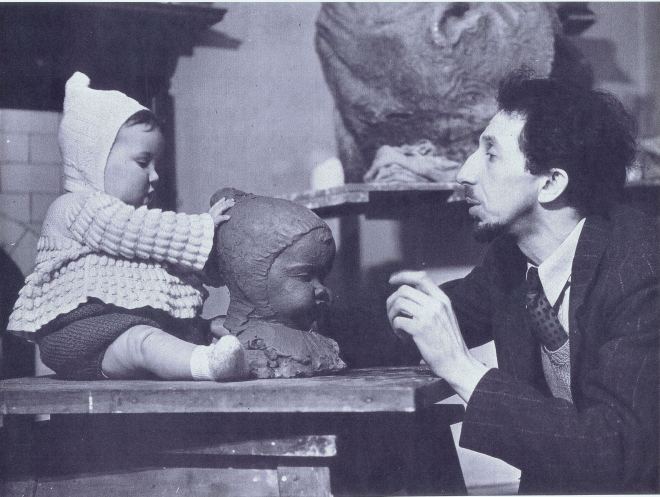
While there is no direct allusion to genocide, it is a composition of the utmost vulnerability. Reaching out and up, neither mother nor child have any form of protection, silently reminding us of the undefendedness of the millions of civilians whose lives were taken both in the concentration camps, and en route for them. The model for the baby was Nemon’s son Falcon, born in 1941 as Yugoslavia was invaded, signalling the likely end of Nemon’s family of origin. Falcon later became my husband.

Nemon only completed two Shoah sculptures, but from 1945 onwards he made sketches exploring living in the aftermath of this loss. They often feature groups of mourning figures, standing together in solidarity, or holding one another. I first discovered them within his papers after Falcon died in 2002. Nemon had previously died in 1985. Recently bereaved, they moved me deeply. When I look through these drawings now, I am additionally struck by their relationships to silences, and silencings, and how they build bodies of gestural language from not speaking. Below is the rapidly drawn Don’t Forget, whose title and injunction come from the page of the memo pad on which it was executed in black felt tip pen.

Don't Forget

Turned away from the viewer, the two figures hold each other, and possibly a child each, in a wordless enactment of grief. They make their loss palpable, but decline to let us into their closed circle, which is a place we can imagine, but not know. By existing, Don’t Forget gives witness, and forms a concrete place of testimony to a crime whose perpetrators attempted to deny it, and to destroy all evidence of what was done. This witnessing is an ambition I also have for the body of work I am making, as I hope to show in the discussion which follows of five poems published since the start of the pandemic in the Cambridge Literary Review and One Hand Clapping.

As a reviewer, and former features journalist, my intention is to use the additional resource of my prose to open up the context of these poems during these uniquely difficult times, to support children and adults with experiences of sexual abuse, whether current or historic. With funding for programmes to heal the aftermaths of this crime  being cut, I also wanted to throw light on the nature of what happens when a child is sexually abused, to make it easier to understand why the damage, though often invisible, can be so profound.

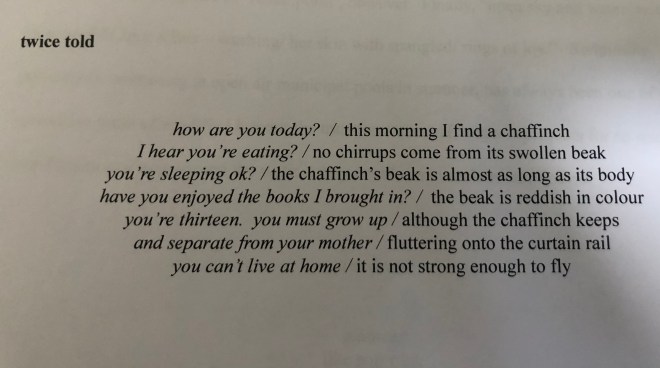
‘twice told’ and ‘quadrant’, the first two poems I will discuss, were published in the full UK lockdown within the ‘script as identity’ issue of the Cambridge Literary Review. There is a clip of me reading them for the online launch available here. Looking back to the autumn of 1977, ‘twice told’ documents the immediate aftermath of the sexual abuse when I was just thirteen. At this point, the physical element had been stopped, but I had no means or opportunity of saying what had been done to me.

Set in a hospital room, the poem remembers the tone of the many conversations I had with Ann Dally, the psychiatrist who admitted me. I weighed 4 and a half stone, and had stopped eating in order to be able to die, but anorexia was still largely regarded as the disease of over-ambitious, perfectionist middle class girls. While Ann Dally rapidly became aware that my relationship with my abuser was not what it should be, it never occurred to her to ask about the possibility of sexual abuse.

‘twice told’ lies in a lozenge on the page, forming the shape of one the many sedating pills I was given. It alternates the psychiatrist’s questions with the child patient’s thoughts about a chaffinch she sees, who is neither able to sing nor fly. Working through the image of a flightless bird, with a grotesquely swollen beak, the poem catches both the impossibility of speaking, and the resulting weight of not being able to do to so.

Photo 05-08-2020, 15 11 29

‘quadrant’, moves beyond this to register the silences surrounding sexual abuse being being enforced, endured, and finally negotiated. It suggests that we may not have to remain in a place of injury forever. The word quadrant initially meant a quarter of a day, or six hours. This led to the name being given to an instrument, shaped like a quarter circle, used to measure altitudes in astronomy and navigation.

The poem is built from four quadrants. The first imagines a little girl’s words as “soft pink kissing” spread onto “iced cakes” and then fed back into her own mouth. The “steel hooves” of ‘intimidation’ follow, and lead to the exile of ‘exclusion’ when “lies puff out on/ washing lines” and “because/ she will not wear them/ the young woman must/ walk out naked.” This image to calls to mind the unprotected state of the adolescent who has suffered sexual abuse, and her vulnerability in the aftermath of the crime when she is trying to reclaim herself.

‘quadrant’ ends in a place of ‘redemption’, however. Finally, “open sky and water/ wind-blink a clear pool of June silver – washing/ her skin with spangled/ rings of joy.” Swimming, and particularly swimming in open air municipal pools in summer, has always been one of the most restorative areas of my life. I honour the transformative gift water represents for so many of us with histories of trauma, and the ways it may enable us to reclaim our bodies.

Photo 05-08-2020, 15 12 28

The three poems published in One Hand Clapping engage with different aspects of living with and in the aftermath of sexual abuse in childhood. ‘embedded’ is already available on this blog in the poems section. It was a poem that came alive for me again during the first phase of the full UK lockdown. The isolation I was experiencing through living alone, combined with the lack of social contact that many of us rely upon to manage our mental health, caused me to re-somatise the injury the poem responds to.

At the time of the poem, I was a pupil in a small village primary in Wiltshire. I worked among other children on shared tables, with papier maché animal masks looking down on us from the walls. Writing ‘embedded’, the soreness of those childhood mornings seemed to materialise within the roughness of the sacking tacked to the underside of my bed, the splinteriness of the wood, the sharpness of the rusty nails – in the same way that water vapour may be precipitated onto a cold surface. The word ‘backdoor’ is embedded centrally in the poem as an act of witness.

Photo 05-08-2020, 15 39 21

One Hand Clapping is also publishing two new poems of mine. They respond to how traumatic memories persist, but also how they may be represented and to some extent transformed. I first experienced penetrative abuse aged eight and a half, in December 1972. Ever since, that month has been difficult for me. Whenever I can afford to, I travel. It helps to be in a different light to that in England, and to open myself to new experiences, rather than being pulled backwards by the ghosts which return each year to claim me.

‘performance’ came out of a late December trip to Sicily in 2017. I wanted to see the island’s landscapes, and understand more of its multi-stranded history. A few days short of the end of the year, I was standing in the ruins of an almost vanished Roman amphitheatre at Eraclea within sight of the sea. Two thousand years ago there would have been crowds, and blood, and gladiators, and wild animals. Now broken rows of stones emerged from the dry grasses to mark where the benches would have stood. More or less the whole town had been carried away over the centuries to build houses nearby – as is the case with many classical ruins.

IMG-3515

My own vanished, but present, past was within my thoughts as I walked around, trying to figure out the layout of the site from the notices and my guidebook, and imagine how everything had been. In their liminality, and near erasure, the ghosted forms of the seating and stage suggested the presences of memory, but also the way time erodes and changes. I was struck by how, although it was impossible, without additional information, to read the site fully, you could not ignore that something had once stood there.

A salt breeze was blowing in off the sea, like it had on the clifftop by my French grandmother’s house in Normandy. This was always my place of safety as a child, where I was usually more protected from my abuser. Feeling it on my face, the phrase “amphitheatres are carved from bones and stagger into stone” slipped into my consciousness. Then I heard “have traps in their floors troughs to drain blood.”

Those two phrases, arriving on the wind, turned my eight year old body into the amphitheatre, and stage for my own attack. Like a looping echo, as I thought about the gladiators forced to fight each other, and the animals they killed for public amusement, I also held somewhere in my mind my own powerlessness to resist my abuser, and the sense of unwitting complicity that the sexually abused child experiences. But, in the historical fact of the “troughs to drain blood”, the imagery also offered the possibility of some form of easing or relief, through draining away. As the poem took shape, I understood it could give a measure of moving beyond the eternal recurrence of what was done to me night after night in the dark, because refusing the silence that my abuser had required and enforced through my childhood and well into adult life, as is the case for many of us with this history.

performance

amphitheatres carved from
bone stagger into stone

traps in floors
troughs to drain blood

bars protect the watchers
from the creature

when attacked
leaves marks

as rain drunk
by growing grass

‘performance’ stayed short – only six more lines came. Sexual abuse is not something that can be fully communicated. Reticence is moreover a retrospective form of redress – clothing the child in a measure of dignity that was denied to her while the abuse was ongoing, and gifting the reader the option to engage only insofar as is safe and comfortable for them. As I worked on the poem, I understood that it needed to be tiny, and tight, and partly folded in on itself like a child’s body – but with a mysterious, felt possibility of growth and healing. The blood at the end is also just rain, in the same way that when we speak the difficult things that happen to us, they may be in some measure transfigured by the act of documenting.

The title was the last element to arrive. For a long time I called the poem ‘evidence’. Then I realised that it was more than that, because not static, but moving. ‘performance’ holds for me how, when we make works of art, whatever their starting point or destination, we construct them in such a way that they enact themselves within the viewer’s or reader’s mind, and then fold away again at the end, like the curtain going down on a stage. In that retelling, and closing down, we also exert our agency as the co-creators of our own life experiences, and give a degree of creative agency to our audience. Together – as artists and audiences, as past and present selves – we may discover the power to see and relate in new ways, as we move forwards through time, and gain different understandings of our own histories, and those of others.

‘papyri’, the final poem appearing in One Hand Clapping, responds to the difficulties inherent to making aesthetic performances from charged materials, and more generally to opening up traumatic memories to allow their energies to be present within a creative work. The starting point was my own reading about the ancient city of Herculaneum, which, like nearby Pompeii, was overwhelmed when Vesuvius erupted. Rather than ash, however, Herculaneum was covered with a hardened shroud of volcanic stone, up to 40 metres thick in places. This has not yet been fully excavated, and may never be, as the modern town of Ercolano stands above much of the ancient city.

Digging down along narrow, vertical shafts, the early excavators discovered among other finds the complex of a magnificent villa, complete with extraordinary mosaics and statues. There was also an area containing blackened, contorted log-like objects. These were originally disregarded as rubbish, or burnt to keep warm – until it was realised that they were in fact tightly rolled papyrus scrolls from the villa’s library. They had been carbonised and crushed during the eruption, and are the only surviving examples of this kind.

Even when the papyri were recognised for what they were, they remained almost impossible to unroll or decipher. The writing is black on black, and the carbonised sheets crumble entirely to dust unless treated with the utmost care. Many techniques were tried for deciphering them, including fixing to a silk background and unrolling by fractional amounts each day. The breakthrough only came in recent years, however, when medical diagnostic technology was brought into play. It was realised the papyri could be read through a combination of using a CT scanner to unroll them virtually, and an infrared scanner to distinguish the letters from the paper.

A CT scanner is of course more usually used to see inside the human body without surgical intervention. For those of us whose bodies have been attacked or invaded, the ability to see within their closed surfaces, to discover the evidence of what took place, is at once an impossible dream, and a potential nightmare. My poem ‘conjugation’, also on this blog, explores this idea, in the context of an MRI scan which I was given in 2014 to assess internal damage following cancer surgery.

While ‘conjugation’ speaks directly to my abuser, ‘papyri’ asks the reader to become a form of CT scanner, calling upon the magical powers of an empathetic imagination in bringing the processes of art into play. Because the sexual abuse of a child very often entails a measure of societal or familial complicity, I wanted to build the poem from phrases already in the public domain to enact a wider engagement. For this reason, the poem uses only ‘found language’ taken from an academic article published by the University of Kentucky about using CT scanners to read two unopened Herculaneum scrolls.

The borrowed and rearranged phrases request the scanner/reader to “distinguish bodily tissue/ detail a human’s organs/ reveal internal surfaces.” The poem accepts, sorrowfully, but also respectfully, “the task immensely difficult/ the scrolls so tightly/ wound and creased”. It allows the resistance to opening and disambiguating of such materials. But it also suggests that when you are able to “unwrap sections/ flatten them” they may gift you the ability to “see clearly” the constituent elements of “papyrus/ fibres/ sand” contained within the seemingly incomprehensible scrolls.

In the context of ‘papyri’, the final word, “sand”, is the saddest, and the most hopeful. It embodies the grit, and abrasion, caught between the soft surfaces of the historic Herculaneum papyri before carbonisation. Through this it looks back to the soreness of ‘embedded’. But it also honours the persistence of selfhood even under the most extreme adversity and fragmentation. Sand is made from minute particles of rock – most commonly granite, quartz or mica, or marine life forms – which still retain their original identities. In the same way, children subjected to sexual abuse retain their original selves, however dissipated and broken up by the trauma to which they have been subjected, as ‘two unopened scrolls’ asks the reader/scanner to recognise:

Photo 05-08-2020, 15 38 53

My late father-in-law, Oscar Nemon, also has a sketch which works with and transforms ‘found’ materials. It is a tender, grieving group, composed of three visible figures. More are implied behind them, completing the circle. With their backs to the viewer, refusing to speak directly out of the frame of the page, the figures cluster together and hold each other close. Their bodies, which form a trunk-like column, are made up of vertical, striped lines, like the striped clothes that the prisoners in the Lagers were required to wear, and which the world saw on newsreels of the liberation of the camps. The base on which they stand is a crosshatch of vertical and horizontal lines – echoing the barbed wire which contained the prisoners, and prevented their escape, also visible in contemporary news reportage.

Mourning group stripes

But extraordinarily, and almost unbelievably, while the figures’ heads bow in sorrow, as grapes on a vine, awaiting harvest, their holding arms form two victory ‘V’s. This was another archetypal image of the second world war, implying resilience, and determination to resist. An additional V has been added below them, in a different pen, at a later date. The resulting shape, made by the interlocking Vs, calls to mind both a diamond – an emblem of light – and an open mouth at the heart of the composition. Made from the raw horror of war, the untitled sketch forms an act of articulation. Loss is made manifest through unflinching, empathetic, witness – without surrendering its final unspeakability. I hope my own poems will be able to work in this way for the global community of those of us living with, and making our lives and arts in the aftermath of, sexual abuse in childhood.

Falcon & Oscar & bust
Oscar Nemon with his baby son Falcon in 1941

One Hand Clapping can be found here.

The Cambridge Literary Review can be found here.