‘I am a different person in one language than I am in another’: L.Kiew on combining Teo Chew, Hokkien and English in ‘The Unquiet’ – then rewriting privilege by letting words become ‘beasts that rub up against each other’.

Lisa poetry cafe

Identifiable in any gathering by her scarlet hair, L. Kiew is not a poet who seeks to conform. Her pamphlet, The Unquiet, was published by the prestigious independent publisher, Offord Road Books, earlier in 2019. A Chinese-Malaysian living in London, and working as an accountant, she is someone whose work I have loved for a number of years – for its originality, and willingness to take risks to arrive in new places, and open different ways of seeing and speaking. Over coffee in the Poetry Café in Covent Garden – ahead of a reading by her publisher Martha Sprackland – we spoke about her rebel great-grandmother refusing to have her feet bound, Chinese ghost stories, diaspora experiences, writing in multiple languages and dialects, arriving in England from Malaysia, and what feminism means outside of America and Europe. To give readers a sense of her multi-lingual poetry live, L. Kiew recorded three of her poems, which are available at the end of this interview, with more on her website.

AH: Your biog says that you’re an accountant and a dancer. Were you always a poet as well – and when did you start actually writing the poems down?

LK: I probably wouldn’t have thought of myself as a poet until my late teens. As a younger child I was happily writing little stories. In my late teens and early twenties I began to think a lot about language, and about the people I was speaking to, and about the challenges of communication. That is when I moved into poetry. I was very influenced by the more experimental work.

AH: Were there any poets who particularly inspired, encouraged or supported you?

LK: Very early I found Lisa Robertson. She was very very influential. I stumbled across Reality Street Press, so I was reading a lot of work from them. That really opened up things for me and made me think about language in quite a different way.

AH: When you are starting out, if you can find someone who is working in your area, it radically expands the field, and your sense of the possible. When it’s on the page, you can engage with it at your own pace. If you are taught in class, often it is being slightly pulled out of you – whereas sometimes you need to work more quietly.

LK: The curriculum was always quite conventional. The canon of English poetry. Obviously it is changing now. I read English at University.

AH: Likewise. Sylvia Plath was as close as we got to contemporary poetry.

LK: She was for me too. Sylvia Plath was quite a big influence on my work, as were a lot of the Imagist Poets.

AH: I really loved HD.

LK: That was a kind of beginning.

AH: Did you have any kind of mentors – or were you just writing on your own?

LK: Pretty much writing on my own. There was a writer in residence at the University. I saw her once. I felt very outside the thing that everyone else was doing so it didn’t really gel. All of my engagement was pretty much on the page.

AH: ‘Swallow’, the first poem in The Unquiet is about working within  a multi-tongued framework. You write about “overeating from the dictionary” and “nouns as sticky as langsat”, but also that “The words I swallow become/ feathers poking through my skin.” Would you say that language learning can be a form of migration in itself, separate from travel?

LK: Yes, because I think when you learn language, you move from one view of the world into another. It is about a change of state. I am a different person in one language than I am in another. Jennifer Lee Tsai write about this in her poem ‘Another Language’, published in Wild Court this year. It is a poem about being different in Cantonese and being in English and I feel that very much too.

AH: I grew up speaking French as well. Your thoughts take different shapes, reflecting the word containers that are available. I wondered if it was important for you to allow your readers to make this journey as well, into a different language, through the physically embodied textures and sounds of Malaysian dialect words with which your poems enact themselves?

LK: Language is a visceral thing – because it comes out of your body, and you experience it through the body as well. I wanted that to be in the writing. I also wanted that sense of when you walk down the street, and things are partially heard. For me, language is all about the lines between one kind of experience and another. I think of conversations and literature and your experience of reading as beasts that rub up against each other. You may rub a little longer some times than others. Sometimes you rub, and you move on. I wanted all of those to be possible in the experience of reading The Unquiet.

AH: When you read words that you don’t understand, you pronounce them in your head because you are trying to get the physical feel of them, to make an engagement. That is definitely a kind of rubbing that also opens your head to different sounds.

LK: I think you can engage in things in all sorts of different levels. One level doesn’t have to be privileged over another.

AH:     Absolutely. Would you be able to say a few words about your own childhood – because that is where your understanding of the world originated? You were born in Malaysia, where both your parents were scientists?

LK:     Yes, I grew up in Malaysia until I was 10. I came to the UK to boarding school – only going back in the school holidays. Both my parents are scientists. My mother is a botanist and my father is a zoologist. Nature plays a really big part in my writing as well, because of that experience.

AH: Once you started to come to England for boarding school, you were cutting between Malaysia and England, so you were having parallel but very different climates and landscapes?

LK:     Yes. In Malaysia, my parents would do field work at the weekend, so we often went on expeditions with them, when they were collecting locally. When my parents went on longer expeditions, we went too. My father ran a field study station for the University for many years, and we spent a lot of time there as children. People in Asia are very tolerant of children so the university students let us be underfoot. I had this wonderful experience – of playing there all the time.

AH: This was in the rainforest? With that density of sound and heat and visual stimuli?

LK: Whatever the students were studying, we were looking at too. We were alongside when they were trapping and collecting things in the rainforest. It was all very close.

AH:     It sounds really fantastic.  Like Natalie Linh Bolderston, whose pamphlet The Protection of Ghosts has just come out with V. Press, your poems occupy the voices of people from multiple generations. I’m thinking of Ląomà and Ah Jek in ‘Haunts,’ but also ‘Pitched in’ and ‘The Catch.’   Could you say something about those three poems?

LK: Some poems in the book are about ghost stories that I remember – family ghost stories. ‘Haunts’ is a series of ghost stories that I was told about people in the family. The Chinese love ghost stories. I really wanted to explore that because it’s not a genre that translates into English much. I was really wanting to write a whole series of ghost story poems.

‘Haunts’ is also about my great grandmother who came from China. I have been thinking a lot about her life, because she moved at a time of great transition. When you look back, she was an incredibly strong woman. For her time, she made very very difficult choices.   She chose not to have her feet bound and she came all the way across to Malaysia. Because her feet were not bound, she had to marry a much much older man. He died very early and then she had a whole brood of children that she needed to bring up. She was a very successful matriarch in that way – but also so incredibly tough.

AH: She would have had to be tough from the start to be able to resist foot binding at a young age?

LK: She had an iron will, I have to say. You have to admire those people who get through life with that strength when so many around them are, in a certain respect, powerless around certain things.

AH: What period did she come over to Malaysia?

LK: I don’t really know. Sometime between the turn of the century and before the second world war.

AH: There is real sorrow, and pain in ‘Pitched in’, which ends simply “dragging steps/ msa”msĭ/ the water is dark”. The words feel wrung from the speaker, but also flinty. You begin:

kangbāng covered in dust
a worn shirt on the line
with no one to fill it

Father at the door
I refused twelve
this was all that was left

kiaogià empty rice bowls
anguish springs like bamboo
on steep slopes

LK: ‘Pitched in’ covers choices about whom you marry.   I was thinking of my grandmother’s generation, where those choices were not great. ‘The Catch’ comes from a family story about my great grandmother and how she didn’t have sons until quite late, and she adopted one son.

AH: ‘The Catch’ has this wonderfully direct, but also swimming-with-feeling, emotional language. Its metaphors are viscerally embodied, and through this, inclusive of the reader. We get the mood of the poem, its love, combative-ness, and wounded-ness, because we can intuit them from the diction. I’m assuming ‘our little fish’ is her son? The poem in total reads:

When he brought that stinky parcel
of catfish home from the market,
Mother-in-law turned her eyes away
like swifts swimming across water.

My heart was an empty
house with its red door swinging wide.
I held our little fish
safe from the monsoon, the gossip

of storm clouds hurled and smashed papayas
against the shutters.
It’s impossible to wash the face of
our house clean.

LK: In Asia, it was quite common that if you don’t have a son of your own, and somebody else had an abundance of sons, then you would come to an arrangement. It is a rumoured in the family that is what she did, so one of my great uncles is apparently adopted. As with all family stories, only half of it comes down to the next generation.

AH: Children come into families in many ways. What matters is the welcome that they receive, rather than the door that they entered through.

LK: Yes, and in Chinese culture a son is very very important. A son is always treasured.

AH: I love all the physical textures in the poem. The “storm clouds” and the “smashed papayas” – and how they speak to a world of unarticulated, but deeply felt emotions around this tiny baby coming into the house from a different background. You’re making in your words a very different world to what some readers in London know – and making it very tangible and palpable. Having been born in Singapore, I really appreciate it. You register heat, and humid atmosphere. That level of physical detail makes different realities three dimensional – rather than saying one place is real and everywhere else is ‘on the map’.

LK: It’s very real for the characters in the poem. I wanted it to be the same for the readers.

AH: That really comes across. There’s also a strong strand of feminism which runs through The Unquiet, again spanning generations, and social classes.   ‘Francesca’ pays a beautiful tribute to a housekeeper “who walks to church/ daily, strong as bamboo// as persistent.”   Elizabeth Bishop also wrote about women in positions of service, and more recently the film Roma honours a woman obliged to take this role in her employer’s family. Was it important to you to give space to this area of working lives? You say also that she “makes sweet/ and sour pork better than anyone” and “tends/ the avocado tree, […] picks its fruit”.

LK: We privilege experience in different ways. I feel that work is equally valid regardless of where it is done. Everybody has a thing they do incredibly well, that is very valuable. I wanted to foreground that because it’s very easy, when you read from a position of education, to say ‘They weren’t educated. They didn’t have great options, so their lives must be less rich’. I don’t that is true. It is really important to show that all of these experiences are equally valid –regardless of their relative socio-economic position, regardless of the position that we read into it coming from the west and being educated, and with a certain reading of feminism as well. It is really interesting to be asked about feminism in relation to this because I read feminism as a western concept. I don’t think my great grandmother or Francesca would recognise it in the articulation that exists. They would say ‘well of course we do these things but there are constraints’. But you know you can get around these constraints. It’s just a different articulation.

AH: I think if you have Francesca’s role, you are a functioning economic unit and that gives you agency. Every being needs agency. Having a value put on your services gives you the ability to pay for food, to pay for housing, to educate your children. It’s a very powerful way of claiming your space as a human being.

LK: There were people who chose domestic work as a career path.   That’s not any different from any other career path you would choose. You know I would say Francesca, from the stories that she told me, chose it deliberately. It wasn’t that there were no other options. This is a path she deliberately chose.

AH: That was a real profession and a respected vocation. I just love that poem. It’s really beautiful and unapologetically celebratory. It really chimed with me.

LK: She is a marvellous and again, a very strong woman. Lots of strong women in my background.

AH: ‘Learning to be mixi’ is one of several poems which suggests that acquiring English language and culture can be a bruising, as well as enabling, experience, socially and personally.   You write:

I was buckled in, and taken off
to England, the boarding school
(not like Enid Blyton, not at all) and
Cambridge, the colleges,
the backs and the hate,
suppressing the suffix-lah,
being proper and nice, cutting
my tongue with that ice.

Could say something about this? It sounds as if you were not necessarily treated in the kindest way?

LK: England was a huge culture shock. I considered myself a speaker of English.   My mother was English. I didn’t perceive myself as being unfamiliar with the culture, having read English storybooks.   You have an expectation – then you arrive. It is so so different. As a child you just go through life. It happens to you.

AH: You live in your skin; you get on with it.

LK: It is only now that I am an adult, and have contemporaries with children at that age, that I look back and think that was actually quite a bruising culture shock. Behind this writing, there has been a lot of reflection – to do with reaching a certain point in my life and seeing other people’s children.

AH: The boarding school I went to very hierarchal and very prioritising of social class and conformity. My father was dead, and I was in a dormitory with girl whose mum was a single parent.   The third girl was from Northern Ireland. We felt marked as different.

LK: There were a lot of children who went home every weekend. The ones that were left behind at the weekend had our parents very very far away. It made a barrier.

AH: Certainly in the 70’s, when I was growing up, English people were not very tolerant of difference. There was a reluctance to allow people to integrate in the schools that I went to. Hopefully that is shifting now.

LK: Yeah, it has shifted a lot. Not everywhere to the same extent but there is certainly a lot more openness. Moving from England to Scotland was a really interesting dynamic. Scotland was very mono-cultural but with a very strong self-identifying of itself against English. As long as you were not English, you were in. It’s been interesting to move around the United Kingdom.

AH: ‘Speech’ begins “Ah Ba speak red: liddat tone/ of voice sure salah wan.” The poem goes on to enact a merging of dictions, and dictionaries, ending:

And I let my words landslide,
ferrous, carrying both stone chips,
rice and tapioca roots.
I dig down, ah, I speak lah,
pearl and pebble, new shoots.

Did this combining reflect an act of healing that has taken place within the pamphlet by bringing in so many different sorts of words?

LK:     As I wrote the pamphlet, I began to really embrace that movement across languages and through languages. Recognising it very much as the identity that I came from – because in Malaysia people are usually multilingual to varying degrees. That kind of dropping between languages is very common. Going to Malaysia with my partner was a lightbulb moment. I realised that shifting between languages within a sentence – something that I took as absolutely normal – was not something that everybody else experienced or practiced. I wanted to embrace that part of myself as I think in different languages. I grew up speaking different languages all simultaneously.

AH:     My father was half-French so I have French and English. I learnt Italian, and can follow Spanish, so I’m quite happy to shuffle languages. My Italian and my Spanish are not particularly good but but I can get by and listen to radio or tv in all those languages. It gives you a different mindset.

LK:     In England people tend to view a language like EU customs tracks. You are put into lines, but life is not like that. There is a lot of movement with the writing across languages. It is much more common than it used to be, and also in more of the poetry coming out of America, with writers who grow up with additional languages.

AH: Although you don’t give translations, because the words that you use are phonetically spelt, rather than written in ‘Chinese’ characters, and can be sounded out, I didn’t feel closed out as a reader. I could still get their sound quality. It didn’t feel that you were putting up icy walls that I couldn’t go across.

LK: I chose romanisation for The Unquiet because actually for me there is an interesting politics around the learning of characters, especially now when the only way to be able to learn them would be through Mandarin. And the primacy of Mandarin is a kind of construct that has come out of the rise of communism in China, and the development that they describe as Mandarin being the common language.   That wasn’t the case previously.  You can write all Chinese dialects in characters but when you do that, what tends to happen is that most readers will then attempt to read them as Mandarin, which they are not. I didn’t want that at all. I wanted to foreground the primacy of dialect in that space.

AH: Which is also functioning much of the time within the spoken space anyway?

LK: Yes. It is also about levels of literacy and levels of education which sit behind the text on the page. I am English educated, but I am not Chinese educated.

AH: You presumably hold the dialects primarily orally? As sounds in your head?

LK: For me, Teo Chew, Hokkien and other dialects were always oral languages. A lot of the older generation would never have completed school, so would read little or nothing. There is not much literature in dialect available outside of China and I’m not sure how much there is within China itself.

AH:     So in fact the ghost stories you re-tell are political, in that they are a form of family literature, and shared storytelling. They may not be written down but they are your heritage and a resource. When we have stories in common, or stories that echo each other – even when you said read Enid Blyton and I got it – there is bonding over those common imaginative currencies.

LK:     Yes, I think stories are common currencies across a lot of cultures. We all have a degree of archetype. They get changed according to the context – but there will be things that people recognise.

AH:     I felt it with the “red shantung” dress in ‘Haunts.’ ,

Ląomà believes the dead
cling to their possessions.
My dress is red shantung;
its last occupant is
heartbroken and tugging
on my hem.

The widower holds me
at arms’ length, cold and stiff.
I waltz around, around.
When I sink down, a white hand
strokes my feet, smearing black
blood over my cracked heels.

It is saying that clothes which pass between owners carry stories, but the dress is also the vessel in which you choose to pour a meaning, that is probably an archetypal, universal one – which each culture, and reader, will particularise. It is a story about past and present, and difficult relationships, and strange things, but also how we make, and find, images to understand our lives. On that note, would you like to say something about your decision not to give any translations, so the English language reader has to try to hear and feel the words they don’t understand, rather than simply dismissing them into meaning? Poetry has that ambiguity built into it. When you don’t translate a word – are you making it an extreme poetry moment?

LK:     The whole thing with poetry for me is the consciousness of language. I am foregrounding of it, and foregrounding the sound and the shape. For readers who can’t access the meaning automatically, they have to engage in it quite differently. I wanted those things not to be that smooth. I like your phrase ‘dismissing it into meaning’ because there is sometimes a tendency in how literature works that everything is made easy for the reader.   That is, easy for the educated reader.   So again there is a sort of dynamic of privilege that is in language. Choosing not to translate was partly about undermining. I want to privilege people who come from that multiple dialect background, and who can recognise some of it. I didn’t want to privilege the reader who has gone to Oxford and who has Latin and Greek but not any other languages. In their text, they might not translate classical Greek on the assumption that all the rest of us should understand. I wanted to shift that dynamic. We have Google translate these days and so actually it’s easy to find out.

AH: Yeah, I really loved it as it was. I think your realisation was a great triumph. Towards the end of The Unquiet, in ‘Cryptography’, you write about words which lie “like a forgotten cellar/ under the house of your childhood”. In ‘Lassaba’ there are “paper wings/ filling the hall with their shadows”. Whereas the earlier ghost poems called up histories in which there was suffering and cruelty, this seems like a more nourishing form of haunting – allowing the past also to be present in a sustaining way, and establishing a form of equilibrium. Does that seem fair?

LK:     The past is who you are, and you can’t change it. Those stories form who you are. It’s about reaching an equilibrium, because you have to acknowledge it, and take where you are, then grow from that soil.

AH: If you said to me cheese soufflé, I would straight away see the cheese soufflé in my French grandmother’s house, because that’s where I ate it. Whatever that word means to anybody else, to me it means a kitchen in Normandy, how we beat the eggs, grated the Gruyère, the way the spoon broke the crust when it was served. Soufflé is just a word – but it holds so much for me.

LK: And it informs all your future cheese soufflés doesn’t it?

AH: I made it when my elder son came home from university for the first time. It was a deep celebration. I wanted to reach back into the good part of my past and have it with us. On that subject, I know you were with Nina Mingya Powles and Natalie Linh Bolderston on a Bi’an retreat for writers of Chinese heritage. Nina tweeted that there was a lot of food talk. How was that as an experience?

LK: It was actually amazing; I have to say, completely, completely amazing to be in a diaspora group.

AH: Nina is New Zealand Chinese. Nat is Vietnamese Chinese English.

LK: It was amazing to meet people who come from different places in the diaspora, in different the waves of diaspora. The commonalities and the differences were extremely interesting. Those sorts of things are really enriching and so very fascinating – because it wasn’t just a retreat for poets. I only really interact with poets on the whole, so it was fascinating to meet people who write fiction, who do life writing, who write for the stage and who write for the cinema. It was a really broad experience. We did some fascinating workshops around translation – which was also really interesting. Working with a group of people with different language levels to read across languages in terms of translation was absolutely fascinating.

AH: Nat and Nina I know came back very happy.

LK: It was an amazing experience.

AH: Have you taken part in any writers’ activities in Malaysia? I know that Romalyn Ante has been really supported by a programme, which she won a place on in the Philippines, for Filipino writers. Did you ever participate in anything like that – or maybe there aren’t those kinds of programmes in Malaysia?

LK: Not that I’m aware of. Malaysia until fairly recently had a small publishing industry. So most Malaysian writers you would come across, Malaysian writers in English, tend to have come overseas and are published overseas first.

AH: Before we go down to hear Martha and Jean Sprackland read, can I ask, in conclusion, where are you headed next, creatively and geographically?

LK: Creatively I am working towards my full collection. I have been exploring the language that people use about the natural world, and what is a native species and what is non-native species. It is very much about belonging – but also drawing on that heritage that I have, from my parents’ scientific background.

AH: That sounds really good. Are you going back to Malaysia, working on this?

LK: I don’t go back that often – every three to five years or so. The more I thought about it, the more I realised lots of things migrate. If you look in your garden, and see where your plants originally came from, you suddenly discover that they are from all over.

AH: I have this ferocious yucca – which is definitely not from an English hedgerow.

LK: Lots of plants we think of as very common, or that have become very common like cyclamens, are not from here originally.   Cyclamens are from around the Mediterranean and down to Middle East. Tulips are as well. Lots of plants that we think of as native to the UK are naturalised. They weren’t originally from here.

AH:     That sounds like a perfect note to end on. Thank you very much, and thank you also for give us live readings of some of your multi-lingual poems, featuring Chinese dialects, Malay and English, which readers will be able to hear with these links.

‘Learning to be Mixi’

‘Cryptography’

‘Swallow’ recorded by Lunar Poetry podcasts.

You can buy ‘The Unquiet’ here.

L. Kiew will be performing at Rich Mix in London’s Bethnal Green on Saturday 13 July  – ‘with a sword on her head’.  More details here.

There’s also a link to L.K’s website with more information about publications and performances.   L. Kiew is shown with fellow poet and Westminster Library collaborator Joanna Ingham – whose debut pamphlet is due out with Ignition on 22 July.
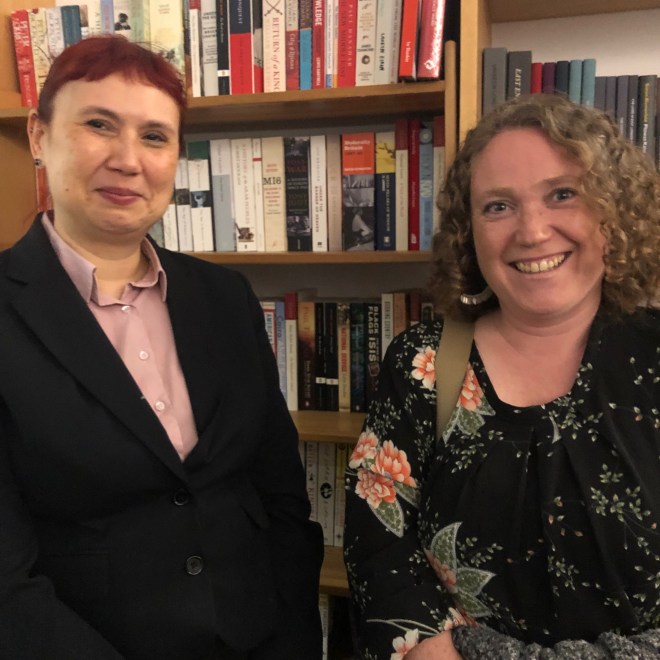
 

Lisa and Joanna


‘I’m trying to write the stories not only of how my family suffered, but also how they survived’: Natalie Linh Bolderston on witnessing and healing in ‘The Protection of Ghosts’.

Natalie Linh Bolderston author photograph

@NatBolderston

Natalie Linh Bolderston has just published her brilliant, moving debut, The Protection of Ghosts, with V.Press, exploring life before, and after, her family’s departure from Vietnam as refugees in 1978 through three generations of women. The first time we met, I was struck by Natalie’s observant, centred quietness, and natural generosity. As I got to know her work, I came to understand how these qualities have been nourished by the multiple heritages which her poems honour. Together, in our conversation, we explored creativity, trauma, and healing – and the poets whose works have helped Natalie find her path. Still only in her mid twenties, while a student at Liverpool University, Natalie copy-edited Nuar Alsadir, under Pavilion’s internship programme, and was encouraged to develop her own poems by Deryn Rhys-Jones. Now working as an editor, Natalie Linh Bolderston has already been the Silver Winner for the Creative Future Writers’ Award 2018, come second in the Timothy Corsellis Prize 2018, been placed as a runner up in the Bi’an Award 2019 – and most recently won the Young Poets Network’s 2019 Golden Shovel Competition.   As key new voice in poetry, I’m honoured to be able to share Natalie Linh Bolderston’s first in-depth interview.

AH: Can I ask when and why you started experimenting with poetry? Were there any mentors, or teachers, who encouraged you, or was it more DIY?

NLB: In my second year at university, I took a creative writing class with Deryn Rees-Jones. I hadn’t written seriously before, and just wanted to see if I could. At the time, I didn’t know what form my writing would take, but I had mainly read fantasy and literary fiction by women. My experience of contemporary poetry was limited: in my previous education, a lot of emphasis had been placed on the canon – specifically the white, male, British canon – which didn’t resonate with me.

Early on, Deryn introduced us to the work of Mona Arshi and Sarah Howe. I felt an immediate connection to both poets: I loved the vibrancy of their images, their use of myth and narrative, and their explorations of family and cultural heritage. I was interested in contemplating family history, traditional stories, and cultural identity in my own work, and reading their poems made me feel more able to do so. As a young woman of colour, it meant so much to me to have two modern female writers of colour to look up to – and to know that there were so many more to discover.

Since my ideas seemed to come to me in intense moments, images, and fragmented lines, poetry felt like the right form to express them. Deryn was very encouraging from the beginning, as well as being very generous with feedback – I owe a lot to her.

AH: Were there any other writers who helped call forth your voice? I know you connect imaginatively with poets outside the UK.

NLB: My two ‘gateway’ poets were Mona Arshi and Sarah Howe. But once I started following poetry accounts on Twitter, I found so many other brilliant poets – the ones I return to most are probably Ocean Vuong, K Ming Chang, Warsan Shire and Romalyn Ante. All four write about migration, sense of place, cultural identity, family, trauma and survival in very different ways, and have made me think about how I can approach these themes and other difficult subject matter in my poems.

I’m also in awe of them from a technical perspective – I find their images particularly astonishing. For example, one of my favourites by Ocean Vuong is: ‘one spring / I crushed a monarch midflight / just to know how it felt / to have something change / in my hands’ (from ‘My Father Writes From Prison’). I love the eerie, tactile beauty, and the emotions captured in that one moment: namely isolation, aggression, and longing. Reading work like this showed me the beautiful and extraordinary possibilities of poetry, and encouraged me to keep going.

AH: How did it feel when you heard that V. Press had accepted your first pamphlet, The Protection of Ghosts, published on 23 April 2019?

NLB: It was a mix of disbelief, joy, and gratitude! As a young, emerging poet, I was prepared to wait many more years to get to the pamphlet stage, so I felt very fortunate and very grateful to V. Press (especially to Sarah Leavesley and Carrie Etter) for their belief in my work.

I was also excited for my poems to appear together, as a lot were written in conversation with each other and form a sort of fragmented arc. Gathering them into pamphlet form made me feel more able to provide a ‘fuller picture’, as the narrative threads that have been passed on to me by my family began to join.

AH: The poems in The Protection of Ghosts speak from your own position and generation, but also through your mother’s and grandmother’s voices.   They both lived in Vietnam until 1978. Did you always plan to have a chorus of mainly female voices speaking in and out of each other, ghosted by the past?

NLB: I don’t think it was a conscious plan at first, but when I started setting down my family’s stories the multiple voices came quite organically. Anything that I create is a collaborative effort, because so much of what I write is inspired by what my family have told me – particularly Mum and Bá Ngoại. I think that highlighting this through the chorus of voices enhances the emotional truth of what they have said, and gives me space to consider how I interact with that. For example, in ‘When Bá Ngoại tells stories’, I list quotes from her alongside my own interpretations and contemplations of these.

AH: How do your family feel about featuring in your work?

NLB: My mum is very supportive, and reads everything I write. She’s one of the first people who I send new poems to – so many stem from her stories, and I want to do them justice emotionally. A lot of poets mention having an ‘imagined reader’ when writing: for me, my mum is always the reader I have in mind. She’s told me that it moves her to see how much I’ve held on to her words and experiences over the years – she actually sent me a message about it, which I keep with me:

Untitled

Bá Ngoại is the same, although she sometimes needs help from me and Mum to fully understand my poems (my mum provides Vietnamese translations for some parts).

I’ve only recently felt brave enough to start showing my work to the rest of my family. The response has been very kind – like Mum, they’ve been interested to see how I’ve interpreted, interacted with and reproduced their stories.

AH: The opening poem, ‘I watch my mother peel longan fruits –’ is both a beginning, and an ending. It slides in a series of present tense scenes from your personal experience in England, to Saigon. On “a long-ago rooftop” for your mother “longans taste like sour rain/ and street dust.” The action then moves to leaving Vietnam: “The family drives through back roads // dark as the mouths of dogs.” You embed thought and memory into taste and texture so the reader also lives the experience.   Did recreating these scenes from the past also help you to inhabit them for yourself?

NLB: Yes – I think that poems like this help me get to know a version of my mother who I have never met: a young girl growing up in extraordinary circumstances, uncertain of her future. Starting with an image of food felt like a good way to conjure this part of her life, as tastes – and other sensory experiences – have a way of making the spectral very vivid.

I don’t hold these memories first hand, but do I have the fragments that my mother has shared with me over the years – memories of memories. Therefore, my piecing them together in my poems always feels like an act of ‘recreation’, rather than setting down verbatim fact. I think that that would be impossible. So poems like the one above are visualisations of the past: collaborations between my mother’s stories and my internal lens, with a shared emotional truth at their core.

Nat readingAH: The second poem, ‘Divinations on Survival’, uses the I-Ching form, devised by K Ming Chang. Each of the stanzas takes the form of an I-Ching hexagram, and can be read top to bottom, or bottom to top, always from left to right.   One of the images is of the speaker’s “body/ like a cooked fruit unravelling across the sea. in sagging boats.” It is a really powerful way of responding to the dislocations of exile, and forced migration. Did you experiment with any other forms first – or was it always going to be this one?

NLB: The poem came after the form. After I read K Ming Chang’s poem, I was first of all awestruck by what she had created with such imaginative self-imposed restraints, and by the very contemporary way in which she had honoured an old tradition (I-Ching is a Chinese method of divination). I then realised that the sense of enigma and fragmentation created by the form would work well as a way to express certain moments in my family’s history. The stanzas in ‘Divinations on Survival’ alternate between the voices of Bá Ngoại and my mother. They are moments of fear and uncertainty, when they had to put their faith in fate and their own courage in order to survive. I think the content also references the original basis of the form – divinations give a glimpse into the future, but the readings can be unclear and open to interpretation. Likewise, my poem depicts two women facing a precarious and unpredictable future, and trying to keep going long enough to see a better life.

AH: Did you grow up speaking Vietnamese as well as English? I think your family heritage is also partly Chinese?

NLB: I didn’t grow up bilingual, which is one of my biggest regrets. I treasure the fragments of Vietnamese that I do pick up from Mum and Bá Ngoại – my mum helps me record them, which is why they end up in my poems. I feel nourished by the sounds and conversations I grew up listening to, even if I didn’t understand them. My mum taught me a little bit when I was young, but she worked full time as a nurse so it was difficult. Now, I’m making more of a DIY effort to learn, which I think will be a lifelong process.

Ông Ngoại grew up in Xiamen in South China. He could speak Mandarin and Hokkien – as well as English and some French – and so can Bá Ngoại. Ông Ngoại died when I was very young, so I don’t have many memories of hearing him speak. But my mum has told me that he and Bá Ngoại mostly spoke Hokkien together. They didn’t teach my mum or her siblings any varieties of Chinese, so speaking Hokkien was their way of keeping things private.

 AH: Like many of your poems, ‘Divinations on Survival’ uses both Chinese characters, and transliterated Vietnamese words. You also had multi-lingual work published in the inaugural issue of harana poetry . Can you say something about using these linguistic markers to evidence your multiple cultural heritages?

NLB: When writing about things that my family have said in Vietnamese (or in a mix of Vietnamese and English), I never like to translate them fully – it would feel wrong, like leaving out an important part of who they are. Mum had to leave so much behind when she fled Vietnam, but she never forgot her Vietnamese. At family gatherings – and when Mum meets up with her Vietnamese friends – most of her conversations are held in her mother tongue. And that’s so beautiful to hear and witness, which is why I want to celebrate this multi-lingual environment in my poems.

Bá Ngoại can speak Mandarin and Hokkien (in addition to Vietnamese and English) but I hardly ever hear her speak any variety of Chinese while in the UK. When we visited Ông Ngoại’s side of the family in China, she spoke with them in Hokkien. She had not seen them for many years, but they were conversing and laughing so easily. It was like the revival of another self, which again was beautiful to see.

We’ve been finding out more and more about Ông Ngoại’s and his family’s life in China from letters and photographs, so this aspect of our family history has also started to feature in my poems. For example, one of my harana poems – ‘Photograph’ – is based on a picture of Ông Ngoại as a baby, sitting on his mother’s lap. It’s actually part of a sequence of poems I’ve been writing, exploring his mother’s life and his early life. This was a time before he learned Vietnamese or English or French, so it feels right to use Chinese linguistic markers when writing about this part of his history. Chinese was part of his identity, and I want to acknowledge and commemorate this.

AH: Your poems never shy away from recording the challenging experiences which your family went through in occupied Vietnam, and then travelling to the UK as refugees. They also acknowledge the lingering impact of trauma. But the people you describe are always presented with dignity and agency.   I’m thinking about your poem ‘Bá Ngoại’, about your grandmother, who teaches you to crochet, and “fastens gold” around your wrist. Could you say something about this resilience and life force?

NLB: When writing about trauma and resilience in my family, I keep in mind this quote from Ocean Vuong:

I’m trying to preserve the acts that made us possible. And so for a poet writing out of violence, it is on one point a moment of creation like the word poet from the Greek says, but also a point of preservation – you’re doing both at once. […] To honour their survival is to record it, and keep it from being obliterated.

This is something that has stayed with me, and helps me situate my writing. I’m also trying to write the stories not only of how my family suffered, but also how they survived. I want to record what they overcame to make a better life possible – for both themselves and the next generation of children.

I think intimate moments like the one you mention show the shadows of that survival instinct: my family’s impulse to pass on their knowledge, beliefs, traditions and heirlooms (physical or otherwise) to the next generation. By doing that, they pass on something of themselves: their strength and history. In ‘Bá Ngoại’, the gold bracelet holds a lot of memories – in Vietnam, my grandparents once owned a jewellery business, and Bá Ngoại was able to make chains herself. So it felt as if she was symbolically sharing that aspect of her past with me.

AH: Buddhist practices, along with the rituals to celebrate key festivals, and the offerings made on the family shrine at different times, are all lovingly recorded. Do they feel like places of strength for you?

NLB: Yes – I would say our shrines are places of strength, preservation, peace and comfort. I was thinking about them a lot when choosing the title for my pamphlet. When we pray, we are asking for the protection of ghosts – that is, guidance and protection from our ancestors. However, by keeping their stories, traditions and rituals alive, we are also protecting those ghosts by preserving and honouring their memory.

The shrines are also places of unity and celebration – some of my earliest memories are of my family coming together and leaving food at the shrine in Bá Ngoại’s house for Lunar New Year or Ông Ngoại’s remembrance day. Those are always special and loving times.

AH: ‘Typhoon in Xiamen’ and ‘Hạ Long Bay’ both refer to a visit you made with your family members to Vietnam and China a couple of years ago, which I believe was your mother’s first visit back since 1978. Would you like to say something about the experience of that trip, for you, and for her?

NLB: We visited Vietnam for the first time in 2014. For me, it was strange and wonderful to finally experience a place that I’ve held in my head for so long. Of course, it has changed so much since my mum left, but I could see shadows of her stories in the streets, markets, cafés, and food. It was also lovely to finally meet the members of my family who stayed in Saigon – they were so kind and welcoming.

For my mum, there were a lot of feelings. Mostly, she was so happy to spend time with extended family who she hadn’t seen for thirty years, and to meet the new generation. However, she was also a little sad – she didn’t feel like she belonged there anymore. In many ways, Vietnam isn’t the same place she remembers: she told me that it sometimes felt like her life there had been erased, or like it had never existed at all.

We visited my grandparents’ old jewellery shop in Bạc Liêu, which was a bittersweet experience for Mum. It was still a jewellery shop, but it had new owners – they turned out to be the people who used to live a few doors away from her, on the same street. They were friendly, and actually remembered my grandmother. Mum was happy to see that the place had been taken care of after so long, but I think it was hard to return to a place where she made so many memories, and where her life changed so suddenly and irrevocably.

We visited China (Beijing and then Xiamen) in 2016. That was a very new experience for both of us. Again, it was wonderful to meet more family, and find out a little more about my grandfather’s early life there. Xiamen has never been a physical home for me or my mum, but it did feel a little like an ancestral home – especially when we visited one of the family shrines, and the mausoleum where my great-grandmother’s ashes are kept. We burned joss paper in a barrel and prayed for her and my grandfather.  

AH: The way you describe it in ‘Ha Long Bay’ suggests Vietnam woke something new in your own voice? You write:

 Mangroves lean in,
knotted to the rockface
with swollen roots –

their rings, I think,
as many as our fingerprints.
A black kite springs alive
from the mist,
its call in my throat.

NLB: The details I included in ‘Hạ Long Bay’ give voice to my astonishment – it is a very beautiful and peaceful place. However, I think that there is also a sense of distance there. It was my first trip to Vietnam, and I was very aware that I was there as visitor rather than a former resident. So, in a way, everything was unfamiliar and astonishing to me. Despite that, it is still a place I feel deeply connected to. That’s why I tried to allude to the relationship between place and identity by linking the landscape to our bodies, as shown in the lines you mentioned.

 H Long Bay is also a site of historical violence: during the Vietnam War, the US Navy placed mines in many areas between the islands. So I also wanted to allude to the lingering presence of that violence beneath the beauty, with lines like: ‘Children wave / from wicker coracles / like upturned shields.’

AH: ‘Operation Ranch Hand’ won the Silver Award in the 2018 Creative Futures competition, and is named for the codename “for a chemical warfare campaign carried out by the US in the Vietnam War” according to the note below the title. It begins:

And just like that, the trees fold around them.
Gas snarls at a woman’s shoulders,
presses her belly to dirt.

She does not know about the scar
that is forming inside, that her daughter
will be born wordless on a stretcher.
That she will carry the smell
of dead leaves on her skin,
her name already cremated.

I think that this poem steps out of your family’s direct history, into the wider experience of the war, and I wondered how you researched it, and the impact on you of doing so?

IMG_0348NLB: When reading about Operation Ranch Hand, I concentrated on civilian accounts – from both victims and witnesses. I think that the methods behind military atrocities are often designed to feel very removed or distant, so that it’s easier for the perpetrators not to hold themselves accountable. So I wanted to show the painful impact of this particular cruelty by removing that distance and focusing in on one life. Even now, it’s hard to know the full extent of the damage caused by the US’ chemical weapons in Vietnam, but the health effects include death by agent orange poisoning, birth defects, and various cancers. Stories like this can be harrowing to read, but I think it’s very important to acknowledge that this happened, confront the impact, and not to forget the harm and destruction that chemical weapons cause.

AH: ‘Triệu Thị Trinh, or the Lady General Clad in Golden Robe’ and ‘Jingwei’ are two poems which both speak through legendary and mythical women.   Did you find that this opened a new dimension for you within your work?

NLB: Yes: I’ve become interested in poetic ‘resurrection’ – researching and amplifying the voices of historical, legendary and mythical women from Vietnam and China. In this way, I want to find my own wider lineage of women to look up to, as well as those in my family.

In the cases of Triệu Thị Trinh and Jingwei, I was interested in the multiplicity of their identities. A lot of the accounts of Triệu Thị Trinh focus on her as a military leader, and as a woman who was desirable to men. But I wanted to get to know her other selves: her identity as an orphan, as a girl coming of age under extreme conditions, and as a protector of other women. So while my poem does depict her legendary battle persona, I also tried to show a layer of vulnerability, expressed through her sorrow over the absence of her mother. I’ve since decided that I would like to write a sequence of poems about her. I’ve already written the next poem, which focuses on a particular coming-of-age moment: her period. The third poem is as yet unwritten, but I’d like this to detail her visits to the graves of and shrines to women who were lost in the war she fought, and the conflicting emotions attached to this.

In Chinese mythology, Jingwei is a bird reborn from the Emperor’s daughter, who drowned in the Eastern Sea. In my poem about her, I wanted to zero in on the process of transformation – the phasing of one self into another – and the sense of loss and estrangement associated with this. I think that I’d also like to return to her story in the future.

AH: ‘My mother’s nightmares’ begins describing how they “taste like seawater and vomit, handfuls of spat blood. The sky is a paper/ bruise, and it is always 1978.” The poem is in three sections. The second is the daughter’s dreams – “There is a garden where her skin is drying on the line.” The third draws mother and daughter together – “We both know there are some things we can only/ consider with our eyes closed.” Was it important for you to explore, and record, how trauma can speak through generations, even within the context of the very warm, and nurturing, connection between yourself and your mother, which shades so many of these poems with a movingly deep love, and tenderness?

NLB: Yes: I think that in this poem, I wanted to show one of the many ways in which my mother has taught me how to love. Although my mother has always been a figure of strength in my life, one of the ways we express our love and trust is through our mutual willingness to share our vulnerabilities with each other – and her willingness to share even the most painful aspects of her past. I think that trauma can manifest in very intimate moments, when you are allowing yourself to be most open. That’s probably why these recollections sometimes come at times of particular closeness, like the one described in the poem.

More generally, I also think that the stories my mother tells me are testaments to the strength and solace of familial love: it is her family’s love for and their determination to protect each other that kept them going through impossible circumstances.

AH: ‘Reflection’ is another poem which enters difficult spaces, describing a time when your mother apparently revolted against her own body while still in Vietnam by trying to stop eating, and then later sought to rub out visual traces of herself in you:

Asks if I remembered to pinch

my nose that morning,
as if I could exile her
from my face.

It suggests that one of the after-effects of trauma can be to alienate people from themselves, and their own bodies. I wondered if that was something which you wanted to draw attention to?

NLB: Yes: when my mum told me the story, it seemed like an expression of pain at a time when she felt voiceless. When your voice starts to disappear, I think that there’s an impulse to attempt to make the rest of your body disappear too. I wanted to show that feeling of powerlessness and isolation can manifest in the silence.

In the section you mention, I was contemplating the effects of intergenerational trauma, and how that feeling of self-alienation can be passed on. It was as if my mum thought that I’d be better off if I looked less like her – that I wouldn’t experience the same level of estrangement from my body if I could somehow assimilate with exclusionary western beauty standards. But of course there was no way to truly erase our internal and external similarities, and I’m grateful for that. She has always been someone who I look up to for her strength and kindness, and who I seek to emulate. I allude to this in the final line of the poem, when I ‘begin to stitch her skin over mine.’

AH: Questions for My Mother’ identifies the racism which she faced within her nursing career in the UK on occasion, but also the danger which originally “chased” the family from Vietnam, after first “lining their clothes with the family gold” to travel. You draw together both the lack of choice which makes people refugees, alongside the hostility which their need for refuge can engender. Do you feel a sense of connection to the current generation of people obliged to flee their countries?

NLB: I think that everyone should: it’s a matter of empathy and compassion. Unfortunately, a lot of people fail to extend that. Everyone’s story is different, but I do see some parallels between my mother’s experiences of coming to the UK and the experiences of refugees now, especially in terms of the way they are treated as ‘other’.

My mum was generally expected to take this racist treatment in silence – especially in her profession – and in this poem I wanted to break that silence. I used multiple scenarios to emphasise that such acts of discrimination are not isolated incidents – they are incessant and exhausting. They make your everyday environment a more dangerous and terrifying place, and solidify the feeling that you don’t belong.

I know that this is the reality for so many current refugees – both in everyday interactions and at a governmental level. I think it’s important to listen to their stories and to think about what it’s like to be forced into that position. Warsan Shire bears witness to this kind of trauma in much of her work – for example, in her poem ‘Conversations About Home (at the Deportation Centre)’ – which I find so powerful.

 AH: The final poem, ‘Aubade’, is a healing dawn song, addressed to your grandmother. It shows her surrounded by her generations of children and grandchildren, who have made full, loving, nurturing, valued lives in the UK.

Let your daughters cook stick rice, egg rolls, soup,
thirteen cups of jasmine.   Notice how they look less alike these days:

some lipsticked, grey-flecked, others ageless. See the chrysanthemums,
lilies, wild roses awaken at their silk shirts, the gold peeking

from beneath their sleeves.

The Asian American ceramicist and writer, Jade Snow Wong, made food one of the symbols of her creative, cultural and intellectual identities, writing in America in 1950, and I wondered if it was similarly resonant for you?

NLB: Yes – I think that food is so central to ceremony, unity and nourishment across generations. When we leave food at the shrine, we are inviting ancestors – both distant and recent – to share in our celebrations. It’s a way of remembering who we are, and honouring who came before us.

‘Aubade’ is about my grandfather’s death anniversary, which we observe every year – so in this poem it is mainly his memory that is being honoured. The anaphora was intended to sound both prayer-like and ritualistic. Grief can be a chaotic and disorienting experience, so I think that some comfort can be found in following set ceremonial practices. Ritual restores some measure of order, if only for a short period of time. Preparing and sharing food is part of this: it’s a practical, necessary task that you can get on with when you don’t know what else to do or say. In this poem, it felt like a very active way of processing loss.

Food is also tied to love. My mum is very openly affectionate anyway, but one of the ways in which she expresses her love is by constantly checking if I’m hungry, if I’ve eaten enough, if I’m eating well. It’s the same throughout my family – I allude to this towards the end of ‘Aubade’, when Bà Ngoại is being encouraged to eat: ‘Surrender to a bowl, / a fork.’ I think of this as my family’s way of strengthening and restoring each other.

AH: You have recently spent a week on an Arvon retreat with Bi’an, the UK Chinese Writers’ Network. How was that as an experience?

NLB: It was lovely and inspiring to meet so many Chinese-heritage writers creating work across so many genres. It felt like a very warm and supportive community, and the tutors – Jeremy Tiang and Yan Ge – were very inclusive and encouraging. Jeremy held a poetry translation workshop, where we translated an old Chinese poem as a group – Jeremy provided the literal translation, and we came up with variations on this. It was a great experience – I hadn’t considered trying translations before, but now I’d like to try translating some Vietnamese poems with my mum.

We were also fortunate enough to have Sarah Howe there as a guest tutor for one evening. It was wonderful to have the opportunity to watch her read and to chat to her afterwards – I told her that she was one of the first poets who made me want to write.

AH: Have you made any contacts with contemporary Vietnamese or Chinese poets outside of the UK?

NLB: I managed to meet Ocean Vuong at his Forward Prizes reading in 2017, which was a very special moment for me. I don’t think I’ve met any others personally, but I follow and have briefly interacted with several on Twitter. These include Đỗ Nguyên Mai and Cathy Linh Che, both of whom I admire very much. In an interview, Đỗ Nguyên Mai said that many of her literary heroines are ancient Vietnamese female writers and political figures. I love how this manifests in her work, especially in her poem ‘From Phùng Thị Chính to Her Child’.

AH: Where to next? I know that as I write these questions, you’re currently travelling in Vietnam again?   Is this somewhere you would like to spend a more extended period of time?

I think that my next creative destination will be an eventual full collection, but I think that this will be quite a gradual process. Poems come to me in lines, fragments, and images, which I then gather, edit and fit together. So I tend to write quite slowly.

I’m not sure what my next physical destination will be, but I’ll definitely go back to Vietnam and China at some point in the future. My April 2019 trip was my second visit to Vietnam. I tried to be more observant this time around – the first time, I think it was all so new to me that I struggled to take everything in. But this time I asked my family a lot of questions and made notes wherever I went, so I feel like I managed to learn even more about old stories, legends and traditions as well as our family history.

Because I didn’t grow up there, I don’t know if Vietnam would ever feel like home – although I know that we can have many kinds of home. I think of both Vietnam and China – specifically Bạc Liêu, Sóc Trăng, Saigon, and Xiamen – as ancestral homes, and so I’ll always feel very connected to both countries in that way.

Natalie Linh Bolderston’s ‘Middle Name with Diacritics’ came third in the National Poetry Competition, and is on the shortlist for best single poems in the 2021 Forwards Prize Awards.  You can read it here. 

The Protection of Ghosts can be ordered through V. Press here.

pamphlet pic

‘When your mother is being unmotherly, it’s taboo to show that’ : Karen Smith on the transformative power of creating in her debut ‘Schist’.

Karen Smith author photo

Growing up is seldom easy – but sometimes it can be considerably more difficult. For Karen Smith, claiming her voice as a poet involved exploring a family history shaped by the mental illness experienced at times by both her loved, and loving, parents. How she did this, and the moving, deeply original poems which respond to her childhood and teenage years in the suburbs of South London, and now living near the South Coast, were the subject of our conversation in the Royal Festival Hall, where Karen works as a Poetry Cataloguer in the National Poetry Library. We talked about imagined landscapes as a form of psychic 3D printing, the challenges of coming to a creative life in the aftermath of complex beginnings, how trauma can be redefined through bringing the light of your adult life to the dark places of your past, and the healing, and the sense of release, that may ensue.

AH: Can I begin by asking you about your journey into poetry, Karen?

KS: I’ll never forget writing about Ted Hughes in an exam at school.   He was writing very graphically about the wind “flexing like the lens of a mad eye” against the house. As I deconstructed the poem, which felt like climbing in, my body responded to it physically – as if it was real. I read English at Goldsmiths after that, and took an optional module on Modern Poetry because I’d been fired up by Moderns the year before (plus I hated long books!). I was shy and always more of a listener in the seminars, and the more I listened the more I could see in the poems. That surprised and excited me. It was like a beautiful bomb had gone off in my head. Part of my internal world suddenly had the music to dance to. During my MA at Kent I read John Ashbery. He grew on me. Sometimes it can be like with that with relationships too. He had a quieter voice, but it was such a beguiling voice. The more you looked into what he was saying – it was like a transformation. You were seeing at a different level. It actually changed your mind. There’s something so special about that experience. And even though Ashbery has lots of references in his work, and you don’t always get those, it doesn’t matter because of how it makes you feel, and see differently. To me, that really carries weight.

AH: I remember you telling me you were starstruck about hanging out at the Poetry Library – around the world that the books represented.

KS: Yeah, definitely. It was a little bit of peace from the world, but where you could be receptive and settle into yourself, and explore your mind going off in these different directions. I found it therapeutic I suppose, but also just so exciting. I enjoyed the fact that there was this quiet space in the middle of London where you could see virtually everything that’s been published in poetry, in modern times, and discover new voices that spoke to you. They seemed to articulate parts of yourself you were barely yet aware of.

AH: You recently published your first pamphlet, Schist, as one of four Laureate’s Choices for 2019 through the Poetry Business and smith/doorstop. When did you turn from being a reader of poetry to also being a writer of poetry?

KS: When I left university and did various jobs, I really missed that sense of intense connection to literature I had when I was studying. After a number of years, I started to feel, maybe I can try to write, as one way back in. I dipped my toe in. I went to a very short course. It was four weeks in the summer at Evolution Arts Centre in Brighton. And it wasn’t a poetry course, it was just creative writing. It didn’t feel great at first, because I didn’t feel I knew what I wanted to say. The other participants picked up on that. And so that was a little bit painful. But I thought I’d keep going because I knew that feeling of being excited and connected – and maybe I could get back there. And then, the poem ‘Schist’ came to me. I went to see my uncle. I was away from home traveling and I woke up one morning with the words playing in my head. I just started writing it down quickly because it felt like the poem was coming to me rather than me generating it. I had been working the previous day on different poem, so I think it kind of loosened something. That’s the first time that I felt a poem again in my body. I felt excited. The writing group were all very excited too. So I thought maybe there is something in this that I can do – even though I’m not sure how I’ve done it.

AH: Schist names your English teacher, Mr. Grey with his “antique-shop air”, (leading to the beautiful admission “I was hot for you, /Sir”), as an early source of inspiration. Were there other teachers, mentors and writers who led you forwards?

KS: Mr Grey was an enthusiastic teacher and his love for literature was very influential and inspiring. He was appreciative of my essays, but we didn’t really do creative writing very much. It was more criticism and analysis.

AH: In your writing life, it was really Carol Ann Duffy who really recognized your ability?

KS: I’d been to a couple of creative writing courses in Brighton before I met Carol Ann, led by Gary Mepsted and John McCullough. They were very encouraging and nurturing. I owe a debt to them. When you’re starting out, to have someone who guides you gently is really important, if you’re self-doubtful.   But when Carol Ann recommended me to smith/doorstop, I hadn’t published anything and I didn’t even really think of myself as a poet. It was a real shock, but a nice shock. It was after I went to her five day “Starting out in poetry” course with Michael Woods at Moniack Mhor. It wasn’t a master class. That’s something I admire about her. She’s teaching at every level. She’s supporting right to the grassroots.

AH: We talked about John Ashbery. Are there any other books that have spoken to you over the years?

KS: I’ve always loved Alice in Wonderland. I keep going back to it because it’s mesmerizing to me – that surreal world. You know, what it feels like to be a child and the craziness of the world – all the playfulness in it.

AH: It’s a book that also captures powerlessness. And incomprehension – and the sense of there being no rules. That’s one of the things that your adult work addresses. Can I ask you about the title and opening poem, ‘Schist,’ which returns to a sun-filled seaside afternoon on the rocks at Mullion, in Cornwall. It begins:

One in a million, you said,
that summer in Mullion.
But we could never agree.
And we bickered all afternoon
between beach and lagoon,
the tide began to carry
more than it gave,
redrew the lines of flint
along the splay-veined shore.
Already, a boat was listing,
letting the water in.

You afterwards remember how the couple “bathed like lizards. Double spaced” – but the next line finds “In the light, a certain angle of extinction, / fulsome but unforgiving.” I know your work quite well, and you have that ability to capture beauty – but in the other hand to hold darkness. I wondered if you wanted to say something about those two forces being present in Schist?

KS: Very nice question. I like to try to capture all those elements, but I’m always conscious of the dark sides of things. And even at school, my teachers sometimes used to recommend things that were a bit strange and disturbing, because I’ve always been drawn to that. There’s a complete experience where you can try and hold everything – to be true to all aspects.

AH: In the dictionary, ‘schist’ signifies layered, metamorphic rock, whose “twist of minerals, caked and forged/ under an ocean of heat and torsion” is the backdrop for your poem. I wondered if there was a reason you felt drawn to this geological imagery, over and above the actual Lizard Peninsula location of the memory?

KS: I am really interested in geology.   There was something about the landscape there that was really arresting and just stayed with me. And so I thought, well, why not explore that? I did a bit of research and then came across these geological terms, which are very beautiful in themselves. The language around the rock was so evocative – that kind of steered me towards playing with it. I think it made a path for other things to come to the fore in my mind. I didn’t set out to write about relationships, but as I was writing about being there with that landscape, the poem emerged in that way quite organically.

AH: One of the topics which your pamphlet explores is the experience of growing up in complex family circumstances. You write about some of the mental health challenges your parents faced. While as an adult, these are things that we can look at with compassion, as a child, it’s very different. When I read about the layered metamorphic rock and the twisting and the pressure and the compression, I thought about some of your other poems about children feeling squeezed and twisted by enormous epic, forces – like the earth’s plates – that they have no control over. Does that seem fair to you?

KS: Yeah, definitely. I think when the experiences are so deep and strong in your psyche, they emerge in that way. You don’t consciously say I’m going to choose this particular symbol, but you find yourself drawn to things. Sometimes, after I put it in the poem, I realized there was some kind of analogy for my own experience. I think it’s good not to be too conscious of that at the time.

AH: I think sometimes we need to look away to see. If you really absorb yourself in the material detail, when you have something very difficult to write about, actually not writing about it often, paradoxically, makes a space for the difficult thing to come into the writing. If you go at it straight on, you lose it. Whereas if you look studiously to one side, there’s always a potential for it to infuse your thought. What made me think about that particularly is Schist’s second poem, ‘Orthorexic Creed.’ It opens with an epigraph from the Catholic Nicene Creed, which it subverts, to address your own father – in the grip of an apparently remorseless eating disorder:

We believed it was right, Christ,
the only kind of love,
eternally forgotten by the father,
no word or song, night after night,
tuned out from tuning in,
forgotten, not savoured,
of being one with the illness.
By him all food was weighed.

For us kids and for our staycation
he came down from Croydon:
by the power of the catamaran.

Eating disorders within families are deeply difficult to write about, but here, as very often your work, a dry wit, and emphatic sound-play – “right, Christ” – leaven the darkness, and help both writer, and reader, to regain a measure of creative agency. I wondered if you could comment on this as a strategy? Did the echoing Nicene Creed give you a way of making space to talk about something else?

KS: Yeah, I think it definitely did. I’ve taken the structure of the Nicene creed, and kept quite close to the form and the sounds. It was a very powerful structure, or container, for an experience that was very hard to talk about and to explore. I was having therapy at that point, talking about my father and my mother. I was ready to reconnect with that time in my life, a time when I felt very vulnerable. Writing the poem kind of dovetailed with that process. I woke up with a line for the poem in my head. It was the line “Eternally forgotten by the father”. This is part of the Catholic mass. If you grow up Catholic, it’s very ingrained in you, it becomes fundamental to your language.

AH: Although I am a Buddhist, I still have the Anglican psalms from my childhood. They are programmed like a rhythm into my body, so I know where the beats and the emphasis falls.

KS: It’s kind of a music isn’t it? When that line hit me, I felt, oh, this is something different. It has lot more to say, you know. It didn’t come to me all at once. I remember I was ill that day and I couldn’t attend my poetry course. I was able to instead to write most of the poem.   The form seemed to hold what I was trying to say so well. It was exciting because I felt that something inside me needed to be said. It needed to come out – and this was my way of doing this. Having the vessel meant it could come out safely.

AH: You say really devastating things in the poem. “no word or song, night after night,/ tuned out from tuning in,/ forgotten, not savoured”. These are very painful things to admit in relationship to parents. Somehow, because they are within the music of the poem, it has a measure of resolution at the end.   It’s like the humour keeps life in the poem? Even in very sad bits, because there’s this dry wit, and the sound-work, life is always present. Even as it’s looking at its own dark, places, life is also resisting them.

KS: I think that’s pretty important, for the reader obviously too. But mostly actually for your self. The work needs to find balance, just as a person does. If you’re going to let the weight of the darkness in, you need to counter it with light. The humour says I can take that forward in my own way. You know, there’s a kind of affirmation.

AH: We’ve both talked about bearing witness to things that people find very difficult to talk about. I feel one of my responsibilities is to keep the reader safe, if I’m showing them something very scary. I say this darkness exists in life – but I’m alive, and I’m telling you about it, in a way that also has beauty and agency. And it seems to me that is part of your process?

KS: Definitely.

AH: The sea, but also the imagery of seaside towns, and funfairs, are threaded through Schist, making a first appearance in ‘How to Survive a Blackgang Chine.” The poem addresses a child “staggering/ round the black planks of the Crooked House.” Do you think it can be freeing for writers to create imagined landscapes, in which we site our younger selves?

KS: I’ve found it really useful to use space with my imagination, to plot out an area that somehow expresses your inner world, and maps itself onto the landscape.

AH: Like psychic 3D printing?

KS: Yes. It’s not just something inside you, that has to be hidden or withheld from the world. It’s actually this place that is real to you. I find that useful – to use places that I’ve been to as a mental landscape. It becomes something that your mind uses to plot the narrative of what you’ve experienced. You bring it into a physical space because emotions live in the body, and bringing that emotional experience into a physical form makes it comprehensible.

AH: Definitely. Like the sea, anger is recurrent energy throughout Schist, where it seems to function as a centreing force, which can return the speaker to herself when her identity is threatened. I’m thinking particularly of ‘Miss Etheridge’, which answers back down through the years to an unfair school teacher – guilty of playing favorites. It ends “I still think of you and your flags. The pig that got in.” Could you comment on some of the ways anger moves within your work?

KS: I think it’s something that I’ve been able to harness more recently, because in my family anger wasn’t something that was really accepted. But of course it’s a natural human emotion, and despite religious or cultural ideas, I think it has a strong energy and you can harness it in your poems. Learning how to do that is a real spur to get that material out. Those are the kinds of experiences – whether they’re anger-inducing or not, things that are very emotional – that can come from such a deep place and be very sustaining, in the sense that energy wants to find its way out. It’s a question of finding ways to allow it.

AH: I found it very difficult, for decades, to connect with my own anger. When I finally did, it seemed to me as if I was reaching out, and finding my own hand waiting for me. It was like – so that’s who I am. It was part of me. It had very deep roots that I’d really been cut off from –because it had been too dangerous. As you know, I was sexually abused by my mother, as a child, and my first focus was simply to try and stay alive. And once I did express my own anger, as an adult, it severed me from my family of origin.   In real terms, it was a very dangerous force. For children who come from difficult backgrounds, it can be hard to own your own anger.

KS: Absolutely. Yeah. I think it sometimes it takes a long time for it to be able to come into your consciousness really. It’s a survival strategy. But if you cut it off, you’re cutting off part of yourself, so it feels first of all healing, actually, to connect with anger, and to say this is a part of my experience. This doesn’t mean that I’m a bad person. It doesn’t mean people are going to judge me.   It’s just one of many human emotions.   One that helps to guide you back to yourself and to say, well here are my boundaries. This is my identity and this is my experience. You know, it just helps you to take ownership of that.

AH: In my own case, it allowed me to define that what shouldn’t have happened, did happen. Your mother had periods of being really very unwell, and behaving in ways that were not maternal or nurturing. Because she was very unwell, they were not in her control either.

KS: Yeah, exactly. It wasn’t a question that she didn’t want to be a mother. She had two sides to her, where she could be very sweet and caring and nurturing, and then some of the time be a completely different person, sort of unrecognisable. I’ve lost boyfriends because I brought them home, and then I didn’t realise that she’d been in one of her psychotic states, and she would just go completely beserk, be really paranoid. It was hard to explain to people really. They didn’t understand that it wasn’t that she hated them.   She was the same to me, you know.   It wasn’t that she rejected me or my sisters, or that we’d done anything to provoke her, she just wasn’t well. I think there is a process of coming to terms with that. Part of you is angry – angry because it hurts, because it ‘shouldn’t be’. You come to understand that in the context of, somebody’s illness – as opposed to a negative intention towards you.

AH: Absolutely. One of Schist’s plainest, saddest – and most moving – poems, is simply titled ‘Her’. Structured within two only subtly different sections, its unstable boundaries suggests porous states of mind, reflecting and shifting points of view between a mother and a daughter. ‘Her’ begins:

You walk up the white corridor.
Smile at the nurse. Fix my hair.

I am trying not to look like you
and not take offence at what everyone says.

This is what it means to hear hell.
They put me in one room, you in the other.

This time we hear the same sounds,
though they make a different message.

The pills help you realise that
voices have no bodies. You’re real mum,[…]

Could you say something about the doubling and mirroring structure you created, which refracts, and blurs, the poem’s two halves, and generations, into each other?

KS: I wanted to write about my mother for quite a while. When I wrote ‘Schist’ I wasn’t thinking of her but, but it made me think of her later – because of the etymological roots of schist, the idea of being split and doubled, and schizophrenic.

AH: This is one of the conditions that your mothered suffered from?

KS: Yes. Since I started writing seriously, I wanted to say something about her, but I stayed away from it for quite a long time, because it just felt like such a big thing to write about, and how was I going to approach it? And you know, when your mother is being unmotherly, it’s taboo to show that. How are people going to react? And there was always this repression of it within the family too, you know, my mother having schizophrenia and my father having an eating disorder. It felt very risky to actually start to talk about it, on the page. Very unknown territory.

AH: I can relate to that. Whenever I tell someone that I’m working on a collection about being sexually abused by my mother – half the time, it’s like I shot myself with an invisibility gun. Suddenly, I cease to exist.

KS: I don’t think they know how to react. It doesn’t fit with what’s safe to think about. We’ve created that figure in society of the ideal mother – or what we think all mothers should be. And, it’s very upsetting to people to pierce that really. You struggle with your own feelings about it. Am I doing her damage? Am I harming her and the family? But if we don’t acknowledge suffering, we can’t change it. I wrote this years after she died and I think that that did free me up. I had a lot of love and happy times too. I felt close to her and respected her. One way I kept myself safe was to try to live up to her expectations. But I also wanted enough space to be me, to be different. When someone’s ill, it helps to remember they are still present as a person, it’s just that they get obscured by the symptoms. As a society we’re beginning to not be so hesitant to voice that now.

AH: It’s also part of a larger project to de-stigmatise issues around mental health. For people with mental health challenges, certainly historically, it was much more difficult to manage them. I think the medication now is less impactful. ‘Ghost Train’, following immediately after ‘Her’, shows a younger sister hanging onto her elder sibling as they rush into a scary ride – which hurtles them headlong through the fears of their unstable childhood. The rhymes in the first stanza have a lock-down effect, predicting the inescapability of the lurching upsets which will follow:

Even before we clattered
into the blackness, I was
already there. Eyes shut
head buried in your hair.
Ruffling and screeching like hens,
our bellies cracked like eggs.
My insides strained to escape,
to get between us and them.

You use rhyme with considerable impact in your work. I wondered how consciously you reached for it, and whether you felt there could be a reassurance in the linguistic control which this provides when writing about difficult material, over and above to the sound-pleasures which it affords?

KS: I’ve always enjoyed rhyme and the oral qualities of the words. I enjoy making those sounds quite consciously, but I think in this poem it was more instinctive.

AH: Often poems for children rhyme?

KS: I think it’s putting yourself back in that place isn’t it, which can be difficult? But if you can put yourself back there physically, almost try and remember how you felt bodily, and then sometimes you instinctively reach for those structures – the rhyme and the more simple language. I think it did help me as well – to enter that territory. It’s not very enjoyable to go back there. It’s only human nature to want to avoid those feelings again. It definitely helped for me to feel okay, knowing I’m going to have a predictable structure here at least, in the beginning, to ease myself into this very uncomfortable space. And so the rhyme felt like a safe way to do it really. It enabled me to travel through unstable ground, which was more the experience I had as a child. In the poem, I’m able to find my way to that point where I could connect with the trauma of it really. It did take me a while to actually get this poem finished, because lots of it felt blurred in my head. That’s just part of going over that material, and parts of your brain trying to keep it locked away. And you can’t always quite see the full reality of what you experienced. The poem really helps to diffuse that kind of memory and allow you to reconstruct, to re-member parts you might have ‘resolved’ by forgetting.

AH: When I write things down, and I have to face them, I can find it devastating. But afterwards, once I’ve made a piece of work, it becomes a repository for that very difficult thing which it holds. Each poem is a box, and I can shut the lid and then open it again when I want to look inside. The work allows me not to forget, without requiring me to remember each day.

KS: Exactly. Yeah. It’s a kind of processing, isn’t it? You’ve really engaged with it – but transformed it at the same time.

AH: The three line poem, ‘In Search of the Pepperpot’, deploys a delicately wrenching compression of alliterations and assonances to bring to mind a medieval lighthouse lost in fog on the Isle of Wight, ending “Wrecked souls, pray for me.” Like ‘Schist’, and ‘Poseidon’s Trident’, it finds its forms of expression through English, and specifically South Coast maritime landscapes, and I wondered if you could say something about your imaginative and real relationships to them?

KS: Again, this poem is another real experience. I was lost in the fog on the hillside, looking for this medieval lighthouse. I had that feeling of being completely lost. I could not even see my hands. There was the irony of looking for this lighthouse and not being able to see it. And I just felt that it said something about my experience, you know, as a child but also as an adult, really and within this landscape of the collection.

AH: Which is also the landscape of where you live now near the South Coast, and you have family roots going back, it seems, a long time?

KS: We grew up in Croydon. We always used to holiday in the Isle of Wight. It was very familiar to us – almost like another member of the family. It’s been a canvas really for some of the things that have unfolded in our family. It has a real meaning to me over and above just being a place. I wanted to include that in the work.

AH: Like many poets, your work also directly addresses its own forms, and relationships to its materials.   I’m thinking of ‘The Contortionist’, and ‘Schizophrenia Test (amended for poets)’ and ‘Drawing Lesson’, which includes the wonderful couplet “Imagine you’re a child/ wearing your eyes for the first time.” Is this process of reflection a particular interest for you? Would you like to say something about those poems?

karen at soutbank

KS: I think that reflection has always been important to me. You can gain a lot of insight into yourself and not only in your work, but you know, generally being reflective about your own mind.

AH: But this is also poetry thinking about how it is made, holding the mirror up to its own self?

KS: It’s always something that I want to reflect on – the process, and what it means to be a poet, and the process of making, and how that can sometimes be very uncomfortable and painful really. And there’s another poem written, called L’Oeuf’, about a hen laying an egg very slowly. In that poem too, there was something I needed to incorporate – because the experience of writing was intense too. I knew I wanted to touch on these very personal, very painful things. I had to incorporate what that felt like, that feeling of trying to embody this experience into words. You know, it’s trying to make it come alive on the page and really be truthful, incorporating all aspects and, and doing that, doing that fully, you know, to feel that you’ve really gone as far as you can with it. As well as the trauma of talking about these difficult things, part of the process of writing is difficult too. It’s all very painful and risky, and even though my parents aren’t alive anymore, it’s still feels dangerous. They’re not here physically, but parts of them are inside of you, and you can still hear their voices and, and you can still get a sense of what they would think and what they say, and so it’s still a very, very present danger.

AH: Yeah, absolutely. I really recognise that from my own work. While there is deep sadness in Schist – and clear witness brought to the challenges for children of growing up with parents whose mental health is fragile – there are also repeated moments of sheer delight and radiance. I’m thinking of ‘Driving in Iceland’, which is laid out over two pages, so the stanzas ring an empty whiteness. It begins “It was like being born/As if a lamp had fallen on its side/ leaking light.” Would you like to say something about these poems – which often include the figure of your partner as a co-presence – and about the idea of healing, and creative self-regeneration, more generally?

KS: Despite difficulties in childhood, I was always a really happy child. I often remember thinking I’m really happy!. And I think there’s something about that joy that we need to celebrate really. And I think that helps to cope with the darkness too. There’s a real joy in being alive and to my mind, it’s also the joy of language itself and, just a feeling of those sensations – laying in a field with friends after an exam – pure freedom. And so those moments really were very important to me and I think that’s why they’ve come out in my work. Sometimes when you have intense traumatic experiences, I think you may also find an intensification of the joyful ones. There’s so much so much pleasure in just being.

AH: Yes, definitely. The penultimate poem, ‘Burning the years’, is addressed to a “you” which the footnote identifies as the “Protestant martyr & East Sussex ironmaster Richard Woodman, brother of my paternal ancestor, who was burned to death in Lewes.” You describe his torture, using “iron finery/ forged by your own hand”, and the poem ends

Come,
walk with me in the dark hours,
tell me what we don’t share,
what we do.

Would you be able to say something about the sense of kinship here?

KS: My aunt did some family research about this figure, our ancestor, and uncovered his suffering. It was a terrible, terrible death. I now live quite close to where he lived and was burnt. I wanted to connect and to say something to him. As a historical person, he’s still very alive in the imagination. He came into my head, and I felt that there’s something very comforting about being able to speak to somebody else who has been through something really traumatic. He was persecuted for his religion. He was part of the family. I wanted to move beyond the confines of time and space to feel as though I could talk to him like people do, when they’ve lost someone.

AH: We were talking earlier about looking at something, or someone, else to see yourself.

KS: I think it makes it easier to digest, for both the writer and the reader, because you don’t really need to have it spelled out. It’s really hard to take if it’s too raw. Poetry especially has this compressive quality, this kind of indirect approach, where you’re able to take on these big subjects, you know, without frightening people away. It’s about communication and connection. Finding whatever way you can to empathize with the subject, with the reader, with yourself.

AH: The final poem ‘Calling Pluto’, returns in the present tense, to your father – using tangy, everyday language to remember the stories he would tell you over the phone when you called him, and “that last night in the hospital.” It is a poem of tenderness, which celebrates a mutuality of care between parent and adult child, and suggests that with their new-found equality comes the possibility of reframing past hurts, and conferring grace on both parties? Could you comment both on the process of creating Schist, and now of sharing your work with a wider readership?

KS: It’s been a difficult process, but it’s really changed the way I feel about the things that I’ve spoken about – in a very healing way. I’ve come to settle them somehow. It feels like I’ve really worked with them, you know, really engaged with them – with the things that were inside my head and, and wanting to be spoken. And so it feels different now. Somehow the pressure has been released from keeping it inside, that kind of burning feeling – that’s released. And that they might bring a touch of joy and insight to another mind, or change just one angle of vision… that’s all I hope for as a writer.

AH: That’s wonderful. Your poems are really extraordinary. I think they’re going to speak to many people, very deeply. Thank you Karen Smith.

To celebrate Midsummer, Karen Smith will be reading with Yvonne Reddick, Victoria Gatehouse, and Natalie Burdett at the Yorkshire Arboretum.  More details here.

Karen Smith will be reading from Schist at Burley Fisher Books on 9 May 2019.

Copies of Schist  can be ordered here

schist cover (1)

The Work of Witness: testifying to sexual abuse in childhood by alice hiller

PHOTO-2018-10-26-21-22-39

Alice Hiller on ‘Leaving Neverland’  – and writing about her own experience of sexual abuse in childhood in her poem ‘elegy for an eight year old.’

In common with most people, I was deeply impacted by watching Leaving Neverland. It made me think about the work of witness – which each of us who has been subjected to sexual abuse in childhood must go through, if we want our experiences no longer to be hidden. As someone who does not share this history, Amanda Petrusich on the New Yorker nonetheless found it a “gruelling and devastating film that asks viewers to reconfigure how they think about both Jackson and potential victims of rape.”

Like James Safechuck and Wade Robson, I was subjected to same-sex, sexual abuse in childhood.   However, my abuser was my mother, not someone ‘famous.’ All the same, I felt as if I was watching a refracted version of myself as James and Wade spoke. They described gradually coming to a place in their lives, and within themselves, where they were able to be open about the sexual abuse that had been inflicted upon them when they were too young to understand, or resist. There was a necessity to their courage, both personally, and morally.

Neither of them had been able to testify against Michael Jackson while he was still alive. This was their chance to create coherence between their inner knowledge of themselves – and how they appeared to the outside world. It supported other young men who had previously given witness to similar alleged experiences with Michael Jackson. James’s and Wade’s open-ness also supported the larger community of people making their lives in the aftermath of sexual abuse in childhood.

My own acts of witness about being sexually abused by my mother are of course less publicised, but ongoing. They take place within my poems, performances, essays, and life-writing.  I also speak about this subject with members of the public, and medical practitioners.   Like most sexual predators, my mother was unknown beyond her immediate circle of family and friends. To my child’s eyes, though, she was as powerful, and compelling, as Michael Jackson was to the boys he allegedly sexually abused.

While it is less common for a mother to perpetrate sexual abuse on her child, my experience nonetheless aligns with many other long-running, private and domestic acts of sexual abuse on children. Knowing this, helped me understand that my writing could potentially be of service to my community – by allowing other people to find elements of what also happened to them represented in my words.  These include the confusing experiences of being groomed, our feelings of powerlessness and shame while the abuse is ongoing, and the potentially troubled aftermaths.  Barnardo’s Charity estimate that one in twenty children are sexually abused, and at least half of them have ongoing problems in adulthood, requiring help.

I had that ambition of representation for my poem ‘elegy for an eight year old’, when I entered it for the 2018 Creative Futures Awards. The first lines came to me when I was walking through Brompton Cemetery in London, early one cold January morning. I saw the rows of ranked graves. Some were tilted and leaning, with their names eroded almost to nothing. Others stood upright as soldiers, with pin sharp lettering, refusing to let their dead be forgotten. The light was a flat, yellow grey – as it would have been at that time of year, back in January 1973.

avenue

It takes ten minutes to walk across the cemetery. Passing between the graves, it seemed that the rows of silent, buried human remains lying beneath that earth, were somehow also the layered, hidden memories of the uncountable numbers of people who have been sexually abused – in the present day and historically. Their unwitnessed, unspoken lives and histories surround us.

In the quiet, empty cemetery, I felt as if I was walking with them – as mourners walk with the body at a funeral, to keep it company, and let it not be alone. My awareness of this became a candle, lighting my way. I also had the sense of my own deep, layered memories, waiting to rise.   And then, into my head came the words:

she perches upright as a needle
before morning break

I knew straightaway they were about the shocked, painful winter mornings, early in 1973, when I was eight and a half, and the penetrative abuse had recently begun. The building where I was remembering myself was a single storey, village primary school. I was driven there every morning from the rented cottage on the main street of a nearby village, where the abuse took place in my mother’s double bed. We had moved to Wiltshire when we came to England, right after my father’s death in Brussels, late in 1972.

Each night in our new home, my mother would expect me to be waiting for her in her bed, or to cross the landing from my bedroom when she came upstairs. What happened next was devastating. It left me sore and stinging. When I wiped myself the next morning, after using the toilet at school, the slippery, tracing-paper-like tissue, was sometimes streaked with bright, red blood.

I remember so clearly the cold mist, sheeting the ghostly winter fields and skeletal trees, that we drove through on the way to school. Then came the welcome, bright, yellow light, and solidity, of my teacher, Mr Ward’s, open-plan classroom. It had a show-and-tell table in the corner, and painted papier maché animal masks on the wall, left over from a performance in Salisbury Cathedral. Even there, with my mother faraway, I could never shake off my sense of fear, and feel safe, or fully integrated.

ranked

Following my father’s death, my mother and I had moved from a flat in the busy centre of Brussels, to an English village with three shops and a post office. My father’s body was transported to Wiltshire after his funeral, and buried in the graveyard of the Norman church. In this new life, I had to learn to say that my daddy was dead, whenever people asked about him. Coming from another country, and having only one parent, were enough to make me ‘different’ from the other pupils in 1973. But what really cut me off from them, and everyone around me, was the shameful, painful sensation inside my ‘bottom’ that I could tell no one about.

Some days it prevented me from sitting properly on the hard school chairs. At breaks, I used to go into the tiny school library, which had padded benches, so I could lean sideways.  In the library, as at home, I read constantly to take my mind elsewhere. Somehow, the books I kept coming back at school to were full of terrifying ghost stories about people being pursued by cruel, vengeful supernatural presences – whom they could never escape.

These 1970s Wiltshire mornings provided the details that seeped, and crept, their way into the poem that began life when I was walking through Brompton Cemetery on that cold, quiet January day in 2018. I called it ‘elegy for an eight year old’ – in memory of the little girl I had been at that time. I have always known that part of her, and part of me, died as a result of what had happened, at our mother’s hands, in that dark bedroom.

shadowedAs I worked on my ‘elegy’ over the next months, I knew it had to be simple, and quiet. It needed to be spoken in words my eight year old self would have used, if she had been able to speak out, about what was being done to her. I also wanted it to be accessible to other people, whose minds, and bodies, were broken into during their childhoods, as mine had been.

I was lucky that Lemn Sissay, the judge for the 2018 Creative Futures Award, chose the poem for one of the awards. I was therefore invited to read at the ceremony. It was held in one of the performance spaces at the Royal Festival Hall on the Southbank in London, as part of the London Literature Festival.   All that October day, I was deeply nervous. I was also determined to do the best job I could, not only for myself, and my poem, but for the larger community of people sexually abused in childhood.

When it came to my turn to step up onto the podium, with the view of the London Eye behind me, I explained how my work seeks to change awareness around the difficult subject of sexual abuse in childhood, arising from my own experiences. I spoke briefly about those mornings in primary school. Then I stood up straighter, looked directly into the audience, and said my:

elegy for an eight year old

she perches upright as a needle
before morning break

outside cold fog
is vanishing all the trees

there are fossils on the show and tell table
blue birds’ eggs          clay pipes someone dug up

in the library iron fingers
are climbing out of the haunted book

their classroom is beginning to smell
of cabbage and mince

the girls will be skipping
in the playground soon

tiger masks with no
eyes frighten the wall

Mr Ward says she’s moving
onto the Green Book for Maths

underneath her wool tights
the hurt place stays on fire

every way
she shifts

As my words moved into the space, and the minds of the audience, my small self was no longer left in the dark. She was there, with us, in the light, sharing what she had been through – as James Safechuck’s, and Wade Robson’s, younger selves did when they spoke about their histories in Leaving Neverland.  After I stopped speaking, the clapping was hard and furious.

People brought their hands together, filling the room with noise, showing that they stood with me – and with my eight year old self. What she and I had been through, in that double bed, and afterwards on those wintry school mornings, had entered into the experience of transformation that my ‘elegy’ represents. Speaking it out loud, I knew that she and I had both been heard – and that others would be also be after us.

Whether ‘famous’, and being broadcast round the world, or communicating our experiences quietly and privately, in a doctor’s, or counsellor’s consulting room, or to a friend or family member – each of us brings our whole selves to our work of witness. Speaking out is the only way our community can heal. We need to defy the silences and shame, in which our abusers seek to imprison us – even decades after the events. This is how we can seek to protect future generations of children. It is also what will ensure that all people, making their lives in the aftermath of sexual abuse in childhood, are given the respect and care which is their right.

I have recorded myself reading ‘elegy for an eight year old’ here.close up

Details of the 2019 Creative Future Awards are here.

Please seek appropriate professional help if reading this work of witness has been difficult for you in any way. Below are links to Victim Support and The Survivors’ Trust who can offer guidance in this area.

Survivors Trust here

Victim Support Child Abuse here

Belinda Zhawi: I started writing fundamentally because I felt represented when I read Black writers, and then I felt that it was my duty as well to contribute.

Belinda K. Zhawi
Tu: http://mamoyobornfree.tumblr.com/
Tw: @mamoyobornfree

Belinda circular

Winter was turning to spring when I met Belinda Zhawi in a pub not far from the Cutty Sark and the Greenwich Meridian line. For someone who came to London as an “immigrant child” aged 12, and whose work responds to the impact of colonialism on Southern Africa, Zimbabwe, and the wider African and Black diaspora, it was a fitting place to talk.   Frank about the moral stain of racism, and the barriers that ‘white’ society can put in the way of articulating your identity as a person, and woman, of colour in contemporary Britain, Belinda shared with me her process of claiming and making her own unique voice, as a poet and performer. We explored why the poems in her pamphlet small inheritances came into being, how she faces down her own insecurities and why, as women, we cannot be afraid of confronting our own fears and sadness if we want to heal.  A former London Laureate, and ICA Associate Poet, who has run BORN::FREE for five years, Belinda celebrated the energy she finds in the London jazz and beat scenes.  She also spoke of what it means to work out of the Thamesmead Estate in South East London, as a creator, and community activist.  Paying tribute to other Black voices which feed into her work, and give her the determination to keep going when times are hard, Belinda described the lineages and blood lines which are integral to her work.  Found in her Shona and Southern African heritages, and the works of other Black writers, these are key to her creative agency in music, performance and on the printed page.  We sat outside as the light faded, and sensation slowly vanished from our feet, talking and sharing our experiences for the best part of three hours – and I left feeling both strengthened, and inspired, by a woman who speaks with extraordinary power, and reach.

AH:Can you tell me about how and when you got started as a writer, Belinda?

BZ:I was reading from a very young age, because Mum was a primary school teacher.  I always knew deep down I wanted to write books. At boarding school in Zimbabwe, I was reading everything.  When I came to England, aged 12, the love of reading was there.   Because my mother was so stressed about young people in this country, the first thing she showed us was the library in Woolwich.  Woolwich Library became my sanctuary. I remember reading pretty much everything in that children’s part of the library and then noticing the Black and Asian and gay interest section.   I mean – what were they doing together?  But it was a revelation.  At 14 I decided that I was only going to read Black books. That was when I realised that I really wanted to write – because I was reading characters that looked like me. Even if I couldn’t always deeply relate, because some of them were American. I thought I could tell my own story, and represent myself.  I could write about people who looked like me, my friends. So, I used to write these little stories for my friends.  When I was about 15 or 16 I became really interested in poetry because for GCSE we got this anthology with all the poems for the exams.

AH: I still have mine.

BZ: We started with Seamus Heaney.  I just couldn’t believe his language.  There was a section of poems from other cultures.   I read the John Agard poem ‘Half-caste.’  At the same time, I was watching Def Poetry Jam videos on YouTube as YouTube was a new thing at the time. I bypassed a lot of things that a lot of people thought was important to read just because I wanted to read James Baldwin, I wanted to read Toni Morrison.

AH: Their work is essential, world-class writing.

BZ: Exactly so.   On Wednesdays we had to bring a book we were reading.  My teacher, Miss Bruce, she was just about done with me saying ‘This is about racism in the 60’s.’   She was supportive but she was also like, ‘Come on child.  You should read other things.’  She was a great teacher –  one of my favourite teachers – but for me it was realising that these Black voices were representing a centrality I hadn’t really seen since I left Zimbabwe. I had that desire to read and write things that other people that looked like me could relate to, or feel connected to.  It has snowballed into other things since then – but I started writing fundamentally because I felt represented when I read Black writers, and then I felt that it was my duty as well to contribute to that.

AH: You wanted to keep the conversation going?  Be the next generation of those voices?

BZ: Yeah, yeah.

AH: Were there other creative role models and teachers?

BZ:Next there was Polar Bear.  Steve Camden he goes by now.  He writes young adult novels.  He was a spoken word artist for many years.  He started off as a rapper from Birmingham but he was central to the spoken word scene in London throughout the 2000’s.  Everybody loved Polar Bear. He was a fantastic teacher at the Roundhouse Poetry Collective.  We used to have weekly workshops on a Sunday afternoon.  There was just a room of other young people and Polar Bear.  It was unlike other workshops I have been in since.  Polar gave us themes and topics and we would have long discussions. The first hour was just chatting. Polar is quite young at heart so he got us.  We got him.  We were just honest.  Some of my favourite poets are people from that group – Deanna Rodger, Dean Atta and Bridget Minamore.  We were in this room, knowing stuff about each other that we would never tell anyone.  One of the most important things Polar  said to me was ‘Write for your voice.’ I was like, ‘What is he talking about?  Now I’m writing for my voice and a lot of that is rooted in music.  After I had Jacob Sam-La Rose who just taught me loads about craft, loads, but also loads about life as a poet, sustaining yourself financially, sustaining yourself emotionally, spiritually. He treated me with a gentleness and a kindness that was rooted in his understanding of the work I was writing and the things I was giving him.  He was my one-on-one mentor for a while.  I ended up doing Barbican Young Poets and then I when I did the MA at Goldsmiths he was a course leader on the Spoken Word Educators program.  I had Moira Dooley as my dissertation tutor.  She gave me a lot of confidence and made me feel calm when I really felt that my writing was a fluke and I had been pretending all of this time.  She grounded me.  She made me read stuff out loud that I had sent her.   I remember reading one poem.  Afterwards, a storm broke outside.  She said – ‘See what you did.’  And I was just like, ‘Me?’ She recommended a lot of reading that I don’t think I would have really looked at for myself.

AH: These poets were your stepping stones?

BZ: Yeah.

AH: Since then you have been involved in Octavia as well?

BZ:Octavia is a community.   Rachel Long leads but it’s more of a sharing and learning space on a mutual level.  It’s more like a space of safety.

AH: It’s valuable to have a process of mentorship as a poet – but then you have to take the trainer wheels off.  Otherwise you are looking to a mentor for validation.  It’s scary to make that transition.

BZ:Jacob Sam-La Rose never really over-complimented me, but one time he invited me to his book launch in Lewisham Library.  And I got there and he introduced me to somebody that he knew, he was like ‘This is Belinda, an amazing young poet.’ I was like, wait, what?!  You never wrote that of my poems.’  He would be like ‘I read a lot of good poems and this is a good poem. But I want to read a great poem from you.’ It was about me finding myself.  Sometimes he said things to me, that I didn’t get at the time.

AH:People used to tell me about my voice.  It took me years to understand. I couldn’t see it and didn’t know what it was. But I realised it is rooted in my spoken words.  And the rhythms of my body as well.

BZ: Yeah.  That was what Polar was teaching me, which Jacob solidified in a different way later.  Which is that your voice on the page, is your voice as a speaker, and your voice in your everyday regular life.

AH:The first time I heard you read, there was both a looseness, and tightness in your voice – a kind of freedom and control.   It’s very beautiful what you achieve. It’s like you learnt to walk a tightrope, without noticing that you are doing it.

BZ:Jacob taught me to make my own forms and to trust my own intuition.  I want to speak the way I speak with my friends in small inheritances, but I also want to speak as a scholar of poetry, a scholar of Black writing, specifically because that is what I have been for so long.  

AH:Can I ask you about when you were the London Laureate and then the ICA Associate Poet?

BZ:The London Laureate was the name they gave to the short-listees of the Young People’s Laureate. It was a great experience for me.   I wanted to apply twice before but I didn’t – because I was terrified of not being picked.  Man, the things that insecurity can do to you right? I wanted the things that come with this award, leading up to when you find out who gets the to be the Laureate.  There were retreats and workshops – things that I knew existed, but nobody was teaching me how to get access to them properly.   The ICA thing came at a time where my confidence was lowwww. I’d finished my MA at Goldsmiths. I had started a job as a book seller.  I remember checking my emails on the way from that job and I had an email from the ICA saying they would like to interview me.  Kayo Chingonyi had done it before.  I got really excited because it was affirmation. Within a few days the ICA were saying ‘We would like to have you on board.’ That was a responsibility I wanted – the element of freedom.   The end of that residency was amazing because I pushed through a project I really wanted to do collaborating with artists in Southern Africa which became my cross-continental BORN::FREE. With the British Council, we brought these South African poets over and it was amazing, beautiful – and then I could get to South Africa.   What happened in South Africa was really life-changing for me.  I had been to South Africa many times but I had never been for work and I never really sat down with other artists in that way.  I would always go to see family or my friends’ families. Meeting with other Southern African artists set into motion a new confidence in myself.  I think it started from just being offered that ICA residency – which got me back connected to South Africa, and really changed my perspective in a deep way.

AH:Do you want to say something about BORN::FREE?

BZ:  BORN::FREE was started as an events night and a Poetry Event between me and my friend Chima Nsoedo nearly five years ago.   We actually met at The Roundhouse during Polar Bear days.   Born Free started off as a monthly night then became a bi-monthly community project.  Right now I’m finding ways to expand it outside of events.  I want to make it a platform where we talk about Black literature in an interesting way. I’m still trying to solidify those ideas and get money.  You want to pay poets properly. I’m trying to get a radio show as well.  I want to start a writing platform that celebrates Black writing.  It’s getting slightly better, but numbers in publishing are still low and these things make a difference.

AH:You need to look after the pipeline.

BZ: Exactly, who are the gatekeepers?  I want to ask different people from all walks of life about a Black writer that they really identify with.  If you read James Baldwin’s One Day When I Was Lost when you were 21, what did that mean to you?  I want to write essays on these things – so we can get the conversation out there, and there is a paper trail when you Google.  Before Alice Walker drew attention to Zora Neale Hurston, Their Eyes Were Watching God was out of print.  Alice Walker did that legacy work about the lineage of writers who you come from, and then the lineage of family you are making.  I really want to make BORN::FREE a very Black-centred project – but without being exclusive.

AH: I think that is a strong place to be.  You claim your home ground – but say others are welcome too.

BZ:This year I have been waking up early to do funding applications to do the work the way I see it.  I want the vision to come out right. I paid my dues in other ways – and then with time you learn you don’t have to pay them any more.

AH:You shift from being mentored to saying ‘I am the next generation.’

BZ:  Yeah.  We have Malika Booker and Salena Godden to look up to.  As they say in the US, they had to walk so we could run, you know.   Right now we are kind of jogging.  We need to be allowed to sprint.  How do we help others get through without unnecessary struggle?

AH: You told me earlier that the Arvon course you did was a booster pack to your career and your creativity?

BZ:It was with Caroline Bird and Roger Robinson.  I was like, ‘C’mon the blessings of the universe!’  I really had given up on writing. In that week, I was awakened literally from the third eye.   I was like  ‘I am a writer!’ How do we make this easier to access?  How do we help people to hear about it?

AH:If you have to come through difficulty, it gives you empathy for other people.  When you have an easy path, you may not be aware of other people who can’t access that path.  In different ways, we are both trying to act for many by going forward.

BZ:Yeah.

AH: Writing about my experience of sexual abuse in childhood, which a lot of people over the years have told me that no one wants to hear about, I know that following a community-minded approach gives me strength on the bad days.  You can say to yourself, ‘I’ll keep going for them – if not for me.   I’ll take this ton of shit.  I’ll face this rejection – because if I get through, others will come after me.’

BZ: Exactly.  That’s so important.

AH:When you come from a hard place, it pushes you forward.

BZ:Got to, man. Just don’t see any other way.

AH: The first poem of small inheritances – thamesmead estate (dregs of south east London)– is a ‘we’ poem, not an ‘I’.  It seemed to me that you were claiming community?  It begins:

We know this city wouldn’t spit on us
were we flagrant
red & ablaze, top deck of a bus.
We learn to hear our screams walk
thru walls before they’re cast into concrete silence.
This city wouldn’t even spit on us.

BZ: I am really pleased you picked that up. It was about setting in place this sort of ‘south’ connection –  Southern Africa and south London.  I live on this estate man, but I was born somewhere else.  But you have people who were born on this estate, whose parents were born on this estate. It really started as a poem about Grenfell.

AH:You used the Master P quote saying – “Black kids …we don’t have rehabs to go to … You gotta rehab yourself” as your epigraph to set it up?

BZ:It really stuck with me when I heard it on Seat at the Table by Solange Knowles.  Towards the end of the album he says something like Black kids – you gotta really help yourself.  I really started thinking about that, particularly in my personal experiences, which are related to people I am close with from the area.   Sometimes you can’t go to your parents with your problems because they’ve got things to worry about. Some of them are working all kinds of hours.  So you have to figure out for yourself. Your own rehab can involve getting past actual drug abuse, or it can involve maybe just travelling.  Rehab can go in so many ways.   But what is expected of you really – coming up in that space of grey? A place of concrete, like you know you can’t win.  You’re expected to pull yourself out of that, and if you don’t it’s your fault – because others pulled themselves out.  No one wants to talk about the fundamental, structural problems. Black boys are dying every day in the city, and nobody wants to talk about the real causes behind this knife crime.  Nobody takes care of the places they come from.   Nobody presents alternative options for them.   If that lifestyle without opportunity is normalised – then you wake up to grey because you don’t have any way to look outside of that. 

There is no real victim status given to these young people, but they are victims.   They are 14-year olds running around with serious mental health issues.  Serious home issues going on. To talk about it will damn the government or damn people in power so they’d rather not go there.  It is such a white system – so inward and so obsessed with itself – that we need to say these boys are being vilified. There are a lot of young Black people dying in this country – incredibly talented and incredibly intelligent. They are also being matched up to their Black counterparts who have managed somehow to figure their way out.   I also wanted to point out this outskirts-of-London experience as well, because we talk about the inner city but Thamesmead is not really.  It’s like Kent.  It’s like Croydon, all that stuff. These brutalist estates, Zones 4-6, can be complete chaos but also like complete cohesion because of our common experience.

I have mates who I grew up with, most of them have a Southern African connection.  Because of our backgrounds and our love of reading, accessing different things from a different country, many of us were leading a kind of interesting middle class life – not necessarily myself – but a lot of my peers have become school teachers, heads of department, lawyers and doctors whatever. But we are aligned with the Black community.  Grenfell messes me up every day.

AH: People are still struggling to get heard around Grenfell.

BZ: Heard yeah, and then it’s like whose voices get heard right? It’s the construct of class.  When we leave the estates we still are not listened to properly, we are still not treated with the same dignity that we deserve as human beings.  I really would never know what it is like to be given the benefit of the doubt outside of my own community, yeah.  And the constant watching over your shoulder – like ‘why did that person behave that way towards me?’  Sometimes they just behave in that way because they are a prick. It’s like ‘Are you doing that because you are a bit racist – or are you doing that because you are just not a nice person, or you are just having a hard day?’ You don’t want to go through life like analysing people’s behaviours like that.

AH: You had a different experience in Zimbabwe?

BZ:I lived 12 years of my life not being scrutinised.  Then I came to this country –  and the constant scrutiny really fascinated me.  I didn’t feel inferior ever at any point.  If anything, I became more and more open-eyed to denigration.  The ‘we’ in ‘thamesmead estate’ also comes from an accepting that I am also from this place, I contributed to the British narrative.  A lot of British people don’t want to hear is that Britain is not only for white people and hasn’t been for a long time.  There was a time that Britain was colonising half of the world, and also contributing to my narrative as a Zimbabwean – which is about the exit, and migration, and what caused that.

This country is full of Black kids who are first generation or no generation whatever – either just come back from their parents’ countries, or their parents were the last ones to leave, so there is always a connection with our cultures in this way, but then also a disconnect from them as well.

For  Black children in London – first, second, third or fourth generation –  there is limbo. You feel like this is your home, but your home is not entirely accepting of you, but then your other home is not entirely accepting of you.  A lot of the time we just want to be one thing – because we want to belong somewhere.  I  think that ‘we’ was really an angry lamentation, but also compassion.

AH:‘thamesmead estate’  is a rightly enraged, pain-filled poem, but its power derives also from its imagistic and sonic beauty.  Did the act of creating help to reframe a difficult experience? You didn’t surrender the pain – but you gained agency by writing about it.

BZ: That’s it. And as soon as I learnt that word – agency – I was like – oh my god, that’s sexy.

AH: Yeah, I felt the same.  It was a breakthrough word for me.

BZ: Before I had that word in my vocabulary, I understood the importance of agency but I don’t think I was exercising it. Sometimes I thought maybe I’m being arrogant, who am I, this little Black girl – and all that shit. Fundamentally, this whole pamphlet is about agency.  Writing for me is about agency. Nobody can tell me what do to and I can really transform what I am feeling.  I can work with these things in any way I want.  I can tell you a story.  If you noticed, there are a lot of ‘you’s used in the poems, which are really ‘I’s.

AH: ‘You’ makes a little bit of space for the reader – and for yourself.

BZ:Yeah, it really does.

AH:Mary Jean Chan often identifies herself within her poems in a hurry of english. She chooses to – because it’s a narrative about queerness, and she needs to inhabit her own queer body to speak about it.   It seems to me that by using ‘you’ and ‘we’ you are making space which is both your life, and a collective life.  It is a space for other people to enter.

BZ: I am also creating images that people can relate to.  I’m trying to get that longing and yearning that most people have.  The essence of the poem should just have that.

AH:I was going to ask you next about ‘rye lane (foul ecstasy)’ which is a stunning ‘drugs poem’. It starts out with B and D sounds –“Black girls don’t do drugs/ said the bouncer/ at Bussey”  – this percussive battery – so you know you are in club world.   And then it goes inwards.  The drug usage becomes a portal to these different selves.  It’s not a poem advocating drugs – but it is a poem which suggests they can be a way into meeting yourself.  There are real moments of psychic, physical and linguistic beauty that you are giving space to –

Buzzed smiles
under drooped eyes
sharpened towards
blue lights
which flood the wet
dance floor.

Our skins
stay open, each
touch from the bass
sending us
in upward spirals
of blue starlight.

We beg
the night not
to end.

BZ: I wrote that on a come-down.  It was really about writing about my feelings and that space and really kind of writing from a personal perspective, but bringing in other girls I had done that with, been out with. We’d talk about it, and this is how we feel, you know. I’m sure that you know the facts about drugs. Let’s say this is about MDMA.  You come up and you feel at one but you feel incredibly sad at the same time – because you don’t always feel that happy every day. I wanted to kind of bring that across, the ecstasy, but also how this is so sad.

I was trying to create some aesthetic of yearning you know – the longing for something.  I think it is the longing for a deep, solid self-acceptance, and a joy, a continuous happiness, but I am also saying these moments are beautiful because you get to really see yourself.

AH:Often with severe depression, people are put on drugs as a short-term measure so they can experience ‘normality’, and then work their way towards it.  The take I got from ‘rye lane’ was notthat you were a ‘drugs missionary’, but more that that experience of MDMA, good and bad, with all its sadness, had let you see something new in yourself which, in the rest of the collection, you work towards in a much more anchored way.  I love that poem. It’s a poem about big experiences, and being human.

BZ:I will go into it further in other things I will write, but I grew up very Christian and thinking I would never do drugs.

AH: ‘holstein way (reclamation song)’ and  ‘evonlode house (self-care)’ look inward to the body for salvation.  Ecstasy comes from “sweet communion with self” – not drugs.  Was that a next step for you?

BZ:  I think when things happen to you as a child, or growing up, that seem like abandonment, neglect, or abuse whatever, you separate from your body.  Maybe that’s why I’m always in my brain. I’m not necessarily like in touch with with what is going on – even though my heart is right here. D’you know what I mean?

AH: Yes, I do.  In ‘holstein way’ you write:

Learn to touch yourself      again & yet again
till you wander into those moments of ecstasy,
sweet communion with self, begging you
to fulfil a wish, to no longer erase yourself.

BZ:When I took MDMA, everything was unleashed in a very beautiful way like.  I was around friends and I was loved – a lot of touching. I always had issues with touching.  A lot of hugging.  I’m working on those things – initiating affection, telling people how I feel and not caring about rejection.  That one night showed me that I didn’t necessarily need to do that drug again.

‘holstein way’ and ‘evenlode house’ are really about deep, deep introspection.  I want absolute freedom in my body.  I want freedom between my mind and my body.   In the past couple of years, that has really led to to this other journey of yoga every day and meditating and training the mind.  I want to be in control in a way that is free.  I want to be able to really get myself.  I want to hear my body but I also to hear my mind.  But I didn’t have those tools. I had to get the tools to combine everything and feel safer in myself.  I am not completely there yet but I am starting that journey. ‘evonlode house’ is about living by myself.

AH:  You wrote about buying flowers as “a weekly ritual when you learnt/ no one was going to heal for you/ so you figured it best to start small.”

BZ:I have plants instead now. These are the two newest poems.  A lot of the poems I was starting writing from very young, and then I just edited the fuck out of them. These two particular poems, I wanted to put across this feeling of a little of where I am now.  I think I really got to that stage where ‘joy is imminent – joy is there.’  I can go and get it – and there is work to do. Those two poems are really about looking into what that work entails.  I think that a lot of that just entails stillness.

AH:You also write about the inner darkness: “Teach her to pray with precision/ for there will likely be days/ when her breasts will search for ripeness/ but black rot might come easier.” It’s like locating sort of psychic calm in the body – but also expressing the whole of what you have to work with to get there. We talked before about the couch in ‘evenlode house’ which held you like a womb and allowed change to happen.   It’s that whole process of being held in stillness and letting yourself change through that. Almost breaking down into yourself.

BZ: Yeah, it’s just like so alone but I love it.  I love self-indulgence in that way.  It’s just like – ‘I’m so saaaadddd’ – and then just like, yeah, ‘I am’, and just kind of doing it.

AH: But not being scared of the sadness.

BZ: No.

AH: Not having to run from it, just like being ok to sit with it and let it pass when it does.

BZ: That is hard too – because you don’t know that it will pass.

AH: Exactly.  It can be very tough.  Do you feel as women, and as writers, it’s important for us to have strategies for restarting out lives – symbolically and actually – to embody our intentions.

BZ:I do yeah.  I cut off my hair. I didn’t do it to be a woman writing or whatever.  I did it because it was hot and I was fed up.

AH: When did you cut it off?

BZ: Summer of 2017.  And that’s the summer I moved in alone so that’s the point.

AH: A new beginning – yes, a new self.

BZ:It’s scary to change things, you know and move things forward, so I think it’s very important to find out little rituals where we can hold ourselves without thinking about what other people think.  My mum had to restart her life when she left Zimbabwe.  She had to change her career from being a teacher.  I wrote about it in ‘reasons for leaving home’, after the Patricia Smith poem ‘Because’.  You know Patricia Smith followed me on Twitter?  And then I DM’d her and I was like ‘I love you, thank you’.  I sent her the video of me reading ‘reasons for leaving home’.  She didn’t reply for a month – but when she did, she said ‘thank you.’ It’s so interesting how sometimes we just need simple structures to kind of express the different disparate thoughts in our heads.  I want to say all these things about Zimbabwe. I need to make a comment on like what Zimbabwe really was at that particular time, which was chaos.  But I wanted to make a personal case.

AH:You wrote a poem out of your own experience based on a model that had been given to you by a Black writer – and then, she picked up on it and, affirmed the heritage. You are drawing lines from yourself, to America and Zimbabwe.

BZ:It was also an exercise in lineage that Jacob taught me.  What lineage of writers are you from?  What are you contributing, and what are you learning from them?  The connection was what Patricia says about being a young Black girl.  A lot of her poetry resonates – even though the geographies are different – because those feelings are just so alike. The diaspora, the Black diaspora is so linked from the Caribbean to North America to Asia.  We are everywhere.  We are absolutely everyone.

AH:The last two poems in the ‘small inconveniences’ section look at the reasons for and costs of migration.  In ‘bantuland (dear whinchat)’, you imagine the migrating whinchat flying “Over former colonies still scarred with leftover pain; over red/ dust roads and broken railways.” Did you want to make the post-colonial legacy something people could feel and see?

BZ:I’m always writing about Africa or African issues.  It’s very tricky and sensitive. When I write I know that other Black people are going to read it, and I want I want fairness to be there always. It was for an anthology about British birds.  I found this bird and the poem didn’t actually make the cut because the lady who commissioned it was saying ‘No, you need to write about the bird specifically’.  I was like, ‘There is no other way I can write this poem’ – once this poem came out.  I couldn’t change it. I backed out of the project. In the first part I really talk about the beauty and the pain of the continent. I didn’t want to make it sound like we were suffering and sad, because that’s not the truth, but we are suffering and sad in the most part.

AH:  ‘dear whinchat’ also catches what is unique to Zimbabwe and Southern Africa.

It has been ten years since I left home.
I’ve forgotten how at dusk the sun slowly sinks
into the ground & the sky becomes still, ablaze.
I’ve forgotten how the night spreads itself
in the folds of a light cold wind;
I’ve forgotten the sound a metal pail,
tied to thick long rope, makes when it falls
into wells swollen with a full night’s rain.
I’ve forgotten the feel of early morning,
how the eastern horizon would birth the sun
til the skies spun themselves violet, as a cockerel
spread its wings wider than its wake-up crow.

AH: The poem makes something extraordinary visible in words – more visible than in a travel documentary because the reader takes your words and plays them inside their head. I see those images much more clearly than something that flashes on a television screen because I have imagined them.  In the same poem you also write “my first language’s started to wilt on my tongue.”   How does it feel to work as well in a second language?

BZ: Shona is my favourite language.  You understand more and more, the older you get, because everything is straightforward, but it’s also so like so elusive at the same time, because you can say so many things without saying anything.  The Shona language is really also tied in with culture and tradition which is about respectability and how you look you know all these things. They find nice ways to say really ugly things.  I think that is what I love about it the most.  It’s so full of like wisdom and history – but at the same time it’s direct.  That is something that would be hard to learn if you weren’t born into it because of its nuances. It’s about the underlying message as opposed to actual words so yeah, it’s a fascinating language to me in that way.

AH: From how you talk, it sounds as if the brain that you developed to speak Shona informs how you function in the English language as well – because you have experienced Shona as a space of possibility.  Even if you are not actually writing in Shona directly, you still have that heritage informing your work?

BZ:A lot of stuff I write has strong imagery.  I think Shona is really about images. Everything is shrouded in like imagery and comparison.  That has really informed how I approach the English on the page – feeling through images.  How can we create images that make you feel things you know?  Specific images but also universal feelings.

AH: We talked about Black poets and writers as models.  It seems to me that you are also taking Shona and African culture as a literary model.   You are using its frameworks to shape your work.  It’s not just the Black, and other, writers you read – but it’s also your own living culture that you using to claim agency within the English language and also to make it new.  You give it something that it wouldn’t have otherwise.   From the start, I found your poems incredibly powerful and magical.  It’s really interesting to think that Shona is partly making them work like that.

BZ: I think some of my favourite writers are Bessie Head, Dorothy Masuka, Yvonne Vera and Chinua Achebe –  these core African writers. Toni Morrison as well.  She writes poetry in novel form.Belinda Zhawi

AH:Beloved was one of the most important books that I ever every read.  I read it when I was in my early 20’s, in the 1980’s. It just stopped me in my tracks, completely.

BZ:Whenever you are reading any Toni Morrison you are suspended.   I feel that’s a thing that I also get from a lot of my favourite African writers.  Chimananda Ngozi Adichie as well – whom I have loved since I was a young woman.  She was a writer of my time.  There is a simplicity in approach that’s really a simplicity in language as well.  An openness in language, but a depth in image, and a depth in the underlying themes.

AH:Toni Morrison was accessing African imagery, storytelling and culture through her African American heritage and oral heritage.

BZ: There’s a distance and compassion in a lot of my favourite African writers works. In The Bluest Eye Toni Morrison is writing about these difficult subjects, but she affords everybody humanity and space – and for me that is very African. It feels like it’s in the bloodline.

AH:That’s a powerful response.  African countries and their peoples may have been looted through colonisation, and also slavery – but the heritage resists and persists.

BZ: You can’t take people’s stories away.

AH: The final section of small inheritancesis set mostly in Zimbabwe – where you lived until you were 12.  It uses Shona words alongside English. Did it feel like a form of home-coming, using the two languages in your work?

BZ: For sure. A lot of my work is really about trying to solidify numerous narratives of what Zimbabwe means for me, which includes that that particular migration.  I think it is going to be written about a lot in the future by other Zimbabweans you know. I want Shona people to read this. I want to write in Shona one day.  I am reading a lot of Shona literature at the moment. I’m reading this guy called Solomon Mutswairo, who published the first ever, full-length Shona novel.  I’ve got this amazing book of his novels and then the last part is his poetry, with other poets who were writing in Shona at the time, who we study now in Zimbabwe within the education system.

It is really nice to be in that space of my literary ancestors – showing me the possibilities of our language – because what they have also shown me is that our language has got these superior vibes.  They can’t come into English with the purity that they have in Shona.  I’m in the space of learning that from people who did it before. From people who were really concerned about wide readership but also about clarity.

AH: We were talking about stillness and self-healing.  Part of the self-healing is necessary nourishment.

BZ: I am hungry for it when I am reading, I am literally devouring it, and I am inspired at the same time, and amazed – and then full of respect and appreciation.

AH: It sounds like you’re anchoring your own sense of identity – claiming what is you and what is yours.

BZ: Which feels like a birthright. Every time I am reading Shona writing, it makes me a voracious learner in terms of my own traditions and my own cultures.  You’ve got to understand that I’m kind of divorced from those cultures because of Christianity.  Some of these things were seen as dark and devilish and demonic.  The religion the colonisers brought said only the Christian way is valid. My mother’s father was a preacher.

AH: A Christian preacher?

BZ: Yeah, he was a Pentecostal minister who was actually really powerful in in his like energy, his spirit. He was the reason why my Mother and her sisters are incredibly spiritual in this particular way.   They passed on something to me to do with spirituality that is very important. They taught me about the possible existence of other realms and all these things that I hold dear despite how I choose to enter their spaces.  But the Christianity they taught me was really about divorcing from traditional African ways.  In my Shona reading, I am being taught that there is a union, in the organic way my ancestors worshipped. In direct translation, the Shona name for god is ‘creator of people’, ‘creator of humanity’.   My people were also spiritual and holistic in their approaches to everyday life – and those cultures don’t exist today.  The more capitalist we get, the more global we get, the quicker and easier it is to let go of the Shona language.  Some of my cousins born and raised in Zimbabwe don’t speak Shona because their parents put them in very expensive schools where English is the lingua franca.

AH: It’s like identity-genocide.

BZ: It’s like ‘Guys – stop!!’ When I was younger, I felt this heroic responsibility.  Now I feel more responsibility towards myself as a Shona woman to be consistently telling my different versions of what it means to be valid. All these nuances are really about solidifying and documenting that culture, because a lot of it is rooted in oral culture.

AH:It seems to me that you have the possibility, through language and through heritage, to access and comprehend that Shona space and articulate it – because its are values about connection to environment, integrity and accountability, which the whole world needs. In a sense, you are a channel.

BZ:  I used to sing in a church choir and what they taught me was when I hear the entertainment, the singing, it’s actually the ministry.  It’s about serving people. In my approach to my work, if I’m going to ask people to listen to this or read this I feel this responsibility to be this best I can.

AH: As a performer and enabler of other performers was this a model for you, that whole idea of of a kind of sacred performance?

BZ: I think maybe in my writing I make that space, because I’m trying to talk about an acknowledgement of ancestors.

AH:Before we end, can I ask what you are doing next?

BZ:  I am working a lot with music at the moment. I am trying to say things that I feel the rules of the page might not allow me to do in a way that I am satisfied with. Working with music affords me the space to experiment with how I say things and what I mean when I say those things.

AH: Are you recording the music yourself or are you working with musicians?

BZ:I’m recording myself but working with musicians.  I’m working mostly with beats at the moment.  There is a lot of interesting stuff happening in South East London.  Shout out south east London as an amazing Jazz scene  – Steez, Trinity Laban alumni, Tomorrow’s Warriors and Steam Down, other creators.  For me that’s a space where I am meeting a lot of interesting creators – Brother Portrait, Nadeem Din-Gabisi, Footshooter.   Some of them approach me  and say ‘Hey would you like to do some poetry over this beat that I made?’  For me it’s all been a challenge, like yeah, why not let’s rise up to the challenge?  It really expands how you read things and how you deliver things, and in terms of what I was saying earlier about economy on the page, economy in speech, especially on top of a structured piece of music.  I like creating textures that people can feel.   You can do it on a page but I find that there is something about also hearing music and being alone with that you know.  Not having to read and make notes and understand – but constantly re-listening.

AH: Music is three-dimensional for me.  Somehow, it’s a form, like sculpture.

BZ: Please go deeper!

AH: Sometimes words are like a painting, and music is like a sculpture.

BZ: I agree! Depending on what kind of music it is, it’s about emotions and feeling.  I love jazz.  A lot of a lot of stuff I am interested in doing next in terms of music is working with contemporary UK jazz because they explore the things I explore through words, through sound, and I am just amazed at like what they can do with that.  You know how sometimes it can sound so disparate, but so harmonious, at the same time. Jazz is so structured and so textured.  You can almost touch it – like you can touch a sculpture. It can be in your body.

AH: And you can touch it with your mind.

BZ:I love the completeness of music. I think that words can always be edited.  Whereas with music, you can change it, but it might not be the same emotion, it might not be the same feeling, but it might also not be the same sound.  A lot of the time when musicians are saying this is done, it is pretty much done you know.

AH: All the sounds are relative to each other.  It’s like they’ve met their matching point. They are all intersecting – once those intersections have happened, that is the energy.

BZ:With music, I relate specifically to beat makers because I think they are poets.  They are sound poets. And it’s funny because a lot of producers will send me those beats and I might be like, ahh I think this just feels like a city poem you know, like a night time you know.  Because of the energy they are giving me, that feeling that I am taking about, and then you go and talk to them – and somehow it’s always linked.  What works best about music and poetry is that they are both about distilling emotions and feelings into particular, almost tangible things, that your senses can access.

AH:. So would you be looking to do some live sets and record a CD as well as write a collection?

BZ:I have been working with a harpist since around this time last year.  Through Spread The Word I applied for a small grant where you could work with another artist.  She goes to Trinity – Maria Osuchowska.  What a legend!  She is in her early 20s –  but she has been playing harp since she was 11.  When we meet, the pieces that she has composed match exactly what I am trying to achieve. We don’t have to rehearse too much.  It’s that connection. It was meant to be a one-off thing, but we have performed so many times now that at the last gig her mother said ‘Now you must record.’  Maria came from Poland at a young age and we were both immigrant children in London. London is both our home and our other home.  I do a lot with her also inspired the jams that I attend at a weekly night of improv jazz in Deptford.  I have also been working with two producers who I have known since I was in my early 20s.  We have got two EP’s coming out this year.

AH:Really looking forward to those.  We’ll put links up on this blog when they come out.  Thank you very much, Belinda Zhawi.

You can buy ‘small inheritances’ for £5.00 here

Search youtube for Belinda Zhawi’s performances – here Belinda reading an earlier draft of ‘dear whinchat’

Belinda will be performing live on 27 February 2019 with Maria Osuchowska at Accidental Power Cut at the House of St Barnabas in London, UK tickets by donation.

Belinda Zhawi will be performing with members of the Steam Down Collective at Poet in the City at Kings Place on 7 June 2019 further details here

Review of small inheritances by alice hiller for harana poetry here.

“Everything I write, I give access to devastate me first” : Shivanee Ramlochan, on ‘saying the difficult thing’ with “weapons of conjure.”

shivanee

Sunday night, I attended the T.S. Eliot award readings at the Southbank Centre.   Each performance was intensely alive. With care, and precision, ten poets walked across to the podium to give themselves, and their work, to the audience. I had been on a different floor of the same building a few months earlier, to take part in a workshop organised by Spread the Word with Shivanee Ramlochan at the National Poetry Library.

In that quiet, afterhours space, surrounded by shelves of books, Shivanee Ramlochan had shared with us as generously, and as memorably, as the T.S. Eliot poets I watched on stage. The impact of Shivanee’s first collection, Everyone Knows I Am a Haunting, on the UK poetry scene was evidenced by the number of people who came to find me after the readings – to ask when the interview about ‘saying the difficult thing’ would be published. Imminently, I promised them.

When I got up Monday, it was waiting like magic in my inbox.   Without delay, I read Shivanee’s answers to my questions, and then read them again, more slowly, more carefully, letting her take me through Everyone Knows I Am a Haunting, and the life which gave rise to its powerful, beautiful, uncompromising poems.

Coloured by desire, unafraid of rage, or terror, aiming hard at redemption, Shivanee Ramlochan’s work, written out of Trinidad, as a queer woman of colour, looks at topics – including infanticide, and rape – which many would prefer to deny, or at least avert their gaze from.   The poems also witness loves, and lives, which have had to assert their right to be, a path that has led to “scorched wings” at times, as Shivanee admits.

As someone writing about making life in the aftermath of sexual abuse in childhood, Shivanee Ramlochan has long been a hero of mine. I am honoured to give you – our readers, our collaborators – the words she has entrusted to me with in this opening interview about ‘saying the difficult thing’. Please share them, and join with us in the work of challenging silence:


Shivanee, part of the project of the ‘saying the difficult thing’ interviews is to help poetry feel more approachable. I’m interested in people’s different ways in. Can I ask how, and why, you started writing and performing?

Thank you for taking the time to talk with me, Alice.

I began writing because it never felt like I had a choice: from the age of five onwards, everything in me compelled me to tell stories – strange, dark, pleasurable things – on paper, for myself first and alone. The idea of writing as public performance didn’t present itself to me til my eleventh or twelfth year, and though I’ve grown in my capacity to read my work aloud, I’m no trained performer. So much of what I write now, at thirty-two, are strings of words I still can’t believe I’m allowed to say out loud.

Were there people, on the page, or in the flesh, who encouraged you?

My mother is my first true encourager. She wouldn’t choose for me the poems I now choose for myself, but she’s never suggested my life would be better, or happier, if I were a doctor or lawyer. The opposite, in fact: she knows this business of wanting to write is precarious, uninsured, often thankless, and has assured me I’m more than welcome to take parental loans if I ever need them (and you know I’ve needed them over the years. Dental bills, alone…)

How long were the poems for Everyone Knows I Am a Haunting, in the making?

Five years.

Your opening poem, ‘A Nursery of Gods for My Half-White Child’, suggests that we can claim and inhabit our heritages, but also remake them. I’m thinking of the last three lines:

drown me to sleep with the names of the gods you have made

shrieking, floating, bastarding into birth
called to the world of the living between the harvest of your thighs [p11].

‘Nursery’s’ strongly female, and bodily, image of making is particularly impactful in the context poems which follow, spoken in the voices of “The Abortionist’s Daughter”, and then her “Grand-daughter”.  Abortion is currently still illegal in Trinidad and Tobago?

Oh, yes.

The first of these poems, ‘The Abortionist’s Daughter Declares her Love’, deploys the heart-breaking aphorism “Never give a woman more sadness than she needs” [p13]. It holds millennia of female struggle. I wondered if you wanted to say something about your use of a detached, authoritative voice for such potentially devastating material?

Everything I write, I give access to devastate me first. Maybe there are easier ways to perform that transaction, writer to poem, but I don’t know them, and I’m not convinced I’d ever want to learn how to do it easier, to make it easier on myself. I don’t think I can make a poem I can trust (or mistrust in totality/in part, but still find necessary) through perfect ease.

That’s true for the Abortionist poems in Haunting. They’re some of the earliest works in the collection, in terms of when they were written, and I was still struggling with asking permission in some specific ways that I’ve since shed. (I still ask, but mostly now, I ask myself.) I knew then that I had to write about women doing dangerous work, and to ask each of these poems to contemplate why that work was dangerous: was the labour inherently damaging, or were the women who worked at it menaced by external evils, expectations, cruelties? I wanted, too, to explore how dangerous working women differed in how they performed labour across generations: would the same salve suit a granddaughter, as it did the grandmother who invented it?

I say this to say that even in seeming detachment – even in the use of a narrator-as-curator, a narrator as observer, there is pain, and I trust that. I believe you must pay what you owe to the work, and each work demands something different, calls for its specific tithe in blood or lots and lots of bad lines, til you get it right.

‘My Sister of the Coral Mouth’, follows the first two ‘Abortionist’ poems and presents an infanticide committed after rape. The grief, and rage, of a “daughter who drowned her wrong child/ at our ocean’s worse fault” [p16] enters the erasing movements of the weeds and waters – but the poet also holds the difficult memory irrevocably present:

I carry your son’s name under my tongue in a barbed suture.
You wanted my speech to keep his first memory safe [p16].

Do you feel that the work of witness is part of your role as a writer?

Without question.

Everyone Knows I Am a Haunting occupies multiple resisting perspectives, rather than speaking exclusively from your own position. I’m interested in the impact on you, personally, of giving yourself creatively to so much dark material.

Have you seen Chilling Adventures of Sabrina? Mild spoilers below for those who haven’t.

So half-witch, half-mortal Sabrina’s been struggling all season with the directive – an order, really, that she wants with all of her being to reject – to pledge allegiance to the Dark Lord Satan by signing his official ledger. It’s an act that would make her greatly powerful, but also bind her to his will. This is exactly what I think of when you so searchingly ask about giving myself creatively to so much dark material. Because there’s no way you get a halcyon happy ending from that equation, right? Which is why, much like Sabrina, I turn more and more to definitions of my life outside of happiness. My tendencies are dark, and often disastrous, and it makes me smile when readers who profess themselves deep admirers of my work are stunned, not always for the better, by ‘Shivanee in real life’. What’s more real life than a book of poems? And where do people think it comes from?

I love happiness, but my objective isn’t to be happy. I haven’t signed my name in any sepulchral ledger, but let’s just say I understand the impulse. Whether I’m writing poems or doing off-the-record deviations, my curiosity always gets the better of me – that’s the core of the dark surrender we’re discussing. I’m that Pandora, that Icarus, that intrepid sinner who knows better and risks it anyway, to see what I can learn. So many of my poems are scorched wings: investigations into what happens when you push too hard at the envelope of your own luck.

In ‘Duenna Lara’, the poem where the title line occurs, you write, graphically, ‘I take the four rivers of the forest by throat and algal sinew,/ pump the waters into my lungs.” Could you say something about the Caribbean landscapes in your work?

The Caribbean is indivisible from anything I write about anything. I used to think I belonged anywhere but here. Now I know that at least in this lifetime, here is where I’m from more than any other place. So it became mountingly important to inhabit the terrain of the places I used to reject out of the inherited colonial curse of self-hatred, to take those places – mountains, markets, rumshops, rivers – and call them by their names, for everyone to see.

‘The Red Thread Cycle’, which makes up the collection’s second segment, has been personally valuable to me, as someone who was raped in childhood. Can I ask you about the work done by the beautifully controlled language in the first poem, ‘On the Third Anniversary of the Rape’. I’m quoting the opening lines:

Don’t say Tunapuna Police Station.
Say you found yourself in the cave of a minotaur, not
knowing how you got there, with a lap of red thread.
Don’t say forced anal entry.
Say that you learned that some flowers bloom and die
at night.   Say you remember stamen, filaments
cross-pollination, say that hummingbirds are

vital to the process [p35].

Was there a reason you chose to write this poem as a second person set of instructions, as opposed to a first person account?

Thank you, Alice, for your sharing here. It means so much.

I talk sometimes about the distinction between poems that come, seeming-unbidden, and declare themselves with such assurance on the page – between those poems, and others that require more slow, methodical finessing. ‘On the Third Anniversary of the Rape’ has always been a poem that belongs in the first category. Because it announced itself to me with such certainty, I used to think that I hadn’t worked for it. It took a reminder from the consummately kind, searingly intelligent Abigail Parry to show me that, in fact, I’d been working on it by living with the inhabitation – the very haunting – of that poem, riveted and tattooed by its imageries, for months before it was written.

The instructions of the poem – the poem as its own instruction – is me speaking to myself. This goes beyond the question of whether the events in this poem happened to me, as they are laid out. What I have always hoped ‘Third Anniversary’ does is to speak where all other speech fails. I turn to it when I find I can say nothing else, and it has never failed me.

The officer to whom the rape is reported, is portrayed as a “minotaur”, and linked to the crime by the length of spooled red thread. What led you to create this suggestion of a second assailant?

Rape is an underreported, misbelieved crime. I wanted to speak directly to the faces of those people put in positions of authority who do not believe survivors of sexual assault, who compound that assault with their refusal to witness that violation, to treat with its aftermath with compassion, care, and mercy.

The six poems which follow respond to different facets, and instances, of rape. You write in the second poem, ‘Nail It to the Barn Door Where It Happened’

Use your mother’s scissors to cut out the words
[father] [minister] [boyfriend]   [wife]
Pick the right word, and nail it to the barn door
where it happened [p37].

Could you say something about how your writing works with decoupage, and nailing Shivanee?

I can speak to it directly in this poem: the cut-out and assembly of bracketed words in ‘Barn Door’ was another direct act of speech. I wanted to address those complicit in assault. I wanted to show that often, the most beloved and venerated amongst us – those in positions of familial and socio-religious power – corrupt their influence by raping and sexually subjugating those in their care. Nailing or bolting acts as a form of signifying here: a way to designate, to point the finger at the hooded assailant, to tear the mask off, to declaim – here, right here. This is the one who did it. They will not, thank the Goddess, be allowed to flee.

You shift towards agency in the final two poems in this central sequence, which are spoken in the first person. The last one, ‘The Open Mic of Every Deya, Burning’ states “I lit hurricane lamps with the lucifers of the stake he splintered/ six inches inside me” [p45]. It’s an amazing transformation of darkness into light, without denying the pain at the core of the image. I wondered if you would comment?

Working towards redemption became one of my primary goals as I worked on the Red Thread poems, which were not written consecutively, though ‘Third Anniversary’ was indeed written first. I went through many interior, often conflicting cycles of emotional travel with this series, over the years – so much of it might forever be past my power to fully articulate. One of the points of recognition on that journey was learning that I wanted a narrative arc that could, and would, tilt towards sovereignty. ‘Open Mic’ isn’t the original ending I devised for the Red Thread poems, but it’s the right place for those poems to loop back to themselves, to take their own temperature and declare themselves all survivors. I came to understand this as my duty of care to the work: to not only present the future as viable, in the face of such shattering trauma, but to manifest the future as an active catalyst, the future as present and viable and full of agency.

I don’t know if trauma can be cured, but I do know I believe in alchemy. Moving towards the deya reminds me of my own personal favourite form of magic: holding all the light I can, on Divali night. I’m humbled that the poems brought me there, and let me hold their light.

‘Open Mic’ also sets up a cathartic, healing reaction between performer and audience, and by implication poet and reader:

Each line break bursts me open
for applause, hands slapping like something hard and holy [p.45].

The third, untitled section of Everyone Knows I Am a Haunting explores queerness within the shifting histories and politics of our embodied identities. I understand that homosexuality was decriminalised in Trinidad and Tobago by Justice Devindra Rampersad on 12 April 2018, following the lawsuit initiated by LGBTQ+ activist Jason Jones?

Yes!

It was therefore still illegal when the poems in the third section affirming and exploring queer identities were written, and indeed when your collection was published in 2017?

Yes.

The first poem of the third sequence, ‘All the Dead, All the Living’, celebrates and reclaims the covert identity of an unnamed “public servant”. She wears “sensible slingback heels” to the office – but has a night-time, carnival patois self of “curry-gold battyriders” and “breasts swinging under electric tape nipples” [p49]. Are concrete, tangible things a valuable creative resource for your work?

Absolutely. The sensory memory of objects I have loved and feared has stayed with me all my life, from my earliest recollections to the present day. No doubt the images have been transmogrified, but they persist, and so many of them, gleaned from my most private encounters, have found their way into Haunting. I love that you ask this question in relation to this poem, because curating the tangible in my poetic practice is how I both hold onto my beloved dead, and vouchsafe my fidelity to my beloved living. It’s a secret act of service that I choose to make public-ish through the work, immersing my own material archive into the realm of the fictive. What emerges is a non-binary catalogue of memento mori, talismans, tricks and trinkets, wards and relics, weapons of conjure. Are they all a part of my life? Yes. Do they all belong to me? Oh, no.

‘All the Dead, All the Living’ understands the “wetness” from the public servant’s aroused, dancing body as a healing “purgatory-unction”.  You make her embodied sexuality a source of identity – and salvation – which allows her to be “turning wolf/ to woman/ to wolf again.” [p.50] Is that something you wanted the reader to feel transformed by?

This is a poem of Trinidad & Tobago Jouvay, a part of my country’s annual Carnival. I’ve written extensively about the craft of this poem for Poetry School, where the full poem can also be read. Jouvay and Carnival are acts of ultimate shapeshifting. In islands so often hemmed by conservative and orthodox rhetoric, this festival represents for so many of its revellers a chance to ‘play a mas’, to perform and inhabit and exult in their chosen manifestations of good, evil, or one of the innumerable stations of love and excess in between those moral poles. So many of the optics of how Carnival is produced and consumed make me uncomfortable, as a fat woman, but when I strip my love for this festival to its bare, beating heart, I see an island of shapeshifters, shedding their skins, and I’ve never known any power that pulses to that specific, exceptional rhythm. It feels like, and is, rebirth.

You write organically, and powerfully, of erotic desire between women in ‘Catching Devi & Shakuntala’.

your daughter’s darkmouth on her lover,
their hair in oiled snakes weeping bright, [p51].

Is this something you choose to make visible?

I am as queer as the day is long, as the world turns, as salt brines on the tongue. Even now, this remains something I never feel I can say easily without looking over my shoulder, without balling my fists in anticipation of self-defense. I have played the long, tiring game of self-cloaking my queerness for so many reasons, ever since I came into the knowing of myself as non-heteronormative. I determined that I wouldn’t ask my poems to enact that same dance. The queer inhabitants of my poems may, and do, feel earth-shattering conflict, but the truth of the queer poem as an active, evident, self-sustaining reality in my work? I will never, not ever, deny that.

‘Good Names for Three Children’ speaks with compassion to those still “feeling filthy for the way you love”, and warns against this form of self-hatred? Was there a context to this poem?

The earliest written poem in the book, “Good Names” was, though of course I didn’t know it at the time, to become a kind of manifesto for how I hoped I could proceed, and grow, in poetry. It belongs to that era in which I found myself asking permission for the spaces I entered, including allegedly safe territory, and it is a gentler sort of poem in many ways than the work I’m making, right now. I feel tenderly about it, because as you say, it moves towards compassion, and is unafraid of the kind of gentleness that is so often stripped, beaten, exorcized and educated out of us when we are either innocent or young.

The final poem, ‘Vivek Chooses His Husbands’, is a fierce celebration of love and desire felt by men for each other, and includes the stunning image

You cling to the backs of his knees
and let the temple peal bells of bright orgasm over you.

After so much darkness, was it a deliberate decision to end in beauty?

More than that, I wanted to offer the truth of darkness, too, as that which is beautiful: the idea that, though the darkness can cut and bruise you, that the instruction you receive from your wounds can be, often is, the very inheritance that keeps you alive. That’s frankly gorgeous to me, the fact that we can, and do, survive the onslaught of unspeakable terror, that we are wound up in mobius strips of displacement, desecration and refuge from the danger. The danger is always, always with us. Sometimes, we are the danger. I know I am, to no one more so than myself. Yet if I’m that, then I’m also my own foul-mouthed, foul-minded, imperfect, incredibly imprecise cure. So if we always carry the danger, then we chemically, scientifically, might never be far from its antidote.

Besides being a poet, I know that you are an editor, blogger, legendary leader of workshops – and of course performer. What are your plans for 2019 Shivanee Ramlochan?

In response to Zora Neale Hurston’s wisdom, I believe this is an asking year for me. I admire and am even slightly envious of poets who can, and do, produce a new volume each year, but I’m not of their prolific ilk. I set myself the mission of reading 219 books in 2019, and I think this, primarily, is how I will do my asking: at the feet of other writers, living and deceased, with a specific focus on trans and nonbinary literatures; works produced by incarcerated writers; books that come from underserved communities in the global south; all poetries of brown and queer politics. I’d also like to interrogate and amplify the ways in which I critically engage with what I read, and to write about as much of it as I can at Novel Niche.

Shivanee-Ramlochan
Photo by Marlon James

Buy Everyone Knows I Am a Haunting from Peepal Tree Press here.

Shivanee Ramlochan is a Trinidadian poet, arts reporter and book blogger. She is the Book Reviews Editor for Caribbean Beat Magazine. Shivanee also writes about books for the NGC Bocas Lit Fest, the Anglophone Caribbean’s largest literary festival, as well as Paper Based Bookshop, Trinidad and Tobago’s oldest independent Caribbean specialty bookseller. She is the deputy editor of The Caribbean Review of Books. Her first book of poems, Everyone Knows I Am a Haunting, was published by Peepal Tree Press on October 3rd, 2017 and was shortlisted for the 2018 Felix Dennis Award for best first collection.

Shivanee Ramlochan will be reading at the Ledbury Festival 2019.

Further details here.


‘Vulnerability as Power’ : Romalyn Ante speaking with Alice Hiller on Nursing in the NHS & finding the words to be heard as a nurse and a poet writing between the UK and the Philippines.

Two years ago, I met Romalyn Ante for the first time at the Jerwood Arvon Totleigh Barton retreat, in Devon, run by the inimitable Joe Bibby. The medieval building, with its thatched roof, and creaking, wooden floors, lies at the end of a long drive, encircled by green hills and fields.   Neither of us had ever stayed anywhere like it before. We were there to meet our mentor Pascale Petit, and our two fellow poetry mentees – now sisters-in-words, Seraphima Kennedy and Yvonne Reddick – for five days’ work together, alongside the brilliant fiction and drama mentees, and their mentors Tim Crouch and Jacob Ross.

All of us talked, work-shopped, performed, ate and walked together, laying the foundations of friendships which have continued to deepen and grow. Later that same year, Romalyn become the joint winner of the 2017 Manchester Poetry Prize, won the 2017 Platinum Creative Futures Award, and was selected for Primers 3 with Sarala Estruch and Aviva Dautch. In 2018 she was awarded the Poetry London Prize – judged by Kwame Dawes – for her poem ‘Names’.

Romalyn Ante can be viewed reading ‘Names’ here.

roma reading poetry london
Romalyn Ante reading ‘Names’ at the Poetry London autumn launch at Kings Place.

For those who don’t know her personally, it can seem as if Romalyn’s  success has come out of nowhere. In fact, the poems which have brought her recognition are rooted in her childhood in the Philippines, when Tagalog was her primary language, and her grandfather told her their ancient myths during power cuts. Having started writing in the Philippines, Romalyn continued when she followed her nurse mother to the UK when she was 16, to complete her studies, and train as a nurse herself.

‘Names’, Romalyn’s Poetry London prize-winning poem carries this journey within its stanzas. Romalyn and I spoke about how it came into being on the evening of the prize reading at King’s Place in London, and again the next morning over breakfast in my kitchen, before she took the train back to Wolverhampton. We both share the desire to represent our experiences on behalf of our communities, and make them available to the wider world.

Remembering how she came to write ‘Names’, as we talked, Romalyn looked back on growing up in the Philippines, and her experiences of migrating to, and making her adult life in, the UK. We swapped notes on our different journeys into poetry, the value of Pascale Petit’s mentoring to us as writers, what it is like to be with someone who is dying, why loss can become a catalyst for growth, and how we let our words find their shapes.

Ahead of launching my first ‘saying the difficult thing’ interview, with Shivanee Ramlochan, on this blog, Romalyn has generously given me permission to upload our conversation:


AH: You told me that you first heard the music that words can carry in English when you were growing up in the Philippines, but that your work is also deeply nourished by its oral culture?

RA: My uncles and aunties would play music every night. My uncle always played the guitar over a table full of gin. Sometimes my Dad would come home and join them. They would sing in English. They would sing American love songs or American pop rock. I think that is how I learnt the music of words. I never read any English poetry when I was growing up, except for my high school diploma. I read literature in Tagalog. At home, my family didn’t really read many books. What got me into storytelling was my grandad – every time there was a blackout. We call it a brown-out. The brown-outs over there don’t just last for less than a minute. They last for an entire night or maybe an entire day. Every time there was a brownout, and say it was at night, my grandad – who is a barber by day, and was a porter or kargador when he was younger – would gather us on the terrace. He would light a candle and all of us would just sit there and he would tell stories about Filipino mythology in Tagalog. All this folklore, legends. My Grandad didn’t realise that he was a storyteller. During the day, and for everyone, he was just a barber who never even finished primary school. Looking back now – all those experiences fed in. I used to think I wasn’t well read.

AH: Your sources were different – oral stories, told myths. You actually had this extraordinary deep, rich background. Even if people read those stories as adults, it’s completely different to being told them as children.

RA: When you are a child, you are like ‘wow’ – and your imagination is going berserk. But I really agree with you. There was also a point when I asked myself if I should get a Poetry MA – because everyone seemed to have an MA and everyone seemed to know what they were doing. I’m thankful that I didn’t because I feel it might have marred the way I write poems now. I think that intuition is very important. I’m glad that I didn’t take any formal training in writing and got what I needed to learn from my mentors who have been extremely helpful.

AH: You told me you started writing initially to process your nursing experience – without a thought of publication?

RA: It started as journal entries. Then I realised that there were some words in my journal that sounded nice, almost like music. I think that really kick-started me into writing poetry.

AH: I remember that in my own work. You come across something that has an energy which you didn’t give it.

RA: It’s as if those couple of words, or let’s say that line, is very alive. It says: ‘There’s something here. You need to explore me. You need to get me out of this journal and put me somewhere I can be fully alive.’ It’s a breathing creature. Pascale Petit said that as well when we were being mentored. She said don’t give up on your poem even, if you think it’s bad, if you see a draft that has that one sentence that’s alive. You can explore it more.

AH: You must have been aware that what you were writing as a nurse wasn’t being written by anybody else?

RA: Kwame Dawes said yesterday, ‘I’ve known a lot of doctor poets but never known a nurse poet.’ I hoped something good will come from that.

AH: It has already. Primers – the CFLA Platinum Award. The Manchester Poetry Prize. The Saboteur Award for your pamphlet, Rice and Rain. I’m writing about sexual abuse in childhood. I just read Paper Cuts by Stephen Bernard. It was really helpful to recognise patterns that I found in my own life. You are the first person writing contemporary poetry about nursing. You had to open the conversation.

RA: Yes. I want my poems to be accessible for everyone.

AH: That’s very important to me. I’m trying to write for everyone who is making their life in the aftermath of abuse. I don’t want there to be any barrier to walking into my work – and that’s a political decision on my part.

RA: Yes, definitely. Can you explore that?

AH: Society has always turned away and denied sexual abuse. I’m standing up to say what it feels like to be sexually abused in childhood, how you try and operate afterwards – the fear, the bewilderment, the difficult teenage behaviour that people who have been abused tend to manifest. I stand before people and say: ‘All these things are in me.’ I don’t want to be the cardboard cut-out of a smiling child. You don’t want to be the cardboard cut-out of the smiling nurse. We want to say: ‘This is us in our wholeness.’

RA: We are putting ourselves in the centre of an arena, naked and saying: ‘This is the real me.’ After that, hopefully someone in the stadium or in the benches would stand up and say, ‘I am also this. I can relate to you, we are the same,’ and someone over there will stand up and say, ‘This is me – and I can relate to you as well.’ And that is what we are doing. We are ‘daring greatly’ – which is a phrase from the writer Brené Brown who believes in the power of showing others your vulnerability.

AH: Aged 23, you realised you had something to say to a wider audience. There was an energy in your words that you wanted to develop. How did that come about?

RA: I found Vera Brittain, who was a nurse in World War I. That was the first English poetry book I read in the UK. She wrote about her nursing career. Her fiancé went to the war and never came back. I read her poems. I felt their raw emotion. I was really inspired that it still rung true to me –  her sense of loss. That was when I started writing in a poem form rather than journaling.

AH: How did you come across Vera Brittain’s work?

RA: I was browsing in a book store. The title captivated me. Because You Died. [Poetry and Prose of the First World War and After, edited by Mark Bostridge]. The title was such a heart-breaking thing. I had a patient who had just died. Every single time a patient – a person, a human being – died in front of me, that changed something in me.

AH: I was with my first husband, Falcon, when he died. To see a body that is alive and has a being in it become just the container of that self, is incredible. Such a small margin between life and death. There is a one-breath margin.

RA: With repeated deaths of patients who I got to know, and who I got to be close to – every death I felt took something away from me, but it also gave me something. After I found Vera Brittain, I joined a local writing group. We met every month and then it came to a point that the facilitator left, and then I had to take over for two years. At that point, I was working as a dialysis nurse and my brother was having dialysis. I left the writing workshop, and then after everything settled down, I said to myself, ‘I need to do something for my writing.’ In 2016 I went on my very first Arvon Course with Ian Duhig and Mimi Khalvati. I had been working on my poems for three years. 2016 was when I also had the courage to really submit work.  I first submitted to the CFLA in late 2016. I got commended and I was very chuffed because that was my first recognition. Late 2016, I submitted my pamphlet to V Press, then in 2017 I got the news that V Press would like to publish my pamphlet. I also had an email from Joe Bibby saying that I was shortlisted for the Jerwood Arvon Mentoring scheme.

AH: And Pascale Petit, our shared Arvon mentor, was your lift-off?

pascale freeword centre
Pascale Petit reading from her forthcoming collection ‘Tiger Girl’ at the Free Word Centre

RA: Pascale was like a cannon blasting me into the sky. She is so generous, isn’t she? She asked what kind of goals do you have? It is very easy for people to assume that I am a nurse, I am a migrant, I am telling my own story. What might not be so obvious straightaway is that it’s not just my story. It happens to every single Filipino who comes here as a nurse. It happens to any migrant – not even Filipino – who leaves their country to work somewhere else. So even though this is so personal to me, it is not just my story. It is a story of people who had to leave something behind. You can’t moan. You have no choice. I want my experience to be able to evoke something that others can relate to. When I was reading Kwame’s Report [for the Poetry London Clore Prize], I was really touched. I didn’t expect Kwame would relate to ‘Names’ so much. He said it was ‘the poem that moved him’. That is his guiding principle. I thought OK, this is it. Even though you weren’t necessarily a nurse – it moved you to the point that you trusted in my work enough to choose it. He felt that something was happening here and something important was being said here – and this is what I need to do, really.

AH: ‘Names’ is a poem of questioning your sense of your own identity. You look at your beginning as a child of your parents, of the adjustments you had to make when your mother had to go abroad to work, and what her departure meant for your identity. You name your other mothers, the mothers that followed your birth mother when she went abroad to work – the supplementary mothers. Many of us are cared for by more than our birth mother. Other than health professionals, most of us only visit hospitals and nursing settings at a time of crisis. Because hospital is your place of work, you have a different way of seeing it. So, in a sense in those poems you are not only speaking for nurses who have to come to England from other countries, but you are also speaking –

RA: – for anyone who cared and for anyone who has lost, I think. We have all lost a loved one, a friend, a country, an identity.poetry london poster


AH: One of the questions that you bring up in ‘Names’ is, how do we survive in the face of loss? How do we remake ourselves? How can it be that loss doesn’t diminish us? How can we live creatively with loss, continue to grow in the face of loss –

RA: – so how can loss be a start of our own growth?

AH: I think that’s really valuable. The poem ends on a hopeful note. It ends on a note of acceptance of loss and change and still finding energy to go forward.

RA: Yes definitely. So, the last lines are: ‘I have the first syllables of my parents’ names, / that is why I am not scared. // I can trek the mountain of Makulot my father’s rifle hanging from my back. // I can carry myself / not how someone carries a cytotoxic drug / but how my mother hooks, / with her finger, a drain bottle / with blood clots / the weight of gemstones.’ The final lines are hopeful – an appreciation of life, the life you know that is going on, and the lives that were lost. It’s hopeful but it’s almost in a tone – for me, when I was writing it – of convincing myself that I’m strong. I’m strong because I’ve had so much pain before – so I can do it. It’s an act of trying to convince yourself of something that may not be necessarily true – you may not be as strong as you think. And I think that is a very normal, that’s a very human thing to do, you know. There are loads of times in our lives we have to convince ourselves.

AH: You were telling me about your grandparents?

RA: My grandad is actually half Spanish and half Filipino. His father left him. He had to bring himself up. He had to be a shoe shiner as a kid, and he worked as a kargador, which is like a porter in the market. After that he married my grandma, who worked at a dress shop in the market, and then he became a barber. I think my grandad finished Grade 3 – when you are an eight-year-old.

AH: Can he read and write?

RA: Yes. It’s very basic – and count. He brought up my uncles my aunties and my Mum.   He worked really hard throughout his life. All the things that he managed to invest, he had to sell when my grandma had kidney disease and she had dialysis. So it was really important to educate my mum as a way of giving her opportunities they did not have and lift her above the hardships of poverty.

AH: When you were a certain age, your mum decided to work abroad?

RA: She was originally a nurse in the Philippines in a local hospital. When I was about 11 or 12 – I was still in primary school I remember – she left for Oman first. She spent about three years in Oman before she came to the UK. And that’s the reason I became close to my aunty and to my granddad. I felt like they were the ones who cared for me. At one point my mum was talking, and she said: ‘When I had to leave I had to kill a part of my heart because I wouldn’t be able to survive’. It’s as if you almost have to forget that you have a child but then you are doing this for your child, really.

AH: How often did you see your mum when she was away working?

RA: She’d probably come once every two years.

AH: But you spoke to her on the phone?

RA: I spoke to her on the phone. Growing up, I was really surrounded by lovable people anyway. I think when my mum was away, I was more vocal about how much I love her. I’m shy face to face.

AH: All this work that you mother was doing was with the goal of being able to bring you to England. She had you in mind all the time she was away from you. She was working to open your life chances and give you different possibilities.

RA: You would have thought that it’s the person who is left who is lonely – but I think it’s much, much lonelier to leave. You don’t want to leave and risk losing the most important people in your life. She would say that sometimes she would call, and she knew I was sick, and in the hospital, and it was so hard for her because her work is to care for the sick.

AH: ‘Names’ is not a poem that takes the easy way out. One of the patients is misdiagnosed and dies.

RA: Yup.

AH: He is assessed in A&E. That figure of the nurse in ‘Names’ also represents your mother and represents many nurses who are struggling to maintain links with home, in a working environment which gives them a three-minute lunch break. It’s not a sugar candy and roses poem by any means, but it’s a poem that seems to be saying that by identifying and connecting with your identity – in your case, your identity as someone who grew up in the Philippines and whose parents grew up in the Philippines – you find yourself. And it’s really about making an honest connection with your own identity to give you strength to go forward.

RA: With the patient who died, it was John Moore-Robinson. He was actually recorded in the latest Staffordshire Hospital scandal. As a result of that, there was a report that came out called the Francis Report. It was an inquiry. So many patients died at that hospital. ‘Names’ is an honest interpretation of our struggle as nurses.

AH: Your poems also address some of the racism migrant workers can face. You write about having to shorten names and simplify names and anglicise names.

RA: I am careful about showing in my poems that I have been attacked by racism – because I want to celebrate resilience, hope and goodness despite bad things. Sometimes it just comes out and I want to delete it, but I can’t. Then it has to be there. The poem is telling me it has to be there. A brave writer is someone for me who can look unblinkingly at the truth.

AH: If we don’t say when people have treated us wrongly, if we don’t bear witness to that, then we are allowing them to continue.

RA: Definitely.

AH: It is important and courageous that you bear witness to these very difficult things in your work.

RA: I guess what I am trying to do is have some subtle hints. But at the moment I am just writing as I remember, then reading it. If that is how your brain wants you to write or how your body wants you to write, then let it be. Because I believe as writers we are our whole body. Holistically we know how to write and what to write and sometimes we just need to let the poem come out.

Alice: Let it have its energy and its truth.

roma and alice photo
Romalyn Ante and Alice Hiller the morning of the interview.

Roma: Yes, exactly.


Romalyn Ante is currently practising as a counsellor within the NHS, working with children and adolescents, while writing her first collection.

Her pamphlet Rice and Rain won the 2018 Saboteur Award and can be purchased via V Press.

Primers 3 can be purchased via Nine Arches Press.

Romalyn Ante co-founded the online journal harana poetry, for poets and poems who resist singleness of tongue and thought, with Kostya Tsolákis.   Alice Hiller is the Reviews Editor.   Our first issue will launch in February 2019 at www.haranapoetry.com

From my 32 year old mouth, a terrified 8 year old whispered ‘Don’t make me’ : alice hiller on ‘saying the difficult thing’ in her work – and life.

Performing, and writing, generate anxiety. It is as inevitable as adrenaline. You worry if your work is original. Does it communicate? How will it will be received? For those of us who explore difficult material – there is also conflict. We fear, or have been warned off, distressing our audiences. But we also know, from personal experience, the greater dangers of remaining silent.

The recent launch of The Dizziness of Freedom by Bad Betty Press, brought this dilemma home to me. By virtue of their strength, elements within the material were difficult to bear. But the searing, fierce, sometimes painfully funny performances by poets from this anthology responding to mental health, resolved many of my concerns – through their ability to transform creatively a raw subject matter into work no one could ignore.

Dean Atta gave us depression in formal mourning clothes in ‘No Ascension’. Rachel Nwokoro made OCD the logical response to growing up queer, short-sighted, and female in a Nigerian/London household in ‘School Days’. And then it was Joelle Taylor’s turn to raise her hand above her head like a pistol – and proclaim an only half-laughing “trigger warning”. She told the audience, with absolute seriousness, if you feel the trigger, you hold the gun – and the power is yours.

Joelle Taylor’s blistering performance – of work about her own experience of having been raped as a child, and its aftermath – bore out her words. I was deeply impacted by hearing her, as someone who, like Joelle, was raped in childhood.   But I was also strengthened. And I jolted home on the train feeling so much less alone in the poems, and memoir, I am creating on this subject.

Joelle Taylor

When I write, or perform, poems about my own experiences of sexual abuse in childhood, I question my right to bear witness on a topic which people may feel disturbed by – no matter how much care I take to engender agency and safety within the work. From past experiences at live readings, and with contacts made through this blog and twitter, I know that there many of us out here. Either we have our own histories of sexual abuse in childhood, or we are connected to people who do, simply as a consequence of the widespread nature of this crime.

But I have found that it is this same group – my group –  who can be most relieved to hear, or read, my work. We discover within it forms of verbal and imagistic play which we recognise as making comprehensible an experience which is difficult to speak of, even in a private or therapeutic conversation.

While my poems appear simple, operating largely through layered imageries, and using direct, accessible language, it took more than a decade of creative experimentation in prose, then poetry, to find out how to write them. Before even getting going, I needed nearly a decade of psychotherapy to begin to able to articulate and resolve what had happened to me, and thereby gain enough separation from the sexual abuse to exercise a measure of creative agency.

I was already 32, with sons of 14 and 8, and researching a PhD at University College London, when I first met the psychotherapist to whom my GP referred me in order to discuss my troubled childhood and adolescence. I had recently discovered legal evidence of other harmful actions, which my abuser had taken concurrently to the abuse in the mid 1970s. This gave me the spur to open up a part of my earlier life which had always seemed too devastating to re-connect with.

I can still see that murky, grey November afternoon when I stood on a doorstep in Earls Court in London, feeling more numb than scared.   After a few moments, the grey-haired, soberly dressed therapist opened the front door of the apartment block to me, and led me up a dark stairwell, and along a narrow hallway, into her consulting room. Small, lined with books, it looked out onto the grey backs of other houses.

I had been confined to a similarly view-less room when hospitalised for anorexia aged 13.   That period of my life, during which I had first received psychiatric care, was one the psychotherapist asked me to discuss, along with the events that had caused me to stop eating as a teenager. I gave her a factual, slightly detached summary of my childhood, including my father’s death when I was eight, and our subsequent move from Brussels to Wiltshire in 1972.

And then she dropped the bomb. She said You’ll have to go back there.

From my 32 year old mouth, a terrified 8 year old whispered Don’t make me.

At that moment, with the light falling, and the darkness seeming to press its way in through the net curtains of the consulting room, a third person was present with us – ashamed, dirty, frightened, barely able to make a sound.

For twenty-four years I had kept this hurt child locked away inside me. Inaccessible, and silenced, her only medium of expression had been my regular, terrifying nightmares, which made me, and continues to make me on occasion, fearful of sleeping.

When our first session was up, I found my way down the stairs, and out onto the street. I was shocked – and deeply shaken. After I got home, time started to run in parallel. I was a mother, feeding my sons, asking them about their school day. I was also a cold, scared little girl, who wanted to curl up and lie absolutely still under heavy blankets.

That same night, I dreamt I was standing alone, in darkness, on the edge of a shingle beach. The stones shelved steeply down into navy blue water, the colour of a silk petticoat my abuser sometimes wore. With the pebbles sliding, and giving way, I stumbled forward into the sea. I was immediately out of my depth. All round me – dark, chilled water, and the pink-orange whiskery antennae of shrimp, touching my skin, entering my mouth, going between my teeth. I smelt a distinctive, fishy smell that I recognised from before.

The following week, with the psychotherapist’s support, I connected the dream with the textures, and colour, of my abuser’s slippery pubic hair, when I was forced to put my face in her aroused genital area. Our work of articulating my experience, and slowly, slowly, finding some degree of healing, was underway.

Many years later, I came to understand that the imagery within my poems could operate as a transmitter of meaning in the same way that the shrimp whiskers had. Back in 1996, the dreams simply intensified as we worked more deeply.  I continued the practice I had already evolved of writing them down, to separate them from myself, and gain some sense of control.

I was simultaneously trying to research and write up my funded PhD, be a partner to my husband, and raise our two sons as best I could. The dreams offered me a space to re-engage very deeply with my childhood experiences of sexual abuse, while also granting a degree of safety in the other parts of my life, where I needed to continue to function for the well-being of our family.  My poems now offer this for other people.

There was always a backlog of material, but I would print out two copies of each dream, and then bring them to my therapy session, so that the psychotherapist and I could respond to and interpret them together – in much the same way that I did the texts which I was writing about for my academic research. The difference was that the psychotherapist would then channel my responses to the imagery that my dreams had generated.

Although it was a slow and halting progress, which invariably left me devastated for several hours after each session, the dreams helped me locate feelings which I had not been able to experience at the time of the abuse because they were too dangerous. They also gave me a language in which to speak about the regular anal rapes, the implement used to effect them, and the emotional impact of living within the climate of secrecy, shame and fear both during the abuse, and afterwards as a teenager.

Heart-breakingly, as the psychotherapy was reaching a measure of resolution late in 2000, my husband Falcon was diagnosed with terminal cancer. For the next 14 months I cared for him full-time, in and out of hospital. After his death in 2002, my priority was to put life back together for our sons, then both in their teens.

Losing Falcon additionally led me to re-engage with the death of my own father when I was 8, which had been the precipitating factor for the penetrative phase of the sexual abuse. Through the Royal Free, I received further counselling. The more I took on board how much what had happened in my childhood had hurt me, the more I realised the need to try and change awareness around the crime of sexual abuse in childhood.

In 2007, once my younger son had left for university, I began to ask if I could find a way of articulating what had happened to me creatively, with all the personal risk this entailed. With younger my son away during term times, and his brother working outside London, I could afford to risk laying myself more open to my past. I was also fortunate to have formed a new, deeply supportive relationship, with the man who later became my second husband, which also helped sustain me.

My first attempt at writing took the form of a novel, which I worked on for seven years, while also working, and undergoing surgeries for ovarian cancer, diagnosed in 2011. The gynaecological surgeries had the effect of opening up more tissue memories of the abuse – a common response according to my surgeon. Although very difficult to bear, this extra layer of memory ultimately hardened my resolve to continue to agitate creatively for change.

Having always been a hungry reader, and previously been a features journalist, the novel initially seemed a good way to explore my story.  I could see its scenes, and hear its voices, and I valued the ability to tell a longer story, and show my narrator at multiple ages, alone and refracted through others.   But then as time went on, it began to feel as if I was working with thick gloves – speaking through a ‘character’.

I came to believe, for political, as well as personal reasons, that I needed to bear witness directly to my own experiences.  At the same time, as I wrote towards the novel’s climax, I found the scenes breaking themselves into shorter and shorter fragments, due to the power, and difficulty, of the material, and the need to contain and offset it within white space.

From here it was only a small step into poetry. Not knowing quite how to negotiate this new terrain, I signed up for Pascale Petit’s final workshop course at the Tate, in conjunction with the Marlene Dumas exhibition. Pascale’s encouragement, and that of poets on the course including Karen McCarthy Woolf, and Seraphima Kennedy, when I shared my draft work, told me that I had found where I needed to be – and set me on the path of developing my craft, and honing my voice as a poet.

I have since taken classes at The Poetry School, and Spread the Word, and was lucky to be awarded a year-long Jerwood Arvon mentorship with Pascale Petit, which also gave me the opportunity to collaborate on poems with fellow mentees Romalyn Ante, Seraphima Kennedy, Yvonne Reddick and Rachel Burns.

The poems may contain refractions of grooming, sexual abuse, and my troubled teenage years as a bisexual girl trying to find her identity after same-sex abuse – but I see them as jewelled musical boxes. They can be opened up, and allowed to play their harshly beautiful, sometimes shocking tunes – but they do so with all the resourcefulness and surprises of precise, beautifully made objects. When the song is done, and the tiny dancers have stopped revolving, the poem-boxes can then be closed down again until they are next needed, whether by myself, or another reader.

Although the materials at the poems’ hearts are given the resolutions of form and imagery, they nonetheless retain the danger, and terror of what happened to me as a child, which I re-experience every time I work on them. Without this, they could not do their work of speaking out on behalf of all those sexually abused as children – to help change how people perceive this global crime.