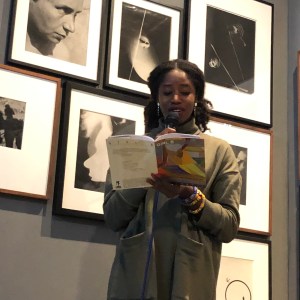
‘Unfamiliarity, the state of being unknown, is not the same as non-existence. Migrant nurses exist. We do exist in this world. But somehow we are not known.’ –Romalyn Ante and Pascale Petit perform and speak with alice hiller about the work witness in their new collections, Antiemetic for Homesickness and Tiger Girl.

Romalyn Ante by S. Chadawong.

Poet Andrea Gorman spoke out at Joe Biden’s inauguration against the force in America that would rather ‘shatter our nation rather than share it’.  In her stunning poem, ‘The Hill We Climb’, she stated instead ‘there is always light…./If only we’re brave enough to be it.’ Anyone listening will have felt the restitutionary power of her words, written and delivered, as she stated, by “a skinny Black girl, descended from slaves and raised by a single mother.’ 

Globally, one of the most necessary questions today is around who gets heard – and who does not.  It has been at the heart of the Black Lives Matter movement.  It is equally central to the legacies of empires round the world, as Satham Sanghera argues in his powerful new study, Empireland, and to our relationship to our environment and the fair distribution of its resources.

Being heard is also crucial in poetry, as two new collections by Pascale Petit and Romalyn Ante remind us. Pascale Petit’s Tiger Girl draws the life of her half-Indian grandmother, born in secret to her great-grandfather’s serving maid, together with conditions in and around the Tiger reserves of Central India.  Romalyn Ante’s Antiemetic for Homesickness explores more recent experiences of migration to the UK, and working within the NHS, against the healing, nurturing background of the Filipino culture which her family brought with them, and which continues to shape their understanding of themselves in the world. 

I had the great privilege of hosting a performance and conversation between Pascale Petit and Romalyn Ante, towards the end of 2021, with a very enthusiastic live audience.  Immediately afterwards, coming up to the holiday period, with infection levels rising steeply, and restrictions changing all the time, was not the right time to share the recording.

But now, with the UK, Europe, and much of the rest of the world, in varying degrees of lockdown, and everyone still separated in physical terms from each other, co-experiencing resources such as this conversation seem to be of the utmost importance in maintaining our sense of connectedness with each other as fellow human beings, and as creative artists. 

To maximise accessibility, I have transcribed both my own introduction, and the conversation between the three of us.  To experience the full event, specifically and crucially, Pascale Petit’s and Romalyn Ante’s readings of their poems, please click on either the video or audio links below.  The video link has close captions enabled via Youtube, although you will need to turn these on in the control bar at the bottom right of the screen. Apologies for the occasional surreal spellings.

If you would like to see the texts of the poems, they are available in Tiger Girl and Antiemetic for Homesickness through the buy buttons below. There are also links to some of the published poems on Romalyn Ante’s and Pascale Petit’s websites.

Photo by Brian Fraser

Romalyn Ante Antiemetic for Homesickness

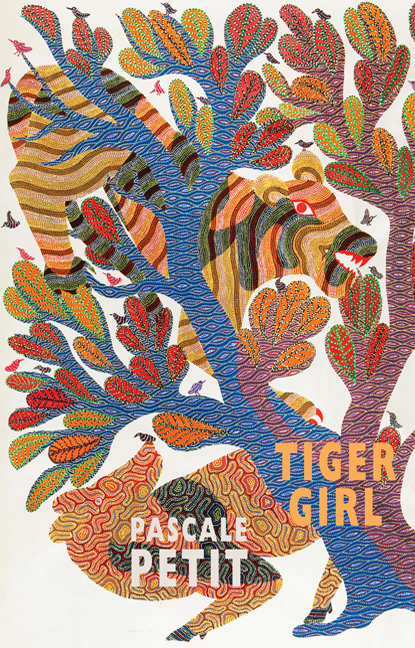
Pascale Petit Tiger Girl

https://youtu.be/V57ZxGbGAQc

Audio Link

alice hiller’s introduction to Pascale Petit and Romalyn Ante, 26 November 2020:

After a rough year and a tough November, it’s a real pleasure to welcome you to this act of creative community.  We’re here to celebrate the deep, healing play of Pascale Petit’s and Romalyn Ante’s brilliant new collections, Tiger Girl and Antiemetic for Homesickness.  Both Pascale and Romalyn are poets of courage, as well as of distinction.  

In a week when we learnt that the UK’s foreign aid budget commitment will be broken, and while so many vulnerable voices are being excluded from the global conversation, Pascale and Romalyn give witness to a wider range of experiences than many poets.  They also help us ask ourselves and our governments, whose foot is being kept on whose head?

Writing about life in the Philippines, Welsh gardens, and the stunning nature reserves of central India, Pascale and Romalyn move our minds to places of delight – even as they remind us that the world is still far from being a fair or kind place for many human and creaturely lives, and the fragile ecosystems and economies which sustain them. 

Our format tonight will be that Romalyn will read from Antiemetic for Homesickness, published by Chatto, followed by Pascale from Tiger Girl, published by Bloodaxe. Afterwards, I’ll open  a conversation between them.  

Before the readings, I’d like to say a few words about Pascale and Romalyn. Winner of the Ondaatje Prize, and inaugural Laurel Prize for Mama Amazonica, amongst very many other distinguished awards, Pascale Petit is also a radically empowering supporter of new voices in poetry  through her mentoring, teaching and judging, as Romalyn and I can both testify.  

Over eight collections, Pascale’s poems have brought an artist’s eye to the Amazon river and its rainforest, the arid landscapes of the Languedoc, and the markets and historic sites of Paris including her beloved Jardin des Plantes.  Tiger Girl, from which she’ll be reading shortly, gives us one of the most life-filled portraits of a woman of colour, and of mature years, that I have read in a long time.  It should be bought for that reason alone, aside from its many other treasures. 

Moving between between continents, Tiger Girl documents Pascale’s time growing up in Wales with her fierce half-Indian grandmother – who took in washing, told fortunes and made her garden a canvas equal to any artist’s.   The poems also respond to Pascale’s experiences on recent trips to nature reserves in Central India.  Celebrating the magnificent wild creatures who inhabit those parks, Pascale also registers the damage to them by poverty-stricken poachers, from whose social class her Indian great-grandmother, her great-grandfather’s maid, would have come. 

Mentored like me by Pascale under the Jerwood Arvon scheme, which brought the three of us together, Romalyn shares with Pascale an intuitive sense of the mythic residing within the everyday.  She is similarly the recipient of many distinguished awards, including the Poetry London Prize, the Manchester Poetry Prize, the Primers Prize, and the Creative Futures Platinum Award. 

Having grown up in the Philippines until she was sixteen, before coming to Wolverhampton, and subsequently training as a NHS nurse and then counsellor, Romalyn conveys how “the wind has the ears of a wild boar” and explains why you have to turn your shirt inside out to find your way home, whether that home is warmed by the “smoke of a Brummie accent”, or cooled by the night breeze.  

Antiemetic for Homesickness moves compellingly between the landscapes, and foods, and folklore of the Philippines – and life as a nurse within the NHS, while living in the Black Country.  Exploring what it can mean to make the UK your home,  Romalyn also witnesses the racism to which so many people who come here have been subjected, and how they have made strong, creative lives notwithstanding the challenges faced. 

The co-founder of  the wonderful harana poetry, for poets working with English as a parallel or additional language, like Pascale, Romalyn is both an outstanding poet, and  a key figure for the expansion of the possible in poetry, both through her own work, and her support for others.  She also gives us life from a nurse’s point of view, as never before, another reason to buy her essential Antiemetic for Homesickness. It’s my great pleasure now to hand over to Romalyn Ante.

[Romalyn Ante and Pascale Petit introduce and read their poems, available via the Youtube or Audio links.]

AH: That was fantastic Pascale.  Thank you so much.  It’s amazing to hear the two of you reading together. I’m going to ask you a few questions because I’ve lived with, loved and thought about your collections since they were published.   The first question is about making  worlds visible that are known to you, but not to your readers?  Pascale, I’m thinking both about your poems about wildlife in Indian National Parks, but also about your poems about life in rural Wales? Romalyn, I’m thinking about your poems about rural life in the Philippines, but also about the day to day life of a nurse in the NHS?  We can really feel the worlds you both have made in your poems.  I wondered if that was an  important part of making them?

RA: Thank you Alice. That’s a very important question. In the UK Filipinos are the second highest immigrant NHS staff, next to Indians. In the US the highest number of immigrant nurses are Filipinos. Most recently, specially during this pandemic, the West has been really dependent on migrant nurses but little is known about us, our own narratives, our own lives.  I feel that mostly people only see us on the surface without knowing our pasts and our own tales, why we came here.   I have people commenting to me ‘So you’re Filipino.  If you’re Filipino, where are you from?  Are you from Korea then?’  They don’t even know what a Filipino is.  There are also some readers’ comments.  You shouldn’t really read GoodReads comments.  But I do.  I read my reviews because I want to improve. There are some comments, ‘I don’t know.  I can’t relate.’ But for me the truth is unfamiliarity, the state of being unknown, is not the same as non-existence.  Migrant nurses exist. We do exist in this world. But somehow we are not known and what puzzles me is why is the United Kingdom or the West so dependent on a sector of people that has so little voice, and that has never been heard of.  And this is the reason why I wrote this.  To really show them not only the physical place we came from, but also to show them our narrative, what propels us to do this. 

AH: That’s a fantastic answer. Thank you so much. 

PP. Thank you. Roma that was fantastic. With Tiger Girl, I wanted to honour my grandmother, and write a book almost of love poems, you know, and acknowledge that she was the daughter of a maid and she was taken in by her father’s white family and she was very poor when I lived with her in Wales.  We didn’t have indoor toilets or running water.  Really quite poor.  Children don’t notice that. What I did notice was an enormous garden and lots of animals, and the incredible world of the garden which she worked in all the time, and which I worked in for her as well. That’s one half of the book. The other is where she came from. The story of the tiger, and my wanting to see tigers, and to see this wildness that she came from, that she’d encountered as a baby, and the terrible realisation that that wildness is so so threatened and endangered.  Even the tigers that are safe are fighting each other. Daughters kill mothers and so on because the forests are too small for them. Even though the tourists are only allowed in 20% of the National Parks. There’s still not enough space. They have enormous territories.  Having seen the tigers, and seen how – I’ve seen wild jaguars as well in the Amazon rainforest – to see what they are like, in their territories in the wild, is so different from seeing them in zoos.  Of course there are far more tigers in zoos than there are in India.  There’s about 2,800 in India, and only a handful elsewhere. So that was the world I was trying to bring forward.  

AH:  Most of us never get to those reserves, to see them through someone’s eyes, to see them emotionally, rather than just on a wildlife documentary, is incredibly powerful. I really appreciated that. My next question is  you both work within your collections with a powerful and healing female figure.   For Pascale, it is your grandmother. For Romalyn, it is your nurse mother.  Did it feel important to honour the ways in which we as women can nurture each other?

RA: Yes, definitely.  In Antiemetic for Homesickness the mother is the one who leaves to provide a better life for her family.  So if you think about it, the mother is away from the very essence of being a mother, which is to take care of her own children. And I think by shedding light on that fact, I also needed to shed light on the fact that in leaving there could also be healing. So even though the mother has left, as a sacrifice almost, she still heals the socio-economic problems that her family has.  She still heals people abroad. She heals people where she works.  That’s incredibly important for me, not only as a nurse, but also as a daughter of a migrant nurse.  I feel very similar to Pascale, writing about the voicing of the poet is really healing the world that is full of annihilation.  

PP: When I wasn’t with my grandmother, I was in various homes and things in France.  If I was with my parents, it was a bad experience. I eventually went to live with my mother when I was a teenager, when my grandmother kind of threw me out, which she had to do, she was tired, she had a teenager on her hands.  But my mother was severely mentally ill, and couldn’t really look after me, and was a malevolent force for me. I had a malevolent maternal figure there, so it was wonderful for me to have a chance in this book to write about a really benevolent figure, who not only was benevolent, but was a very powerful person. She was known as the local witch where we lived. As a good witch, but she was. And she also had an extraordinary second sight. I did have the experience of being with her and her telling me about ghosts.  For example she saw the postman who lived down our lane.  For example she said ‘I’ve just seen him walking down our lane and he said hello to me as if everything was normal but his feet were floating off, weren’t touching the ground, so I knew he was a ghost.  I knew he had just died.’ And he had. So there were always those kind of experiences going on. She also used to tell fortunes.  People in the village used to come.  The vicar and the doctor would come to have their fortunes told. I would go with her as well to fairs to see her tell fortunes. 

AH: Looking back, women have been disempowered for centuries. It’s really important that we make work than honours female power, female goodness.  It seems to me a very positive thing to do. But at the same time these healing figures work within very injurious and injured societies and you both show them as being capable of deeply wounding those who are dependent on their care and provision.    Pascale, you explore your grandmother returning you to your mother.    Romalyn, you look at the impacts on you of being separated from your mother when she goes to nurse abroad, and not seeing her for several years.   In each case, the wounding behaviour is driven by larger socio-economic pressures, and the vulnerable positions which these women occupy.  The fact that your mother left the Philippines to give you and your siblings a better life, Romalyn.  It was the only way she could materially improve your lives.  Your grandmother had very limited resources Pascale. We’re now talking in the pandemic about the impact of material strain, of poverty, on families.  Was it also important to show that in difficult circumstances even loving people can in injurious ways, through no real volition of their own.  Or does that feel too challenging?  

PP: It can’t be challenging. You need to write the truth.  For me, I was thirteen. So the injury wasn’t being moved from my grandmother. I was still a child.  She was still the best thing that ever happened.  The real wound was not being allowed to grieve her loss, when I lived with my mother.  That was the wound.  I never realised that I wasn’t allowed to grieve.  I just knew it was a subject that mustn’t be mentioned.  I wasn’t allowed to grieve for my grandmother, who I saw as my mother, because my mother couldn’t bear that. 

RA:  I think what you said a while ago Alice really resonated with me, when you said we left because we were propelled by socio-economic circumstances.  See, even though in Antiemetic for Homesickness, the left-behind-child was left by her nurse mother, this story is not unique to me. It happens to a lot of children, millions of children around the world. Your parents don’t even need to go abroad for you to be a left-behind-child.  In China, parents go to richer cities to help financially with the family.  My mother left because she really had no choice. But then again, she made a choice.  Her only choice was not having any choice.  She left knowing that the people she would leave behind would be hurt.  That knowledge hurt her, I’m sure, in return.  For me it’s not just me who is wounded, it’s the mother who is wounded. It’s very timely and relevant to this day, especially when I see my colleagues, or my mother even, who has been going all around the country helping in the pandemic front line, my other Filipino colleagues who could choose not to go home, as their homes across the street, so they don’t put their children at risk of Covid. So mothers have always been leaving their children, and this story has always been happening. But then again, it’s not the children who get hurt. The wounded one is also the mother.  And I think that’s what Antiemetic for Homesickness is also about. 

AH:  That really comes across. It’s very important.  I see we’re coming to the end of the time.  I have one final question.  While neither of you holds back from speaking about difficult subjects, both collections give the gift to their readers of being able to abide in beauty.   Romalyn, you let us glimpse the pre-colonised life, and warmth of community, in the Philippines.  Pascale, your work gives itself deeply to the natural world.  Was that an important thing to do, to give the gift of beauty, when the world is facing so much difficulty?

PP:  Absolutely.  You can’t write about the threats to the natural world without showing why, without trying to show – it’s a real challenge – the awe and the wonder of it. That’s something I’ve always felt.   You have to show what it is you’re trying to protect.  What the non-human world is.  I keep getting these flashes which are images of the planet without one human life on it, without animals, and that’s like hell.  I don’t want that to happen.  But I need to show the beauty and the awe. The wonder of tigers. 

AH: Absolutely.  Stay with the programme Pascale! Romalyn?

RA:  I echo what Pascale has said.  It’s very true to me.  It’s also one of the reasons, when Chatto asked me what kind of cover I wanted, I really wanted it to be colourful, with some kind of insignias of the Philippines, the sun bird, the abaniko flower.  For me these beautiful images serve as anchors, and guides, that will lead us back to healing, and perhaps to hope.  It’s very similar to what we hope for now. We look for that beauty. When we can go again to our favourite coffee shops again, or we can hug our parents again, or meet up with our friends.  I think that’s very important to look for beauty, because beauty gives hope. 

AH: I think that’s the perfect note on which to end.  I’m going to thank everyone who’s joined us. I’m going to especially thank Pascale and Romalyn for these two brilliant books. The season of gifting is coming upon us. These have to be top of your list. This has been a stunning evening.  Thank you so much.  Everybody, buy the books. Thank you so much. 
Romalyn Ante’s website is here.

Pascale Petit’s website is here.

Romalyn Ante Antiemetic for Homesickness

Pascale Petit Tiger Girl

“As long as the body is moving/ the heart will follow”: Troy Cabida on how “tenderness becomes a strength” when writing into the bi-cultural, bi-queer British-Filipinx space – and how he is taking to the skies with his Bad Betty debut ‘War Dove’ despite lockdown.

Troy-18Troy Cabida is the first poet I have had the privilege of interviewing about ‘saying the difficult thing’ in their work during lockdown, and the second librarian poet in this spot, following on from Karen Smith last year. Troy tuned into poetry while still at school (further details below) and has shared with us a live recording of his poem ‘In Conversation with Past Troy’ to a backing track by Gabriel Jones of Bump Kin, from which the title quote is taken. If you want to carry Troy’s live voice in your ears alongside our conversation about War Dove, Troy’s debut with Bad Betty Press, published on 2 May 2020, click on the link here  now. 

Like Romalyn Ante, who also spoke with me, Tagalog was Troy’s first language. Romalyn and Troy both choose to write in English at present. Troy is originally from Las Piñas City, Metro Manila, but is currently based close to me in southwest London, which makes us both neighbours of the magnificent Brompton Cemetery. Built as a Victorian burial ground, with flamboyant avenues of tombs, it has over time also become an impromptu nature reserve, and was a legendary queer hang-out in the 1970s and early 1980s before HIV/AIDS took hold, which works for us both as out bi-queer poets. Had social distancing not been in force, we would might well have hung out in its café for the interview.

Photo 10-04-2020, 18 20 31Widely published in Bukambibig, harana, TAYO Literary, Ink, Sweat and Tears, Cha: An Asian Literary Journal, and Macmillan,   Troy was a member of two legendary London co-operatives, the Barbican Young Poets, and Roundhouse Poetry Collective, which previously nurtured Belinda Zhawi and Dean Atta, amongst other distinguished poets. Belinda’s and Dean’s interviews also feature in this series and tutor and poet Rachel Long’s is also available. 

While he has not neglected his own career, Troy has also been generous to other emerging and established talents, editing The Murmur House and Síblíni Journal as senior editor and Issues 3-7 of the Thought Notebook by Thought Collection Publishing. He is also editor for 30 Days Dry by Chicago poet-playwright Robert Eric Shoemaker. A notable and powerful live performer, as a producer, Troy’s projects include London open mic night Poetry and Shaah, his debut headline show Overture: An Evening with Troy Cabida, Poems for Boys,  a night that gives space for male-identifying poets to talk about their relationships with masculinity and Liwayway, an open mic night and art collective bringing together UK-based Filipinx creatives spearheaded by Jessica Manuel for British-Filipinx poets, singers and rappers.

Photo 25-03-2019, 19 41 08
Rachel Long

As a fellow poet who, like Troy, identifies as bi and queer, and also carries two languages in my psychic toolkit, not to mention a whole load of supplementary musical and other inspirations, it was really powerful for me to hear what Troy had to say about his own experiences of realising these doubled aspects of his identity, and negotiating them relative to his private, public and creative selves.   I was also really drawn to hearing how the extraordinary poems in War Dove, his debut pamphlet just launched with Bad Betty, found their voices and forms, within the context of both London, and the wider world, including through some targeted “binge-watching’ of the series Sorry For Your Loss, and how the poems fuse the multiple languages and registers through which Troy speaks to us all.

AH:     Can you tell me about your path into poems Troy? When and why did you start writing and performing?

TC:       I was introduced to poetry back in 2010, through a blue GCSE English anthology everyone in my generation will probably remember with utmost emotion. We studied Derek Walcott, John Agard, Carol Ann Duffy and I remember specifically a worksheet highlighting poetry techniques like the simile and the enjambment and how they work within a poem. I experimented writing when I got home that same day and fell in love.  I started submitting my poems for publication after I left sixth form, around 2013, and started doing working as an editor for several journals and manuscripts to get myself acquainted with how poetry works as a collaboration rather than something purely solitary. It’s great because turns out, there were people that liked my work and accepted them into their publications, many of which I highly regard.My first experience performing was at the open mic night BoxedIn back in 2016. I remember my performance was so stiff, but I just knew where to go from there to become a better reader, and I owe that confidence to the hosts Sean Mahoney, Amina Jama and Yomi Ṣode, who have and continue to curate a night that listens to poets but also challenges them to be better. I initially found performing to be daunting because I didn’t know how to place myself within it but then found it fun and a way to get an immediate response for your poems. An audience can be a very good sounding board.

AH:     Were there any poets, songwriters or other creative figures who made this seem more possible? I know you have been part of the Barbican Poets and Roundhouse collective.

pascale freeword centre
Pascale Petit reading from her forthcoming collection ‘Tiger Girl’ at the Free Word Centre

TC:     I’m lucky to call the Barbican Young Poets and Roundhouse Poetry Collective strong support systems in this crazy poetry scene. Being a member of both programmes taught me about community and knowing how to work and give parts of yourself to create a tight unit. I have to shout out Jacob Sam-La Rose, Rachel Long, Bridget Minamore and Cecilia Knapp, who are all amazing. I get a dopamine rush every time they say something nice about my work.  In terms of poets, I really admire Joseph Legaspi, Pascale Petit, Richard Scott, Amina Jama, Victoria Adukwei Bulley, Natalie Linh Bolderston, Helen Bowell, Andrew McMillan, R.A. Villanueva, Romalyn Ante, Kayo Chingonyi, Terrance Hayes and Chen Chen. I always find myself going back to their work. Then musicians like Karylle, (((O))), Curtismith, Janelle Monáe, Bamboo, The Corrs, She’s Only Sixteen and Yolanda Moon. I’m a huge fan of BTS. “Interlude: Calico” is written after their song “Serendipity”.

I binged on a Facebook Watch series called “Sorry For Your Loss” starring Elizabeth Olsen when I was drafting the poems, and I loved and studied the show so much that it ended up being a huge influence on the overall manuscript. Its execution of someone’s emotional journey from a major event, in this case the death of the lead’s husband, was handled with both logic and heart that I was inspired to follow that route with this pamphlet.

AH:     Your epigraph is in Tagalog, from a song by the indie folk Filipino band Ben&Ben, whose debut was out in May 2019.   What made you choose this as the launch pad for your work?

TC:     Thank you for catching that! It’s from their song “Lucena”, which I first heard around October 2019, around the time I was going through the manuscript by myself before Amy began working on it. Through that time, I couldn’t help but feel an emotional distance between myself and the poems as majority of them were written in 2017 and 2018 and studying them from that perspective dawned to me how different I am now from the person who wrote those poems.   I chose “Lucena” because it sings about the joy in letting go, in hitting the ground running after a long time of hurt, which I felt would work as the epigraph as it reflects where I was emotionally at the time of the pamphlet’s release.

AH:    As a dual language speaker, I don’t translate or italicise the French words I use in my work because I want to reflect the way that my mind doesn’t give primacy to

Photo 18-01-2019, 20 32 03
Victoria Adukwei Bulley

any single language. L. Kiew, who I have also interviewed for this series, follows the same approach. What was your thinking around this decision for the epigraph?

TC:       I chose “Lucena” because it does so many things at the same time. I have this fantasy in my mind that when people read the lyrics, they’ll get curious and check the song out and then get a feel of its message and sound, which is anthem-like, like feet stamping and voices cheering. Starting the pamphlet in Tagalog is my way of letting the reader know that although the poems are in English, it’s still a second language to me, and that my relationship with Tagalog heavily informs my relationship with English. I often call English my “work language” and that I get tired of speaking it after 11pm. True story.  Also, R.A. Villanueva was once asked how his readers will understand his work if he doesn’t translate his Tagalog into English and he answered with a picture of Chewbacca. Now, I may not be the most prolific of Star Wars fans, but I share the exact sentiment.

AH:       The title of the opening poem, ‘Ladlad’ is glossed as “From Tagalog – unfolded; spreading out on a surface; to expose;” .  To the English ear, it reads initially as a twinned or dual male identity, like a doubled lad. The poem refracts a shifting expression of identities:

you stretching
out of yourself, your wrists bending
at the sides of a box struggling to contain you,
translates to you falling from somewhere high,
reminder that you are unpolished quartz,
your sense of a man cracked for wanting man
as if to say:
you deserve all that is twisting your heart,
all that is crushing your torso.

 It has an almost biblical feel – as if a new definition of masculinity, in a different shape to what has gone before, is being formed through and claimed in words, albeit not without great struggle, reflected in the stone imageries. Was that process in your mind while you were writing?

TC:          I was speaking to my dad about a friend who had come out publicly which I admired. We were speaking about it purely in Tagalog and it took me a second after we finished to realise that the word we used for “coming out” can be interpreted as derogatory.  When taken out of the LGBTQ+ context, “ladlad” means to spread an item so it is entirely visible, or to force the truth out of someone. To constantly use this word to describe that process made me feel uncomfortable, and then realising how it can even parallel with how Filipino culture perceives being gay: an immoral truth that can’t help but be a truth, but something others have the freedom to punish you for.   ‘Ladlad’ chews and squeezes the juice out of that word, uncovering any silenced or repressed emotions and associations that it passes down to people. In the context of the pamphlet, it being the first poem takes the reader straight into the psyche of the narrator, who is in the middle of this ocean of confusion and isolation that they have grown to believe that they deserve.

AH:        That’s a really moving explanation Troy.  Thank you.    Mary Jean Chan, Norman Erikson Pasaribu and Jay G. Ying are other poets who are currently making work that explores the negative impacts of societal hostility on the queer identity.  They

Photo 18-05-2019, 14 41 06
Bridget Minamore

also claim the idea of the queer self as a place of cultural regeneration and onward transmission of new and different possibilities. Is that a project that also speaks to you?

TC:          I believe it’s really important for artists to create work that is true to themselves, as well as it is important to consume art made by those who live those experiences. Too many times I’ve read poems about the queer experience written by straight poets as a prompt for them to experiment with and it doesn’t sit well with me.   I used to have this idea that I shouldn’t be writing about my experiences of being bisexual because, for some reason, I didn’t think they’d fit the mould of what can pass as bisexual narrative. But then you try to ignore that thought and hope that someone reads your work and feel a little less alone.

AH:      Speaking from my own experience, I know that bisexual self can be a scary one to claim, not least because you fear hostility and negative judgements from all quarters!  I was terrified, joining Mary Jean Chan’s Queer Studio online course with the Poetry School, in case I would be rejected by more ‘purely queer’ poets.  But in fact the space was intensely freeing and supportive, and gave me an audience for whom I could write first drafts of poems about a relationship I had with a girl my own age when we were both teenagers – which was a seminal and reclamatory experience for me after I experienced same sex abuse in childhood.

Turning back to your work Troy, the poem ‘Hawk and dove’ continues a work of re-forming. It fuses poetry and martial arts, remembering “when I tried to punch you/ with a hand boxed like a rock/ only to see it crack open on impact.” Where there could have been harm, there is instead transformation and co-existence – “Fist bouncing from chest/ feather meeting concrete”.   Do you envisage language as having the capacity to operate in this fluid, shifting way?

TC:        I think poetry can break rules that other forms of language can’t. Poetry is often an artform where you can do that and then the craft reverts to freshness rather that disrespecting it. Jacob would always teach us to know the rules of a specific form, and then he’ll encourage us to break it apart if it serves the poem.   I imagined “Hawk and dove” to be about the playing of foils and how opposites can melt into one another. For me, it’s a nostalgic look into a relationship between polar Photo 25-03-2019, 15 05 55opposites: where the first stanza focuses on a dominant and physical figure, the second stanza is about the more pensive counterpart. Having both stanzas hold six lines each, to me, meant that they were still standing on equal grounds even though they were different.    In a normal situation, the “fist bouncing from chest” would have resulted in pain and then a cue to retreat, but in this instance, this clash becomes a gateway into a deeper relationship, where you can see “flickers of your eyes from mine to the ground”, and then the two personalities mix and learn from one another.

AH:     ‘The Afters of After’ is a coming out poem, which called to mind Norman Erikson Pasaribu’s voice, albeit that the outcome is very different.   Here the kitchen is homely – “moist from steam and cigarette smoke and white wine” – and the parents appear to be understanding:

They refer to a friend’s son, whose name was meant for me. Paul.
Remember him? He works in Malta now. He’s bisexual too!

 As the bisexual mum of a queer son, I had my own experience of this, when he came out to me in his teens, only for me to come out back to him. It was a very emotional but very beautiful experience for us both, that continues to inform our adult relationship. It seems to me that this is a very important exchange to record for other young LGBTQ+ people – to give them hope and confidence about revealing themselves to their families. Was this part of your intention within the poem?

TC:   That’s such a beautiful anecdote that you’ve shared. Thank you for sharing that, Alice.   When I was editing “War Dove”, I knew that I would be dealing with personal themes, and thankfully I’ve been able to add in experiences of levity into my poems because while there has been negative aspects to my process of coming out, there has been lighter stories that I can share, which I think should be celebrated. Coming out is an experience that has facets of both good and bad, and poetry has the ability to narrate all of that. One of the stanzas in “Makeup and heels and Reece King” came about because the first thing my friend Idil asked me upon finding out I’m bisexual, was my opinion on this model named Reece King. It was in an escalator in Debenhams.

In terms of my parents, I’m also so thankful that they’ve been supportive. It wasn’t always the case with them growing up, but it’s definitely something that’s changed. The moment I captured in my poem is my parents grasping the fact that their son has finally come out, after years of holding his breath, and they’re getting used to the idea that they finally can talk about this thing in front of them and the first story they manage to bring to the table is how their high school friend’s son is also bisexual, which I found so awkward then but really funny looking back now. From then on, our relationship has relaxed, my parents have spoken more and more, and I’ve felt comfortable working on becoming more open with them.

However, I understand that coming out to family, or anyone for that matter, is a concept that shouldn’t be taken lightly, and I totally see my privilege in having an accepting inner circle. Coming out or voicing out this aspect of your identity should be done whenever you are most emotionally ready. Do it for yourself and do it in service of your growth and healing.

AH:   Poems including ‘Buddy’, ‘Bonds’ and ‘Interlude: Calico’ give witness to the complexity of inhabiting a queer identity in a predominantly heterosexual world, and also to the sense of alienation and separation which can sometimes arise even when seeking to form queer relationships or simply enjoy more casual connections. In ‘Bonds’ the speaker uses the disjunct of a stanza break to state “Man, I have a feeling // we’re not watching the same thing.” Was this an area that you felt drawn to exploring?

TC:   I once heard someone say that poems about sex shouldn’t just talk about sex as it can become one dimensional, and I took that in, when drafting ‘Buddy’. I wanted it to be about the defence mechanisms we’re not aware of creating, due to loneliness. Oftentimes toxic relationships are born out of the desire to shut out parts of ourselves that we don’t want to deal with. Sometimes those kinds of relationships exacerbate those exact parts and when they come out, it’s in ways that they shouldn’t, which causes more damage.  ‘Bonds’ is a poem that I took the longest to edit because of the ending, where the poem jumps from the narrator to the subject, the person that the voice is sitting next to. It’s about dynamics in a relationship can develop because of unrequited love and an inability to heal past that.  Where “Buddy” uses couplets to indicate two people’s close connection, the subjects in “Bonds” have a barrier that keeps them from fully connecting, which I wanted to highlight through the three-line stanzas. The sudden shift is abrupt and uncomfortable because that’s another voice altogether and it’s a wakeup call back into reality, one that’s hard to accept because it’s not the reality that you want to be in.

roma reading poetry london
Romalyn Ante reading ‘Names’ at the Poetry London autumn launch at Kings Place.

AH:   Romalyn Ante writes in her poems of the sense of unreality which can arise from her Filipino heritage and identity being portrayed in crassly simplified terms by the European and American media. The opening stanza of ‘Examples of Confusion’ suggests the danger of becoming party to a news and entertainment media which marginalises and diminishes non-white experiences:

You can laugh through floods and earthquakes and dictators
but your heart cracks easy for emotions? You’re losing colour.

The action cuts between the speaker and his friend in a UK Costa, a vignette of family life in Manila, and a close up of the American actor Timothée Chalamet, when the camera is “romancing yet another scrunched up white boy forehead.” Chalamet made his name in Call Me by Your Name, but could be one of many young white male pin ups.  Would you like to say something about this poem?

TC:   Oftentimes, being Filipino means carrying a certain pressure to uphold a stereotype that we’re the happiest culture in the world, something that American media has perpetuated for so long. And to criticise that means I’m ungrateful for having what has been called a “positive stereotype”. It’s ridiculous because the conversation about mental health issues has been deeply vilified and buried in taboo, leaving many people confused and in need of a professional, which should be a solution as logical as seeing a doctor for a physical illness.

‘Examples of Confusion’  tackles my unrest about this situation of growing up in a culture that teaches us that it’s better to sweep things under a rug and weather the storm with a smile than admit that we’re actually struggling, which denies us human substance and depth. It’s really dangerous because it does get to the point where Filipinos grow up thinking we don’t even get mental health problems, that things like anxiety and depression are just for white people, which is far from the truth. The stanza about Timothée Chalamet’s performance came about because I had reached a point where I was able to feel more heard through art produced by non-Filipinos, which bothered me because I know I can’t say that that story is truly mine to compare with.  It’s funny because digging deep, deep into Filipino art and media outside of the mainstream circuit that encourages these stereotypes rather than challenging them, I managed to find like-minded artists who make work that I can 100% empathise with. And the biggest criticism they get is that they’re too radical or that they’re too ungrateful to appreciate what we already have.

AH:  ‘War Dove’, the title poem, draws many of your pamphlet’s themes together:

I’ve come to know the kind of tender
that packs muscle, that doesn’t cower
even to my own desires.
In front of the face that profits from my labour
but doesn’t know how to give back,
the doves around me fought to remain.

 You express a form of reclamation enacted in the teeth of harsh treatment and continuing adversity –  “the understanding of the apology, / the need for it to be verbalised and accepted/ to release the victim of their past”. What was in your mind when you were writing and revising this?

TC:  Whenever I read this poem out to an audience, I always mention how much of this poem isn’t trying to solve the problem against violence or toxic masculinity, but it’s rather thinking through those things and wondering what it can do internally to stop becoming a part of the problem, if such an act can ever be truly done.  The first stanza is after “Trevor” by Ocean Vuong, where he says that “tenderness depends on how little the world touches you”. I agreed with that for a long time until I started to realise that when you’re put in a situation where you can retaliate after being wronged, it’s actually perfectly okay to ignore the voices that push you to fight back and just remain still. Practicing compassion after being punched in the face. The idea that the world can beat you up and your response to that is to accept and find strength in the tender state that you’re left in makes as much sense to me as Ocean Vuong’s line does. And then tenderness becomes a strength, which defies the idea that the two can’t be synonymous with one another.  The third stanza was very fun to write because it was my attempt in understanding the concept of forgiveness, an action that hasn’t been truly perfected yet, in my opinion. It puts something so emotionally driven in a logical perspective because it’s looking for something that can’t be found through that emotional route. I grew up in a community where forgiveness is a hazy and mystical thing that you must experience and to give it concreteness, reasoning for its validity and actual steps to follow is somehow taboo and disrespectful, which I find so interesting.

AH:     As someone who was subject to sustained sexual abuse by a family member in childhood, forgivenesss and compassion are things about which I have thought often –  though without yet fully reaching resolution, I must admit.    I really value the subtlety and rigour of your thought in this respect Troy, particularly because I try to follow a daily Buddhist meditation practice which can generate a freedom to renegotiate my relationship with my past, without surrendering agency.  Your idea of how we can allow tenderness to become strength is very powerful and beautiful.

I’d like to close our page conversation by asking how it feels to launch your debut in lockdown?   Will you be doing some live events to share the work when it becomes possible for venues to open again?

TC:       So I’m launching the pamphlet online on Bad Betty Press’ Instagram Live and I’m sharing it with an amazing poet named Gabriel Akamọ with his own debut pamphlet called At The Speed of Dark.    We joked about how our pamphlets will make poetry history by being one of the publications released during the lockdown.    I was having a conversation with another poet friend about how the lockdown has affected the poetry scene and he said that despite not being together physically, the support between us have only gone stronger and have adapted to the tides. Moving our launch into the digital space is still as exciting as it would be on a venue because it means more people can watch alongside our community, watching at the comfort of their own homes. I’ve been contacting nights for a possible feature slot with them at the start of the year so I hope we can get those off the ground when it’s safe to do so.  I’m a co-producer for an open mic night called Poetry and Shaah with Neimo Askar, Fahima Hersi, Abdullahi Mohammed, Ayaan Abdullahi and Idil Abdullahi and when we’re all able to resume our normal shows, we’ll only go upwards from there. I’m asking them for a feature spot to help promote the pamphlet, so fingers crossed they say yes!

AH:   Thank you very much for talking to me so generously, and so insightfully, Troy Cabida.    We’re launching this interview after your launch, the thinking being that readers would already have joined you, Gabriel Akamọ, and your brilliant support acts, in the live event, the facebook link for which is here.   I’m also placing links to the publications and live videos we’ve discussed below this for our readers to follow, and most importantly, the buy button link to Bad Betty so they can get themselves their own copy of War Dove through the mail, and bring it along for you to sign when performances are able to take place in shared physical spaces again.   

To buy Troy Cabida’s pamphlet War Dove from Bad Betty click here.

To check out more of Troy Cabida’s work, a few links to click on.

Troy Cabida’s website.

New poem from BathMagg

harana poetry for the poem Ladlad.

Bukambibig here.

Tayo Literary

Ink Sweat and Tears

Cha: An Asian Literary Journal

Slam: You’re Gonna Want to Hear This

Liwayway

Poems for Boys

Overture: An Evening with Troy Cabida.