‘Finding new flight patterns’: working creatively to heal beyond trauma at the Newcastle International Poetry Festival 2024.

Every city we travel to, we meet a new version of ourselves. Meantime, the city becomes a different version of itself through our eyes. That was certainly the case for me when I arrived in Newcastle on 9 May, the day of the train strikes. With all the dazzle of fresh green growth, and light, bright clothes, summer was coming in a sudden rush of heat, that caught us all half unawares. Confirming the sense of a new world, York station, normally a constant to-ing and fro-ing of trains and passengers, was all but empty. Under a blue sky, cafes were closed, the lines and platforms silent, as I waited for my connection.

Newcastle itself was alive and bustling once I left the station and walked along the Tyne. The hotel the Newcastle International Poetry Festival had booked me into was directly opposite the glamorous 1930s Baltic Arts Centre. The air felt warm and tender, the river was quiet and glassy, the passersby lingering over drinks on waterside terraces. With a sense of adventure, I left it all behind to head uphill to Newcastle University, and the Northern Stage venue. Walking through the layers of the town its history was written in its built structures, from solid Victorian municipal buildings to Sixties and Seventies car parks and office blocks. Buskers turned the long shopping streets into layers of sound that inscribed the always changing present moment.

Millennium Bridge, Newcastle.

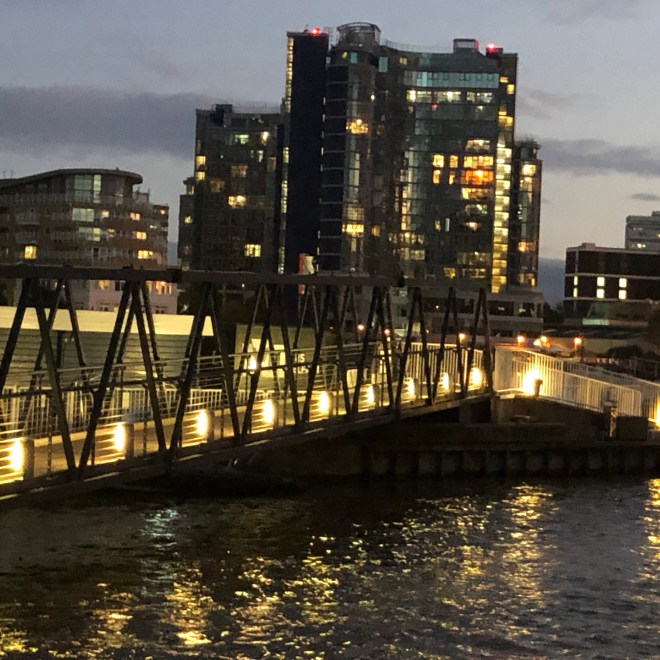
To enter the Northern Stage venue, where the Newcastle International Poetry Festival was taking place over three days, we had to pass alongside the student encampment, protesting the genocide being committed in Gaza, and the larger international and institutional complicities enabling this. It felt right and necessary that Abigail Parry, who joined Jane Clarke for the T.S. Eliot Prize Reading, to close the first day, directly referenced the huge disparity between our security and comfort within the theatre, and those co-inhabiting the planet with us who are denied a place on our ship of plenty. These thoughts and images were in my mind as I walked back after eating with the festival poets. The party streets of Newcastle were unfurling nights of summer hedonism and along the jet black Tyne where the Millennium Bridge formed a shark’s mouth of rainbowing colours.

Occupation Camp, Newcastle University, Photo by Anita Pati.

Wanting to prepare both for the workshop I was running on the Friday, about colour as a conduit and energy portal, and my own reading on Saturday, exploring healing beyond childhood trauma, I sat on the public deck of the Baltic Centre in the quiet of early morning, looking out across the Tyne, and seeing the seaweed exposed where the tide had flowed out. Built by Rank Hovis from the 1930s as a flour mill and huge grain silo, it once stored 22,000 tons of grain. Now a community and arts space, the Baltic Centre held within its built structure the memory of the 300 workers employed there during its 1950s heyday. Back then, it was only one of several silos and grain stores along the Tyne. As I looked across the water, shimmering with reflections, to the cafes and bars on the far side of the river, it was impossible not to think of the acute need for grain and foodstuffs in Gaza, and other parts of the world afflicted by shortage and famine.

The changing presences of history made themselves felt again during the Newcastle Poetry Festival’s readings for that afternoon, when Kit Fan and Jennifer Wong spoke of what it meant to them to have grown up in Hong Kong, and the almost unimaginable shifts currently underway in that city. Chaired by Festival director, academic and poet Theresa Munoz, they were also reading poems and speaking with Troy Cabida, of the connections arising from their shared heritages, discussed in the interview exchanges of State of Play: Poets of East and Southeast Asian Heritage in Conversation. Having bought the book at the excellent Poetry Book Society bookshop upstairs, I read it all the way back on the train to London, and warmly recommend its paired conversations between poets and writers.

Closing Friday evening’s performances with her longtime friend Carol Ann Duffy, Imtiaz Dharker shared work from her new collection Shadow Reader, noting how “the map of this country/ is made of scars” and asking “can the writer be forgiven/by the one who is written?” Over dinner, in a former monastery, with stone walls, and high, beamed ceilings, I talked in depth with Jennifer Wong and Marjorie Lofti on the impacts of displacement and childhood trauma on the adult self. We were agreed on the need to tread carefully in adulthood, and recognise the vulnerabilities that necessarily remain. Having read and loved the collection, I was also able to tell Marjorie how much I appreciated her debut with Bloodaxe, The Wrong Person to Ask, exploring her childhood flight from the Iranian Revolution, and what she witnessed before her family was able to leave.

On Saturday, for the Royal Society of Literature lecture ‘Nostalgia: Architectures of Longing’, poet, musician and academic Anthony Joseph spoke accompanied by photographs he had taken of the Caribbean. Approaching from multiplying, interconnected angles, he used the images to explore the process of becoming conscious of your separation from your place of origin as a pre-requisite for being able to comprehend it creatively. Joseph’s Sonnets for Albert, which takes the death of his father as its starting point, was one of my most revelatory and moving reads of 2022. I shared poems within my Newcastle workshop. It was therefore even more of a gift to hear Anthony Joseph remember his own arrival in wet, April London, and the resonance of this shift within his subsequent creative output. He explained “you don’t become a Caribbean person until you leave the Caribbean”, but that “this liminal space is full of uncertainty, where the work of being occurs.”

Anthony Joseph: Nostalgia, Architectures of Longing, Newcastle May 2024.

I had the great privilege of opening that final afternoon’s readings with a celebration of Pavilion Poetry’s tenth birthday, alongside Hannah Copely, whose extraordinary second collection, Lapwing, was published by Pavilion this year. Fellow Pavilion poets Linda Anderson and Anita Pati were in the audience. Titling my talk ‘Finding New Flight Patterns: Healing Beyond Trauma’, I decided to explore the bird poems of bird of winter, and specifically how they helped the collection navigate beyond the trauma of childhood sexual abuse towards healing. The slightly expanded text of my reading follows. If you would prefer to watch the video, please click this link, kindly supplied by the Newcastle Poetry Festival and the Bloodaxe Books team.

alice hiller by Anita Pati

[‘Finding New Flight Patterns: Healing Beyond Trauma’ talk given by alice hiller at Newcastle Poetry Festival, 2024, photo by Anita Pati].

Thank you for inviting me to this beautiful festival and city. It’s a real privilege to celebrate Pavilion’s founder Deryn Rees-Jones, Alison Welsby, of Liverpool University Press, and of course my wonderful fellow poets.  Like everyone on the Pavilion list, I value how gently Deryn holds the radical risk-taking and uncensored experimentation which is integral to our hatching new work. In bird of winter, Deryn guided me to bring together a collection which directly addresses the global crime of childhood sexual abuse, and its long aftermath – but also documents creative paths towards healing and reclaiming ourselves. 

As some of you may know, I was sexually abused by my mother until I turned thirteen, in 1977. Incorporating both that hurt, and my recovery beyond it, and paying tribute to Hannah Copely’s brilliant Lapwing, my reading’s structured around the bird poems of bird of winter. With an emphasis on hope, it’s titled Finding new flight patterns: healing beyond trauma. 

As we share this space, I would ask you all to keep in mind the ongoing genocide in Gaza. Let us stand in solidarity with the Palestinian people, and the occupation encampment honouring them outside the Northern Stage, looking with them to when they will regain their territorial freedom and autonomy.

Whatever our histories and circumstances, as humans we instinctively define ourselves by what we love, not the injuries we may receive. Connecting with where we feel joy can help us recover our agency, and resilience, no matter the challenges we face. Reading my bird poems, I’ll focus on how they were created as acts of beauty and care for my younger selves. Linking them to larger patterns and processes of art-making and art-sharing, I’ll also show how I wanted to change the energy around difficult times which they record, and my relationships to them. 

I’m going to be talking about complex subjects, but I’ll be careful to keep us safe. From the start, birds are at the heart of the collection’s voicings and transformations. They appear in the first poem, ‘o dog of pompeii’. Going in search of the dog’s buried howl, we enter “my mother’s house where the garden/ hides dark sheds   hung with limp pheasants” and “the dead eye of the bird bath/ looks up    but sees nothing”. 

This is rural Wiltshire during the early 1970s. I was nine, and being regularly raped. In their stillness, and apparent lifelessness, these pheasants offer images of my child body in my mother’s bed. But they also hold the possibility of flight in their folded wings, linking into a long tradition of representing the soul as a bird. This reaches back at least to Ancient Egypt, whose treasures nourished me when I discovered photos of them in books at my primary school.

‘o dog of pompeii’ was the second poem I ever wrote. Although it wasn’t consciously planned, as I continued to work with the darknesses of my childhood experiences, I found that more and more birds kept flying in. A robin took my place in ‘the holly tree’, which responds to my homelife while I was learning about the pyramids and Pompeii. 

An Easter chick helped me record where I hurt during, and after, those nights in my mother’s bed. It also registers how very young and vulnerable children remain, when adults injure them, and how this experience colours every waking moment, and follows them into their dreams.

Shaped visually like a clutch of eggs, ‘cyclical/ house of the cecii’ is structured on a rotating axis. I wanted to reflect how it’s always open season for sexual abuse, but also claim the poem’s place in the tradition of works that turn with the year. The interleaved text, of a hunting scene fresco from ancient Herculaneum, links the collaged images to the tradition of art that records the hunting of prey. This reaches back to the cave paintings that I also learnt about at school. Looking back on those times, I have understood how crucial the sense of adventure, choice and growth implicit in learning were to helping me retain a sense of myself notwithstanding the abuse. They also resourced the art-maker I have become, laying down places of resonance to which I could return.

If birds are emblems of hurt, they can also provide markers of healing. My poem ‘bains de mer’, meaning literally ‘sea bathing’, remembers the Normandy holidays I spent throughout my childhood with my French bonne maman or grandmother. Celebrating the two of us us heading down to the beach below her clifftop house, to swim together at high tide, she is “eighty-four   your robe zipped/sure-footed as a penguin/ me your chick kept close”. Every day that we spent together, Bonne Maman let me know I was loved, and through this anchored my identity and sense of self, helping me to withstand the crime my mother was committing against me. 

There was a limit to Bonne Maman’s protection, however, as she lived in another country. A couple of years later, birds in a snowy English churchyard near where I lived with my mother in Wiltshire, gave me another freeze-frame image of myself while the abuse was ongoing. 

Aged twelve and a half, in the icy winter of 1976-77, I was becoming able to see in ways not possible when younger. ‘snowfall’ dramatises the moment of revelation, something like the separation that Anthony Joseph identified in his lecture, that would allow me eventually to “speak winter”. The mood music comes from Breughel paintings of snow scenes. I remembered them from Brussels, where we lived until my father died when I was eight, and where my Bonne Maman continued to live when not by the sea in Normandy.  Breughel’s tiny, busy figures suggested the persistence of life – as mine returned. The painting below is from the Brussels Royal Museums, and is titled ‘Winter Snow with Bird Traps’ by Pieter Breughel.

A much darker experience had precipitated ‘snowfall’s’ moment of seeing. It is recorded in other frozen birds, naked “plucked pheasants” held within my mother’s house, in the poem ‘december 1976’. The poem is preceded by the epigraph “seize your slave girl whenever you want it’s your right”, taken from Roman graffiti in Pompeii:

On the night of 24th December 1976, my mother had claimed that my visiting uncle needed my bed, rather than sleeping on the couch in the living room. This meant I had to sleep with her after the carol singers had left, leading to the poem’s feeling of heaviness and soiling the following morning. I wrote the first draft of it in a workshop run by Sarah Howe, also attended by Mary Jean Chan, and it came to me with the sung quality of a carol of the unspeakable. Because the subject was so painful, the beauty and control of the long open syllables and child-like images – threading stars through the prickly branches as an image for the rape that occurred – gave a measure of safety to their holding.

I went back to boarding school when the holidays ended, and after seeing the birds in the churchyard, and myself within them. Come the Easter holidays of 1977, my mother used a short holiday to Stranraer, in Scotland, to make me share a bed with her again. Aged nearly thirteen, I finally saw a way out, and decided to stop eating, and refuse her. By that autumn my weight had dropped to 28.5 kilos, or 4.5 stones and I was hospitalised. ‘primary or classical anorexia [1977]’ revisits this experience through a sparrow child. Like call and answer birdsong, it grows from two merging voices.  

The more authoritative voice paraphrases Obesity and Anorexia Nervosa: A Question of Shape, published by Peter Dally, who treated me.  Fortunately my main doctor was Peter’s less conventional, more compassionate ex-wife, Ann Dally.  She recognised the risk my mother represented, though I wasn’t able to speak directly about the sexual abuse. Remembering Ann’s daily visits, the pill-shaped title poem, ‘bird of winter’, learns from a chaffinch that the possibility of being heard can support healing. 

Ann Dally made it a condition of my release that I couldn’t live full-time with my mother after leaving hospital. During the school term, I was taken in by relatives in London. I began ordering Spare Rib and feminist zines, and going to the cinema and the theatre, and to free art galleries. I was connecting myself to the conversations of consciousness-raising, and art-making and sharing, and being nourished and transformed by them. Bonne Maman had encouraged me to engage with all forms of artworks from when I was very small. The next poem pays tribute to her and her magical flat in Brussels, where my bird-self was safe. 

Life was improving, but I was still a long way from being out of danger, as the pigeon chicks reflect in ‘when they begin to have feathers’. It alternates my teenage memories with advice by the Roman author Varro on preparing squabs for the table, to reflect the vulnerability that persists in adolescence for people who share my history. Once again, the words that came to me were very simple and light, suited to a teenager who couldn’t begin to understand the world into which her body was leading her, while her mind closed off what had gone before.

Even as I was being preyed upon, I was simultaneously finding and opening my own wings, helped by partly the languages I was learning at school. Absorbing their separate vocabularies, their layered literatures, I climbed further out of the tight, silenced box of the abuse into larger, more possible modes of being. Through books, I met Violette Leduc, Camus, Italo Svevo, Primo Levi, Dante and Ovid. Each writer gave me new words, and let me know that I could mediate my lived experience through my own forms of art-making, however long it might take me to be able to do this.

‘libation’, which recalls my father’s death on 22 November 1972, is informed by the myth of Leda and the swan, inviting a “cygnet” and a “swan beak dress” to hold something of what it meant to be to be told that news by my mother when I was eight. 

In a place of the most absolute darkness, birds open their “wild wings” to hold me to life. Like the birds in cave paintings, or Ancient Egyptian tombs, they are conduits to resurrection and new being. Reflecting this, and how poems may also perform shamanic rituals of healing, ‘libation’ sits opposite a short found poem. This describes an object found in one of the graves of Pompeii, onto which the ritual libations of wine would have been poured to link the living and the dead, as I imagined myself being connected to my papa by our shared love of endives. 

Almost at the end of bird of winter, more songbirds appear in ‘vesuvius’ which re-visits the eruption as an experience of revelation and refusal of silencing. Working from film footage of the 1944 eruption, the poem asks the volcano to “pour down ash and pumice/ muffle our streets with mourning” and to “press your lips against/ those who turn their faces”. It ends in an image of healing and new growth, that arises from the rich soil created in the aftermath of volcanic eruptions: “let grief melt the ash/ until vines climb your slopes again/ until birdsong is heard.”

Far into adulthood, flocks of birds flew in to help as I felt my way back towards understanding how transformatively I was loved by my lost father, at the start of my life, and how this love had contributed towards me finding my own wings, and voice. The title of the next poem translates as ‘birds of winter’. It’s dedicated to him.

A found poem which follows immediately after communicates how my bird and human selves live relative to each other. It’s captioned “wall painting from the ‘villa of the mysteries’ pompeii”. I’ll read it, then end with ‘o goddess isis’, the last poem of  bird of winter. I wrote it on the train back from Liverpool, after Deryn had said Pavilion would like to publish my poems. Please place your feet flat on the floor, then breathe slowly and gently, as we move through these words, into the light of this late spring afternoon. 

If anything I have written about has been difficult for you, the Mind website is a good place to look for support.

bird of winter can be ordered here.

Reclaiming the records that other people make of our lives: working with my historic medical notes.

Youtube interview between alice hiller and Danne Jobin.

How do we see ourselves when we look in the mirrors that other people have held up to our lives, during times when we ourselves had little or no control over them? Do official records have value if they were made while we were silenced children, or discredited teenagers, and only our bodies were able to communicate that a crime was being committed against us? 

These are questions I ask myself working with my historic medical notes, specifically those relating to my childhood, adolescence and early twenties. For the past decade, first as I wrote the poems of bird of winter, and now as I put together a new prose memoir of my first eighteen years, I’ve been looking at the ways these records register and reflect the sexual abuse to which I was subjected by my mother until I was thirteen, and also its long aftermath.

I initially requested my medical records from my GP following surgery for ovarian cancer, which was diagnosed in 2011 when I was forty-seven. I had no idea what my file might contain, or how far it would reach back. I had lived permanently in the UK from 1972, when I was eight, but moved around until I was seventeen, with a series of different doctors. 

After the GP’s receptionist called to say my file was ready, it took me six weeks to be ready to walk the fifteen minutes from my home to the surgery to collect the photocopies. A further eighteen months were required to go through the file in depth. There were a limited number of pages, but the events they referred to were seismic for me. Reading about them remained impactful – even at a distance of decades. I had to take it slowly. I would advise anyone else with a complex history to proceed with care in investigating its official documentation, and think about how you will keep yourself safe as you do.

Some of the things I read were eye-opening. Seeing myself described by different doctors, while knowing what my mother was actually doing to me at home, I found repeated evidence of the lack of awareness of childhood sexual abuse within the medical profession during the 1960s and 1970s. Doctor after doctor clearly had never been trained to look out for how children being subjected to this crime might present when seen in their surgery. 

I also discovered extensive, and often devastating, examples of how some of those doctors judged me as a child, and later a teenager, for behaviours arising as a consequence of what was being done to me by my mother, who was my abuser. To those doctors, I was clearly misbehaving, delinquent, disreputable and of less worth than a better behaved child. Others connected with me, and let it be understood through what they wrote to each other that they had concerns about how my mother was behaving towards me, as when she was pressuring them into performing an appendectomy on my for my teenage stomach aches.

What I saw were only samples of a larger body of material to which I was not able to gain access. Huge swathes of documents and correspondence had already gone missing from the photocopies I was given across the counter. The receptionist wanted to know why it had taken me to so long to come in for them. She then backed down and became more understanding when I told her.

Whether the missing documents had been lost or destroyed over the years, and during the moves from one practice to another, or simply not photocopied for me, as the file was considered too large, I will never know. This GP practice would not allow me to see the original file of my historic medical records despite my requests. The same historic file then failed to arrive at the new, much more helpful, practice I transferred to. It has since become untraceable, despite my repeated attempts.

Redacted and circumscribed though they were, the blurry photocopies I finally recovered, when I was approaching fifty, were nonetheless invaluable documentation. In them, I found concrete records of physical symptoms I remembered, tests I knew I had gone through, hard conversations that I had been part of, and a prolonged hospital stay when I was thirteen and being treated for anorexia within a psychiatric unit after the school nurse had insisted I was referred for medical attention, while all around me were busy looking away.

Reading through the pages, over and over again, I met my younger selves holding onto life – sometimes against all odds. As a child, I presented with symptoms that tried to say all was not well with my mind and my body. As a teenager I ‘acted out’ and asked questions some doctors considered inappropriate. While this was not always the case, often I was often heard and responded to with care and professionalism by the doctors who made the notes and wrote the letters – even if they did not question the root causes. 

Because I eventually left my childhood home with no material objects, these medical records gave me back needed physical evidence of how my younger selves moved in the world, and who surrounded them. Confirming events I remembered with unexpectedly forensic precision, document by document, vertebra by vertebra, they grew into an invisible but strong spine of correlations — as I continued to write and heal. 

The photocopied records also allowed me to hear fragments and refractions my own muted voice, under the dominant tones of my mother speaking about me to medical professionals. Through the doctors’ recorded comments in my file, and in correspondence with each other, I witnessed how my mother re-positioned the physical and psychological symptoms which her sexual abuse of me gave rise to, so that the doctors would look away from what caused them as my family members did. 

This reframing of the abused child’s narrative is of course the practice of many abusers. Along with the child, the abuser grooms the circle of adults around them. From relatives, to friends’ parents, to teachers, to medical professionals, all are led to look in other directions, so that the abuser can continue to perpetrate their crime without interference. 

What prompted me to think about this subject more recently was a request by the poet and academic Dr Danne Jobin for an interview about using my medical notes within bird of winter, as part of the Poetology series. I wore a spring green cardigan I’d bought the day before in a charity shop for positive energy and hopefulness, and set a photo of Ithaca behind me to reflect her invisibly lying on guard at my feet. Together these magical objects worked their spells of protection. Danne and I could talk about hard things with laughter as well as anger, as our conversation opened further into how we experience and process childhood trauma, but also recover our lives beyond its harms as you’ll see if you watch the video whose link is here.

Danne and I additionally explored how creative acts of making have the power to generate autonomous objects, such as the poems in bird of winter, through which trauma can be interrogated with a measure of safety and agency. Invoking the collaborative play that arises between a recipient and an artwork, whatever the medium, this interactive process is integral to its reception. 

To give readers a chance to find out for themselves how this works, and also to see how one of my medical notes became part of an artwork, I’m ending this blog with my poem ‘pistil’, along with an extract of the medical note which I built into it as an act of witness. As you decipher the looping handwriting, imagine a GP somewhere near Victoria Station. I would have been taken to visit her during the course of a trip from Paris, where my father worked as a diplomat, to London for my mother to see her family. 

This doctor, who I’ll call Dr P., is named for a fruit. She has short grey curls, framing her round face. Green Virginia creeper leaves surround the window, giving the light an underwater feel. Dr P. wears a business-like white shirt, and matching grey flannel jacket and skirt, with flat black shoes. Her belly bulges a little under her skirt and her calves are wide and strong. I notice them because I’m sitting on a red and blue Turkish rug quietly taking toys out of a wicker basket, and turning them over.

Meanwhile my mother, who has been this doctor’s patient for many years, tells her with some irritation how I am  Difficult with medicines. Aggressive & difficult with other children, that I bite and Scratch and that it’s difficult to get her off to sleep at night, leading the doctor to conclude  ie spoiled++. All the time my mother is saying these things, she knows that back home, when no one is looking, she’s pushing her fingers into parts of my body where no parental finger should ever go.

‘pistil’ holds how I was presented by my mother, and how this was received by the doctor who wrote the note. I would continue to see her intermittently until I was a teenager. The poem also records how this exercise of power over me resonated within my own two year old body, and the stomach aches the abuse resulted in. It closes with an image of me at that age, drawn from a remembered holiday photograph taken by my father. Named for the female reproductive parts of the flower, but reflecting in the shape of the gun and bullet how historic medical practices could be weaponised to further injure an abused child, as a poem ‘pistil’ honours the girl who I was, and her role in forming the woman I am now. Together, and notwithstanding the harms that were visited upon us, we look to the future with hope.

If anything I have written about is difficult for you, the Mind website is a good place to go for further support.

For anyone in the Newcastle area, I’ll be teaching an-in person workshop on Colour as portal and energy channel: working the rainbow to amplify your poems’ impact and reach on Friday 10 May, between 1-3pm. Click the title to book.

We’ll be exploring how colour can be channelled to intensify the emotional, political and philosophical resonances of your poems. Generative practical exercises will offer fresh ways into creating – including a colour-themed guided freewrite, and a three stage writing exercise drawing together memory and association with found materials to begin new and develop new work. I’ll be supplying visual prompts and art materials. Supporting this, we will also look at colour theory and consider how colour is used by poets including Elisabeth Bishop, Gail McConnell, Airea D. Matthews, Anthony Joseph, Paul Tran, Padraig Regan and Ella Frears.

I’ll also be reading live and online with my fellow Pavilion Poet Hannah Copely between 1.30 to 2.30 pm on Saturday 11 May as part of Pavilion Poetry’s 10th birthday celebration. Hannah has recently published her wonderful second collection, Lapwing, and I’ll be reading from bird of winter.

You can book live tickets here.

You can book online tickets here.

‘I am a spring/ The storm enters her’: Sarala Estruch on making art that transforms the silencings of family, history and diaspora.

Few journeys are ever single or simple. Whatever we leave behind often moves alongside us – whether as a source of harm, or healing.  In ways that feel radical, and necessary, Sarala Estruch’s revelatory debut poetry collection, After All We Have Travelled, invites us to look with new eyes at the complexity of diaspora, and how the violences implicit in empire may impact successive generations. The poems also reflect strong energies that arise in speaking beyond the silencings of history – as Estruch does here, through fragmentation and uncertainty.  

Published by Nine Arches, and edited with great thoughtfulness and care by Jane Commane, After All We Have Travelled is a collection which speaks additionally to me as someone who lost their father in childhood, as Sarala did. This is something about which Sarala and I have talked about briefly in person, and in more depth within the interview which follows this review. Because I feel that both her poems, and the themes she explores, will speak to many of us with multiple heritages or languages, and complex histories, in addition to reviewing her collection in this blog, I wanted to offer Sarala a space to talk about how about how the collection came together, and the thinking, and reading, and living which informs the poems.

Review of After All We Have Travelled by alice hiller:

After All We have Travelled’s prefatory poem, ‘On Sound’, notices how it remains at a “frequency / our ears // cannot touch/ but // the body / hears”. In the speaker’s history, this reverberation is true of the separation before she was born (at the insistence of his family), of her Indian father and European mother. ‘Starting from a Dream, 1983’ observes the speaker’s pregnant “mother-to-be” waking at night in a separate room, in his family’s home.  By day the family appear “as though they are // already / watching her leave”. At the close of the poem the speaker’s unborn self rises up into an act of self-claiming that fuses separate perspectives into a voice that is simultaneously scattered, and whole: 

All too soon, the “single star” of the speaker’s father has been extinguished by his early death. Elegising his gifts to her, and honouring the inarticulacy of childhood bereavement, ‘the things that remain’ is made up of fourteen tiny couplets, laid out as seven pairs, with a central dividing space running between them. Enacting smallness, the worn objects hold a potent residue of love alongside the grief through which they have been cherished:

Speaking to a theme to which Will Harris, Sarah Howe, L.Kiew, Rowan Hisayo Buchanan, Nina Mingya Powles and others respond, this second section also documents the complexity of growing up of mixed cultural heritage, and the fragmentations and dispossessions of self that can ensue. In ‘Freight’, these include “believing people/ were praising the whiteness/ in me when they called // me ‘pretty’.” Set alongside this is the confusion of travelling alone to India to meet the plethora of loving relatives who nonetheless chose to be strangers during her father’s lifetime. ‘Home/Home’ begins “It is hard to feel Indian when this country is as unknown to you/ as you are to her.” 

Like a tide flowing back, from the midpoint, the poems shift towards reclamation as the speaker understands what she has lived without, and becomes more able to heal. ‘how to talk about loss’ reflects “for // decades i’ve been a river-bed/ bereft ~ not a drop of// what i was made to hold ~ ”. Responding, ‘To leap’ is one in a sequence of passionately alive love poems encompassing an energy of deep regeneration. Opening with an epigraph from Toni Morrison, ‘I didn’t fall in love, I rose in it.’  this honours “pitching your strength/ at every atom that has pressed// you down & soaring”, then ultimately  “learning to live// with doubt, learning to rise in it;/ learning to love like that.” 

The collection closes with multiple reintegrations. Arriving at “Indira Gandhi International Airport” in ‘Return’, the speaker and  her Jamaican husband are told by the immigration officer that their children are “universal.”   ‘Dear Father’ records a sense of homecoming in India when the grandfather, who originally refused her and her mother, now welcomes her husband and children, making her lost father also present again with them: “These rooms pulse with you, motes/ of thought and feeling still in motion.”

Three powerful poems directly address the harm resulting from the British Empire. ‘The Residency, Lucknow’, documents “crumbling walls pierced with exit wounds.” ‘Vaisakhi, Vaisakhi’ contrasts the speaker’s family observance of the Spring Festival in 2019 with the 1919 Jallianwala Bagh Massacre, when the British Army killed somewhere between 400 and 1500 of the people who had gathered peacefully in Amritsar to celebrate, wounding many more. ‘Grandfather Speaks (Via Audio Recording)’ documents how the family dispossession of their home, in the Punjab during Partition, remains unspeakable by him even in the present day: 

The final poem, ‘Ghazal:Say/ After Will Harris’, centres around a memory of the speaker running to meet her father in a “garden”, and cutting her knee. Her spilt blood is both historical fact, and a metaphor for the redemptive interpersonal transactions that occur through the reactions of art-making and art-sharing, and the energies that they confer on those who create and receive them. In a way that encapsulates both personal experience and the reverberations of history, the speaker realises: “All I know is you’ve been gone these long years and, at the same time, you haven’t,/ you’ve been right here.” The collection ends with loss and connection inseparable from each other, remembering a father and daughter who have moved beyond fixed time into the resonant indeterminacy of art and memory: 

Interview between Sarala Estruch and alice hiller

alice: We both started out trying to write novels – then found our projects translating themselves into poems. I found the wildcards, and subconscious dark woods of poetry helped hold spaces in bird of winter that simultaneously required, and denied, language. What led you into poetry from prose, Sarala, and how did writing in this form help you realise After All We Have Travelled?

Sarala: Yes, ever since my late teens, I had been wanting to write about my parents’ story – how they met, loved, and separated. I kept trying to find ways into writing it. For years, I thought the book would be a sort of historical novel set in London in the 1970s and early 80s (where my parents met and then lived together for several years). Then, in 2016, after reading Bhanu Kapil’s The Vertical Interrogation of Strangers, I tried to write the story as an experimental novel or a hybrid work of prose/poetry, but eventually realised that what interested me most – where the energy really resided – was in the poetry. 

I came to see that I was less interested in narrative progression and more interested in language, specifically language’s ability and inability to explore the complexities of human psychology and emotion. Saying that, narrative is still important to me, and, in some ways, my collection could be described as a novel-in-verse, but the experience of feeling and thinking beyond the ordinary day-to-day parameters is more important, if that makes sense. 

And yes, as you’ve said, poetry is a place where it is possible to attempt to speak about things for which ordinary language doesn’t suffice – inexplicable loss, complicated and prolonged grief, devastating personal, communal and/or intergenerational trauma. Poetry helps us in our attempts to articulate that which cannot be articulated, to create a language (or a non-language) of the unspeakable. 

alice: That’s such a beautiful and thoughtful answer. I love the idea of the ‘language (or a non-language)! Following in that train, during your launch with Nine Arches Press, you referred to the voices of the poems in After All We Have Travelled as coming from their ‘speakers’, rather than necessarily articulating your single experience. I see my poems as speaking through and with me, but coming from a larger hinterland. Would you be able to say something about how your poems are voiced?

Sarala: I think when I insist that the voices in After All We Have Travelled are those of ‘speakers’, I am trying to draw attention to the fact that, while I have drawn on personal experience and family history, these poems are not purely works of autobiography or biography. The poems are works of invention and craft; throughout the writing of AAWHT, factual accuracy was less important to me than emotional and imaginative truth. 

In addition, a huge source of inspiration for my work, beyond my personal experience, is the work of other poets. The poems in AAWHT were created in conversation with the works of writers including Bhanu Kapil, Marie Howe, Emily Berry, Sarah Howe, Sandeep Parmar, Kayo Chingonyi, Ocean Vuong, Will Harris, and many others.    

alice: Those are all poets whose work has also been crucial to me in different ways. Some of them, like you and I, also operate in more than one language. ‘Bouchon’, meaning stopper, explores your work’s relationship to language, and to the blockages which also shape it, but moves beyond them towards a space of freedom and speaking. The poem ends ‘There are no stoppers –’  How has this journey come about in your own work and life as an artist?

Sarala: These are all such excellent questions – thanks so much for your care and attention to the work, alice. I think, in terms of ‘Bouchon’, the poem is speaking about how language can get in the way of experiencing things, how language can sometimes ‘stopper’ the world by making us see things in a habitual way, rather than allowing us to experience things afresh, as children do, without language. This poem is about having a complicated relationship with language, fearing how language can ‘hold things down. Its false claim / to ownership’ (which, of course, can also refer to the colonial impulse of ‘naming’ that which is ‘unknown’, but which may already have a name). I think this poem is about embracing the joy of not knowing; how there can be real joy in being in a place where you don’t have the language to describe the things around you, which takes you back to experiencing the world in a sensory, pre-verbal way. I suppose, in my work, I am interested in exploring ‘the nameless / things, a poet spends her life chasing and / never quite arriving at’. It’s a way of accepting that we can’t know or control everything; that it’s OK to ‘just be’ – this is also a form of belonging. You don’t need to know everything in order to belong.

This was a new way, for me, of writing about unknowing, which is a strong theme of the book and of my life, if I’m honest. There is a lot about my family history and  about my parent’s countries and cultures that I don’t know and that I often feel shut out or apart from, since both my mother and father immigrated to England before I was born (from France and India, respectively) and, also, as a result of the difficult, painful things that families avoid speaking about and which are enveloped in shame, such as my paternal relatives preventing my parents from marrying and being together. However, in this poem, the speaker is embracing the state of ‘unknowing’, how it can be a fertile and joyful ground to stand on. 

Of course, another important theme of the book (and one that is even more significant in my pamphlet Say), is the journey of moving from being unable to speak (about trauma, childhood bereavement, and complicated grief) to finally finding a language and the courage to be able to voice these experiences and emotional states, so yes, that is also another possible reading of the poem – thank you.

alice: Developing what you say here, poems including ‘The Residency, Lucknow’, ‘Vaisakhi, Vaisakhi’ and ‘Grandfather Speaks (via Audio Recording)’ address the ingrowing silences and shames that living beyond catastrophic loss may precipitate for some individuals, and considers the ways that art-making can offer spaces of communication, as well as commemoration and witness, which confer agency on both creator and recipient. Was that something which was important to you? 

Sarala: Yes, very much so – thank you for putting it so beautifully. Attempts at communication and connection are central to my work, as are attempts to create poetry of commemoration and witness. Trauma is carried in the body and passed down through generations, so speaking about and sharing our experiences of trauma, in a safe way and in a safe environment, can create space for reparation and healing, which is so important – otherwise we become stuck in cycles of suffering. 

Thank you for everything you’ve said here, particularly about the poems’ attempts to confer agency on both creator and recipient – this is such a vital component of the work.

alice: It is a collection which means a lot to me Sarala. I feel changed by reading it, which was part of why I wanted to share my response to the poems and ask you more about them. In reviewing After All We Have Travelled, I was strongly drawn to your experiments with form, and the freedoms these gave you, which of course generate agency for both reader and writer.  Would you like to say something about this space of deep play, perhaps with reference to ‘Camera Lucida/ After Roland Barthes’?

Sarala: Yes, I consciously wanted to include a wide variety of forms in this collection, having been inspired by Sarah Howe’s Loop of Jade, in this regard – Howe’s use of multiple poetic forms really highlights and illustrates the points she is making about the instabilities and multiple possibilities of language/meaning, and also in terms of shaking up the English canon and creating a space where multiple poetic forms (originating from various countries and cultures), languages, cultural myths and histories can sit side-by-side and be enriched by one another. Howe’s work also creates a fruitful space to think about the many possibilities inherent in cross-cultural and mixed-race relationships, and mixed-race identities. I was drawing on all of this while writing AAWHT.

It was also, as you say, a space for deep play – a liberating and (mostly) joyful (although, of course, at times highly challenging) experience to write these poems in the forms they asked to be in. 

‘Camera Lucida’ was strongly inspired by Barthes’ eponymous text on photography and mourning. The poem began because I had a memory of seeing a photograph in my father’s photo album which carried a lot of significance to me. I told Sarah Howe (who worked with me as a mentor on these poems) I wanted to write about this photograph but I wasn’t sure how. She suggested that I read Camera Lucida. As soon as I began to read Barthes’ text, I very quickly felt the urge to replace the word ‘photography’ with the word ‘father’ or ‘lost father’. Barthes seemed to be, from the very start, speaking directly to my experience of losing a parent, while, at the same time, speaking very intelligently about photography. I, therefore, played with Barthes’ words and incorporated many of them into the poem (the words in italics are direct quotations lifted from Camera Lucida) – so this poem is, in part, a found-poem. 

Early drafts of the poem included several parts, which were short and fragmentary, like discrete photographs. Then my editor at Nine Arches Press, Jane Commane, had the wonderful idea of drawing faint boxes around the separate parts of the poem, so that they would visually appear to be photographs in a photo album. In addition, I asked Jane to typeset the poem so that ‘the photographs’ slowly fade over the course of the poem, so that the final ‘photograph’ is only faintly visible, evoking how memory (like photographs) fades over time. At least, that is my reading of the poem. I am open to other interpretations; I don’t think an author has absolute authority over the meaning of their work, and, in fact, there is often a lot in a work which the author does not know is there, since it is as a result of the work of the unconscious mind. 

alice: I agree very strongly with what you say about the role of the unconscious mind in generating and shaping the work we make. Continuing with the theme of the deep experiences which inform our beings, I wondered if we might think alongside each other about early childhood bereavement, which I touch on in my review also, and is something my own work addresses. One of the most moving and profound journeys of After All We Have Travelled is towards finding forms of words to hold this succession of losses, which travel alongside a child as they grow towards adulthood and find their parent is absent also from the new places that are opening in their lives. Could you say something about the process of creative reclamation which your collection performs, and the sense of nurturing presence it generates? 

Sarala: Wow, alice, I can’t quite express how very grateful I am for your careful, close reading of AAWHT and what the work is trying to do. 

Yes, the central journey of the collection is the process of moving through life as a child who lost a parent, then as an adult and, finally, as a parent oneself, and all of the different and cumulative losses of growing up and living without a parent throughout the various stages of one’s life. However, as the closing poem ‘Ghazal: Say’ suggests, even while the person who was bereaved in childhood has keenly felt the loss of their parent throughout their life, they have also, at the same time, keenly felt their parent’s presence: ‘All I know is you’ve been gone these long years and, at the same time you haven’t, / you’ve been right here’. 

The creative reclamation of After All We Have Travelled is the acknowledgement and expression of what bereaved persons know to be true: when you lose someone important to you, at whatever stage of your life, the person never fully leaves you; they are still always here, with you, within you – in your mind and in your heart. They are always present in your life, just as the loss of that person is also, simultaneously, always present. Expressing this perplexing, contradictory, and yet strangely beautiful truth gave me much solace, and I hope that readers of these poems will find a similar solace. 

alice: I personally felt that beautifully realised, complex, tender solace Sarala, and it is one of the many elements of your work that I wanted to bring to others. Finally, and to close, can I thank you again for the gift of your poems, and ask what you are working on now, and where we may hear you read from After All We Have Travelled in the months to come?

Sarala: Yes, I am currently working towards a second collection of poetry, as well as a work of creative non-fiction. Both continue to explore and develop themes of identity, (un)belonging, and loss, which are so central to AAWHT, although in new and different ways. 

In terms of readings: I am reading at the Cheltenham Poetry Festival Lounge (online) on Tuesday 27 June, at Ledbury Poetry Festival on 1 July (with Stephanie Sy-Quia), and at Deal Music and Arts Festival on Saturday 8 July (with Jessica Mookherjee). I am also teaching an online poetry workshop on writing poems about memory and family history for Verve Poetry Festival on 18 July.  

‘Solitude as Translucence on Worthing Beach’: Travelling the intertidal zone back to my two year old self for Magma Poetry.

 Trigger warning: reference to childhood sexual abuse in the context of witness and healing.

In high summer, when our days swim with light, and heat,  it can be hard to remember midwinter. In the same way as adults, sometimes we often feel unreachably far from who we were as very small children. With the publication this July, of an essay that I wrote for Magma Poetry back in January, about my first two year old memories, I have been able to set these two sets of opposites side by side.  My brief for the magazine, edited by Isabelle Baafi, Ilya Kaminsky and Lisa Kelly, was to explore solitude. I chose to document a three night writing retreat, staying in a seafront hotel in Worthing, more or less opposite the Normandy beaches below my French grandmother’s house that I visited every childhood summer from when I was two.

Worthing, West Sussex.

 The essay grew from observations I made and photographs I took on the winter beach, responding to Worthing’s marine landscapes, and tides. I wanted to open myself to the acts of looking, and noticing, that are the foundation of a very young child’s self.  Through them, we begin to build their relationship with the world, and form a sense of who we are and where we fit. 

My creative intention was always to share the photos and diary entries through this blog when the Magma essay was published, to give readers access to the raw materials I was working with. My journey from London started out looking bleak. I passed through heavy fog on the South Downs, and then came out in the the aftermath of heavy rain along the coast. No sooner had I left my bags in the hotel room, however, than the huge sky began to clear. Straight away, I felt new and old energies entering me.  Seeing the sand ripples left by the tide, early days rose up again.  I was fifty-seven, wrapped up against the end of a midwinter afternoon in scarf and gloves, a thick winter coat and rubber boots. But I was also a two-year-old barefoot child dressed only in her swimsuit and rubber sandals. Together, through our shared consciousness, we registered the thrill of small waves breaking and frilling around our ankles, of wading through streaming seaweed, jumping over water channels streaming down the beach. 

As I walked back down the beach towards the hotel, the sunset made the shallow tide pools to flame with colour – as if they were singing back the sky’s song.  Climbing the stairs to my room, it seemed as if the natural world had opened itself to me in my time of need, and longing.

I stayed working and reading until high tide, just before midnight, then headed out to a world flooded with moonlight:

Nearly high tide no 1: January 19, midnight. The nearly full moon is looking down on the beach out of its single white eye, silvering the black waves. It feels as if the water is breathing. Clear blue sky. Intense cold. Frost coming.  Wet shingle sparkling.

Hurrying down onto the beach the next morning, I used the low, vertical light to capture the mussels growing on the iron legs of the pier, the worm casts rising like twirling castles out of the sand casting tiny triangular shadows, before the water covered them.  After an hour of walking and thinking alone, and swimming in memories, I climbed up the shingle to the Marine Gardens Cafe.

Surrounded by friends meeting, and couples enjoying breakfasts, admiring a lady cutting up a sausage on her plate, for two alert terriers beside her on the bench seat,  made me feel I was in the presence of other lives. I began to write my way back in time. On my way back to the hotel room, the tide was rising, and I sat on the shingle to document it.

Thursday 20 High Tide 

Sitting by the sea with my eyes closed, I hear the tide clink through the shingle. A long slow rattling pull back, then the landing thrashing of a wave crest and its rush upwards through the stones. The water dropping, the breath landing.  The slow rattling pull back of exhalation. I try to sound-time my body to this in-out movement. Drawing the world in. Letting it out. Hearing the water rattle the shingle and gather its energy to rise up a little further. 

I open my eyes to see the swelling that pushes the wave up closer to me each time and the swirl of the foam.  As if the sea is heaving itself towards me, sliding up the beach in liquid movement.  Further out the sun makes a triangular glitter path. Warm enough for the first time this year to feel it on my skin. I face myself into its energy.  Say enter me. Enter me life force. 

Close up the lace frill of breaking water. Curling over, massing in whale rises.  Heaving and roiling. Covering the beach in wet kisses.

When I went into the hotel after the high tide I dropped back into writing.  Three or four pages flowed, and the essay opened.  Then it was time for the cafe on the Lido, with its checked plastic tablecloths, and view of the sea through the storm grills. By now, people were enjoying a mid-afternoon slice of cake. After, I walked out along the pier over the water, adding a vertical line to the horizontals I had traced up and down the seafront. The sun was behind the pier, and the wind was cold, but the light was golden. 

Afternoon on Beach 20 January spoken into phone:

Four o’clock.  The tide is sliding down the beach with barely a ripple. Out to sea, a huge flock of seagulls have landed. They’re just sitting on the water.  Little white flecks.  Shimmers catching the setting sun.  The sun is gold and heavy, dropping down past the end of the pier.  The water is gunmetal, turquoise, grey, aquamarine.  The colours keep shifting.  It will be minus 3 tonight and the cold is in the air already, biting my fingers through the gloves, making everyone wrap up. The low sun is catching pebbles, catching the shingle, catching the wooden groynes that stop the beach shifting. Layers of golden colour striping the beach and two women wading into the still water. Further out the wind turbines rise up like white exclamations marks. The sky is moody grey over Brighton. Golden to the west.  The two swimmers have dipped down into the water.  They are keeping their heads high, swimming out with confidence.  The seagulls are turning golder as the sun drops lower.  The wind turbines are glowing. The sun is catching them. The wooden groynes are golden stripes across the brown shingle. A child is balancing on one. His father is photographing him, holding this cold January moment when the sun is still high enough to see by at 4pm, when the pier is balancing on its metal stilts and the sun’s path is golden beyond it. When the rim of the sky is apricot fading to gunmetal. 

On the way back to the hotel, my ears ached from the cold, but my head felt exploded by colour. Walking into the Marine Office to buy a tide timetable, I was shown a small tank of beach finds.  Purple-green snake haired anemones tangled their tendrils in the artificial current. A cuttle fish rose out of the sand on the floor and shot out its tentacles for food. Weed billowed. I knew I wanted to create ‘Chalk’ as a space where people could experience a microcosm of my childhood through their senses as well as their minds. 

On Friday morning the sand was shining again as the sun rose above the long low tide pools.  Sitting in the Marine Gardens cafe, for toast and coffee, after walking the morning beach, I fell deeply into writing a darker memory, which I describe in the Magma essay. On my way back, I found two lumps of chalk on the beach and carried them up to my hotel room to put on the windowsill.   They are cold to the touch, heavy, punctured by holes, the work of many events. I have taken them back to London.

Friday 21  high tide.

Yesterday I was on the beach recording the tide at sea level.  Today I am in my fourth floor room. The water is aquamarine today – a clear pale green blue – and moving more friskily than yesterday.  Seagulls surround a man as he takes his shoes and t-shirt off ready to swim He makes a star shape before entering the water. The waves are creaming and breaking up the shingle – full of energy. The man is waiting with his arms up then dives down at 1.13 into the high tide and swims parallel to the shore.  The cold waves are lapping and caressing the beach and he is swimming strongly where I swam last summer.   After a clear morning the sky has clouded over but there is a low gold on the horizon which is gilding the moving water. Pale blue, green, gold running up the land, agitated with movement all the way out to the horizon after yesterday’s stillness.  Seagulls flying strongly at level with my window. After a grey two months there is gold everywhere as if to remind me that life is always present. The swimmer is swimming strongly down the coast. The waves are curling and breaking into discreet white froth, not wild ragged storm waves but their elegant midwinter companions doing the work of bringing the water up onto the beach and letting the sand flats shine out in Normandy.  The swimmer is coming back doing a brisk crawl. He duck-dives down, immersing himself fully, doing somersaults, playing like a child in the freezing water before wading out.  There is an immersion in vastness that art also requires – a surrender to something huger and not without risk, that can infuse you with a larger energy.   Pulling on loose trousers and a t-shirt, he seems intensely alive going across the beach at speed to dry and warm up. The waves are less frothy now they are being called back to France, the work of travel moving the other way.  

In the early hours of Saturday morning, after writing all day about my father, and reaching back deep into golden places with him which I thought I had lost, I woke very cold after dreaming that my mother had come for my two year old self and taken me from my grandmother’s house.   Afterwards, when I tried to go back to that house, its door had been broken in and all the cupboards had been ransacked. The bathroom streaked with red. This is something I write about in more detail in the essay.

I got up on Saturday morning to a grey sky. My head was still heavy with tears with my eyes swollen – as if I had been crying in my sleep. These were tears which had taken more than half a century to be allowed to form. My time alone by the winter seaside had allowed me to go far back into my childhood and find a very difficult memory, which I write more about in the Magma essay.

I packed up my bag, and settled my bill, knowing that a part of my two year old self, who had been exiled from my conscious mind for decades, at last had her place again within me. The memory the dream gave me back was hard to receive, but I could have asked for no greater gift. As the year has turned from winter, through spring, into summer, this very small girl has continued to travel with me.  I am more whole for her presence. 

If anything in this blog has been difficult for you, the Mind website is a good place to look for help, or you could speak with your doctor.

If you would like to buy the Solitude issue of Magma it’s available here.

I will be reading from the Magma essay ‘Solitude as translucence’ live and online in Cardiff at 11.30 on Saturday 30 July at the Seren Books Cardiff Poetry Festival. Tickets for the event are £3.00 online or £5.00 live or you can buy a Festival Pass for all the readings over the three days from 29 to 31 July for £5.00 online or £90.00 live.

Inviting the reader to collaborate dynamically in the act of reading – an interview and essay by alice hiller with Arc Magazine in India on how working experimentally can confer agency around complex materials.

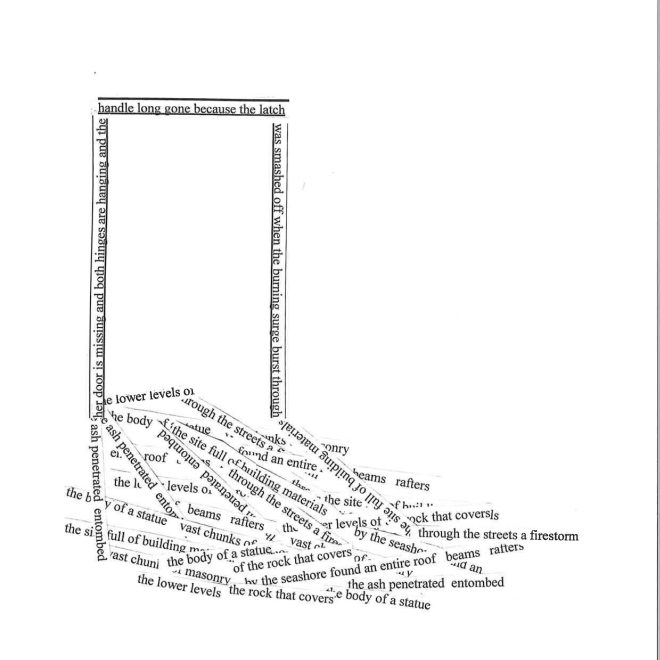
Back in March, when spring was only beginning in the UK, Dr Pragya Suman asked me if I would contribute a short essay and three poems to Arc Magazine. I chose to explore what working experimentally can bring to those of us whose work responds to complex materials, and was given permission by Pavilion to reproduce ‘her door is missing’, ‘and now came the ashes’, and ‘tessellation’ to evidence what I was saying in practice. Pragya and I also explored the topic further in a mini interview. The beginning of the essay is quoted below, and you will be able to read it in full, along with the other powerful material featured in Arc’s spring 22 issue if you follow the link at the end of the excerpt or here:

alice hiller in Arc Magazine: When I was growing up during the 1970s, England experienced intensely cold winters. Walking through the graveyard of the parish church with my mother, I would sometimes find small birds lying curled in the snow.  Seeking shelter within yew bushes, they had frozen to death overnight, then fallen from their perches. Although I could not articulate why at the time, the hunched shapes of their still, undefended bodies resonated with me. 

During those same years of unlocking the church, polishing its brasses, singing hymns on Sundays beside my mother, I was also being subjected to penetrative sexual abuse by her. We had moved together to Wiltshire from Brussels when my father died, the year I turned eight.  In the English countryside, surrounded by darkness and silence, my mother took me into her bed. I was not able to tell anyone what came to pass between us for two decades beyond the physical abuse ceasing. 

Writing bird of winter in my fifties, which gives creative witness to this crime, also on behalf of the millions who are subjected to childhood sexual abuse around the world, I knew the poems needed to exist in relation to the white spaces around them. I wanted them to communicate at a somatic and an instinctive level, through the shapes they made on the page, as the birds’ hunched outlines in the snow connected with me to suggest my own body when I was word-less.  I wanted the freedoms of more experimental poetry to open pathways to healing. 

Working visually as well as texually in bird of winter, I invite the reader’s conscious and subconscious selves to collaborate dynamically in the work of ‘reading’, conferring upon them an agency that the abuse denied me. Through this they become discoverers, rather than recipients of this complex material, and participate in the collection’s journey into meaning and resolution. They can also calibrate their depth of engagement, as I hope these three featured poems reflect. 

If you would like to keep reading, please follow the link below.

Link to Arc Magazine spring 22 with full essay by alice hiller, plus interview and 3 poems.

Welcoming back ‘the little cat’: holding and healing the hauntings and recurrences of childhood trauma within the artworks we make.

Trigger warning: non-explicit references to childhood sexual abuse.

This has not been an easy blog to put together. I have written, and redrafted its plain sentences, bare as winter branches, but like winter branches, holding within them the promise of spring. For those of you who are thinking of reading further, I should warn you that I write honestly about the challenge of living with a complex history, and the fact that resolution can seem hard to find. But I work my way through these hard places, to arrive at a point of hopefulness, which you will hopefully also reach if you stay with me and with these words.

In life, as in art, we’re encouraged to think in terms of beginnings, middles and endings.  Progression and resolution give structure to stories. When an artwork responds to trauma, the requirements change.  Anyone who has experienced, or observed the impacts of traumatic events, knows that they continue to resonate and replay themselves for many years.  To generate a truthful creative transaction between a traumatic subject matter, and the work into which it is translated, calls for forms of expression which can suggest recurrences and hauntings.  Through this act of creative witness, we may begin to change their power and reposition our relationships to them.

Living beyond, and making art that responds to, my own experience of childhood sexual abuse, amongst other subjects, I face this challenge myself.  As the light dims towards the end of November, and the days grow shorter and darker, child ghosts walk again for me.  They remember and re-live my father’s death in hospital when I was eight, in 1972. These ghost-selves also re-experience the beginning of the penetrative sexual abuse to which I was subjected, very shortly after, when my mother, who was my abuser, and I moved from Brussels to Wiltshire.

Impacting both my physical and mental health, these hauntings can lead me to feel as if I am sinking down through waves of old sadness. Like heavy black sump oil, they seep into my thoughts and bodily movements. When things get really bad, they can make it hard to move – or even think.  Because this has happened every November and December since I was a teenager, over the years, I’ve developed resources to keep myself going.  I work beside my SAD light.  I try to be kinder to myself and organise my working life so that I am not too pressured.   I meditate, swim and walk my dog Ithaca, noticing the natural world around us.  I connect with people who love me. 

But all these strategies only ever mitigate the after-effects of the dreams which rise up at night.   In my sleep, I become again a scared, hurt child, taken back to a place between life and death by my mother. This was the case – very brutally – in November and December of 2021, as it had been in 2020, and all the years before that. 

None of us likes to speak of what we perceive as our vulnerabilities, for fear people will think less of us, or feel we are ‘seeking attention’ in some way. But in 2020, working on bird of winter‘s final manuscript alone with my dog Ithaca in lockdown, I decided to make an artwork that could enact being haunted by a traumatic past, and reaching beyond this towards a form of resolution. At the time, I was following an online workshop with Nina Mingya Powles around multiple language heritages with the Poetry School, which my fellow Forwards Shortlistee, Cynthia Miller, was also part of. I was also experiencing difficult dreams. They shaped what I wrote.

What emerged is called ‘je suis son petit chat il est mon papa 1972/ I am his little cat he is my daddy 2020’.  It’s a multi-form piece which exists simultaneously as a conventional poem, a visual work, a sound experience and a performance. It was published this January 22 in bath magg no 8, as you’ll be able to see and hear by following this link.

When I performed it at bath magg’s online launch, I began by saying a few words about the poem. The response I received made me feel there would be a value in expanding them into this blog, however inelegantly. Opening up the deliberately smudgy, troubled layers of the poem up in this way also gives me the opportunity to separate the two overlaid texts, and look at each one in isolation.  In the final print they are blurred across each other to play out how traumatic stories repeat and recur, as you’ll have seen from the fragment above, and the link to the full work at bath magg.

‘je suis son petit chat/ I am his little cat’ begins in French and English, the two languages of my childhood. They refract and translate each other, but the work also makes complete sense in either language. In the first two lines, I’m waking up from a nightmare in 2020, aged fifty-six.  I’m also myself  in bed, aged eight, in 1972,  as my father lies dying in intensive care. From there it is back to 1972 and my eight year old self returning home to our flat: 

Underlay text of ‘je suis son petit chat’

Describing my life before my father died as if it was still simultaneously present, including my grandmother taking me to the hospital, and my father sending me drawings home, the narrative enacts how, in dissolving the boundaries of time, these dark hauntings also open opportunities for healing, by re-accessing a fuller range of memory. Next in the underlay text comes the nightmare at the heart of the poem, which invaded my sleep in the early hours of 22 November, replaying  the sexual abuse to which I was subjected as a child by my mother. As the poem reports, the terror of the dream induced vomiting and diarrhoea in my fifty-something year old self:  

Tough though it was to experience in reality, this act of voiding is also a release, which opens up ‘je suis son petit chat/ I am his little cat’ to new energies – whereby the recurrence of the trauma becomes an opportunity to reset my relationship to the original events. Resetting happens through a short poem in both French and then English, which is overlaid on the looping narrative beneath it in larger font and bolder text, as the extract at the top of the blog shows. 

Within its overlaid phrases, my adult self summarises the impacts of my childhood sexual abuse, including how it continues to haunt me.  Speaking directly to my abuser, I refuse the silence which she imposed on me throughout my childhood and adolescence, and for long years beyond that. This frees the underlying narrative to begin to move towards the light of a different ending, where the recurrences of physical voiding can finally come to a stop: 

The account of the nightmare, and falling “down a black tunnel” is repeated below the overlaid text, as when in nursery rhymes like ‘Oranges and lemons’, or ‘Frère Jacques’ in French, the verses come round again.  Following the earlier shift, the act of voiding is once again purgative, letting go of some of the blackness and shame held inside me, and allowing gentler and more nurturing memories of my loving engagement with my father to continue to surface in the segment which follows: 

Like many others with my history, for long years the trauma of the penetrative abuse in childhood separated me from being able to feel my own feelings, or know my own wants. Here, they begin to return to the child who lives within and alongside the adult.  She can say once again “I want my daddy” and by expressing this longing re-form a more authentic connection with herself.  My grandmother’s phrase translated means “let her through, let her through, she’s his daughter”.  She was trying to get me allowed into the intensive care unit, but the phrase also acts out the way I am asking for my child self to be allowed back through, to speak and know herself, and how she was once loved. 

‘Je suis son petit chat/I am his little cat’ ends in a place of quietness, with the possibility of integrating my separated selves more fully. Translating the “petit chat” nickname my father gave me into the English “little cat”, and laying it down on the page, the poem performs an act of witness to the co-presence of my child and adult selves. It also documents how, by reconnecting more fully with child-alice, adult-alice is able to begin to make a new relationship what made us who we now: 

Walking in Shotover County Park near Oxford in the last days of 2021, after some very tough weeks, I saw trees and misty light that reminded me of Wiltshire, and felt unkind old ghosts crowd around me.  But breath by breath, I drew the damp, cold air of the present into my body, and with it new energy.  With each out-breath, I tried to let what I no longer needed pass from me.  As I did this, the pearlescence of the fields and clouds became a wilderness of beauty, and the black branches of the trees uplifted themselves into acts of elemental resistance.  With my dog Ithaca scenting the damp leaves, and pulling us forwards, and the landscape saying that life would return, I felt how this difficult annual recurrence was also a gateway to transformation – that each year I must find the way through.

The link to ‘je suis son petit chat’ at bath magg is here if you would like to hear or see the work again in its entirety. 

If you would like to buy bird of winter, please follow this link.  Poems from the collection are also available on the blog. 

If you need support after reading this blog, https://www.mind.org.uk/ has valuable links and helplines.

Further exploration: four books and StAnza Festival

I often set a creative prompt after exploring one of my own poems for people to explore in their own practice. In this case the subject material is too dangerous.  Instead, for anyone wanting to work creatively with complex materials, or look at other examples of this practice, I would recommend four books which open pathways to new understandings, and new creative forms of expression, from the breakages and fractures of trauma.  I would also recommend the other brilliant poems in bath magg no 8, many which respond to complex subject matters – and make from them acts of beauty and reclamation. 

In terms of books, Bloodroot, by Annemarie Ní Churreáin creates provisional, shifting structures to hold the lives and reposition the representations of Irish women whose lives were appropriated by the Irish State and Church.  Documenting how the State invaded every corner of life in Romania under Romania, under Ceausescu and the Romanian Communist Party, for Buried Gods Metal Prophets Maria Stadnicka and Antonia Glűcksman assemble a living memorial that incorporates diary entries, photos, erasures, quotes from statutes, and building plans, as well as more conventional ‘poems’.  In Things I have Forgotten Before Tanatsei Gambura speaks through radical formal innovation of what it can mean to have grown up as a “Black Girl” in Zimbabwe during the 1980s – and how losing a country can form you as much as having one. Sasha Dugdale’s extraordinary collection Deformations explores trauma and PTSD, through fragments composed around Homer’s Odyssey. A separate long sequence responds to the sculptor Eric Gill’s work and life, within the framework of his recorded sexual abuse of his daughters. Sasha and I spoke about our work in Volume 48 of PN Review. Sasha has a hugely impactful new poem in bath magg 8 which you can read here.

Annemarie Ní Churreáin, Maria Stadnicka and I will be appearing at the StAnza festival on 12 March both live and online with many other brilliant poets in St Andrews. You can find more details here. Prices start from £3.00. Booking opens on 21 January. For people not able to travel to Scotland, many of the events are online and very reasonably priced. As well as performing, I’m going to be sure to pack out my schedule with hearing other poets and it’s a great way to check in with a huge range of voices and perspectives.


Letting new light in – setting your creative compass for 2022 and beyond with the help of a ‘Basque Whaler’

Letting new light in to set your creative compass: photo alice hiller

How can we resource our work in lean times? Where does inspiration come from when travel and and a wide range of live experiences are significantly curtailed, whether for financial, health or other restrictions? My steadfast belief is that we hold our own deepest and richest reserves within ourselves, accumulated through our lived experiences and interactions with the world at multiple levels. When more expansive possibilities are denied to us, to keep working, and generating new material, we therefore need to find ways to tune into this, both by nurturing ourselves, and also by finding new sources of ‘strangeness’ and intellectual and creative adventures to act as stimuli.

Basque poet Julie Irigaray Voicing Our Silences 15.12.21

Working with my fellow poet and cherished friend, Julie Irigaray, I set out to devise a solstice workshop, performance and conversation for the Voicing Our Silences collective that I founded. We wanted to deliver both these aims – of self-nurture and adventure. Core to the process were the two prompts we developed, which were designed to complement each other. Mine is a two-part process for setting your creative compass, which begins with a gentle breathing exercise, to clear your creative space, and then builds up your individual compass on the page – through a five stage guided prompt, which I lead participants through. There’s then a follow-up to be completed two or more days later. People who did it on the night we recorded the event have said how valuable they found it to be. This compass process can be used for a specific piece of work such as a poem or prose work you are developing, or would like to start. It works equally well for people looking to explore a new project, or simply to check in with themselves. Julie’s explores ways to expand your work dynamically through different forms of research and I found it gave me a breakthrough into a poem which had been hovering half-realised since the summer, so I warmly recommend trying it for yourself.

Frame for Setting Your Creative Compass to draw in central third of A4 page.

In addition to these prompts, we both performed two short sets of poems, and spoke to each other between them about how they came into being, going deep with where we resourced our work – whether from online resources including YouTube, books, museum catalogues, or other starting points. My poems came from my collection, bird of winter, and Julie’s from her pamphlet, Whalers, Witches and Gauchos. Because we were recording in the run up to the winter solstice, we structured our sets to rise from darkness into light, and both kept lit candles burning beside us as symbols of inspiration and resilience. The aim was also to share how although our poems appear to journey huge distances through time and space on the page, much of this travel is in fact realised without ever leaving home, whether we’re writing about Pompeii and Herculaneum in my case, or in Julie’s about the Basque heritage she explores in Whalers, Witches and Gauchos, which she published this year with Nine Pens.

pistil by alice hiller from bird of winter

Julie also asked me about my practice of working with my childhood and adolescent medical notes, which have been crucial to my collection bird of winter, as with the poem ‘pistil’, given above. The poem is named for the female reproductive parts of the flower. It juxtaposes a quote from my medical notes when I was two, with a direct memory, which reflects how the grooming to which my abuser was subjecting me was already impacting my behaviour, and a photo I recall of myself at that age which my grandmother loved. I was very glad to have the opportunity speak about both the risk, and benefit, of working with documentary evidence such as medical notes if you have a complex history, as I do, arising from my experience of being groomed and then sexually abused as a child, and finding my way towards healing beyond this.

As you will be able to hear if you check in with the video, I said how valuable, and painful it was in equal measure, to have factual corroboration of events that lived inside my memory. I explained how I had felt very apprehensive about engaging with my medical notes, for what I might find there, but was very grateful to see that events which my abuser had tried to deny, were in fact recorded in sober black and white. I also told Julie that reading these same notes had in fact provided a core source of motivation for my ongoing activism around changing awareness with regard to childhood sexual abuse. Driving this was how harshly the medical profession had judged my troubled teenage behaviours once the abuse had stopped. I wanted people to understand this adolescent acting out of harm done differently and more compassionately. In the questions which followed, Chaucer Cameron raised the query about notes being redacted, that is having sections blanked out, which has been her experience.

alice hiller Voicing Our Silences 15.12.21

Normally, when I record a Voicing Our Silences performance and workshop, I pause the recording at the prompt stops, and cut the audience participation, to keep the event around an hour. This time, however, we wanted to create an immersive experience for everyone who was joining us, and give the feeling of how the Voicing our Silences collective operates as a place of mutual creative nurture and adventure. Given that it’s a longer watch, I’ve therefore noted the minute timings of the different elements within the YouTube video, (which is captioned for accessibility), for ease of location. While they are managed safely, and there are no explicit references, this video includes discussion of grooming and childhood sexual abuse. If you need support with anything raised the Mind website is very helpful.

Youtube video: resourcing your work in lean times: setting your creative compass with Julie Irigaray and alice hiller

Please note, you will need a piece of paper and something to write with for each prompt.

0.00 alice hiller introduces
4.00 Julie Irigaray set 1: ‘The Basque Whaler’, ‘Six War Letters’, ‘Kreig’
12.00 alice hiller set 1 ‘bains de mer’, ‘pistil’, ‘three small shrines’, ‘in the vineyard’, ‘circular’, ‘joujou’, ‘libation’
21.20 Julie & alice discussion 1 including use of medical notes in poems
39.32 alice hiller prompt : setting your creative compass
1.00 audience feedback.
1.05.50 julie irigaray set 2 : ‘Red Card’, ‘Divine Seraphine’, ‘Via Domitia’
1.12.30 alice hiller set 2 : ‘the holly tree’, ‘vesuvius’, ‘benediction’, ‘o goddess isis’
1.20 Julie & alice discussion
1.35 Julie Irigaray prompt turbocharging your creative explorations
final questions from Voicing Our Silences collective

Julie’s poems include references to her Basque heritage, which is at the heart of her debut Whalers, Witches and Gauchos, published by Nine Pens earlier in 2021. In the spirit of expanding our horizons, Julie was kind enough to answer a few questions about Basque culture and history, which you can read below.

Photo of the Pyrenees in the Basque region of France by Julie Irigaray.

AH: Whalers, Witches and Gauchos opens with an epigraph from Thomas Jefferson about Basque fishing in the Atlantic. From what he said, Basque sailors and whalers were clearly active off Newfoundland and further south from the 1400s onwards.  Could you (briefly) tell us something of the history of Basque involvement in whaling? It is partly the subject of the poem ‘The Basque Whaler’, which you perform on the video, but it clearly has deep roots.

JI: The Basques started hunting whales in the 11th century because whales were used to create a wide range of products: candles, soap, cosmetics, to fuel lamps. In the early modern period, Basque whalers spent between six and nine months per year fishing cod and hunting whales near the coasts of Canada and Iceland, in dreary living conditions.

AH: I know the Basque territory is currently ‘divided’ between France and Spain, and there has been political and other forms of activism, including formerly armed conflict, to reclaim and redefine this cultural, geographical and linguistic identity.  Would you be able to outline this for us?

JI: The Basque Country is divided between seven provinces: four of them are in Spain, three in France. It has never been a unified country because it was always split up between the kingdoms of France, Navarre and Spain. The Basque language is not related to any other existing language, so some academics theorised the Basques were part of the first wave of human migration in Europe. The pronunciation and dialects of Basque are different from one province to another, although a unified Basque has been created by scholars. The armed Basque nationalist and separatist organization ETA emerged in the Spanish Basque Country in the late 1950s, mainly as a reaction to Franco’s dictatorship. But they kept on carrying out terrorist attacks well after Franco’s death, especially in the 1980s. I think it was particularly difficult to be young in the Basque Country at that time. But this is my parents’ story, not mine. I’ll probably write about it one day after doing more research. When I went on holiday to England fifteen years ago, there were still some people telling me “Oh! You come from the terrorists’ place!”

AH: Am I right in thinking that both your parents’ families are of Basque heritage?  Your surname, Irigaray, has a sound which stands outside what I know of both French and Spanish, and I know the final poem ‘Exte’, in Whalers, Witches and Gauchos addresses this? Note – you can read ‘Exte’ at the end of this interview.

JI: You’re absolutely right – and that’s why nobody outside the Basque Country apart from you knows how to pronounce my name! Three of my grandparents are Basque, and the final one comes from les Landes, which is still in the south-west of France. My maternal grandmother comes from the coast and a different province from my father’s family, so there are differences of pronunciation and vocabulary between their Basque. My paternal grandparents used to speak Basque to each other or with their neighbours, and my father has a good grasp of it as well. 

AH: One of the ideas that our Voicing Our Silences collective works with is how our difficult histories and experiences can be creatively fruitful, because asking us to find new forms of language to respond to them. ‘Krieg’ in an incredibly vivid, and subtle poem, imagining two former combatants from World War I meeting high in a Basque mountain pass, and reaching a form of understanding which hinges on the title word, which only the German officer understands initially.  Could you say something about this poem and the idea of how poetry can open spaces for things we might not otherwise be able to say and also comprehend?

JI: I always knew I was going to write about this family anecdote one day, but I wanted to avoid certain pitfalls, like making it too overly emotional, or depicting my French great-grandfather as the good guy and the German soldier as the villain. These two men cannot communicate because they do not speak the same language, but also because they were conditioned to think of themselves as enemies for seventy years, and fought against each other during World War I. The memory of World War II in occupied countries like France is still sensitive since so many unspeakable things happened. My family did not suffer more than average, but a variety of things happened to them which are difficult to talk about or even taboo, like a great-aunt who fell in love with a German soldier, or a great-grandfather sent to Czechoslovakia to work as forced labour for the German war effort – which was seen as treason by some. During lockdown, I have written a few poems about World War II from the point of view of several family members. I hate black and white pictures of a character, or moralistic views, so what I try to achieve with my poems is a sense of balance. I want to give a voice to both sides of the story without judging, as I did in ‘Krieg’. 

AH: ‘Their Common language’ addresses your great-grandparents’ migration to Argentina, and subsequent return to France.  Could you say something about the Basque relationship to South America and how that came about?

JI: On my father’s side of the family, several great-grandparents emigrated to Argentina with their parents or siblings because they came from a rural area with little prospects. As I explain in ‘Etxe’, in the Basque tradition, the eldest child (either girl or boy) inherited the family house while the other siblings were left with nothing. One of my great-grandfathers who emigrated to Argentina had thirteen siblings: three sisters ended up nuns, one brother a missionary in Madagascar. Back then, there were not many opportunities to earn a living apart from entering the Church or emigrating to America… In the late nineteenth-century, many Basques moved to Uruguay or Argentina to work as gauchos, others chose the USA to become shepherds in Nevada, California or Florida. The great-grandmother from “Their Common Language” worked in an hotel in Buenos Aires, like the great-grand-uncle who inspired the poem ‘Amerikanoa’. Some of them stayed in Argentina, but many Basques have a sense of nostalgia and preferred moving back to the Basque Country after a few years. 

AH: A number of your other poems also lean into this Basque restlessness, and sense of not-belonging to any single place, which I know you and I both share for different reasons, as do millions of people around the world, who have left their places of birth to migrate for economic, political or other reasons.  Would you like to say something about this experience of becoming un-rooted, but also of carrying your roots with you?

JI: Since I was a teenager, I dreamed of living abroad. Either for my studies or for professional reasons, I moved back and forth between the Basque Country, Paris, Ireland, Britain and Italy seven times in seven years, which had its toll on my mental and physical health. When I moved back to the UK for my first job, I felt terribly homesick, and for the first time. I started a series of Basque poems that made up the greater part of Whalers, Witches and Gauchos, probably because I felt completely unrooted. I found it more difficult than the first time I lived in England to study to fit in.  I think it was because I had lived in so many countries, and picked up some bits of each of their cultures, that I didn’t belong anywhere anymore. I’m still processing this. My poems interrogate cultural differences because it is a subject that I constantly think of. 

AH: I know you have been back in the Basque region of France during the lockdown, able to travel both to the Atlantic and the Pyrenees, when free of restrictions. How has it impacted your work being back in these landscapes?

JI: Unfortunately, few good poems came out of my lockdown writing, precisely because of the anxiety generated by the closing of all borders. The border between France and Spain remained shut for almost four months, and I have spent a day in Spain since Christmas 2019 because things are still not back to normal. Even during World War II or under Francoism, the border could be crossed, albeit illegally. I wrote a poem about a friend being in lockdown in San Sebastian (where the lockdown was extremely restrictive) and my panic at the idea that I could not see him for months because the border was shut. I wanted to capture this claustrophobic feeling. It’s difficult to explain this to people who live on an island, but sharing a border with another country is for us a natural right and a source of enrichment. I have also written a poem from the point of view of the border, and all the historical events it witnessed through millennia. But in the end, I did not write much about the Basque Country. I write better about a place when I see it from a distance, ideally when I live in another country. I wrote almost all my Basque poems while living in the UK, and during lockdown I wrote many poems about Italy because I felt extremely upset about not being allowed to travel back there.

AH:  Some of your newest poems are following your interest in military history, addressed in a number of the poems in WWG, including the ways in which countries who have denied citizens their rights nonetheless require them to die in their wars. This was the the case for many soldiers brought in from Britain’s colonised countries during the first and second world wars, as Sathnam Sanghera has explored in Empireland.  It was also the case for Basque citizens resident in France.  Could you say something about these poems, and the new ones which are forthcoming?

JI: I was looking for books on this subject, so thank you for recommending Sanghera’s! I would like to address the subject of the soldiers who fought for the French and British colonies one day as they were completely written out of history, but I need to find the right approach. 
I normally write a lot about women, but these days I am interested in the values conveyed by the army, especially with regard to masculinity. France is still a very militarised country. With the rise of the right and the French presidential elections taking place in five months’ time, some politicians have suggested the return of the military service for both men and women, and I don’t see it in a good light. There was also the bicentenary of Napoléon’s death this year, and I’m not fond of the idea of promoting the legacy of a man who invaded and subjected a whole continent and killed around three million European soldiers (and God knows how many civilians) for his campaigns. 
I am writing a couple of poems about these themes and the toxic myths surrounding masculinity. My poem ‘Six War Letters’ tells the story of an underaged young man who is enrolled in World War I in spite of all and stops idealising war as a way to prove his manhood. One English teacher told me she’d taught this poem to her boys-only class and that one pupil said it made him reconsider masculinity. I couldn’t be prouder! 
I also recently talked to my parents about my father’s and uncle’s experiences of military service or hazing when they entered their engineering school, and I found these testimonies deeply disturbing. As someone who was bullied in school, I can imagine the psychological impact of hazing in elite schools and universities, and I am outraged by the mechanisms used by the bullies to make their victims believe this is perfectly normal, and even desirable.

AH: Finally, I know you are also working on a PhD about Sylvia Plath and her relationship with England and Europe at Huddersfield.  What does 2022 hold for you Julie Irigaray, in so much as it is possible for any of us to answer this question?

JI: A lot of travelling, I hope! If Covid does not come on the way, I should attend several conferences in France and the UK. I am co-organising an online conference on Sylvia Plath (https://bit.ly/3yHGIW0) on 11th and 12th March 2022, and I will be a volunteer for The Sylvia Plath Literary Festival that should take place in Hebden Bridge at the end of October. I also need to write a couple of academic articles, so 2022 will be more PhD-oriented. But I will try to assemble a poetry collection as I have enough poems that satisfy me to create one now. 

from Whalers, Witches and Gauchos by Julie Irigaray.

If you would like to read more of Julie Irigaray’s work please visit her brilliant website.

‘Just because there’s a fence, the garden don’t stop growing’: poems as pathways beyond trauma at Poetry in Aldeburgh.

On Saturday 6 November, I was asked to read and speak at an event on Poetry and Trauma at Poetry in Aldeburgh 2021 with brilliant, radical poets Chaucer Cameron, Day Mattar and Tessay Foley, introduced by poet and academic Patricia Debney.  We have in common a background of having been subjected to predation and sexual abuse, in childhood or afterwards.  Our shared experience, and the fact that we have all made artworks which begin in this harsh place, set the stakes very high in terms of creating an event which could speak collectively to people with similar experience in their own histories. The link to the podcast follows further down.

Sixty-five people tuned in to join us mid-afternoon.  I don’t think anyone who was there will ever forget what was said and read. Both Chaucer and Day touched on their experiences of sex work or prostitution. Chaucer’s pamphlet In an Ideal World I’d Not be Murdered is part memoir/part fiction. It explores the impact of sex work on body, mind and spirit – through the voices of characters speaking to and with each other, while also questioning what it takes to leave this profession. Speaking of one of the female characters, who in real life was murdered, Chaucer said : “In my version she has her own voice, she sings her own song…and this is what it looks like.”  The same could be true of her performance of those extraordinary poems on 6 November. 

With real poignancy, and an ability to enter a child’s perspective, Day’s debut Springing from the Pews, with Broken Sleep Books, documents a six year old boy being groomed and then abused.  Interweaving confessions, journal entries, and multiple voices into a verse play, the poems follow this little boy into adult life, asking how we may live with, and beyond, this very difficult legacy. He explained “I struggled for a long time to write these poems… I had multiple voices in my head…responding each as loud as each other… contradictory, loving, manipulative.”  The results are astonishing.

Tessa Foley’s poems live in rooms where shadows rise up from the corners, even when the lights are on, and follow people down the streets at high noon.  Drawing both on family history, and her own experience of volunteering for three years at Portsmouth Rape and Abuse Counselling Centre, the poems of What Sort of Bird Are You? witness the greatest difficulties, but also document moving beyond them into a more hopeful and resilient spaces, engendered in part through acts of mutual solidarity and community. Her line “Just because there’s a fence, the garden don’t stop growing” could speak for us all. 

My own text is given in full below, exploring the idea of trauma as a wound, and how we may heal beyond it. I chose poems relating to water, to honour Aldeburgh’s seaside setting. To hear Chaucer’s, Day’s and Tessa’s voices testifying to experiences which I felt in my own body and spirit, had my heart rushing before I ever got to my own set. I was hugely honoured to perform with them. Inevitably, I needed to rebalance myself afterwards. Walking by the Thames later that afternoon, allowing the present world back into me as dusk deepened, I saw a footbridge lit up over the dark water. Watching it, I felt as if I had been given a visual representation of how we had, through our works, lit safe passages over places where we had once known great suffering.

You can hear the podcast of Chaucer Cameron, Day Matar, Tessa Foley and I reading together here which Poetry in Aldeburgh have just released.

If anything is difficult for you, the Mind website has helpful links.

As the set was an hour long, and very intense, I decided to record the audio of my poems and words separately as well – for people who wanted a shorter listen, or who might be hesitant around exposing themselves to the longer experience of the full set. The performance and comments from the audience set twitter alight for hours and days afterwards. My individual recording is 15 minutes long. I have put the linking text I wrote below it as a guide to what to expect.

audio link to alice hiller’s Poetry in Aldeburgh ‘healing beyond trauma’ set of poems.

To give a flavour of my approach, the words I wrote to link the poems are reproduced below in italics, interspersed by the poem titles. ‘phare d’ailly’ is reproduced as a sample of my work, because it has appeared in PN Review, along with a description of discovering ancient Herculaneum by Scipio Maffei. You can hear all the poems in full on the recording. If you face hearing challenges please contact me through the blog and I can send you a full text of words and poems.

If you would like to buy bird of winter, it’s available here.

alice hiller words and water poems on healing beyond trauma at Poetry in Aldeburgh:

As many of you know, trauma means wound in ancient Greek. My own collection, bird of winter, is partly about the childhood wound of being groomed and sexually abused by my mother.   But it’s also about healing, and opening our wings into wider, freer skies.  I’ll alternate poems which explore my difficult early years with others honouring experiences that helped me reclaim life.  Celebrating Aldeburgh, many of the poems include water.  First up is ‘bains de mer’ or ‘sea swimming’, remembering my beloved French bonne maman or grandmother.

bains de mer [performed]

Bonne maman represented a space of safety and unconditional love.  Because my mother was my abuser, danger remained omnipresent. Normandie is the backdrop to a photo taken by my father in ‘pistil’. Named for the female reproductive parts of a flower, the poem combines words from my childhood medical notes with direct memories. 

pistil [performed]

In addition to my medical notes,  bird of winter is framed by Pompeii and Herculaneum. Both were harbour towns, but water is not a place of refuge or safety in the abuse poems.  ‘let none of this enter you’ is spoken to my four or five year old self – with extra lines by Pliny the Younger describing the eruption of Vesuvius, which shapes bird of winter. 

let none of this enter you [performed]

Even though he worked long hours, my diplomat father had been my protector.  Once he was diagnosed with motor neurone disease when I was six, power shifted.  I was eight when he died and my mother and I moved from Brussels, to England.  I saw my father as the lighthouse whose beams lit my bedroom in Normandie. 

phare d’ailly

papa the tide at vasterival was going out 
when you were carried from our flat as I slept

your jaw swung
open like a latchless door

the sea is now 1km from the site of pompeii 

The penetrative abuse began in England.  My erasure ‘and now came the ashes’ is from  Pliny the Younger’s account of Vesuvius

and now came the ashes [performed]

Traumatic events such as rape fracture our consciousness.   Scipio Maffei’s 1747 account of excavating Herculaneum offered a way of suggesting the injuries arising from raping a child, along with the difficulties of voicing this. The reader gets to puzzle out the imagery.  They can determine how far to engage. 

proceeding blindly through
tunnels and through narrow
passages much will be broken
much will be destroyed
nor will it ever be possible
to see the noble buildings
in their entirety

Scipio Maffei 1747

Even in very difficult times, the memory of my father, and my bonne maman’s love, gave my spirit a space of nurture.  This is critical for all of us who are subjected to wounding experiences.  ‘Rue de l’aurore’ was my grandmother’s address in Brussels. It means street of the dawn.

rue de l’aurore [performed]

I escaped the physical element of the abuse when I was thirteen by  stopping eating.   I was admitted to hospital – but this was 1977.  Eating disorders were not recognised as a possible indicators of childhood sexual abuse.  I wasn’t asked about, or able to speak directly of, what my mother had done.  The psychiatrist who saw me understood something terrible had happened.  Writing ‘tesselation’,  I instinctively sited myself between worlds, like water becoming vapour. 

tessellation [performed]

My mother ended all contact with this psychiatrist when I was released from hospital.  I was left very vulnerable.  With time, I reconnected with life and love again and began to reclaim my body. My final poem  moves between capture and release, remembering when I was seventeen. 

becoming your channel of pearl [performed]

I dedicate it to all of us who turn our faces to the light, no matter what darkness we have come through [end of set].

The Festival brought together a rainbow of poets from Andrew McMillan, Sean Hewitt, Kim Moore, Victoria Kenneflick, Dom Bury, Colette Bryce, Rachel Long, Vidyan Ravinthiran, Momtaza Mehri and Sarah Westcott, to name but a few. The podcasts will be up on the Poetry in Aldeburgh website over the next days. I really recommend checking in with them.

If you live in or near London, I’ll be performing live for Outspoken at the Southbank with Nick Mahona and Wayne Holloway-Smith on Thursday 25 November at 7.45 pm. I’ll be sharing poems about the bumpy teenage years that follow grooming and childhood sexual abuse, but also how these are the freedom trail that leads to reclamation and healing.

Tickets are here for Outspoken on 25/11/21 at 19.45 at the Southbank.

‘sea level’ : the poem as miniature tornado – ‘bird of winter’ podcast no 2.

Like miniature tornados rising up off the page, poems move energy.  Working with words and sounds, they carry their readers, or listeners, into spaces which are new to us – hopefully without inflicting damage.   By involving us imaginatively, and creatively, they open our consciousnesses to transformative alchemies. Or that’s the aim. For those of us who work with difficult materials, the reader or listener can of course decide how far ‘in’ they want to go, and how much of the created world they allow to come alive.  When a poem has an element of catharsis, they can also choose if they want to become part of the shift this precipitates. 

Naples seen from above, with Vesuvius

To explore how this poem/tornado process might take place, my second bird of winter podcast rides the energy flow of ‘sea level’, which came together on a winter trip to Naples. Specifically, I engage with how the poem imagines worlds to generate forward and upward movement. In this case, it’s from a place of suppression and denial towards a place of comprehension and healing, and from underground darkness up towards the light of day.  If you’d like to listen to this as a podcast, with an optional prompt at the end for your own art-making, the link is here: https://youtu.be/pJLPHD5A2sE

If you’d prefer to check it out, developed for the page as an essay, please keep reading. The photographs are ones I took in Naples.  As a word of warning – this episode mentions sexual abuse briefly, in the context of the weight of silencing that can arise from this crime, and its potential for continued resonance in our adult lives.  I also explore how we can move beyond its heavy legacy towards reclamation. While I’ll be  tracking the energy flow through the individual lines of ‘sea level’, to hear the poem from start to finish please follow this link to my recording: 

sea level

Naples harbour at nightfall

For ‘sea level’s tornado to lift off, it needed both darkness and light. Real tornadoes require warm humid air, and cold dry air, to create the rotating updraft that leads to the formation of the funnel cloud.   In this case, I wanted readers to feel the oppressiveness of the silence and denial that abusers, including my own, force onto children.  These weights are carried by many of us whose experiences have been denied or dismissed.  Having encountered them within the physical landscape of the poem, we can enter into the relief that arises when they are released, collectively, into an act of witness and reclamation.

Back in December 2018, the day before I wrote the first draft of ‘sea level’,  (when I still had no idea it was coming to me), I’d visited the palatial Archaeological Museum, in the grimy heart of Naples. The city’s soundtrack is a symphony of car horns but the tight street grid in the old town dates back to Roman times.  Extraordinary finds, from statues, to frescoes, to objects from daily life including a charred cradle, were excavated from the volcanic rock that covered the ancient city of Herculaneum.  Key items are displayed in room after room, alongside equally dazzling, moving, and mundane, treasures from the neighbouring city of Pompeii.  They make you feel as if time is melting and you no longer know quite where you stand.

Wall painting of young woman from Archaeological Museum

While Pompeii was covered with ash that was relatively easy to shift when Vesuvius erupted, four metres of molten volcanic materials settled into solid rock over ancient Herculaneum.  To rediscover the city, the original excavators had to tunnel down, partly below the modern town of Ercolano, at great personal risk from poisonous gases and cave-ins, beginning during the eighteenth century.  Reading about them, and seeing old illustrations in my guide book, called to mind my own painful, stumbling, sometimes dangerous and destabilising, process of excavating my childhood memories. I embarked on this in my thirties, during the 1990s, with the support of a skilled psychotherapist.

Those same childhood memories were moving in the shadowed corners of my thoughts as I walked around the museum, trying to take in as much as possible, and then explored the tiny shops and tight backstreets of Naples while dusk came and people started to congregate in bars and cafes after work. While most people think of December in terms of holidays and celebrations, for me it marks the anniversary of when the penetrative sexual abuse began during my childhood, in 1972.  I was eight and a half. With my abuser, who was my mother, I’d just moved to a small village in Wiltshire following the death of my diplomat father.   Even decades later, whenever I can, I go abroad briefly at that time of year, to reset the light in England, which can intensify the return of flashbacks and nightmares. 

Eighteenth century anonymous illustration of visiting the excavations at Herculaneum

Despite the Southern Italian location, the night after I visited the Archaeological Museum, I woke in the early hours from a dream of being held down in the darkness, as had happened when I was a child.  Lying in the dark hotel room, cold and scared, the feeling the dream left me with,  after a day of imagining  the still largely buried ancient city of Herculaneum, and then walking Naples’ shadowy, narrow twisting back streets, somehow led to the phrase “there will always be the city/ beneath this city charted by no one” dictating itself. This became the first two lines of ‘sea level’. I was thinking of Herculaneum. I was also articulating my own underground memories, nestled beneath the surface  of my daily life, but swimming up to its surface again in the crack in time that the December anniversary had opened.

Jotting the words down, on a bedside scrap of paper, but also opening myself to the energy I could feel rising up, I next heard “where column of stone tears/ cling to the ceilings.” As a child, I could neither cry, nor cry out, in bed beside my abuser. When you visit underground cave systems, the stalactites and stalagmites can seem like frozen ghosts, caught momentarily in the electric lights of the present.   I knew these stone columns were my own emotions, unarticulated and unacknowledged, until my thirties – when I first started to thaw and allow myself to re-experience them with professional support.  Brittle and dangerous until that point,  they had hung within me like unwieldy stone daggers, triggering panic attacks and flashbacks, as is the case for many peoples who have experienced trauma.   But the image was by no means exclusively sad. Stalactites are also objects of great beauty. Crystalline structures, created from dripping water, they sparkle when illuminated, and make visible the accretions of time. 

Seeing the lines on the hotel notepad,  I felt again that tornado of energy rising within them, driving the narrative forwards.  What came to me next was an image that called back the lost inhabitants of my imagined underground city “whose people were once/ lost or vaporised/ their houses and temples/ buried and forgotten”.  This of course happened historically to the citizens of Pompeii and Herculaneum – whose lives we now know in considerable detail thanks to the works of recovery undertaken by archeologists, and scholars. Within the carbonised cradle, the feather-light residue of a baby testified to his or her former presence. In Pompeii, archeologists pour plaster into voids left in the ash where bodies decomposed, to cast out the shapes of the people who fell trying to escape Vesuvius.

Figures cast from hollows left in the ash at Pompeii photo Wikipedia

By the end of 2018, when I visited Naples, I had begun to share the poems which were my own creative acts of recovery. I was also being mentored by Pascale Petit under the Jerwood Arvon scheme.  Through the responses I was receiving from her and other people, I knew that by writing about my childhood, the spell of denial thrown over my own life was being undone.  This also happens when other denied and buried histories – including those of enslavement, persecution, and genocide – are recovered and documented.

Writers including Primo Levi, who recorded his experience of Auschwitz, and the long journey home, and Toni Morrison and Maya Angelou, who make work in response to the histories of enslavement and racism, and the impacts of colonisation, were integral to my own process of giving creative testimony, as was Pascale Petit. Also crucial to my ongoing sense of possibility have been works of exploratory witness from contemporaries writing alongside me including Bhanu Kapil, Sandeep Parmar, Isabelle Baafi, Romalyn Ante, Jenny Mitchell, Rachael Allen, Rachel Long, Caleb Femi, Will Harris, Nina Mingya Powles, Troy Cabida, Arji Manuelpillai, Karen Smith, Natalie Linh Bolderston, Holly Pester, Ralph Webb and Cynthia Miller – to name only a very few. 

Carried forward by so many powerful examples, scribbling in bad handwriting by the streetlight coming through the gap in the curtains, I felt myself caught up into the process of collective reclamation and voicing. This was the journey of the poem, from darkness to light, from silence to noise.  As it took hold of me, with the Bay of Naples moving as a wash of liquid blackness beyond the town, I heard “let these people  who are my people/ enter your lives again”.  What had been denied and pushed down was rising up now in a way that made me think of a different set of tunnels altogether. 

Oritigia, showing temple columns in the wall of the church.

These were the tunnels under the Sicilian town of Ortigia, that I had previously visited with Pen, the younger of my two adult sons. The town has existed since classical times, and its main church is made from a former Greek temple, whose columns are still visible within the walls.  Ortigia’s deep network of tunnels were used over the centuries for rituals, burials and shelter, including from bombing during the second world war.  They formed places of safety, as we discovered during a guided tour.  Going underground in the town square, the musty, twisting passages emerge from darkness into the light of day at sea level, where the white gold rock of the island meets the turquoise waves. It was this memory which informed the next lines – “and hope will shaft passages/ up through the bedrock”. The photograph I chose for the YouTube podcast was taken on that holiday.  Being with my own son, by the iridescent waters of the Mediterranean, was in my mind as the last lines of the poem came to me, as you will be able to hear again. 

sea level

alice hiller emerging from the tunnels in Ortigia, photo by Pendragon Stuart.

‘sea level’ moves from suppression and denial, into life and community, ending “until we swim free/ within the breathing harbour of morning”.   The double sound meaning of its final word – morning – holds within it an echo of the sorrow and loss which is also part of the process of the poem.  It gives the journey into the light an element of circularity, echoing the circling of energy which is also integral to the formation of a tornado.  Those of us who have known difficult times will recognise how this circling can be manifested in the return of memories and anniversaries of the sort which kicked off the poem for me. While such a legacy is not easy to carry, I understand that it forms the foundation of who I am as a person, and as an artist, and has become one of the deep energy sources that fuel my work and my political consciousness.

Sunrise over the harbour in Naples

If anything in this blog has been difficult, the Mind website has valuable links.

If you would like to read more about bird of winter please go to the page in this blog, where I explain its background, or follow this link to Pavilion Poetry’s website: http://bit.ly/birdhiller.

If you would like to try out putting your own journey poem or artwork together, the following prompt may give you a few ideas. 

The first stage of putting your own journey poem or artwork together will be to think of an experience, feeling or memory which will be your starting point. It doesn’t have to be taken from your own life, but it should be something that you can potentially travel beyond to a new place, physically, emotionally,  geographically or conceptually.  This is what will give your work its forward motion and form its primary energy source.

In my case, the journey was from my child to my adult self, from a crime taking place to its anniversary many decades later, and from an individual, silenced position, to a collective act of witness. Be careful if your explorations start to feel upsetting for any reason, and plan beforehand how to stay emotionally safe.  You might want to have a friend you can connect with, or a helpline you can call, or another form of support. 

The next stage is to select your recording materials.  You might want to write on a sheet of paper or in a notebook, or type into a new document on your computer, or speak into your phone using a voice memo app.  All are equally good.   Once you’re ready, set a timer for five minutes, and then write, or speak freely, and without censuring yourself, about the starting point of your experience. What you’re looking to capture is the emotional mood and colour of the subject, rather than any formal description. Rough jottings, phrases, and images are great. 

Naples from the island of Capri

The next step will be to repeat this writing or recording process for another five minutes, envisaging and describing the place where the journey travels to.   You could do this straight after, or you might want to leave it until another day, week, or even month.  Sometimes poems and artworks come quickly, but other times they reveal themselves to us more slowly and gradually.    When you’ve got the two sets of material, combine them into a single document, so you can see how they sit together.

Beyond this, or alongside the process, you want to start thinking about a physical terrain across which the emotional journey of your poem or artwork can realise itself.  In my case, it was the double set of tunnels in Herculaneum and Ortigia, which became a single joined underground landscape. They could be landscapes you know personally, or ones you have experienced either online or via film or television or books. They could be from the past, or the present.  

The sea off Ortigia in Sicily.

Once you have identified your landscape, or landscapes, you want to generate some words around them.  If they are nearby, maybe visit them with your phone to speak into, or paper to write on. Otherwise, spend some time just looking at them online or in books. As you’re engaging with the landscapes, notice the feelings and ideas that come up, and again jot down phrases and images.  Do it as a timed session if that’s feasible and helpful.  As before, be careful if this starts to feel upsetting for any reason, and plan beforehand how to stay emotionally safe.

Land travelling into water

The final step will be to bring together your two sets of words and images – about the experience, and the landscape – in a way that makes the journey of your poem or artwork travel forward through time and across geography to its place of arrival. 

Good creating – and thank you for reading. Please sign up to the blog if you would like to be notified of other bird of winter podcasts and materials, and writing and interviews more generally on the topic of working creatively and transformatively with difficult materials.          


Naples underground

“Ask yourself what makes you unique, different and amazing”: Arji Manuelpillai talks to alice hiller about saying the difficult thing in his debut ‘Mutton Rolls’ by “reflecting the way the mind moves” and embracing “exclusion as a force of creativity.”

Arji photo
Photo Credit : Martin Brown

Traveller, writer, theatre-maker, and freestyler, Arji Manuelpillai is a poet whose work has always derived energy and resonance from its live components.   While Mutton Rolls, his debut pamphlet from Out-Spoken, was launched online from his living room in lockdown, this in no way diminished audience numbers, or the warmth of their appreciation. Mutton Rolls’ poems find their subjects in UK raves and garage forecourt shops, but also on Sri Lankan beaches and in the aftermath of bombings and tsunamis.  Like strobe lights flashing moments of visibility, they illuminate growing up in Britain with the double consciousness that derives from knowing your parents and family once lived somewhere else, and explore what it means not always to be made to feel welcome.  Witty, joyous, and irreverent, the poems we talk about do not hesitate to call out the unacceptable.  They can spin in a second to catch your heart  – and hold it in a net of words that makes it beat differently when let go again. 

AH: I’d like to start by asking you about your experience of the last few months Arji.  You launched Mutton Rolls within the full UK lockdown.  You also ran free poetry workshops with special guests on zoom which attracted huge attendances during the months when we were largely unable to meet in the physical world.  How has this been for you?

AM: Such a pleasure to be here with you Alice and thanks so much for taking the time to chat to me. It has been a whirlwind few months. With so much of our collective futures turned upside down, I’ve found it difficult to manage my own expectations and keep the positivity up. However, in another way I have lived my whole life as a freelancer and with that sort of lifestyle comes an ability to adapt to the challenges with innovation and creativity. I can think of nothing worse than being furloughed at home being unable to work on new projects. So I was thankful for the opportunity to start Arji’s Poetry Jam, to continue with workshops with young people, help create a Refugee Week education resource for Kazzum Arts, and to plan and deliver a great release party for the pamphlet. It has been interesting as I feel like the online thing has provided people with greater accessibility in many ways. It creates a global playing field with fans for the workshops appearing in NZ, Finland, Canada and New York. It also made me feel like anything is possible with a little creativity. Right now, I’m spending a whole lot of time on Zoom but I’m really missing the real life groups, the community and the love of people connecting and creating together. I’m praying for the future, that we will return and still create wonderful work someday.

AH:  I understand that.  I feel the same way.  It’s really fantastic that you have been able to continue to reach out and deliver to so many different groups against all the odds.  People who want to find out more about these projects can check out the links on www.arji.org.  Coming back to the current situation, you tweeted your uncle was one of the first doctors to die from COVID 19.  The poem ‘after being called a paki’ confronts the racism which your father and his generation were met with on arrival in the UK.  I wondered what it’s been like to publish a pamphlet which calls out UK racism past and present, and then have the #BlackLivesMatter movement rise up so powerfully here and round the world, speaking to and with so many of your themes?

AM: It has been so interesting to see how people respond to the poems about race. I’ve been surprised by some animosity towards poems like ‘white people’ and then I’ve had some really heartfelt messages from other South Asian people who connect with the work. I hadn’t really realised how important it was to speak to my community and capture those feelings until it was actually out there. This was highlighted by a good friend of mine who doesn’t ‘do poems’, (those are the people I really love to reach).  He told me how he had never found the words to say how he felt growing up as a British Asian but now suddenly the book had captured them. I felt moved by that. As the BLM thing started to rise I was fully engrossed, angry, unsurprised, pretty much like most of the minority communities – but as it moved forward I started to unpack some of the racism within the South Asian community. I think we have to remember that the racism that black people feel in this country is unique to this country and the people within it. Black people deserve this space for discussion and the recognition of the racism they face and it is up to us all to face that head on and bring sustainable change. That’s not to say the South Asian experience isn’t important or valid.  It is just accepting that the grouping together of races doesn’t help any of us. I am fortunate to have worked with inspiring black men and women and will continue to fight for change and equality. I believe that this is a movement of hope and change is possible if we are willing to keep trying.

AH:   I absolutely agree with you, and I think your work is unquestionably part of that larger movement, and has been for many years.  Calling into question the stability and integrity of contemporary identities, and the pressures to which people can be subjected, your opening poem, ‘credit card’, begins  “someone pretended to be me/ filled my details out online”.  The intercepted card is imagined/described as being used to facilitate an impeccably ‘middle class’ spending spree which includes “crème fraiche” for leek and potato soup, and ends up funding a seat at a shared table in a café “on the white side of Peckham” where the thief is supposed to have:

had a tea and carrot cake
read the paper, lent
back in their seat

so their hands fell to their sides
and the lady to the right
casual as breathing
pulled her handbag close

The only skin tone that is mentioned is “white”, but the “casual as breathing” action of the woman has the effect of putting the “someone” under suspicion for no reason that can be deduced from their tea drinking, paper reading or carrot cake eating.  Would you be able to say something about the relationship between the speaking “me” and the observed “someone” in ‘credit card’, and why you chose to open Mutton Rolls with this poem? 

AM: This poem is one of those poems that fell out of my head on a long walk. Someone actually did fraud my debit card and went to Morrisons and spent a small amount of money on groceries. I couldn’t get this idea out of my head, that someone was just hungry, no drugs, no alcohol, just hungry. All of those preconceived prejudice I had were thrown away. Almost in the same week I was in a theatre show, it was a play set in South Africa. In the middle of the piece I sat back in my seat and the lady beside me suddenly reached to her side, grabbed her bag and put it in her lap in the most awkward position. I sat there for 2 hours wanting to ask her why she had done that but I didn’t have the guts and it probably would have seemed over-the-top. As with many of my poems, it is the coming together of two contrasting ideas that gives birth to a real ‘charged’ feeling. So, let’s go back to the debit card thief. I started imagining a whole world for this thief, I created short vignettes of them all round town and the question kept coming up as to why they might have stolen the card. I was moving towards the ‘someone’ wanting to feel like they were part of the elitist class, like they could dine in the places the middle class dine but at the bottom of all that, they never truly belong. I combined that idea with the concept that no matter how well the thief works, he can never shake his class away. Hence the lady pulling her bag in at the end. I love that poem as it is all about wanting to belong and that’s the reason I put it at the opening of the pamphlet. 

AH: Wanting to belong gets imagined in a different way in ‘brown boys in Kavos.’ The poem begins among a “tulip-topped spliffs” and “the backwash of cheap vodka” at “4am in a balmy Greek heat.”  A hymn to the hedonism of “rumbling dance floors”, its heroes are “four brown corduroy-coloured boys” who are “failing to get laid/ in the ‘getting laid’ capital of Greece.” Their charms are coming off worse to “sweaty charisma and beautiful blackness” on the one hand, and “glitter soaked torsos/ all fearless and normal and slavemastery.”  Against this temporarily disheartening outcome, their salvation, and reclamation of themselves comes in their solidarity, as the sun calls into life a new day:

brown boys think themselves ugly

but not yet ugly because they are brown
the sun is reaching over the rooftops
brown boys light cigs and laugh
an orgasm is caught in the breeze

I wondered if the idea of working collectively, and in concert with others, resonated with you, as part of a creative and transformative process?

AM: Everyone who knows me knows that I believe creativity is best enjoyed together. The camaraderie, the sharing of ideas, the spontaneity, I believe it is at the centre of a healthy mind and spirit. I have spent most of the last 15 years in participation arts because I truly believe making art together is integral to a happy society. In other parts of the world participatory arts is just art, by which I mean, everything is focussed around making art together. This is really true when we think about poetry. Poetry communities are integral to the scene, taking a poem to a group and sharing process is everything.  Without it I really feel I would not be half the poet I am. This is one of the reasons why I feel there needs to be more mentorships for minority groups to encourage collaboration and connection.  It is these communities that will nurture and grow Britain’s best new poems. Many publishers at the moment are asking for BAME poets to come forward but we need ‘quality’ –  and to make ‘quality’ poets you need quality mentoring spread over long periods of time. 

If you are interested in finding yourself a group perhaps start at The Poetry School where regular bursaries are available. Alternative options are Malika’s Kitchen and Covent Garden Stanza (run of course by you Alice). These are free groups but you will probably be asked to send samples. Loneliness is affecting us all at the moment so don’t sit in silence, connect with others and use art as a vehicle for transformation.

AH:  Again, I can only agree.  The Poetry Society co-ordinates Stanza groups up and down the UK, with further groups available in a few other countries, or with online membership.  I’ll put details at the end of the interview.  I know that the support of our stanza group really helped me personally during a very difficult few weeks in lockdown, It’s also been a fantastic place for me to try out new work in a safe place.   Going back to Mutton Rolls, while ‘brown boys’ has a sunrise ending, ‘half catholic’ strikes a more sombre note. The first person speaker reveals himself to be a man who, while attracted to women, also responds to men with desire. As a woman who is drawn to both women, and men, this is a duality which I recognise.  Reflecting how Catholicism can become a force which risks alienating people from themselves, the speaker remembers how:

at fifteen I touch a man in a way
that makes me wish God didn’t exist

throw up behind a Ford Fiesta
brush my teeth till the toothbrush snaps

“in Lourdes years later” he promises “not to want/ a man again” and prays for this to happen.  Returning to the motif of theft, also present within ‘credit card’, the poem ends:

after the tsunami
I watch a man 

pickpocket a corpse
quietly as though hiding it from the sky

The pickpocketing is presumably a matter of economic necessity, in order to ensure survival.  I wondered if you could say something about why you chose to set those two narratives consecutively, and whether the reader was being asked to think about the historic thefts and appropriations of colonialism, and their enduring impacts through time?

AM: This poem is the coming together of a series of moments in my life. All of them are strung together through a feeling of humiliation and shame, a sense of not belonging and being unable to conform to a system that didn’t necessarily fit me both religiously, ideologically and spiritually. Landing in Sri Lanka during the Tsunami was one of the most pivotal moments of my life. It came at a time when I was turning to activism and God, observing the situation unravel was painful. I was amazed by the level of blind faith that many of the victims had, even after they had often lost their family, friends and livelihoods. Their faith gave them strength, it was something I envied but also something I ridiculed. This for me, connected the two parts of my upbringing. One side of me is always in awe of my heritage as a Sri Lankan Tamil, half Catholic and half Hindu. With that side comes all of the myths and stories and the rich cultural history of tradition and ritual. But the other British side was often disillusioned, faithless and sceptical of it all. That dichotomy is at the centre of the poem and a great deal of my work. I dabbled with the ending for a long, long time. Finally I came to this idea of a man stealing money while only caring about God watching. It seemed to connect to the British impact in Sri Lanka, it shows the power of capitalism and it also illustrates shame and it also connected with the desperation to survive.

AH:    That’s an incredibly rich explanation Arji.  It really captures how poems can hold multiplicities without forcing a single or simple resolution.  Belinda Zhawi talked to me earlier in this series about the impacts of colonialism in Zimbabwe which was similarly powerful. There is an ongoing, and fruitful, tension in your work between narrating your experiences as a person, not least in several powerful break-up poems, and as a person of colour.  Many writers are responding to this, not least the poet Cathy Park Hong in her study Minor Feelings, whose work speaks to many of us. ‘nominated for a BAME prize’ tackles this complexity head on, beginning “it’s always in capitals/ like someone is shouting it.” The speaker states “I feel almost unBAME// in my M&S shirt and trousers”, and seems to position the BAME branding as something which risks diminishing and ghettoising artists, and over-simplifying complex, nuanced narratives.  Is that a fair reading?

AM: I think that is an extremely astute reading. I feel like BAME as a title has a truckload of problems associated with it. It boxes us all together, which dilutes the differentiation of culture between countries and religious groups. It gives people the perception that we are ‘all the same’ when in actual fact the continent of Asia is as diverse as you can get and Sri Lanka is a place made up of so many different minority groups. I totally sympathise with those that have tried to champion the representation of minorities in the arts but BAME is starting to feel a little dated. On top of this I’ve seen the term become quite divisive within the arts sector. Artists like me get a role or new project but it feels rather shadowed by the idea that ‘I only got it because I’m brown’. Often other artists may think me not deserving of the opportunity and that hurts. By segmenting us off, and doing call outs and competitions just for specific groups, it ends up feeling like we are in some way not applicable to the same rules of quality as our white counterparts. This is the opposite of what we as a society are trying to achieve. The funding and grant system in this country is creating divisions amongst artists, from those that do or don’t get funded, to those that can or can’t write an application form.  Sometimes it feels like we spend so much of our time divided instead of innovating together.

I’m not sure what the answers are, but I believe the start is to have a universally clearer understanding of the differentiation between countries, cultures and traditions. When we begin to accept our own ignorance we will begin to move into a space where we are ready to grow and learn. This space is a position of true power.

AH:  Undoubtedly your work is helping this transformation. The back cover of Mutton Rolls says you , like the speaker of ‘nominated for a BAME prize’, were “shortlisted for the Burning Eye BAME Pamphlet Prize 2018.”  I wondered if I could ask you here something about the first person “I” of your poems?  Do you see it as primarily specific, that is linking the work with you, Arji Manuelpillai, as a series of statements of witness? Or is it more a ‘first personal universal’, so that the I becomes a portal through which the reader can look with a greater degree of empathy and understanding?  Or both?

AM: You are the first person to call this out. Yes, much as I love and respect Burning Eye, they did inspire that poem. After I was shortlisted I found it interesting how I didn’t tell my parents it was a BAME prize. I was almost embarrassed by it. So I create vehicles for the personal messages to travel through. I do feel like the work is reflective of where I was at during that time. I wanted it to be like a calling card for my style and voice. The voice is very much me, the situations (though not always completely true) are very much like me and I’m proud of that. I hope that they will provide a greater understanding and empathy from the reader but I also feel they are fragments of myself and not designed to lead or coax the reader into any set reaction. I think in the newer work I am creating I am more interested in the ‘I’ taking a back seat, perhaps even disappearing and allowing the reader space to walk around, wander and discover. I hope that doesn’t sound too over-the-top. I feel like my new work is going to discuss life in a whole new nuanced way and I’m super excited about it.

AH:    I really look forward to those poems Arji.  Many of your Mutton Rolls poems explore the emotional lives of men.   ‘Cecilia says we’re all fucked up’ is an unpunctuated prose poem that explores the conversations between a psychotherapist and her client.   There is a surface play of humour and irony, riffing on the neutral décor and demeanour of the therapist.  This anodyne professional setting elicits the revelation “my friend died when I was 24    I never got to say goodbye.” After the apparently desultory meandering leading up to this, however, the closing lines have all the impact of being dropped down through a trap door 

                            I was busy being strong   that’s why abstract
paintings work so well    she’s leaning back  must be time  wipe
the tears away like face paint    how long before I’m wandering
drunk down the Old Kent Road     not knowing how I got there

Could you say something about the poem’s ending, and what it means to you to find forms through which to speak of things which can’t easily be said, but are powerful forces within our lives?

AM:  This poem was a real turning point to me. The Cecilia in the poem is actually Cecilia Knapp and the poem came out of a need to connect many opposing internal dialogues with the running dialogue with a therapist.  After I finished it I took it to a feedback session and I literally wasn’t sure whether it was good or really rubbish. I think the poem began to unpack a need I have to move towards reflecting the way the mind moves without the need for set narrative. My favourite poets are doing this currently, the work of poets like Jericho Brown, Chen Chen and Morgan Parker have led the way in this, but poets like Wayne Holloway Smith and Emily Berry have paved the way in England too. I feel that this poem was the start of that hunger and movement. The final lines took a lot to muster, the balance was integral and it was discussed over many a cup of tea with Hannah Lowe, who helped me learn about the soft step off. She always says ‘go in hard and get off lightly’ (or something like that). Finding this form and flipping the camera upside down allows us to capture the intricacies of this complex world that we live in. During this answer I’ve name-dropped a bit. I am doing this because it is important to remember that these poems are the product of many discussions, feedback sessions and books by other poets.

AH:   You mentioned Wayne Holloway-Smith in the roll call.  I know you’ve taken workshops with him.  Wayne is concerned to investigate and call out how the complexities of masculinities are represented,  and to challenge cultural and class stereotyping.  To what extent do you feel your work is in conversation with his poems?

AM: Wow, I never thought of it like that. I’d be honoured for people to even consider them in connection with Wayne’s work. He has been a real inspiration to me.  His work unpicks so much about being a man and growing up but it also deals with emotions in an incomplete and broken linear. The real admiration I have for Wayne is his attitude to poetry itself. His mindset is settled around feeling, process and freedom, not necessarily making sense or clarity of narrative. He isn’t bothered whether things look or sound like a poem, he is just about how it makes an audience squeal or turn in their seat. He has taught me to be the sort of poet that doesn’t give a f-ck, to innovate, challenge preconception and industry notions of acceptance, to dig into process, to grow, discover, play with it all and take nothing for granted. Everything we read in the Monday night class we question, poke fun at, pick apart, no one is on a pedestal, everything isn’t about what’s happening but what is ‘working’. Some people say ‘oh it doesn’t seem much like a poem’ and that really doesn’t bother us, I want to make people think and Wayne has taught me that. Thematically, any connections between our work is simply because I have spent too many Monday nights in his group. 

AH:  I’m sure Wayne will be happy to read that.  Your wonderful poem ‘regret’ was placed in last year’s Oxford Poetry Prize.  It offers a vignette of “my mum chatting in Tamil to the boy at the petrol station counter.”  Snatches of their conversation are represented in Tamil, and the mum is shown as being completely at ease and lost in this moment: 

she is Aunty, he is Thamby
and the queue behind us can wait 

The speaker, however, is excluded, catching only snatches of the conversation, “plucking subtitles from their eyebrows”.  Yet it is from this sense of not-fitting that the poem’s voice and consciousness grow. I wondered if you would like to say something about the creative potential of dislocation and exclusion as a generative force for you as an artist, in this poem and more generally?

AM: I feel like not belonging drives the majority of my work. We spend most our years growing up hoping to fit into the system only to realise our uniqueness is what makes us special. In my workshops with young people I’m always encouraging people to think about their exclusion as a force of creativity. Ask yourself, what makes you unique, different and amazing. This poem is a very truthful representation of my mother and I in a petrol station. My Mum is an amazing conversationalist. Whenever we go anywhere she is talking to the cashier or catching up with someone in the queue.  In England, India or Sri Lanka she’s always speaking to people and often I wish so much I could join in. I mastered the English language but perhaps in doing so sacrificed my Tamil heritage. This poem isn’t just about language though, it is also about the love I have for my Mum.

AH:  Another important woman in your life has been the poet Hannah Lowe, who was your mentor on the Jerwood Arvon Scheme, and who, like so many of us, works from a place of cultural multiplicities. I was massively helped by having Pascale Petit as my mentor on the same scheme.  Could you say something about your experience of being mentored by Hannah?

AM: Getting the Jerwood Arvon mentorship was probably one of the biggest achievements of my writing life. It provided me (and you too) with a community of artists, a space to create and a mentor who really believed in me. Hannah has been completely instrumental to my growth as a poet and artist. Her work transcends cultures and backgrounds, her control of narrative is second to none and her ability to mentor is truly masterful. Hannah is always focussed on clarity of image, constantly pushing me to make even the abstract hold true conceit and is always encouraging me to take the reader by the hand and lead them from line to line. This has been so influential to me. When I’m lost, I often see her on my shoulder asking ‘I don’t really get this bit’ or it’s not really clear enough’. She is also a poet who believes in accessibility of the work, so she pushed me to make sure the poems reached the readership I wanted to reach instead of tumbling into abstraction. In many ways Hannah and Wayne sit on opposite ends of a poetry spectrum. This was a wonderful thing to experience, it allowed me to see how poetry could pull and shift in different directions, it allowed me to ride a very thin line between being abstract and being very clear and it also showed me that finally my own choices had to be made. As Hannah once said to me ‘just be confident with what you’re trying to do’. Hannah’s passionate, down to earth, giving nature is something that I will always be thankful for.

AH:  ‘after the Sri Lankan bombing that kills 360 (after the 20 year more than killed significantly more)’ uses the powers of miniaturisation deployed by Elizabeth Bishop in her poem ‘Brazil, January 1 1502’, and by Rachael Allen in her poem ‘Banshee’ – to name but two other poets of the tiny. Elizabeth Bishop is describing the rapist-conquistadors who are “hard as nails/ tiny as nails, and glinting, in creaking armour.”  Rachael Allen (interviewed last year in this series) is reanimating the murder of a woman whose aggressor works “like a small model forester/ axing up plastic logs.”  

Your poem begins “after the news   my skin feels darker”, and uses responses to the bombing in the Grand Cinnamon Hotel as a prism to make more visible the complexities of only being “Sri Lankan / at weddings and funerals  or for inquisitive white people”.   The poem ends by distilling its contradictions into three singing lines:

from here (on the toilet) it’s all just a cluster of tiny red faces
wailing in a language I don’t understand    in a country I can’t
oh look!  that’s where Mama and Appa first met  

I wanted to ask you to what extent the miniaturised space of the poem – which takes huge subjects and telescopes them down – creates a measure of safety for dealing with difficult or otherwise unmanageable materials

AM: I think you’re really onto something there. I’m really interested in pulling big political constructs into my poems and sometimes that can be a very daunting thing. Finding methods to do this is tricky. I’ve found that keeping the subject of the poem down-to-earth and ‘local’ allows the overriding message to have its own open plain. In this poem it all centres around the speaker watching a video online yet the focus is bigger. All political problems have a microscopic impact on our lives, that means taking a subject like war and persecution and asking yourself where does that sit on a local level. This can be a very fruitful task and I feel it allows you an ability to not seem ‘over-the-top’ or ‘self-righteous’ which is always the problem of political poetry. I want to take risks and over the last year since the pamphlet has been released I have been researching political poets. Most of them from USA. Tracy K  Smith creates letters charting the journey of black slaves from varying people in history. Patricia Smith tells the story through accounts from victims and family members of violence. These poets are a real inspiration to me, they take the human, local situations and show how they are the repercussions of larger political problems. I believe poetry needs to reflect our politics and begin to unpack some of the complexities of our political system. Often these systems seem too much to deal with, too complicated and too daunting but it is important we find ways to do it, it’s important we do not turn away, but instead create vehicles to promote discussion. 

AH:    I can relate to that, albeit in a slightly different field.  As you know, in my current work I am trying to use my own direct experiences of being abused as a child to give witness to, and change awareness around, the global crime of the grooming and sexual abuse of children, and look at its aftermath for vulnerable teenagers.  To make the poems, I have to find or open myself to imageries and forms that can hold the materials so they become accessible to, and safe for, the reader, notwithstanding their potentially very difficult subject matters.

More generally, poetry is about control, but it’s also about the reverse – abandoning and opening yourself to let complex things enact a form of authentic aesthetic identity in language. Could you say something about how, when, and where your poems come into being, and your process of working with them to their published forms?  I know you also freestyle, where improvisation and being able to trust yourself and go with the energy, is a key?

AM: I am a true believer in play as a means to creation. I believe that being playful will allow us to open ourselves up and throw away the inner voice obsessed with judging our success. Freestyling is the epitome of this. A rapper freestyling is a magical, spontaneous force of creativity. For me, I freestyle best when I am relaxed, when the audience lack judgement, I can move into a space where my brain seems to work outside of itself, where I don’t think of the words, the words just fall together like bubbles pulling together in a bath. This feeling is as much about the people around me as it is about my presence in the moment. I believe that workshops and feedback groups should adopt this way of thinking. The workshops should initially focus on connecting people, creating a relaxed and free space full of love, while allowing people to express and discover themselves in a wholly present way. After this, the poems will simply flow naturally. I chase the feeling of freestyle when I am creating poems. I’m always looking for experiences that bring the playful from me, that pull me out of my usual surroundings and throw me into a space where I must be fully present. I’m all about the process, the feeling of building a poem like a house, and living in it, taking risks and pushing it to see how far it can go. In terms of practise, I try to wake up each day and put something into being. Anything, just accepting whatever comes out can be really rubbish or be the start of something really good. Recently I have read more as this has been a weakness for me. 

AH:   I wanted to ask about your brilliant final poem, ‘because it’s in the Lonely Planet top five places to visit’.  The poem intercuts a couple telling the speaker about how the husband proposed “as the sun / licked the sea red   and birds punched shrapnel in the sky”, on the sand outside their beach hut, with the speaker’s account (thought, not spoken within the live conversation) of the island’s recent bloody history, to which they appear oblivious or indifferent :       

              will you –  I used to march to make change   but
since then     I march just to sleep at night         that country
changed me she says   the bars  the sea-views  biryani kothu roti
plus the people are so generous    they don’t hassle like Indians
they’d drop a bomb   wait five minutes    drop another to
kill the rescue party    they spent the whole evening staring
out to sea      she says it’s their paradise    they made a pact to
go back there every ten years      to that bar    in that country where
bombs rained into no fire zones    where bodies are hidden sixty
to a hole   it’s hard to put into words    he says as their fingers
weave together   it’s somewhere we could call our second
home   the soldiers were spread across Tamil land   few tried
for war crimes    I don’t know why you don’t move back there

In your opening poem, ‘credit card’, identity is precarious, deniable, steal-able.  Here the only two points at which the speaker uses the “I” pronoun come around his attempt to assert a contradictory narrative, as quoted above.  The reader is given the sense of a narrative about Sri Lanka which is being repeatedly drowned out by the denials of history and blithe rewritings of the tourist industry.  The final phrase first person phrase, spoken by one of the members of the couple, – “I don’t know why you don’t move back there” – is moreover one used by people challenging migrations globally.   Would you be able to say something about this poem and its ending?

AM: The poem was originally built in a train in India. Remember when I talked about the local situation being used to talk about global issues? In this poem the local situation is a Californian couple. Yes, they did indeed speak in detail about how they loved Sri Lanka. I actually spent a little while explaining my mixed feelings about the place but it didn’t seem to faze them. The recent groom said ‘well you could say that about a lot of places’ and that message stuck with me. I wanted the poem to capture this conversation in a new way with multiple perspectives. To create a range of conversations happening simultaneously. That is the spoken words, the internal dialogue, as well as the dialogue to the reader. There is a line that I really battled with ‘I used to march to make change…’ that line is a clinical line for me as it is the speaker’s internal dialogue, it comes from a different place. The ending has gone through many different stages, it used to have more of a back and forth but I found that pulling it back left the reader on more of an edge and let the poem live on after the poem was finished. This is a real life situation for a lot of second generation migrants. There is conflict between our own feelings and those that go there, there is a conflict between the politics of oppressors and the politics of our supposed mother land. I attempted to capture this conflict in the use of this cut and splice form.

AH :  It really works for me, Arji.  Can I end by asking where to next?  What are your plans for 2020, and beyond?

AM: I’ve been really productive since lockdown from writing to workshopping and I’m looking forward to an August break in Wales. I’m also about to become writer in residence for a pub in Dorset where I will be writing a series of poems in conjunction with local patrons of the pub. I’m also currently commissioned by Stockton Council to write 40 poems for isolated people across the North East so I’ve been writing poems and ringing people up out the blue to share them. I love that so much. 

In terms of poetry I want to be pushing my process and work as far as it can go.  I feel like I’m only just reaching my stride and I have a whole lot left to give. I am really excited about the new work I’m writing connected to race and hate crime. I’m messing with the ‘i’, writing from a range of perspectives and most importantly, still enjoying it. It’s a risky, deep vat of possibilities so at the exciting part of the process. I want to be more political in my poems and create work for those without a voice. I want to push the boundaries of what we can say and how we say it with regards to race, it’s a dicey game but also very exciting. There’s a lot to keep an eye out for, you can follow me at @theleano, or Arji Manuelpillai on insta or you can join the mailing list at www.arji.org. Thank you so much for having me on here Alice, you are an inspiration to so many of us poets.

AH: Thank you so much for such an amazing set of answers Arji.  As always with these interviews around the idea of ‘saying the difficult thing’, I feel I have gained so much by being given an insight into to the workings behind your poems.  I’m really excited for your new work and so happy to have had the chance to share the poems in Mutton Rolls with our readers.

Mutton Rolls can be bought here from Out-Spoken’s website for £7.00..

If you want to find out more about joining a Poetry Society Stanza workshop group to develop your poems and connect with other poets details are here at the Poetry Society’s website.

For details of Arji’s ongoing creative adventures, including films he’s made, and performance collaborations, sign up to his mailing list at www.arji.org .

To check in with Arji’s Pickle Jar podcast, where he checks in with poets making and chatting, click here.